
Genesis 14 to Hebrews 7 · Subject · Featured Study
The Tithe
The tenth given to God in Scripture, from Abram's gift to Melchizedek, through the Levites' tithe and Malachi's storehouse, to the argument of Hebrews 7.
Abram gave Melchizedek a tenth of everything, and Hebrews argues from that gift that Melchizedek's priesthood is greater than Levi's.
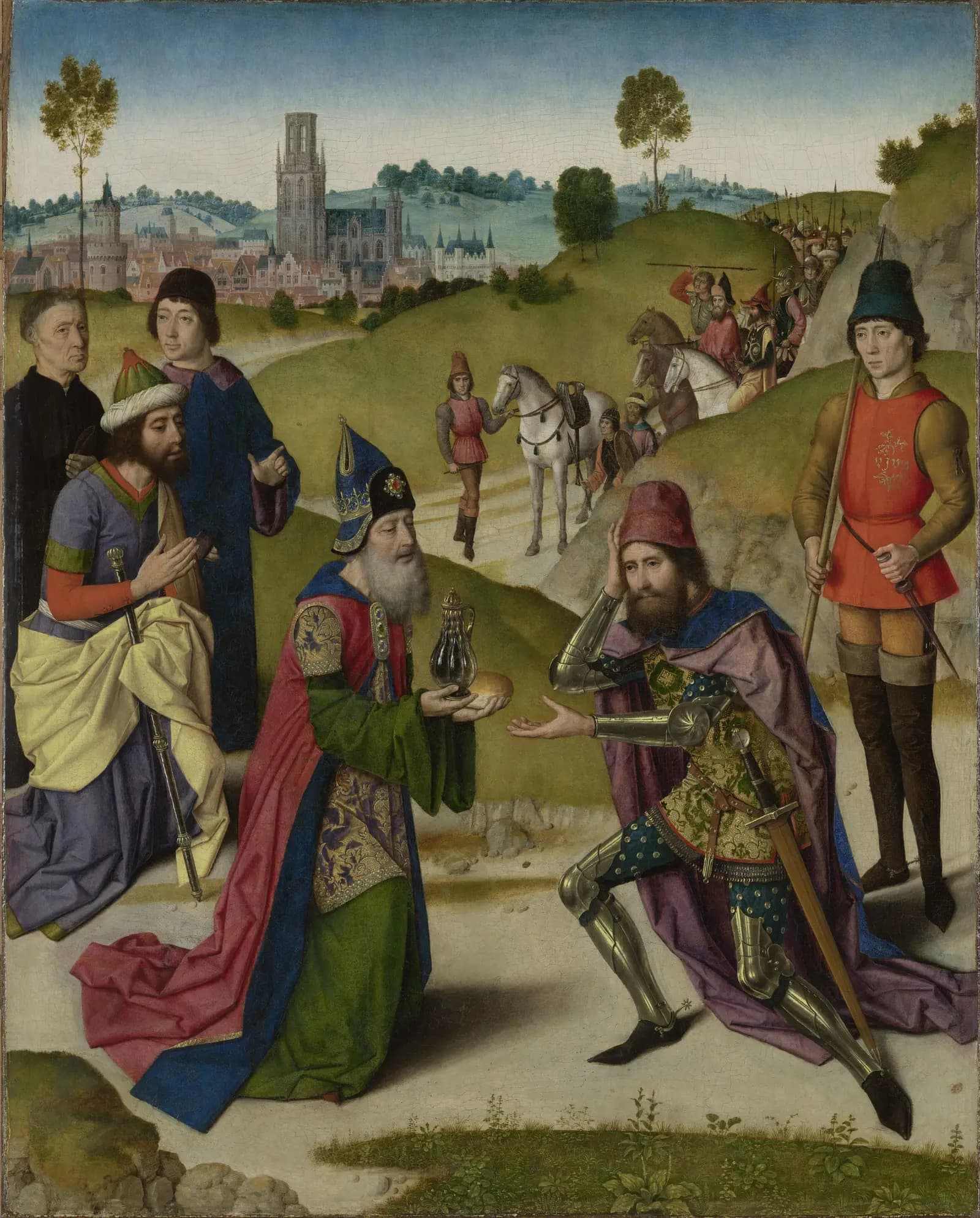
Dieric Bouts, The Meeting of Abraham and Melchizedek, between 1464 and 1467, Sint-Pieterskerk, Leuven. Public domain, via Wikimedia Commons.
THE ARTWORKBouts set Melchizedek at the centre in a blue mitre and red robe, holding out a loaf and a vessel of wine. Abram kneels before him in armour, one hand at his hat and the other reaching for the bread. A soldier with a spear stands at the right, and riders climb the road to a town behind them.
Summary
The tithe is a tenth of the harvest, the flock or the spoil, given to God. Scripture names it from Genesis to Hebrews.
- Abram gave Melchizedek a tenth, and Jacob vowed a tenth at Bethel.
- The law calls the tithe holy to the LORD and gives it to the Levites, who had no land.
- Deuteronomy has the tithe eaten before the LORD, and every third year it feeds the poor in the towns.
- Malachi says Judah robs God in tithes, and Jesus faults Pharisees who tithe herbs and neglect justice.
- Christians differ on whether the tenth binds them.
The Tithe from Abram to Hebrews
Nine passages trace the tithe from Genesis 14 to Hebrews 7 in canon order.
Then Melchizedek king of Salem brought out bread and wine—since he was priest of God Most High— and he blessed Abram and said: “Blessed be Abram by God Most High, Creator of heaven and earth, and blessed be God Most High, who has delivered your enemies into your hand.” Then Abram gave Melchizedek a tenth of everything.After the battle of the kings, Abram gives the first tenth in Scripture to a priest.
And this stone I have set up as a pillar will be God’s house, and of all that You give me I will surely give You a tenth.”At Bethel, Jacob vows a tenth on his way to Haran.
Thus any tithe from the land, whether from the seed of the land or the fruit of the trees, belongs to the LORD; it is holy to the LORD.At Sinai, the law names the tithe of the land the LORD's.
Behold, I have given to the Levites all the tithes in Israel as an inheritance in return for the work they do, the service of the Tent of Meeting.In the wilderness, the LORD gives the tithe to the Levites for their service.
You must be sure to set aside a tenth of all the produce brought forth each year from your fields. And you are to eat a tenth of your grain, new wine, and oil, and the firstborn of your herds and flocks, in the presence of the LORD your God at the place He will choose as a dwelling for His Name, so that you may learn to fear the LORD your God always.In Moses' last address in the land of Moab, the tithe is eaten before the LORD at the chosen place.
When you have finished laying aside a tenth of all your produce in the third year, the year of the tithe, you are to give it to the Levite, the foreigner, the fatherless, and the widow, that they may eat and be filled within your gates.In the third year, the year of the tithe, the tithe goes to the Levite and the poor.
Bring the full tithe into the storehouse, so that there may be food in My house. Test Me in this,” says the LORD of Hosts. “See if I will not open the windows of heaven and pour out for you blessing without measure.In Malachi's day, the LORD calls for the full tithe in the storehouse.
Woe to you, scribes and Pharisees, you hypocrites! You pay tithes of mint, dill, and cumin. But you have disregarded the weightier matters of the law: justice, mercy, and faithfulness. You should have practiced the latter, without neglecting the former.In the temple courts, Jesus weighs the tithe against justice, mercy and faithfulness.
Consider how great Melchizedek was: Even the patriarch Abraham gave him a tenth of the plunder. Now the law commands the sons of Levi who become priests to collect a tenth from the people—that is, from their brothers—though they too are descended from Abraham. But Melchizedek, who did not trace his descent from Levi, collected a tenth from Abraham and blessed him who had the promises.The letter to the Hebrews reads Abram's tenth as a sign of a greater priesthood.
The Tithe Through the Canon
Six parts of Scripture each add to the teaching on the tithe.
BEFORE THE LAW
Abram gives a tenth of the spoil to Melchizedek, and Jacob vows a tenth if God brings him home.
THE LAW
The tithe of seed, fruit and flock is holy to the LORD, and a man who redeems part of it adds a fifth.
THE LEVITES
The Levites receive the tithe in place of land and give a tenth of it to the priests.
THE KINGS AND THE RETURN
Hezekiah's people bring tithes in heaps, and Nehemiah restores them to the storerooms after the Levites leave for their fields.
THE PROPHETS
Amos mocks tithes brought by rebels at Bethel, and Malachi calls Judah back with the full tithe.
THE GOSPELS AND HEBREWS
Jesus rebukes a tithe kept while mercy is neglected, and Hebrews reads Abram's tenth as Levi's tenth paid to Melchizedek.
The Storehouse and the Herbs
Malachi 3 and Matthew 23 in their settings.
Nehemiah names the place where the tithes were kept, the storerooms of the treasury in the house of God, and Adam Clarke reads Malachi's call beside Nehemiah 13:10. The Levites were to bring a tenth of the tithes to those rooms, and when their portions stopped they went back to their fields.
Malachi's promise is spoken to the whole nation, the descendants of Jacob, which he says is under a curse for robbing God. The test he names is food in the LORD's house and the windows of heaven opened over the land.
In Matthew 23 Jesus speaks to scribes and Pharisees who tithe their garden herbs. He tells them they should have practised justice, mercy and faithfulness without neglecting the tithe.
Luke gives the same saying with the love of God in place of mercy and faithfulness. In the parable of Luke 18, a Pharisee who tithes all he gets stands beside a tax collector who asks for mercy.
The storerooms in Nehemiah
A priest of Aaron’s line is to accompany the Levites when they collect the tenth, and the Levites are to bring a tenth of these tithes to the storerooms of the treasury in the house of our God.The storerooms of the treasury, where the tenth of the tithes was kept.
I also learned that because the portions for the Levites had not been given to them, all the Levites and singers responsible for performing the service had gone back to their own fields.The Levites leave the temple when their portions are not given.
The Pharisee's tithe
I fast twice a week and pay tithes of all that I acquire.’The tithe as a boast before God.
How Many Tithes Did Israel Give?
The Levites' tithe, the tithe eaten at the feast, and the third-year tithe.
Numbers gives the tithe to the Levites as their inheritance. Deuteronomy tells the giver to eat his tithe before the LORD at the place He chooses, and to sell it for money and buy food there if the way is too far.
Every third year the tithe stays in the towns, so that the Levite, the foreigner, the fatherless and the widow may eat and be satisfied.
A tenth could also be a king's tax. Samuel warns that a king will take a tenth of the grain and the flocks.
The feast and the third year
But if the distance is too great for you to carry that with which the LORD your God has blessed you, because the place where the LORD your God will choose to put His Name is too far away, then exchange it for money, take the money in your hand, and go to the place the LORD your God will choose. Then you may spend the money on anything you desire: cattle, sheep, wine, strong drink, or anything you wish. You are to feast there in the presence of the LORD your God and rejoice with your household.The tithe turned into money and spent on a feast before the LORD.
At the end of every three years, bring a tenth of all your produce for that year and lay it up within your gates. Then the Levite (because he has no portion or inheritance among you), the foreigner, the fatherless, and the widow within your gates may come and eat and be satisfied. And the LORD your God will bless you in all the work of your hands.The third-year tithe laid up within the gates for those without land or family.
How the commentators count them
Jamieson, Fausset and Brown count a first tithe for the Levites and a second brought to Jerusalem.
The first was appropriated to the Levites (Nu 18:21). The second, being the tenth of what remained, was brought to Jerusalem in kind; or it was converted into money, and the owner, on arriving in the capital, purchased sheep, bread, and oil (De 14:22, 23).
Jamieson, Fausset & Brown · Commentary Critical and Explanatory on the Whole Bible · on Deuteronomy 26:12-15Reformed
John Calvin, on Numbers 18:26, held it improbable that double tithes were paid in the same year.
The king's tenth
He will take a tenth of your grain and grape harvest and give it to his officials and servants. And he will take your menservants and maidservants and your best cattle and donkeys and put them to his own use. He will take a tenth of your flocks, and you yourselves will become his slaves.The king's tenth, a tax the people would pay for asking for a king.
Every Tithe in Scripture, Book by Book
Every verse of the Berean text that names a tithe or a tenth given to God or a king.
Twelve of the sixty-six books name the tithe. Deuteronomy holds seven verses of the list, Hebrews six and Nehemiah five.
Genesis (2 verses)
and blessed be God Most High, who has delivered your enemies into your hand.” Then Abram gave Melchizedek a tenth of everything.Abram gives Melchizedek a tenth of everything.
And this stone I have set up as a pillar will be God’s house, and of all that You give me I will surely give You a tenth.”Jacob vows a tenth of all God gives him.
Leviticus (3 verses)
Thus any tithe from the land, whether from the seed of the land or the fruit of the trees, belongs to the LORD; it is holy to the LORD.The tithe of the land belongs to the LORD.
If a man wishes to redeem part of his tithe, he must add a fifth to its value.A tithe redeemed costs a fifth more.
Every tenth animal from the herd or flock that passes under the shepherd’s rod will be holy to the LORD.Every tenth animal under the rod is holy.
Numbers (4 verses)
Behold, I have given to the Levites all the tithes in Israel as an inheritance in return for the work they do, the service of the Tent of Meeting.The tithes go to the Levites for their work.
For I have given to the Levites as their inheritance the tithe that the Israelites present to the LORD as a contribution. That is why I told them that they would not receive an inheritance among the Israelites.”The tithe is the Levites' inheritance in place of land.
“Speak to the Levites and tell them: ‘When you receive from the Israelites the tithe that I have given you as your inheritance, you must present part of it as an offering to the LORD—a tithe of the tithe.The Levites give a tithe of the tithe.
So you are to present an offering to the LORD from all the tithes you receive from the Israelites, and from these you are to give the LORD’s offering to Aaron the priest.That tithe goes to Aaron the priest.
Deuteronomy (7 verses)
To that place you are to bring your burnt offerings and sacrifices, your tithes and heave offerings, your vow offerings and freewill offerings, as well as the firstborn of your herds and flocks.Tithes are brought to the chosen place.
then the LORD your God will choose a dwelling for His Name. And there you are to bring everything I command you: your burnt offerings and sacrifices, your tithes and special gifts, and all the choice offerings you vow to the LORD.The place where the LORD sets His Name.
Within your gates you must not eat the tithe of your grain or new wine or oil, the firstborn of your herds or flocks, any of the offerings that you have vowed to give, or your freewill offerings or special gifts.The tithe may be eaten only at the chosen place.
You must be sure to set aside a tenth of all the produce brought forth each year from your fields.Set aside a tenth of each year's produce.
And you are to eat a tenth of your grain, new wine, and oil, and the firstborn of your herds and flocks, in the presence of the LORD your God at the place He will choose as a dwelling for His Name, so that you may learn to fear the LORD your God always.Eat it before the LORD and learn to fear Him.
At the end of every three years, bring a tenth of all your produce for that year and lay it up within your gates.Every third year the tithe is stored in the towns.
When you have finished laying aside a tenth of all your produce in the third year, the year of the tithe, you are to give it to the Levite, the foreigner, the fatherless, and the widow, that they may eat and be filled within your gates.The year of the tithe feeds the Levite and the poor.
1 Samuel (2 verses)
He will take a tenth of your grain and grape harvest and give it to his officials and servants.A king will take a tenth of the harvest.
He will take a tenth of your flocks, and you yourselves will become his slaves.A king will take a tenth of the flocks.
2 Chronicles (3 verses)
As soon as the order went out, the Israelites generously provided the firstfruits of the grain, new wine, oil, and honey, and of all the produce of the field, and they brought in an abundance—a tithe of everything.Under Hezekiah Israel brings a tithe of everything.
And the Israelites and Judahites who lived in the cities of Judah also brought a tithe of their herds and flocks and a tithe of the holy things consecrated to the LORD their God, and they laid them in large heaps.The tithes are laid in heaps.
And they faithfully brought in the contributions, tithes, and dedicated gifts. Conaniah the Levite was the officer in charge of them, and his brother Shimei was second.Conaniah the Levite keeps the tithes.
Nehemiah (5 verses)
Moreover, we will bring to the priests at the storerooms of the house of our God the firstfruits of our dough, of our grain offerings, of the fruit of all our trees, and of our new wine and oil. A tenth of our produce belongs to the Levites, so that they shall receive tithes in all the towns where we labor.The people pledge a tenth to the Levites.
A priest of Aaron’s line is to accompany the Levites when they collect the tenth, and the Levites are to bring a tenth of these tithes to the storerooms of the treasury in the house of our God.The Levites bring a tenth of the tithes to the storerooms.
And on that same day men were appointed over the rooms that housed the supplies, contributions, firstfruits, and tithes. The portions specified by the Law for the priests and Levites were gathered into these storerooms from the fields of the villages, because Judah rejoiced over the priests and Levites who were serving.Men are appointed over the storerooms.
and had prepared for Tobiah a large room where they had previously stored the grain offerings, the frankincense, the temple articles, and the tithes of grain, new wine, and oil prescribed for the Levites, singers, and gatekeepers, along with the contributions for the priests.The tithe room is given to Tobiah.
and all Judah brought a tenth of the grain, new wine, and oil into the storerooms.Judah brings the tenth back to the storerooms.
Amos (1 verse)
“Go to Bethel and transgress; rebel even more at Gilgal! Bring your sacrifices every morning, your tithes every three days.Tithes brought at Bethel by a people in rebellion.
Malachi (2 verses)
Will a man rob God? Yet you are robbing Me! But you ask, ‘How do we rob You?’ In tithes and offerings.Judah robs God in tithes and offerings.
Bring the full tithe into the storehouse, so that there may be food in My house. Test Me in this,” says the LORD of Hosts. “See if I will not open the windows of heaven and pour out for you blessing without measure.Bring the full tithe into the storehouse.
Matthew (1 verse)
Woe to you, scribes and Pharisees, you hypocrites! You pay tithes of mint, dill, and cumin. But you have disregarded the weightier matters of the law: justice, mercy, and faithfulness. You should have practiced the latter, without neglecting the former.Tithes of mint, dill and cumin, and justice neglected.
Luke (2 verses)
Woe to you Pharisees! You pay tithes of mint, rue, and every herb, but you disregard justice and the love of God. You should have practiced the latter without neglecting the former.Tithes of mint and rue, and the love of God neglected.
I fast twice a week and pay tithes of all that I acquire.’The Pharisee boasts that he tithes all he gets.
Hebrews (6 verses)
and Abraham apportioned to him a tenth of everything. First, his name means “king of righteousness.” Then also, “king of Salem” means “king of peace.”Abraham gives Melchizedek a tenth.
Consider how great Melchizedek was: Even the patriarch Abraham gave him a tenth of the plunder.A tenth of the plunder shows Melchizedek's greatness.
Now the law commands the sons of Levi who become priests to collect a tenth from the people—that is, from their brothers—though they too are descended from Abraham.The law has the sons of Levi collect a tenth.
But Melchizedek, who did not trace his descent from Levi, collected a tenth from Abraham and blessed him who had the promises.Melchizedek, outside Levi's line, collects from Abraham.
In the case of the Levites, mortal men collect the tenth; but in the case of Melchizedek, it is affirmed that he lives on.Mortal men collect it here; there, one who lives on.
And so to speak, Levi, who collects the tenth, paid the tenth through Abraham.Levi paid the tenth through Abraham.
The Words for the Tithe
The Hebrew and Greek words the English tithe translates.
MAʻĂSÊR (HEBREW, H4643)
A noun that means a tenth, used especially of the tithe.
ʻÂSAR (HEBREW, H6237)
A verb that means to tithe, to take or to give a tenth.
DÉKATOS (GREEK, G1182)
An adjective that means tenth, and Hebrews uses it of Abraham's gift.
APODEKATÓŌ (GREEK, G586)
A verb that means to pay a tenth in the Gospels and to collect a tenth in Hebrews 7:5.
DEKATÓŌ (GREEK, G1183)
A verb that means to give or to take a tenth.
Where Scripture Is Silent
Three questions the text leaves open.
Genesis gives no reason for Abram's tenth and records no command to give it.
Genesis records Jacob's vow and his return to Bethel, and leaves unrecorded whether he paid the tenth.
Paul's letters to the churches name no fraction. He asks each believer to set aside a portion on the first day of the week and to give what he has decided in his heart.
On the first day of every week, each of you should set aside a portion of his income, saving it up, so that when I come no collections will be needed.Paul asks for the collection for Jerusalem to be set aside each week.
Each one should give what he has decided in his heart to give, not out of regret or compulsion. For God loves a cheerful giver.Giving decided in the heart, without compulsion.
What the Tithe Teaches
The land is the LORD's, His servants eat from it, and a greater priest receives the tenth.
The law says the tithe belongs to the LORD, and Deuteronomy gives its purpose: that Israel may learn to fear the LORD always.
The tithe also fed those who had no field. The Levites served at the tent of meeting in place of an inheritance, and the third-year tithe fed the foreigner, the fatherless and the widow.
Hebrews makes a different use of it. Levi, who collects the tenth, paid the tenth through Abraham, so the priesthood of Melchizedek stands above the priesthood of Levi.
The letter names Jesus a priest forever in the order of Melchizedek.
In the case of the Levites, mortal men collect the tenth; but in the case of Melchizedek, it is affirmed that he lives on. And so to speak, Levi, who collects the tenth, paid the tenth through Abraham. For when Melchizedek met Abraham, Levi was still in the loin of his ancestor.Mortal priests collect the tenth; Melchizedek is affirmed to live on.
For it is testified: “You are a priest forever in the order of Melchizedek.”The psalm Hebrews applies to Jesus.
Two Voices on the Tithe
Two voices from the eighteenth and nineteenth centuries.
John Wesley, in his notes on the Old Testament, reads the Levites' tithe of the tithe as a lesson for those who lead the worship of others.
Ye shall offer up an heave-offering - They who are employed in assisting the devotions of others, must be sure to pay their own as an heave-offering. Prayers and praises, or rather the heart lifted up in them, are now our heave-offerings.
John Wesley · Explanatory Notes upon the Old Testament · on Numbers 18:26Evangelical
Jamieson, Fausset and Brown, on 2 Chronicles 31, describe how the tithes were gathered and kept under Hezekiah.
Private individuals brought their own first-fruits to the temple; but the tithes were levied by the Levites, who kept a faithful account of them in their several places of abode and transmitted the allotted proportion to the priests.
Jamieson, Fausset & Brown · Commentary Critical and Explanatory on the Whole Bible · on 2 Chronicles 31:11-18Reformed
Does the Tithe Bind Christians Today?
Three positions, each with its holders, its tradition and an objection.
A tenth older than the law, kept for the ministry
Jamieson, Fausset and Brown call Abram's tenth a token of gratitude given in honour of a divine ordinance, and say the law of Leviticus gave divine sanction to an ancient usage. The Catena Aurea gives the Opus Imperfectum on Matthew under the name of Chrysostom. The Opus says God established the tithe for the support of the priests, so that they minister spiritual things and the people supply carnal things. It holds the church of its own day to that order.
The objection is Adam Clarke's, on Hebrews 7:2.
Gave a tenth part of all - It was an ancient custom, among all the nations of the earth, to consecrate a part or tenth of the spoils taken in war to the objects of their worship. Many examples of this kind occur. This however was not according to any provision in law, but merely ad libitum, and as a eucharistic offering to those to whom they imagined they owed the victory. But neither Abraham’s decimation, nor theirs, had any thing to do, either with tithes as prescribed under the Mosaic dispensation, or as claimed under the Christian.
Adam Clarke · Commentary on the Bible · on Hebrews 7:2Evangelical
The law's tenth, and the gospel asks more
Gregory the Great, in his fortieth homily on the Gospels, sets the tithe of the law beside the call of the Redeemer.
For whatever is said through the law is less than what is commanded through the Lord. For the law commands that tithes be given, but our Redeemer commands that everything be given up by those who follow perfection.
Gregory the Dialogist · Homily 40 (Forty Gospel Homilies) · on Leviticus 27:30Patristic
Augustine, in a sermon the Catena Aurea gives on Luke 11, says the Jews gave a tenth of all their produce, which rarely a Christian does.
The objection is Origen's, on Matthew 23:23, as the Catena Aurea gives it.
But because it was possible that some, hearing the Lord speak thus, might thereupon neglect paying tithes of small things, He prudently adds, These things ought ye to have done, (i. e. justice, mercy, and faith,) and not to leave the others undone, i. e. the tithing of mint, anise, and cummin.
Origen of Alexandria · Catena Aurea by Aquinas · on Matthew 23:23Patristic
In proportion to what each has received
Albert Barnes, on 1 Corinthians 16:2, says rich and poor were expected to give according to their ability, each setting apart a portion at home as he had been prospered. Charles Spurgeon says believers are moved to Christian duty by gospel motives rather than by legal arguments, and that Paul urged the Corinthians to give without telling them what the law required. He adds that the Word of God lays down no rule for Christian liberality.
The objection is Matthew Henry's, on Deuteronomy 14:22.
They are commanded to tithe truly, that is, to be sure to do it, and to do it faithfully and carefully, that God's part might not be diminished either with design or by oversight. Note, We must be sure to give God his full dues out of our estates; for, being but stewards of them, it is required that we be faithful, as those that must give account.
Matthew Henry · Commentary on the Whole Bible · on Deuteronomy 14:22Puritan
The Tenth and the Whole
The tithe of the law confessed that the land and its harvest belong to the LORD. Jesus asked those who kept it for justice, mercy and faithfulness as well.
Hebrews ends where Genesis began, with a priest who receives the tenth and blesses. Mortal priests collected the tithe in Israel, and Hebrews names Jesus the priest who lives forever.
These texts ask the reader to honour the LORD with the harvest of the year, to provide for those who serve and for the poor, and to give cheerfully, as decided in the heart. Hebrews asks the reader to draw near to God through Jesus, who always lives to intercede for those who come to God through Him.
Keep studying
Read it4
Doctrines7
Peoples and groups1