
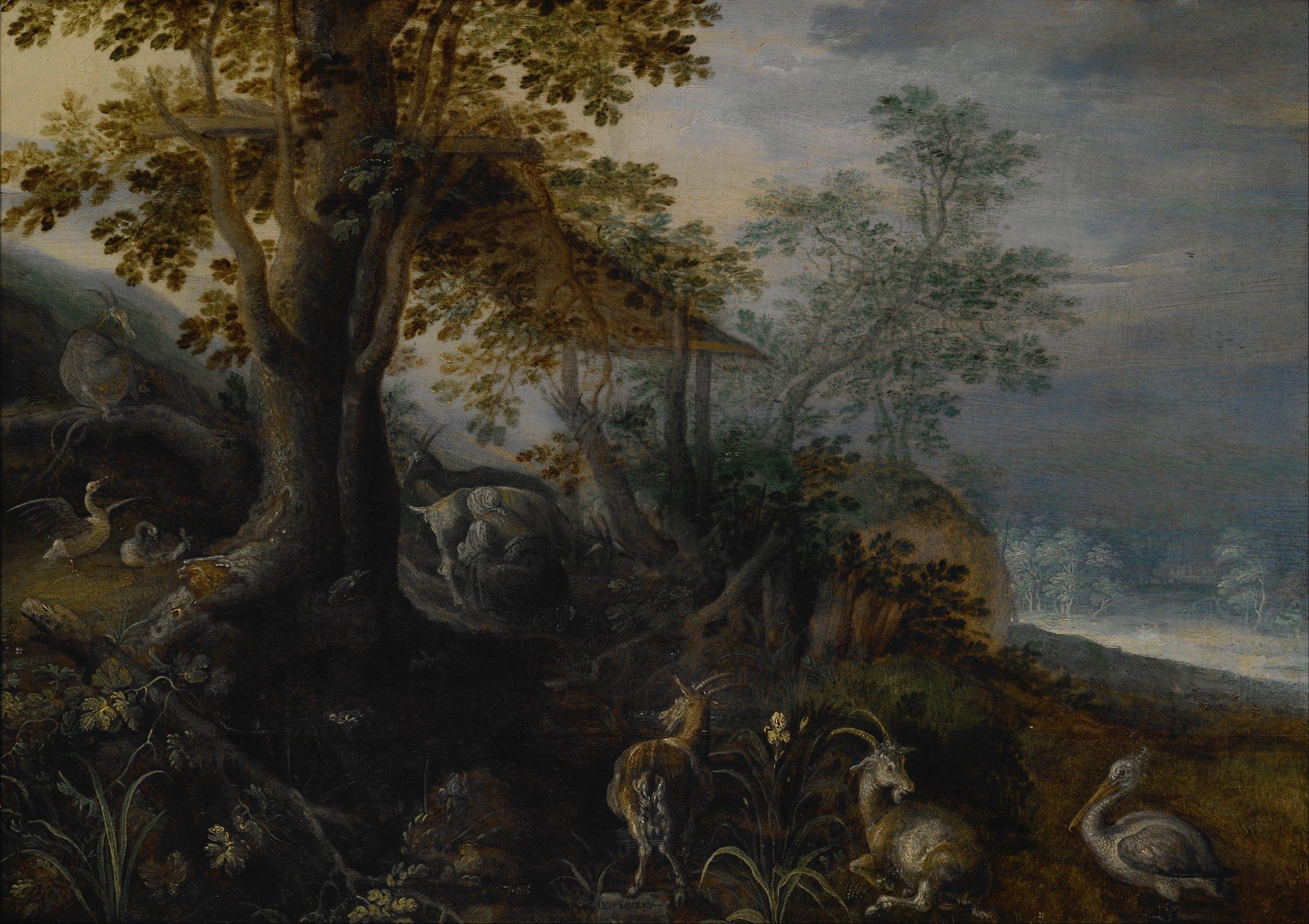
Roelant Savery, Landscape with Animals, about 1610. Public domain.
Psalm 104 · Passage · Featured Study
Psalm 104 and the Order of Genesis 1
The psalm sets its praise in an order close to Genesis 1.
How many are Your works, O LORD! In wisdom You have made them all; the earth is full of Your creatures.
- The passage
- Psalm 104:1 to 4, Psalm 104:5 to 9, Psalm 104:10 to 18, Psalm 104:19 to 23, Psalm 104:24 to 30, Psalm 104:31 to 35, Genesis 1:3 to 8
- Books
- Psalms, Genesis
- Hold in memory
- Psalm 104:24, Psalm 104:30
The psalm sings of creation as a work God is still doing.
Summary
The psalm begins and ends with the words Bless the LORD, O my soul. Between them it moves from light and the heavens to the waters, the land, the moon and sun, the sea and the breath of life. J. J. Stewart Perowne and Franz Delitzsch read that order beside Genesis 1.
- Perowne and Delitzsch differ on how closely the psalm keeps to the days.
- Breasted, a historian of Egypt, found a likeness between the psalm and a hymn to Aton.
- The psalm's last word, Hallelujah, is the first Hallelujah in the Book of Psalms.
Bless the LORD, O My Soul
The psalm opens with a call to bless the LORD and turns at once to God clothed in light.
Bless the LORD, O my soul! O LORD my God, You are very great; You are clothed with splendor and majesty. He wraps Himself in light as with a garment; He stretches out the heavens like a tent,The psalm's first work is light, as on the first day.
Delitzsch notes that Psalm 103 opens the same way and that this psalm bears no name. Charles Spurgeon observes that the two psalms also end alike.
Bless the LORD, all His works in all places of His dominion. Bless the LORD, O my soul!The Psalm Beside the Days
Perowne sets the psalm's parts against the days of Genesis 1 where he finds a day.
Five of the seven parts have a day of Genesis 1 in Perowne's reading.
| Psalm 104 | The work | Perowne's reading |
|---|---|---|
| Psalm 104:2 to 4 | Light, the heavens, the clouds and the wind | The first and second days, Genesis 1:3 to 8 |
| Psalm 104:5 to 9 | The waters set within their bounds | The first part of the third day, Genesis 1:9 to 10 |
| Psalm 104:10 to 18 | Springs, grass, crops, trees and the creatures that use them | The rest of the third day, Genesis 1:11 to 12, and far beyond it |
| Psalm 104:19 to 23 | The moon and the sun, night and day | The fourth day, Genesis 1:14 to 18 |
| Psalm 104:25 to 26 | The sea, its creatures great and small, the ships and Leviathan | The fifth day, Genesis 1:21 |
| Psalm 104:27 to 30 | All creatures fed and given breath | No day; the dependence of all creation on its Maker |
| Psalm 104:31 to 35 | God rejoicing in His works | No day; a new sabbath of creation longed for |
Where the Psalm Leaves the Order
Perowne and Delitzsch both note places where the psalm departs from the order of the days.
Perowne notes that the creatures of the fifth and sixth days appear in the psalm before the sea is reached. They are the birds, the beasts and man, and the sea and its life come back only in Psalm 104:25 to 26.
where the birds build their nests; the stork makes her home in the cypresses. The high mountains are for the wild goats, the cliffs a refuge for the rock badgers.Perowne counts these verses with the third day's trees and mountains.
The moon comes before the sun in Psalm 104:19. Delitzsch explains that the poet wants the picture of the day to follow that of the night.
He made the moon to mark the seasons; the sun knows when to set. You bring darkness, and it becomes night, when all the beasts of the forest prowl.The night comes first, as Delitzsch reads the order.
Creation as a Present Work
Perowne contrasts the creation of Genesis 1 with the creation the psalm sings.
Perowne points out that the creation of Genesis 1 lies in the past, while the creation of the psalm is going on now. The psalm's verbs give God's work a present force.
When You hide Your face, they are terrified; when You take away their breath, they die and return to dust. When You send Your Spirit, they are created, and You renew the face of the earth.Perowne's present creation stands in these verbs.
Perowne finds the same view in Paul's speech at Athens, where the God who made the world goes on giving all things life and breath.
The God who made the world and everything in it is the Lord of heaven and earth and does not live in temples made by human hands. Nor is He served by human hands, as if He needed anything, because He Himself gives everyone life and breath and everything else.Paul speaks of God's making in the past and His giving in the present.
The Psalm's Last Word
The psalm closes with a prayer against sinners and a call to praise.
May sinners vanish from the earth and the wicked be no more. Bless the LORD, O my soul. Hallelujah!The prayer and the praise stand side by side in one verse.
Delitzsch reads the close as the wish that evil be driven out of a good creation. In his reading that is the way to make complete God's joy in His works and the joy of His works in Him.
Psalm 105 ends with Hallelujah and Psalm 106 begins with it.
Voices on Psalm 104
Jerome and John Calvin wrote on the opening verses.
Jerome (died 420)
Homily 30, on Psalm 103
Jerome's homily calls this psalm Psalm 103, and in it he quotes The heavens declare the glory of God as the eighteenth psalm, Psalm 19 in the Berean numbering.
“This psalm contains the created world itself praising and blessing the Lord its creator through the prophet; just as he also says in the eighteenth psalm: ‘The heavens declare the glory of God, and the firmament proclaims the works of his hands.’ Bless the Lord, O my soul. The prophet rouses himself to bless God. But to bless the Lord means this: whoever praises the Lord blesses himself. O Lord my God, you are exceedingly magnified.”
on Psalm 104:1Patristic
John Calvin (1509 to 1564)
Commentaries
Calvin took up the image of the curtain in Psalm 104:2.
“When it is said that the heavens are a curtain, it is not meant that under them God hides himself, but that by them his majesty and glory are displayed; being, as it were, his royal pavilion.”
on Psalm 104:1Reformed
How Closely the Psalm Follows Genesis 1
Three readings set the psalm's order against Genesis 1 and against an Egyptian hymn.
The days as the psalm's outlineJ. J. Stewart Perowne
Perowne holds that the psalm follows the creation story of Genesis 1 in its main outline. He writes that the psalmist drew on that chapter and found in it his subject, though the psalm is no copy of it.
Against this reading, Delitzsch finds Psalm 104:18 forced in without any connection, contrary to any plan.
Seven groups for seven daysFranz Delitzsch
Delitzsch calls the psalm an echo of the seven days of creation in Genesis 1:1 to 2:3. Its seven groups answer the seven days, but no group keeps to the work of a single day. It begins with the light and ends with an allusion to the divine Sabbath.
Against this reading, Perowne finds the psalm without any division into stanzas.
A likeness to the hymn to AtonJames Henry Breasted
Breasted, in his History of Egypt (1905), translates the longer hymn to Aton of King Ikhnaton. He writes that the psalm shows a notable likeness to the hymn in its thought and its order. He sets four passages of the psalm beside the hymn.
Against this reading, Perowne and Delitzsch, writing before Breasted, trace the psalm's order to Genesis 1.
Books to Read Next
All three works are in the public domain, and each has a free copy to read.
The Book of Psalms: A New Translation, with Introductions and Notes, Explanatory and Critical, volume 2
J. J. Stewart Perowne · 1876
Perowne's introduction to the psalm stands on pages 224 to 227.
Read at the Internet ArchiveBiblical Commentary on the Psalms, volume 3
Franz Delitzsch, translated by Francis Bolton · 1877
Delitzsch writes on the psalm on pages 127 to 134.
Read at the Internet ArchiveA History of Egypt from the Earliest Times to the Persian Conquest
James Henry Breasted · 1905
Breasted prints the hymn to Aton beside the psalm on pages 371 to 374.
Read at the Internet ArchiveThe LORD Rejoices in His Works
Near its end the psalm turns from the works to the One who made them.
May the glory of the LORD endure forever; may the LORD rejoice in His works.Delitzsch reads the psalm as an expansion of the very good of Genesis 1:31.
Sources
Scripture is the Berean Standard Bible.
- J. J. Stewart Perowne, The Book of Psalms, from the third London edition, Warren F. Draper, 1876, vol. 2, pp. 224 to 227.
- Franz Delitzsch, Biblical Commentary on the Psalms, translated by Francis Bolton, second edition, T. and T. Clark, 1877, vol. 3, pp. 127 to 134.
- James Henry Breasted, A History of Egypt from the Earliest Times to the Persian Conquest, Charles Scribner's Sons, 1905, pp. 371 to 374.
- Jerome, Homily 30, on Psalm 103 in his numbering.
- John Calvin, Commentaries, 1554, on Psalm 104:2.
- Charles Spurgeon, The Treasury of David, volume 5, 1878, on Psalm 104:1.