

Genesis 12 · 15 · 17 · Featured Study
The Abrahamic Covenant
God calls one man out of Ur and binds Himself to him by oath — land, seed, and blessing to all nations. It is a grant, not a bargain: in Genesis 15 God alone passes between the pieces while Abram sleeps, and Paul will later give the promise its true name, the gospel, foretold. Every covenant after this one stands on it, and so does every believer: “if you belong to Christ, then you are Abraham's seed.”
Caravaggio, The Sacrifice of Isaac (c. 1603) — Public domain, via Wikimedia Commons
Summary
This page walks the covenant's three scenes across twenty-four years, then follows Genesis 15:6 into the three different arguments Paul and James each build on it.
- Genesis 15's ceremony is a treaty turned inside out: Abram sleeps while God alone walks the blood path and binds Himself.
- Genesis 15:6's "credited as righteousness" is quoted three separate ways: Paul's timing argument, his chronology argument, and James's completion argument.
- The unconditional-grant reading and the one-covenant-of-grace reading are laid out side by side, each with its own holders.
- Five Hebrew words anchor the covenant's own vocabulary, from berith (covenant, meaning "cut") to the fourfold olam of Genesis 17.
Three Scenes, One Oath
the covenant is given in words, then blood, then flesh: across twenty-four years
Then the LORD said to Abram, “Leave your country, your kindred, and your father’s household, and go to the land I will show you. I will make you into a great nation, and I will bless you; I will make your name great, so that you will be a blessing. I will bless those who bless you and curse those who curse you; and all the families of the earth will be blessed through you.”Seven I-wills over a childless man of seventy-five: the whole Bible's plot, stated in three verses.
Abram had been divinely commanded to go forth and had not moved a foot but as he was guided by the word of God.
John Calvin· Commentary on Genesis (1554), on Gen 12:1
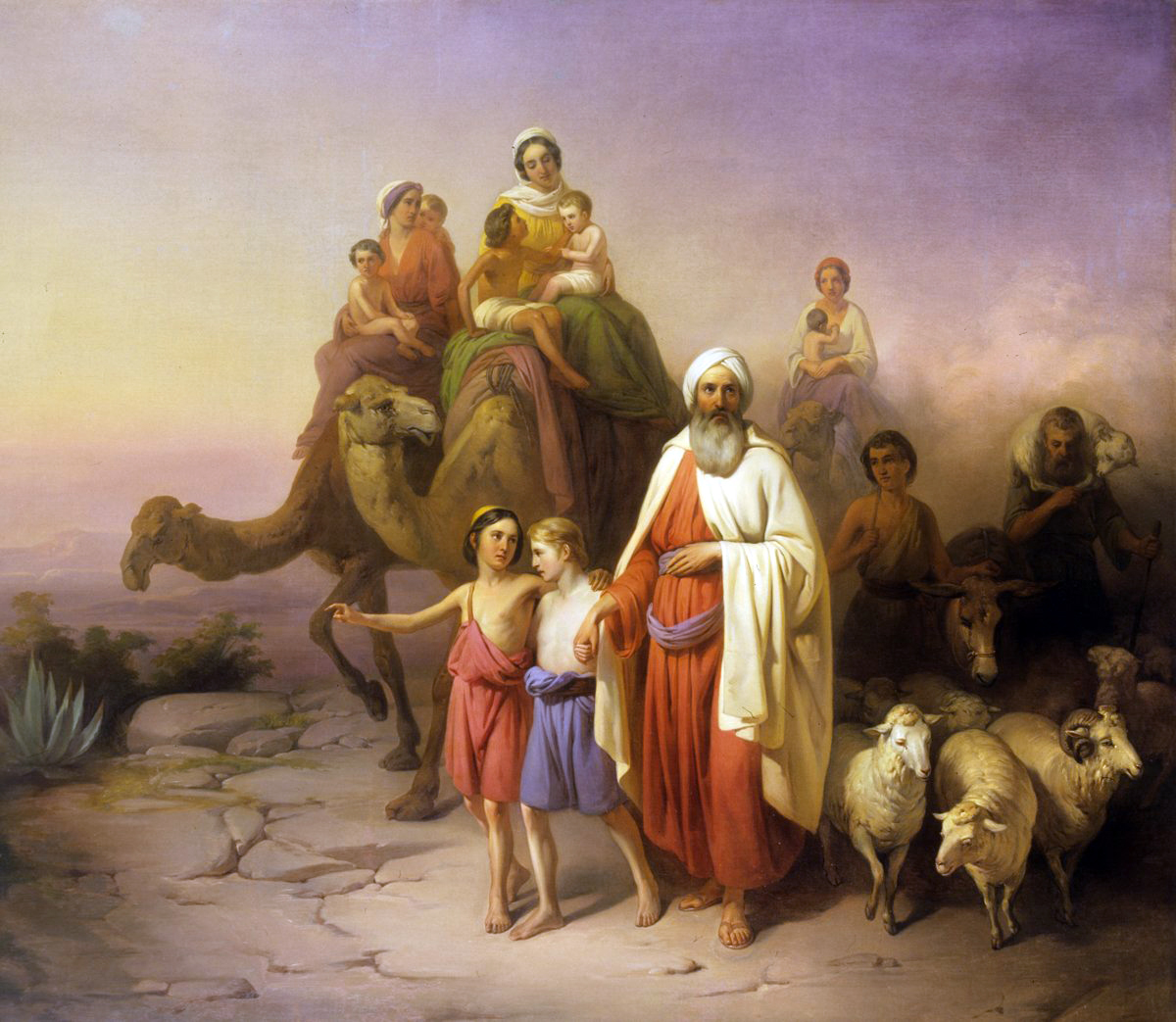
THE ARTWORK
József Molnár paints the caravan mid-stride, flocks, servants, Sarai on the donkey, and Abram looking not at the road but upward, toward the One whose word is the only map he has. The covenant begins exactly here: an old man walking away from everything on the strength of a promise.
József Molnár, The March of Abraham (1850), Hungarian National Gallery. Public domain, via Wikimedia Commons.
Land, Seed, Blessing
the threefold promise: and where each thread runs
Land
A land to his descendants: Canaan, walked and altar-marked by the patriarchs.
Gen 12:7; 15:18–21
→ The borders, verse by verseSeed
Descendants as the stars and the sand, and one Seed, “meaning One, who is Christ” (Gal 3:16).
Gen 15:5; 22:17–18
→ The Seed Promise: the thread from EdenBlessing
“All the families of the earth will be blessed through you”, the gospel foretold (Gal 3:8).
Gen 12:3
→ Paul's name for this promiseThe Night Only God Walked the Blood Path
Genesis 15: a treaty ceremony turned inside out
In Abram's world, covenants were cut, not signed. The parties halved animals, laid the pieces in two rows, and walked together down the corridor of blood: a walking oath meaning may this be done to me if I break my word (the idiom survives in Jeremiah 34:18). Genesis 15 stages exactly that ceremony, and then breaks its most important rule: Abram, the human party, is put into a deep sleep, and only God, a smoking firepot and a flaming torch, passes between the pieces.
Scholarship has given the pattern a name. Ancient Near Eastern kings made two kinds of covenant: the suzerain-vassal treaty, loaded with obligations on the lesser party, and the royal grant, a gift sworn by the king to a servant: a distinction set out by Moshe Weinfeld in the Journal of the American Oriental Society (1970). Sinai will read like the treaty. Genesis 15 reads like the grant: God alone swears, God alone walks, God alone is bound.
The patriarch did not pass between the sacrifice and the reason was that in this transaction he was bound to nothing. He asked a sign, and God was pleased to give him a sign, by which, according to Eastern ideas, He bound Himself.
Jamieson, Fausset & Brown· Commentary Critical and Explanatory (1871), on Gen 15:9–21
The ceremony, charted
An ordinary covenant, both parties walk the path, both are bound:
Genesis 15, Abram sleeps; God alone walks; God alone is bound:
A one-way walk down a two-way road: the covenant's keeping rests on one Person's faithfulness. Hebrews 6:13 says it plainly. He swore by Himself.
When the sun had set and darkness had fallen, behold, a smoking firepot and a flaming torch appeared and passed between the halves of the carcasses.The theophany walks the path Abram never touches: fire for the God who will later lead Israel as a pillar of it.
On that day the LORD made a covenant with Abram, saying, “To your descendants I have given this land—from the river of Egypt to the great River Euphrates—Not “I will give” but “I have given”: the tense of a deed already executed.
I have given the promise, the charter is sealed and delivered, and cannot be disanulled.
John Wesley· Notes on the Old Testament (1765), on Gen 15:18
One Verse, Three New Testament Arguments
Genesis 15:6, quoted by Paul twice and James once, each proving something different
Abram believed the LORD, and it was credited to him as righteousness.An accounting entry: faith on one line, righteousness credited on the other, before circumcision (ch. 17), centuries before Sinai.
This is urged in the New Testament to prove, that we are justified by faith without the works of the law, Rom. iv, 3,Gal. iii, 6, for Abram was so justified, while he was yet uncircumcised. If Abram, that was so rich in good works, was not justified by them, but by his faith, much less can we.
John Wesley· Notes on the Old Testament (1765), on Gen 15:6
Paul's timing argument: Abraham was credited righteous in Genesis 15, two chapters BEFORE circumcision in Genesis 17. So righteousness cannot come from the sign; the sign seals what faith already received.
Galatians 3:6Paul's chronology argument: the promise stood 430 years before the Law came, and a later law cannot annul an earlier ratified covenant (3:17). Faith was always the way in.
James 2:23James's completion argument: the faith credited in Genesis 15 was PROVED real on Moriah in Genesis 22, the offering of Isaac showed the ledger entry had been true all along.
The Gospel, Preached Beforehand
Paul's own name for Genesis 12:3, and the oath Hebrews anchors the soul to
The Scripture foresaw that God would justify the Gentiles by faith, and foretold the gospel to Abraham: “All nations will be blessed through you.”Paul's verb is euēngelisato: the gospel itself, announced to Abraham two millennia early.
The promises were spoken to Abraham and to his seed. The Scripture does not say, “and to seeds,” meaning many, but “and to your seed,” meaning One, who is Christ.Paul reads the singular: one Seed. The covenant's line runs from Genesis 3:15 through Abraham to a single Person.
And if you belong to Christ, then you are Abraham’s seed and heirs according to the promise.The covenant's widest door: in Christ, every believer is written into Abraham's family.
When God made His promise to Abraham, since He had no one greater to swear by, He swore by Himself,Hebrews' commentary on the blood path: no one greater to swear by, so He swore by Himself.
So when God wanted to make the unchanging nature of His purpose very clear to the heirs of the promise, He guaranteed it with an oath. Thus by two unchangeable things in which it is impossible for God to lie, we who have fled to take hold of the hope set before us may be strongly encouraged.Two unchangeable things, the promise and the oath, and the writer's conclusion: this covenant is where hope drops anchor.
The chain is complete: the promise spoken (Gen 12), cut in blood by God alone (Gen 15), marked everlasting (Gen 17), sworn by oath on Moriah (Gen 22), argued by Paul as the gospel in seed form (Gal 3), and anchored by Hebrews to the soul of every believer. One covenant, one Seed, one faith counted for righteousness — the scarlet thread runs straight through it.
“Everlasting”: and Contested
unconditional grant, or covenant with conditions? both readings, and who holds each
I will establish My covenant as an everlasting covenant between Me and you and your descendants after you, to be your God and the God of your descendants after you.Berit olam, “everlasting covenant”, four olam-stamps in one chapter (17:7, 8, 13, 19), floor-verified.
The unconditional-grant reading
The one-sided ceremony of Genesis 15, the royal-grant form (Weinfeld's ANE parallel), the fourfold olam, and Hebrews 6's self-sworn oath read the covenant as a gift God alone secures: commands inside it (circumcision, walking blamelessly) regulate enjoyment, never ownership. This is the dispensational teachers' reading. Chuck Missler's covenant teaching carries it, and much of the wider evangelical tradition stands here too.
The one-covenant-of-grace reading
Covenant theology: the Reformed tradition R.C. Sproul's What Is Reformed Theology?(1997) summarizes, reads Abraham's covenant as one administration of a single covenant of grace running from Eden to the New Covenant, with the church inheriting its promises in Christ; Genesis 17:1's “walk before Me and be blameless” keeps real obligation inside the relationship.
Where the readings meet: no tradition holds that God's promise to Abraham failed, and both read Galatians 3:29 as true — everyone in Christ inherits this covenant's blessing. They differ on whether Israel's national promises remain a distinct, still-future track. That question has its own full page: the two frameworks, side by side.
The Words the Covenant Turns On
five Hebrew words: every address verified against the text
Go Further Than This Page
the works that have carried this covenant: free doors for the classics
Commentary on Genesis
John Calvin · 1554
Calvin on chapters 12–17: the covenant read verse by verse by the Reformation's most careful exegete.
READ IT FREE AT CCEL →Commentary on the Whole Bible
Matthew Henry · 1710
Henry's warm, full walk through the Abraham narratives: the devotional companion to this page.
READ IT FREE AT CCEL →“The Covenant of Grant in the Old Testament and in the Ancient Near East”
Moshe Weinfeld · 1970
The landmark study behind this page's grant-versus-treaty distinction: published in the Journal of the American Oriental Society.
In print: find it wherever books are sold.
Treaty of the Great King
Meredith G. Kline · 1963
The case that Deuteronomy runs the full ancient treaty form: the other half of the covenant-shapes story.
In print: find it wherever books are sold.
Word studies
The Hebrew and Greek under this study, each word in its own room.
Keep studying
Read it1
By subject
Faith6 pages
The patriarchs7 pages
On this page
Studies5
Words1
Doctrines17
- The Covenants: all of them, one axis
- The Davidic Covenant: the throne added
- The New Covenant: the promise landed
- Circumcision of the Heart
- The Edenic Covenant
- Hagar and Sarah: the Allegory
- The Land Covenant
- The Mosaic Covenant
- The Noahic Covenant
- The Covenant of Phinehas
- The Scarlet Thread
- The Seed Promise
- Why God Is Not Finished With Israel
- Put That on Mine Account: Imputation
- The New Perspective on Paul
- Justification by Faith: the Verdict of the Cross
- Names of God