
Deuteronomy 16 · Subject · Featured Study
The Three Pilgrim Feasts
Deuteronomy 16 names the three yearly feasts, where they are kept and the gift each man brings.
Each spring, summer and autumn the farmers of Israel left their fields for the place the LORD would choose.
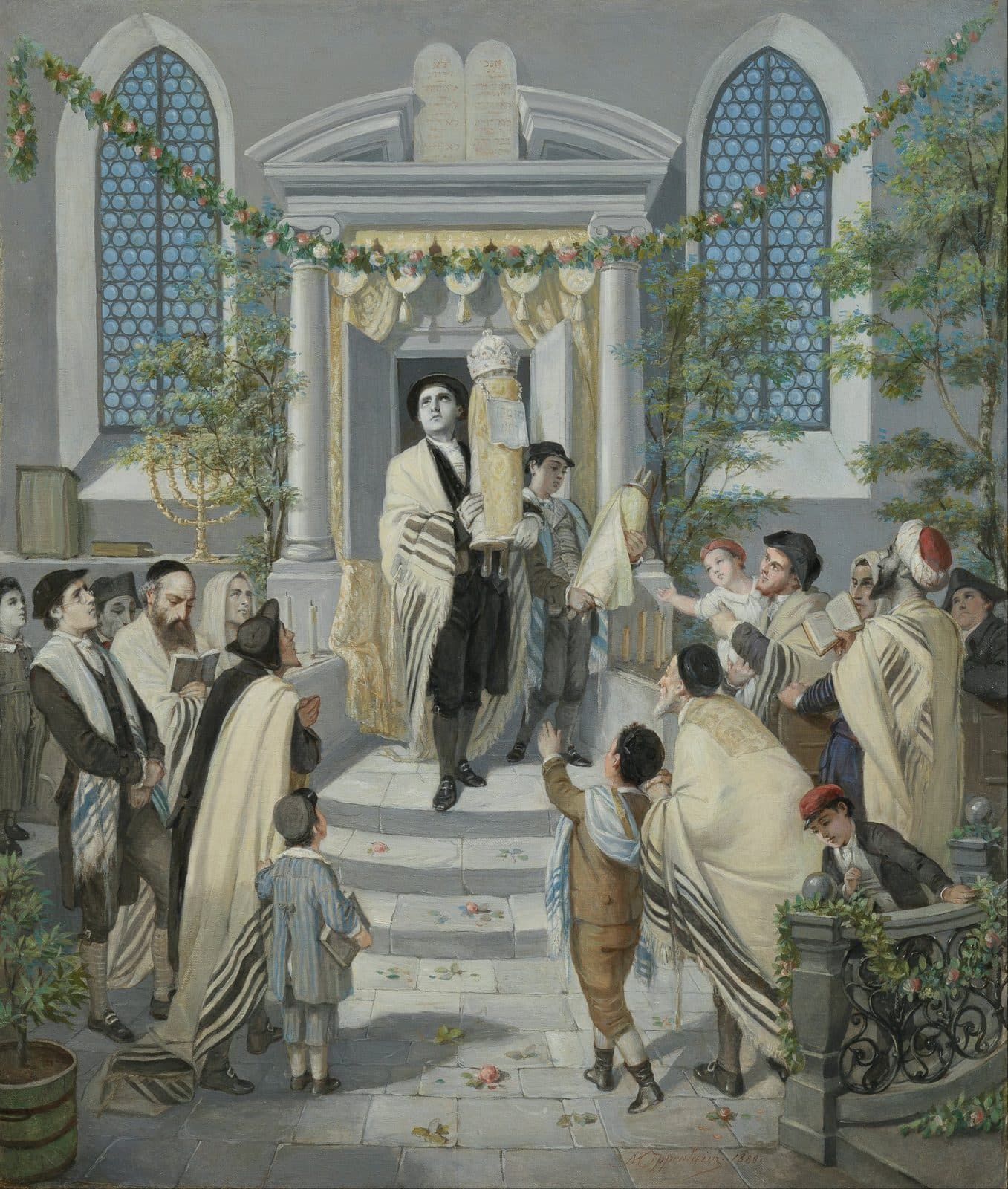
Moritz Daniel Oppenheim, Shavuot (Pentecost), 1880. Public domain, via Wikimedia Commons.
THE ARTWORKMoritz Daniel Oppenheim painted a synagogue dressed in green boughs and garlands for the Feast of Weeks, with the Torah scroll carried down from the ark. The tablets of the law stand over the ark, and men and boys in prayer shawls crowd the steps.
Summary
The three pilgrim feasts are Unleavened Bread with the Passover, the Feast of Weeks and the Feast of Tabernacles, the times Deuteronomy 16 names for all the men of Israel to appear before the LORD.
- Exodus 23, Exodus 34 and Leviticus 23 give the same three feasts before Deuteronomy.
- Six verses of Deuteronomy 16 send the feasts to the place the LORD will choose, and verse 5 forbids the Passover in the towns.
- Paul calls Christ our Passover lamb, Luke dates the gift of the Spirit to Pentecost, and Jesus calls the thirsty to Himself on the last day of Tabernacles.
Three Times a Year at the Chosen Place
Deuteronomy 16:16 to 17 holds the rule, and verses 1, 9 and 13 date each feast.
Three times a year all your men are to appear before the LORD your God in the place He will choose: at the Feast of Unleavened Bread, the Feast of Weeks, and the Feast of Tabernacles. No one should appear before the LORD empty-handed. Everyone must appear with a gift as he is able, according to the blessing the LORD your God has given you.These two verses close the law of the feasts, Deuteronomy 16:1 to 17, with its rule for all three.
The three feasts in Deuteronomy 16Deuteronomy 16:1, 16:9 to 10 and 16:13
The chapter takes the feasts in the order of the year.
Observe the month of Abib and celebrate the Passover to the LORD your God, because in the month of Abib the LORD your God brought you out of Egypt by night.The first feast is tied to a month of the farming year and to the night of the Exodus.
You are to count off seven weeks from the time you first put the sickle to the standing grain. And you shall celebrate the Feast of Weeks to the LORD your God with a freewill offering that you give in proportion to how the LORD your God has blessed you,Of the three feasts, only the second is dated by a count of weeks.
You are to celebrate the Feast of Tabernacles for seven days after you have gathered the produce of your threshing floor and your winepress.The third feast waits until the grain is threshed and the grapes are pressed.
The same three feasts in ExodusExodus 23:14 to 17 and Exodus 34:22 to 23
You are also to keep the Feast of Harvest with the firstfruits of the produce from what you sow in the field. And keep the Feast of Ingathering at the end of the year, when you gather your produce from the field.Exodus names the second and third feasts by the harvest they close, Harvest and Ingathering.
And you are to celebrate the Feast of Weeks with the firstfruits of the wheat harvest, and the Feast of Ingathering at the turn of the year. Three times a year all your males are to appear before the Lord GOD, the God of Israel.Here the second feast takes the name Weeks and brings the firstfruits of the wheat.
The fields left behindExodus 34:24
For I will drive out the nations before you and enlarge your borders, and no one will covet your land when you go up three times a year to appear before the LORD your God.The LORD answers the danger of leaving the borders unguarded three times a year with a promise.
The Feasts in the Farming Year
The farming year from the Passover in Abib to Tabernacles in the seventh month, the days each feast is kept, and a table of the three feasts.
The three feasts follow the harvest from the first ripe barley in Abib to the grapes of the seventh month.
- The Passoverthe fourteenth day of Abib, at twilight, the barley in the earLeviticus 23:5
- Unleavened Breadthe fifteenth to the twenty-first of Abib, seven days of bread made without leavenLeviticus 23:6
- The first sheafthe day after the Sabbath, a sheaf of the firstfruits waved before the LORDLeviticus 23:10 to 11
- Seven weeks countedforty-nine days, the barley harvest and then the wheatDeuteronomy 16:9
- The Feast of Weeksthe fiftieth day, in the third month, the firstfruits of the wheatExodus 34:22
- The Feast of Tabernaclesthe fifteenth day of the seventh month, for seven days and an eighth, after the threshing floor and the winepress, the produce of the land gathered inLeviticus 23:34 to 36
Six stops in the order of the year, each with its day and its verse.
Unleavened Bread is kept seven days, Weeks one day, and Tabernacles seven days with an eighth day of assembly.
The 3 days kept as a table
| Feast | Days kept | What the verse sets | Verse |
|---|---|---|---|
| Unleavened Bread | 7 | seven days of unleavened bread, the seventh a solemn assembly | Deuteronomy 16:8 |
| Weeks | 1 | a sacred assembly on that same day | Leviticus 23:21 |
| Tabernacles | 8 | seven days of offerings and a sacred assembly on the eighth | Leviticus 23:36 |
Three bars from zero, each the days one feast is kept, with the verse that sets them.
The three feasts in one tableDeuteronomy 16:1 to 15
| Feast | Hebrew name | Date | Harvest | What it remembers | Verses |
|---|---|---|---|---|---|
| Unleavened Bread, with the Passover | chag hammatstsot, חַג הַמַּצּוֹת | the fourteenth of Abib, then seven days | barley | the night the LORD brought Israel out of Egypt in haste | Deuteronomy 16:1 to 8 |
| Weeks | chag hashavuot, חַג הַשָּׁבֻעוֹת | seven weeks from the first sickle | wheat | that Israel were slaves in Egypt | Deuteronomy 16:9 to 12 |
| Tabernacles | chag hassukkot, חַג הַסֻּכּוֹת | seven days in the seventh month | grain and grapes | the booths Israel lived in after Egypt (Leviticus 23:43) | Deuteronomy 16:13 to 15 |
A month added to the yearRashi on Deuteronomy 16:1
Rashi reads the command to observe the month of Abib as a charge to watch the ears of grain before the month comes. If they will not be ripe for the sheaf by the sixteenth of Nisan, a month is added to the winter so that Abib falls later.
The Feasts Kept Through Scripture
From Shiloh and the temple of Solomon to the feasts Jesus kept in Jerusalem.
And all the men of Israel came together to King Solomon at the feast in the seventh month, the month of Ethanim.Solomon dedicated the temple at the feast of the seventh month, the Feast of Tabernacles.
When the Jewish Passover was near, Jesus went up to Jerusalem.As a grown man Jesus kept the law of the pilgrim feasts.
The house of the LORD at Shiloh1 Samuel 1:3 and Jeremiah 7:12
Year after year Elkanah would go up from his city to worship and sacrifice to the LORD of Hosts at Shiloh, where Eli’s two sons, Hophni and Phinehas, were priests to the LORD.Before the temple, the yearly journey went to Shiloh.
But go now to the place in Shiloh where I first made a dwelling for My Name, and see what I did to it because of the wickedness of My people Israel.Josiah's Passover2 Kings 23:21 to 23
The king commanded all the people, “Keep the Passover of the LORD your God, as it is written in this Book of the Covenant.” No such Passover had been observed from the days of the judges who had governed Israel through all the days of the kings of Israel and Judah. But in the eighteenth year of Josiah’s reign, this Passover was observed to the LORD in Jerusalem.In the Gospels and ActsLuke 2:41 to 42, John 7:2, Acts 2:5 and Acts 2:41
Every year His parents went to Jerusalem for the Feast of the Passover. And when He was twelve years old, they went up according to the custom of the Feast.Mary went up with Joseph, as Hannah went up with Elkanah, though the law summoned the men.
However, the Jewish Feast of Tabernacles was near.The rest of John 7, to the last day of the feast in verse 37, takes place at Tabernacles.
Now there were dwelling in Jerusalem God-fearing Jews from every nation under heaven.The crowd at the feast is why the apostles were heard in many languages that day, as Acts 2:6 records.
Those who embraced his message were baptized, and about three thousand were added to the believers that day.Luke counts the first believers gathered on the day of the wheat harvest's feast.
The law read at TabernaclesDeuteronomy 31:10 to 11
Then Moses commanded them, “At the end of every seven years, at the appointed time in the year of remission of debt, during the Feast of Tabernacles, when all Israel comes before the LORD your God at the place He will choose, you are to read this law in the hearing of all Israel.What Deuteronomy Adds to Exodus and Leviticus
Four changes in the law of the feasts, with the readings of Rashi and Sforno.
ONE PLACE FOR THE PASSOVER
Exodus 12:7 set the blood on the doorframes of each house, and Deuteronomy 16:5 to 6 moves the sacrifice to the place the LORD will choose.
THE WHOLE HOUSEHOLD
Exodus 23:17 summons the males, and Deuteronomy 16:11 and 16:14 call the whole household, the Levite and the poor of the towns to rejoice with them.
THE COUNT FROM THE SICKLE
Leviticus 23:15 counts the weeks from the waved sheaf, and Deuteronomy counts them from the first cut of the harvest.
A GIFT AS EACH IS ABLE
Exodus 23:15 forbids coming empty-handed, and Deuteronomy 16:17 sets the gift by the blessing the LORD has given.
Rashi, the Jewish commentator of France (1040 to 1105), reads the list of those who rejoice in two halves. The Levite, the stranger, the fatherless and the widow are four of the LORD's, and the son, the daughter and the two servants are four of the household. If Israel gladdens His four, He will gladden theirs.
Sforno, a Jewish commentator of Italy (about 1475 to 1550), notes on Deuteronomy 16:5 that the Passover in Egypt needed no altar and no sanctuary. The Passover of later years was to be kept another way.
The day the count beginsRashi; Matthew Henry; Adam Clarke
Rashi, citing Menachot 65b, takes the Sabbath of Leviticus 23:15 as the first day of the feast. Matthew Henry, on Deuteronomy 16:9, also counts from the morrow after the first day, and Adam Clarke sets the forty-nine days from the sixteenth of the first month to the sixth of the third.
Six days or sevenRashi on Deuteronomy 16:8
Deuteronomy 16:8 speaks of six days of unleavened bread, and Exodus 12:15 gives seven. Rashi's first answer is that bread of the old grain may be eaten all seven days, and bread of the new grain only on the last six, after the sheaf is offered.
The herd and the flockRashi on Deuteronomy 16:2
Deuteronomy 16:2 allows the Passover sacrifice from the herd or the flock, and Exodus 12:5 names a lamb from the sheep or the goats. Rashi takes the flock for the Passover lamb and the cattle for the festival offering eaten with it.
Return to your tentsMatthew Henry on Deuteronomy 16:7
Some, Matthew Henry reports, read Deuteronomy 16:7 as leave to go home on the morning after the Passover meal. Henry answers that the first day of the seven was appointed for a holy convocation, so the people did not disperse on it.
The Harvest in the Land
The plague of hail and the gleaning of Ruth date the barley and the wheat.
(Now the flax and barley were destroyed, since the barley was ripe and the flax was in bloom; but the wheat and spelt were not destroyed, because they are late crops.)The hail of the month of the Exodus shows the barley ripe weeks before the wheat, the gap the count of seven weeks spans.
So Ruth stayed close to the servant girls of Boaz to glean grain until the barley and wheat harvests were finished. And she lived with her mother-in-law.Ruth gleaned from the start of the barley harvest to the end of the wheat, the same span of weeks.
“The Passover, Pentecost, and feast of Tabernacles, in spring, summer, and autumn, were the three times appointed for their attendance; not in winter, because travelling was then uncomfortable; nor in the midst of their harvest.”
John Wesley · Explanatory Notes upon the Old Testament · on Exodus 23:14Evangelical
The Words of the Feasts
Six Hebrew words of the feasts, each with the lexicon's gloss and count.
CHAG, FEAST (H2282)
The lexicon glosses chag a festival, or a victim therefor, and counts 62 occurrences. It names the Feast of Tabernacles in this verse.
ABIB (H24)
The lexicon glosses abib green, a young ear of grain, and counts 8 occurrences. The month takes its name from the barley in the ear.
SHAVUA, WEEK (H7620)
The lexicon glosses shavua sevened, a week, and counts 20 occurrences. In this verse it gives the Feast of Weeks its name.
SUKKAH, BOOTH (H5521)
The lexicon glosses sukkah a hut or lair, and counts 31 occurrences. The Feast of Tabernacles takes its Hebrew name from the plural, and this verse uses it twice for the booths.
SAMACH, REJOICE (H8055)
The lexicon glosses samach to brighten up, to be blithe or gleesome, and counts 155 occurrences. It is the first word of Deuteronomy 16:14.
REYQAM, EMPTY (H7387)
The lexicon glosses reyqam emptily and counts 16 occurrences. It is the last word of this verse, which the Berean text renders empty-handed.
The Name Jerusalem in Deuteronomy
Deuteronomy keeps one name for the sanctuary of the feasts.
Across its 959 verses in the Berean text, Deuteronomy calls it the place the LORD will choose, and the name Jerusalem stands in none of them.
The Feasts Fulfilled in Christ
The Passover in the death of Christ, Weeks in the gift of the Spirit, and Tabernacles in the call of John 7:37 and the ingathering of the nations.
Get rid of the old leaven, that you may be a new unleavened batch, as you really are. For Christ, our Passover lamb, has been sacrificed. Therefore let us keep the feast, not with the old bread, leavened with malice and wickedness, but with the unleavened bread of sincerity and of truth.Paul reads the Passover and the bread without leaven in the sacrifice of Christ and the life that follows it.
But Christ has indeed been raised from the dead, the firstfruits of those who have fallen asleep.Paul calls the risen Christ the firstfruits, the name Leviticus 23:10 gives the first sheaf of the harvest.
When the day of Pentecost came, they were all together in one place.Pentecost is the Greek name of the fiftieth day, the day of the Feast of Weeks.
On the last and greatest day of the feast, Jesus stood up and called out in a loud voice, “If anyone is thirsty, let him come to Me and drink. Whoever believes in Me, as the Scripture has said: ‘Streams of living water will flow from within him.’” He was speaking about the Spirit, whom those who believed in Him were later to receive. For the Spirit had not yet been given, because Jesus had not yet been glorified.John reads this call, made at the feast of the ingathering, as the promise of the Spirit.
The firstfruits and the two loavesOrigen; Bede
Origen reads the firstfruits of the Feast of Weeks in the Spirit given to the apostles.
“An offering of ‘first fruits,’ that is, from the beginning of the harvest, is commanded. If you remember well, the law commands this is to be done on the day of Pentecost. This was obviously given to them as a ‘shadow,’ but the truth was reserved for us. For on the day of Pentecost, after they offered up the sacrifice of prayers, the church of the apostles received the first fruits of the coming of the Holy Spirit.”
Origen of Alexandria · Homilies on Leviticus 2.2.5 · on Deuteronomy 16:10Patristic
Leviticus 23:17 brings two loaves of the new wheat to the same feast.
“Two loaves of bread made from the first fruits of the new harvest were rightly ordered to be offered, for the church gathers those it can consecrate to its Redeemer as a new family from both peoples, the Jews and the Gentiles.”
Bede · Homilies on the Gospels 2.17 · on Leviticus 23:17Patristic
The last day and the nationsAlbert Barnes; Zechariah 14:16
Albert Barnes takes the last and greatest day of the feast as the eighth day, the solemn assembly of Leviticus 23:36.
Then all the survivors from the nations that came against Jerusalem will go up year after year to worship the King, the LORD of Hosts, and to celebrate the Feast of Tabernacles.This verse carries the feast of the ingathering beyond Israel to the nations.
And should any of the families of the earth not go up to Jerusalem to worship the King, the LORD of Hosts, then the rain will not fall on them.The penalty for staying away from the feast of the ingathering is the loss of the rain.
Two Teachers on the Feasts
John Calvin on the day of Pentecost, and Matthew Henry on the gift of Weeks and the joy of Tabernacles.
The law and the Spirit, fifty days apartJohn Calvin on Acts 2:1
Calvin weighs a reading of Augustine that joins the law given at Sinai to the Spirit given at Pentecost.
“I will not refute that high and subtle interpretation of Augustine, that like as the law was given to the old people fifty days after Easter, being written in tables of stone by the hand of God, so the Spirit, whose office it is to write the same in our hearts, did fulfill that which was figured in the giving of the law as many days after the resurrection of Christ, who is the true Passover.”
John Calvin · Commentaries · on Acts 2:1Reformed
Henry on the gift and the joyMatthew Henry on Deuteronomy 16:10 and 16:15
Henry turns to the word the Berean text renders a freewill offering in Deuteronomy 16:10.
“It is here called a tribute of a free-will-offering. It was required of them as a tribute to their Sovereign Lord and owner, under whom they held all they had; and yet because the law did not determine the quantum, but it was left to every man's generosity to bring what he chose, and whatever he brought he must give cheerfully, it is therefore called a free-will offering.”
Matthew Henry · Commentary on the Whole Bible · on Deuteronomy 16:10Puritan
He finds the ground of the joy of Deuteronomy 16:15 in what the LORD has promised.
“We must rejoice in God, not only because of what we have received and are receiving from him daily, but because of what he has promised, and we expect to receive yet further from him: because he shall bless thee, therefore thou shalt rejoice. Those that make God their joy may rejoice in hope, for he is faithful that has promised.”
Matthew Henry · Commentary on the Whole Bible · on Deuteronomy 16:15Puritan
Two Dates for Deuteronomy
Two readings of the date of Deuteronomy, each with its holders and its work.
The date given to the book decides what its law of one place first meant.
A law for the land to comeAdam Clarke; Albert Barnes
Adam Clarke, on Deuteronomy 31:9, takes the law Moses wrote to be the book of Deuteronomy. On 2 Kings 22:8 he holds it very probable that the book found under Josiah was the autograph of Moses. Albert Barnes, on Deuteronomy 31:24, takes the book Moses finished to be the whole Pentateuch up to that verse.
The book found under JosiahWilhelm de Wette
Wilhelm de Wette, in his Dissertatio critica of 1805, identified the book found in the temple under Josiah with Deuteronomy.
Then Hilkiah the high priest said to Shaphan the scribe, “I have found the Book of the Law in the house of the LORD!” And he gave it to Shaphan, who read it.On this reading the law of one place served Josiah's Passover in Jerusalem and his desecration of the high places of Judah.
Books on the Pilgrim Feasts
Six commentaries on the feasts, from Rashi to Albert Barnes.
Pentateuch with Rashi's Commentary
Rosenbaum and Silbermann · 1929 to 1934
Rashi's notes on Deuteronomy 16 are set in English, with the rules of each feast and their sources in the Sifrei and the Talmud.
In print: find it wherever books are sold.
Commentary on the Whole Bible
Matthew Henry · 1710
Henry reads each feast of Deuteronomy 16 for its duty and for its meaning to the Christian reader.
Explanatory Notes upon the Old Testament
John Wesley · 1765
Wesley's short notes explain the seasons of the feasts and who was bound to attend them.
Commentaries
John Calvin · 1554
Calvin's commentary on Acts 2 sets the day of Pentecost beside the law and the Passover.
Notes, Explanatory and Practical, on the Old and New Testaments
Albert Barnes · 1832 to 1869
Barnes explains the feasts in Leviticus 23 and the great day of the feast in John 7.
Commentary on the Bible
Adam Clarke · 1832
Clarke counts the days of the feasts and weighs the authorship of Deuteronomy.
Keeping the Feast
Jesus at the well and Paul in 1 Corinthians 5 carry the feast to Christ.
“Believe Me, woman,” Jesus replied, “a time is coming when you will worship the Father neither on this mountain nor in Jerusalem. You worship what you do not know; we worship what we do know, for salvation is from the Jews. But a time is coming and has now come when the true worshipers will worship the Father in spirit and in truth, for the Father is seeking such as these to worship Him.The woman's question in John 4:20 is the question of the chosen place, and this is the answer of Jesus.
Matthew Henry draws the Christian keeping of the feast from Deuteronomy 16:3 to 4.
“Christ our passover being sacrificed for us, and we having participated in the blessed fruits of that sacrifice to our comfort, let us keep the feast in a holy conversation, free from the leaven of malice towards our brethren and hypocrisy towards God, and with the unleavened bread of sincerity and love.”
Matthew Henry · Commentary on the Whole Bible · on Deuteronomy 16:3 to 4Puritan
Deuteronomy 16:11 to 12 asks the reader to rejoice with the whole household and to remember the slavery.
Keep studying
Studies5
Symbols1
Doctrines19