
Exodus 21 to Deuteronomy 22 · Mot yumat
The Death Penalty in the Law of Moses
The capital laws of Exodus, Leviticus, Numbers and Deuteronomy name the offences that carry death and the courts that try them.
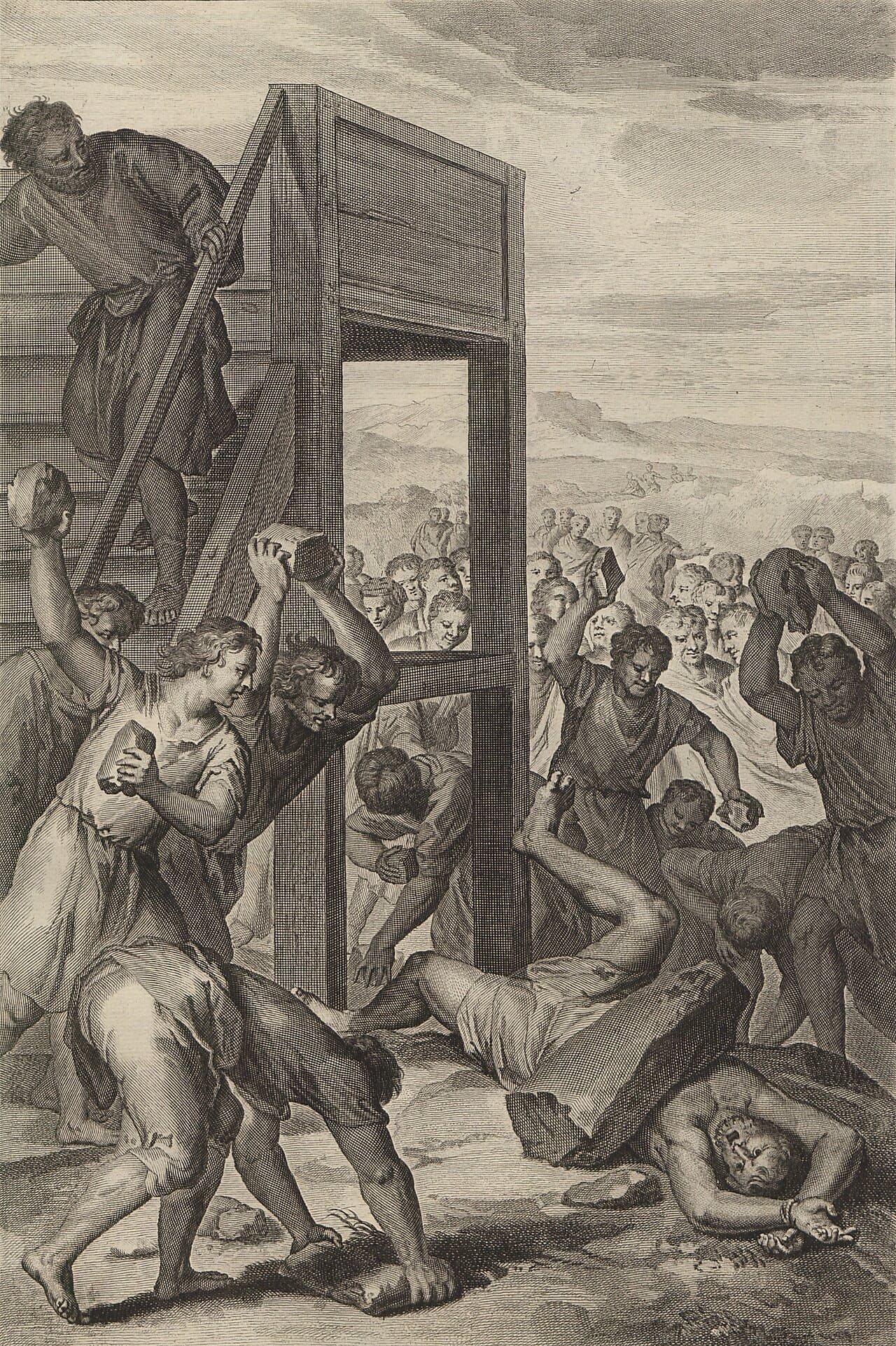
When a man was found gathering wood on the Sabbath, Israel held him in custody, because no one yet knew what should be done to him.
- First taught
- Genesis 9:6
- Fullest statement
- Leviticus 20:1 to 27
Gerard Hoet and others, The Blasphemer Stoned, Figures de la Bible, The Hague, P. de Hondt, 1728. Public domain by date (published before 1930), via Wikimedia Commons (File:The Blasphemer Stoned (5753069).jpg, from the National Library of Poland).
THE ARTWORKThe plate shows the sentence of Leviticus 24:23, when Israel took the blasphemer outside the camp and stoned him.
Summary
The law of Moses sets death, mot yumat in Hebrew, for offences against God, against life, against parents, against liberty and against justice, and for sexual offences.
- Genesis 9:6 requires the life of the one who sheds man's blood before Israel has any law, because God made mankind in His image.
- The murderer is put to death, and the one who killed without intent flees to a city of refuge until the high priest dies.
- No one may be put to death on the testimony of a lone witness, and the hands of the witnesses are the first against the condemned.
- The Mishnah gives the court four deaths, and it calls a court that executes once in seven years destructive.
- Calvin and the Westminster Confession hold that the penalties ended with Israel's state, while the Massachusetts Body of Liberties of 1641 set its capital laws on texts of Moses.
From Genesis 9 to the Law of Moses
Genesis 9:6 gives the first sentence of death for bloodshed, and Exodus 21:12 opens the capital laws of Moses.
Whoever sheds the blood of man, by man his blood will be shed; for in His own image God has made mankind.This sentence is given to Noah's family before Israel exists, and its reason is the dignity of every human life.
Whoever strikes and kills a man must surely be put to death.The Hebrew ends mot yumat, he must surely be put to death, the words that close Exodus 21:15, 16 and 17 as well.
You are to have the same standard of law for the foreign resident and the native; for I am the LORD your God.’”Verses 16 and 17 put the blasphemer and the murderer to death, and this verse applies both sentences to every man in the camp.
On the testimony of two or three witnesses a man shall be put to death, but he shall not be executed on the testimony of a lone witness.This rule governs every capital case, and verse 7 makes those who testify the first to act.
The Offences That Carry Death
Nine of the offences are against God and ten are sexual offences, and the other eight fall in four groups.
The law names stoning for nine of these offences, burning for two and the sword for one. For the other fifteen it names death and gives no manner of death.
The Capital Laws, Passage by Passage
The capital laws stand in six groups of passages, from Exodus 21 to Deuteronomy 22.
1. Exodus 21:12 to 32, murder, parents, kidnapping and the goring ox3 passages
If, however, he did not lie in wait, but God allowed it to happen, then I will appoint for you a place where he may flee. But if a man schemes and acts willfully against his neighbor to kill him, you must take him away from My altar to be put to death.Intent decides the sentence here, and even the place of sacrifice gives a murderer no protection.
Whoever kidnaps another man must be put to death, whether he sells him or the man is found in his possession.The crime is complete at the taking, whatever became of the captive afterward.
But if the ox has a habit of goring, and its owner has been warned yet does not restrain it, and it kills a man or woman, then the ox must be stoned and its owner must also be put to death. If payment is demanded of him instead, he may redeem his life by paying the full amount demanded of him.The man's guilt lies in his neglect of a danger he knew of, and verse 30 opens a way out of the sentence.
Jamieson, Fausset and Brown, in their Commentary on Exodus 21:30, call this the only case where the law expressly allowed money in place of death.
2. Exodus 31:14 to 15 and Numbers 15:32 to 36, the Sabbath2 passages
Keep the Sabbath, for it is holy to you. Anyone who profanes it must surely be put to death. Whoever does any work on that day must be cut off from among his people.This verse gives two penalties for one offence, and verse 15 repeats the first of them.
And the LORD said to Moses, “The man must surely be put to death. The whole congregation is to stone him outside the camp.” So the whole congregation took the man outside the camp and stoned him to death, as the LORD had commanded Moses.The LORD's sentence settles the manner of death, which Exodus 31 had left unnamed.
3. Leviticus 20 and 24, the Holiness Code and the blasphemer2 passages
If a man commits adultery with another man’s wife—with the wife of his neighbor—both the adulterer and the adulteress must surely be put to death.The sentence falls on both parties to the act, with no difference made between them.
“Take the blasphemer outside the camp, and have all who heard him lay their hands on his head; then have the whole assembly stone him.The witnesses lay the guilt on the man who spoke, and the sentence then belongs to the people.
4. Numbers 35:9 to 34, the murderer and the manslayer3 passages
then the congregation must judge between the slayer and the avenger of blood according to these ordinances. The assembly is to protect the manslayer from the hand of the avenger of blood. Then the assembly will return him to the city of refuge to which he fled, and he must live there until the death of the high priest, who was anointed with the holy oil.A court stands between the killer and his pursuer, and the refuge lasts as long as the high priest lives.
If anyone kills a person, the murderer is to be put to death on the testimony of the witnesses. But no one is to be put to death based on the testimony of a lone witness. You are not to accept a ransom for the life of a murderer who deserves to die; he must surely be put to death.The law prevents both a false conviction on one witness and a bought release.
Do not pollute the land where you live, for bloodshed pollutes the land, and no atonement can be made for the land on which the blood is shed, except by the blood of the one who shed it.This verse gives the reason the murderer may not be ransomed in verse 31.
5. Deuteronomy 13, 17 and 19, the courts and the witnesses3 passages
Instead, you must surely kill him. Your hand must be the first against him to put him to death, and then the hands of all the people. Stone him to death for trying to turn you away from the LORD your God, who brought you out of the land of Egypt, out of the house of slavery.The law makes the one who heard the secret invitation its first witness.
But the man who acts presumptuously, refusing to listen either to the priest who stands there to serve the LORD your God, or to the judge, must be put to death. You must purge the evil from Israel.Defiance of the highest court of Israel is itself a capital offence.
The judges shall investigate thoroughly, and if the witness is proven to be a liar who has falsely accused his brother, you must do to him as he intended to do to his brother. So you must purge the evil from among you.The judges must search out the lie, and the liar then receives the sentence he sought for another.
6. Deuteronomy 21 and 22, the son and the betrothed woman2 passages
his father and mother are to lay hold of him and bring him to the elders of his city, to the gate of his hometown, and say to the elders, “This son of ours is stubborn and rebellious; he does not obey us. He is a glutton and a drunkard.” Then all the men of his city will stone him to death. So you must purge the evil from among you, and all Israel will hear and be afraid.The parents bring the charge, and the sentence passes out of their hands to the town.
But if the man encounters a betrothed woman in the open country, and he overpowers her and lies with her, only the man who has done this must die. Do nothing to the young woman, because she has committed no sin worthy of death. This case is just like one in which a man attacks his neighbor and murders him.The law holds the woman blameless, since the act was done to her by force, and verse 26 likens it to murder.
The Four Deaths of the Mishnah
Mishnah Sanhedrin 7 names the deaths a court could give, and Mishnah Makkot 1:10 records how the Sages judged a court that gave them.
The Mishnah, in tractate Sanhedrin 7:1, gives the court four deaths, from the most severe: stoning, burning, the sword and strangling. Rabbi Shimon puts burning before stoning.
Sanhedrin 7:4 lists eighteen offences punished by stoning. Among them are blasphemy, the worship of idols, the gift of a child to Molech, the desecration of the Sabbath and the cursing of a parent.
Albert Barnes, in his Notes on Deuteronomy 21:22, says that strangling is named nowhere in Scripture, though the rabbis held it the usual death where the law names none.
Mishnah Makkot 1:10 calls a Sanhedrin that executes once in seven years destructive, and Rabbi Elazar ben Azarya says once in seventy years.
What the Law Leaves Unsaid
The capital laws leave three questions open.
Genesis 9:6 says the murderer's blood is shed by man, and it does not name a judge or a court.
Leviticus 20:17 to 21 names five other unions and sets for them cutting off, bearing iniquity or dying childless, and it does not say who carries out the sentence.
The Pentateuch does not say how often the sentences were carried out in Israel's towns.
Where the Capital Law Points
Hebrews 10 and John 8 take up the capital law of Moses, and Romans 13 gives the sword to the governing authorities.
Anyone who rejected the law of Moses died without mercy on the testimony of two or three witnesses.The writer reasons from the lesser sentence to the greater, which verse 29 sets on the one who despises the Son of God.
For he is God’s servant for your good. But if you do wrong, be afraid, for he does not carry the sword in vain. He is God’s servant, an agent of retribution to the wrongdoer.Paul writes to the church in Rome, under rulers who did not keep the law of Moses.
Irenaeus reads the sword of Romans 13:4 as the fear of man, which God set over men who no longer feared Him.
“For since man, by departing from God, reached such a pitch of fury as even to look upon his brother as his enemy, and engaged without fear in every kind of restless conduct, and murder, and avarice; God imposed upon mankind the fear of man, as they did not acknowledge the fear of God, in order that, being subjected to the authority of men, and kept under restraint by their laws, they might attain to some degree of justice, and exercise mutual forbearance through dread of the sword suspended full in their view, as the apostle says: ‘For he beareth not the sword in vain; for he is the minister of God, the avenger for wrath upon him who does evil.’”
Irenaeus · Against Heresies Book V · on Romans 13:4Patristic
The woman brought to Jesus in John 81 passage, 2 quotations
J. C. Ryle, in his Expository Thoughts on John, notes that some in every age have doubted whether John wrote this passage. John Calvin gives his reasons for receiving it.
“But as it has always been received by the Latin Churches, and is found in many old Greek manuscripts, and contains nothing unworthy of an Apostolic Spirit, there is no reason why we should refuse to apply it to our advantage. When the Evangelist says that the scribes brought to him a woman, he means that it was done by an agreement among them, in order to lay traps for Christ.”
John Calvin · Commentaries · on John 8:3Reformed
In the Law Moses commanded us to stone such a woman. So what do You say?” They said this to test Him, in order to have a basis for accusing Him. But Jesus bent down and began to write on the ground with His finger. When they continued to question Him, He straightened up and said to them, “Let him who is without sin among you be the first to cast a stone at her.”The scribes set the command of Moses before Jesus, and His answer turns the sentence back on the accusers.
Adam Clarke, in his Commentary on John 8:6, says a sentence of death would have let them accuse Jesus before Pilate, because Rome had taken the power of life and death from the Jews. John 18:31 has them say before Pilate that they are not permitted to execute anyone.
John Wesley, in his Notes on John 8:5, says Moses commanded stoning only for the betrothed woman and gave no manner of death for other adulteresses.
Albert Barnes, in his Notes on John 8:11, reads the words Then neither do I condemn you as the refusal of a judge's sentence, since Jesus claimed no civil office. John Gill, in his Exposition of the New Testament, says Christ did not come into the world to act as a civil magistrate.
Matthew Henry joins the holiness of Christ to His mercy toward the woman.
“Christ was without sin, and might cast the first stone; but though none more severe than he against sin, for he is infinitely just and holy, none more compassionate than he to sinners, for he is infinitely gracious and merciful, and this poor malefactor finds him so, now that she stands upon her deliverance.”
Matthew Henry · Commentary on the Whole Bible · on John 8:10 to 11Puritan
Voices on the Capital Laws
Jamieson, Fausset and Brown and Matthew Henry explain four of the sentences.
Jamieson, Fausset and Brown explain why gathering wood was judged as a defiant sin, the sin Numbers 15:30 to 31 had just named.
“The mere gathering of sticks was not a sinful act and might be necessary for fuel to warm him or to make ready his food. But its being done on the Sabbath altered the entire character of the action. The law of the Sabbath being a plain and positive commandment, this transgression of it was a known and wilful sin, and it was marked by several aggravations.”
Jamieson, Fausset & Brown · Commentary Critical and Explanatory on the Whole Bible · on Numbers 15:32 to 34Reformed
Matthew Henry explains why the blasphemer bore his own sin, with no offering to carry it.
“He that was put to death for blasphemy is said to bear his sin, in the punishment of it; no sacrifice being appointed, on the head of which the sin might be transferred, he himself was to bear it upon his own head, as a sacrifice to divine justice.”
Matthew Henry · Commentary on the Whole Bible · on Leviticus 24:15 to 16Puritan
Henry explains why the worship of other gods was judged apart from other sins.
“It was on this condition that God took them to be his peculiar people, that they should serve and worship him only as their God, so that if they gave to any other the honour which was due to him alone that covenant was void, and all the benefit of it forfeited. Other sins were transgressions of the command, but this was a transgression of the covenant.”
Matthew Henry · Commentary on the Whole Bible · on Deuteronomy 17:2Puritan
Henry separates the presumption of Deuteronomy 17:12 from an honest difference of judgment.
“To differ in opinion from weakness and infirmity may be excused and must be borne with; but to do so presumptuously, in pride and wickedness (as the ancient translations explain it), this is to take up arms against the government, and is an affront to him by whom the powers that be are ordained.”
Matthew Henry · Commentary on the Whole Bible · on Deuteronomy 17:12 to 13Puritan
How Far the Capital Laws Bind After Moses
Calvin and the Westminster Confession, the Body of Liberties of 1641, and the commentators Henry and Gill give three answers.
The penalties ended with Israel's stateJohn Calvin; the Westminster Confession
John Calvin, in the Institutes of the Christian Religion 4.20.14 to 16, divides the law of Moses into the moral, the ceremonial and the judicial law. He calls the judicial law a polity given to Israel, and he writes that the Lord did not deliver it by the hand of Moses to be promulgated in all countries.
The Westminster Confession of Faith, in chapter 19.4, says the judicial laws expired together with the state of that people, binding further only as their general equity requires.
You are therefore to keep all My statutes and ordinances, so that the land where I am bringing you to live will not vomit you out.The capital laws of Leviticus 20 are given for life in the land the LORD is bringing Israel into.
The objection rests on Genesis 9:6, which Henry and Gill read as a sentence on murder given to every nation before Moses.
The penalties as the pattern for a Christian commonwealthThe Massachusetts Body of Liberties, 1641
The Massachusetts Body of Liberties of 1641 made twelve offences capital in its Liberty 94. Its margin cites a text of the law of Moses beside eleven of them, such as Exodus 22:18 for the witch and Exodus 21:16 for the man who steals a man.
Calvin had named this view in Institutes 4.20.14, as held by those who deny that any commonwealth is rightly framed which neglects the law of Moses.
You must not allow a sorceress to live.The margin of Liberty 94 cites this verse for the colony's capital law against the witch.
The objection is Calvin's in Institutes 4.20.16, that each nation may frame other laws, provided they aim at the same equity.
Genesis 9:6 binds every nation for murderMatthew Henry; John Gill
Matthew Henry, in his Commentary on Genesis 9:6, reads the verse as a law that wilful murderers must be put to death. John Gill, in his Exposition on Leviticus 24:17, says the law of murder reaches any man whatever, from Genesis 9:6.
Henry, on Romans 13:4 to 6, holds that laws with penalties for the lawless must be made in Christian nations.
And surely I will require the life of any man or beast by whose hand your lifeblood is shed. I will demand an accounting from anyone who takes the life of his fellow man:The accounting God requires in this verse reaches every man, and verse 6 names the sentence.
The objection comes from Mishnah Makkot 1:10, where Rabbi Tarfon and Rabbi Akiva say that on the Sanhedrin they would have tried cases so that no one was ever executed. Rabban Shimon ben Gamliel answers that they would then have increased the number of murderers in Israel.
The Curse of the Law and the Cross
Deuteronomy 21:23 puts the hanged body of the condemned under God's curse, and Galatians 3:13 sets that curse on Christ.
The capital law asked Israel to purge the evil from among them. Galatians 3:14 gives the purpose of Christ's redemption, that by faith we might receive the promise of the Spirit.
If a man has committed a sin worthy of death, and he is executed, and you hang his body on a tree, you must not leave the body on the tree overnight, but you must be sure to bury him that day, because anyone who is hung on a tree is under God’s curse. You must not defile the land that the LORD your God is giving you as an inheritance.The hanging here follows the execution, and the law limits it to the day of death.
Christ redeemed us from the curse of the law by becoming a curse for us. For it is written: “Cursed is everyone who is hung on a tree.”Paul writes this after Galatians 3:10, where everyone who does not keep the whole law stands under its sentence.
Keep studying
Read it1
Studies5
Doctrines16