
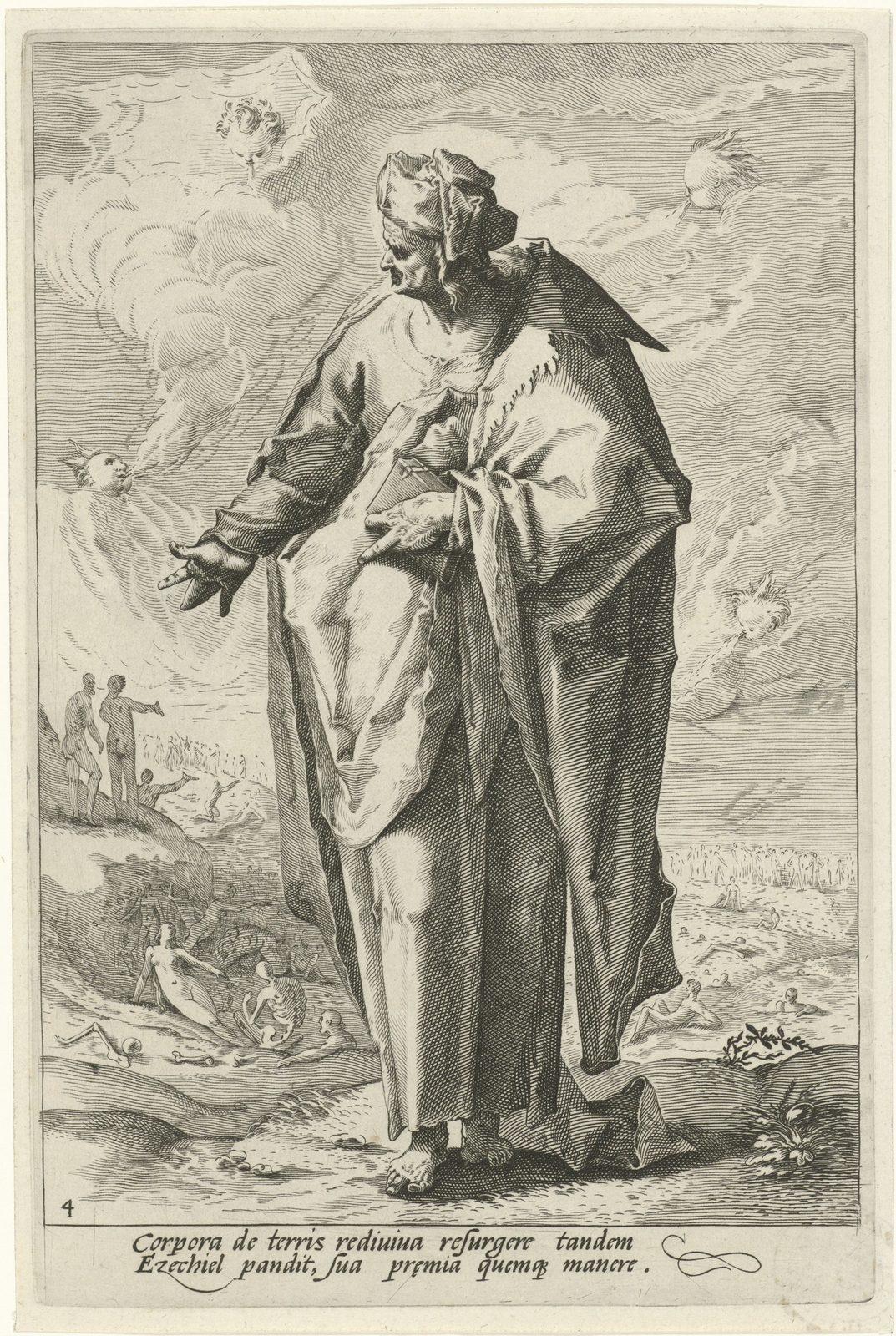
Jacob Matham, attributed, 1589. Public domain.
Ezekiel 1 to 40 · Debate · Featured Study
The Dated Oracles of Ezekiel
Thirteen headings in Ezekiel give a year and a day, and most of them a month.
Ezekiel's latest date stands in chapter 29, ahead of the dates of chapters 30 to 40.
In the thirtieth year, on the fifth day of the fourth month, while I was among the exiles by the River Kebar, the heavens opened and I saw visions of God.
In the thirtieth year, on the fifth day of the fourth month, while I was among the exiles by the River Kebar, the heavens opened and I saw visions of God.
- The question
- Ezekiel dates his visions by the years of King Jehoiachin's exile: where do the dates fall in our calendar, and what does the thirtieth year of Ezekiel 1:1 count from?
- The texts
- Ezekiel 1:1, Ezekiel 1:2, Ezekiel 33:21, Ezekiel 40:1
Summary
Ezekiel counts his years from the exile of King Jehoiachin, and his dated headings run from the vision by the Kebar to a word on Egypt in the twenty-seventh year of the exile.
- Eleven headings fall on a known day in our calendar, and two on a span of a year.
- Rodger C. Young dates two headings a year earlier and the vision of the new temple about six months earlier.
- The thirtieth year of the first verse has four readings, each with its holders.
The Fifth Year of the Exile
Ezekiel 1:2 and 2 Kings each give dates by the years of the same exile.
On the fifth day of the month—it was the fifth year of the exile of King Jehoiachin— the word of the LORD came directly to Ezekiel the priest, the son of Buzi, in the land of the Chaldeans by the River Kebar. And there the LORD’s hand was upon him.Jehoiachin king of Judah, his mother, his servants, his commanders, and his officials all surrendered to the king of Babylon. So in the eighth year of his reign, the king of Babylon took him captive.On the twenty-seventh day of the twelfth month of the thirty-seventh year of the exile of Judah’s King Jehoiachin, in the year Evil-merodach became king of Babylon, he released King Jehoiachin of Judah from prison.The Dates on One Line
Each stop gives a heading's modern date and how sure it is.
The dated headings span twenty-two years, from 593 to 571 BC.
To scale: 13 of 13 stops dated; two dots joined are the two years held; a mark that would lie on another stands in a lane under the axis.
- The vision by the Kebar31 July 593 BCProbable; Young agrees on JulyEzekiel 1:2
- The visions of the temple in Jerusalem17 September 592 BCProbableEzekiel 8:1
- The elders come to inquire14 August 591 BCProbableEzekiel 20:1
- The siege of Jerusalem begins15 January 588 BCContested; Young gives January 589Ezekiel 24:1
- Against Pharaoh and all Egypt7 January 587 BCProbableEzekiel 29:1
- Pharaoh's arm is broken29 April 587 BCProbableEzekiel 30:20
- Pharaoh is compared to a great cedar21 June 587 BCProbableEzekiel 31:1
- Against Tyre587 or 586 BCProposed; no month is named, so the date spans a yearEzekiel 26:1
- Egypt sent down to the Pit586 or 585 BCProposed; the day is given and the month is notEzekiel 32:17
- The news that the city has fallen8 January 585 BCContested; Young gives January 586, and some manuscripts read the eleventh yearEzekiel 33:21
- A lament for Pharaoh3 March 585 BCProbableEzekiel 32:1
- The vision of the new temple28 April 573 BCContested; Young gives October 574Ezekiel 40:1
- Egypt given to Nebuchadnezzar26 April 571 BCProbableEzekiel 29:17
The stops stand on one axis of years BC, ordered by the dates of the Asbury Bible Commentary, which holds every date shown. Where Rodger C. Young or the text differs, the stop says so.
Pharaoh is compared to a great cedar, Against Tyre, Egypt sent down to the Pit, The news that the city has fallen, A lament for Pharaoh, The vision of the new temple, Egypt given to Nebuchadnezzar
Four Readings of the Thirtieth Year
Each reading names its holders and its starting point.
The prophet's ageThe Pulpit Commentary, after Origen; Barnes' Notes; Gregory the Great
The Pulpit Commentary inclines, after Origen, Hengstenberg and Smend, to read the date as the prophet's own age. Barnes' Notes links it to the age at which the Levites began their service.
Gregory the Great, in his Homilies on Ezekiel, took the thirtieth year as the mature age at which a man may teach.
men from thirty to fifty years old—everyone who is qualified to serve in the work at the Tent of Meeting.Thirty years from the finding of the bookThe Targum; Seder Olam Rabbah; Jerome
The Targum, the old Aramaic rendering of the prophets, dates the vision thirty years after Hilkiah found the law in Josiah's reign. Seder Olam Rabbah, an early Jewish chronicle, counts the same way.
Jerome, in his Commentary on Ezekiel, says the year is neither the prophet's age nor a jubilee, and counts it from Josiah's reign.
A jubilee countJohn Calvin; Rodger C. Young
A jubilee is the fiftieth year of release in the law of Moses. Rodger C. Young counts from a jubilee cycle that he dates to the autumn of 623 BC. John Calvin also reckoned the thirty years from a jubilee.
An era of BabylonMatthew Henry; John Gill
Matthew Henry counted from Nabopolassar, who reigned nineteen years, so that the vision fell in the eleventh year of his son. John Gill also held the thirtieth year of Nabopolassar.
Where the Text Varies
Three headings read differently in the Hebrew, the old versions and the BSB.
The Hebrew of Ezekiel 26:1 gives the eleventh year and the first of the month, and names no month. The BSB prints the eleventh month of the twelfth year.
The Pulpit Commentary reports that the Septuagint, the old Greek translation, adds the first month there. Ezekiel 32:17 also leaves out the month.
At Ezekiel 33:21 some Hebrew manuscripts and the Syriac, an old translation into the language of Syria, read the eleventh year. Keil and Delitzsch decline to follow them.
In the twelfth year of our exile, on the fifth day of the tenth month, a fugitive from Jerusalem came to me and reported, “The city has been taken!”Archbishop Newcome proposed reading the fifth year in the book's first verse, as in its second. Adam Clarke answered that no ancient version and no manuscript reads it.
Two Ways to Count the Years
The modern dates turn on when the year began and when the city fell.
The Asbury Bible Commentary takes its dates from the Babylonian records and dates the news of the city's fall a year later than Young.
Rodger C. Young, in the Journal of the Evangelical Theological Society of 2004, counts Ezekiel's years from the autumn month of Tishri. He dates Jehoiachin's capture to 597 BC and holds that Jerusalem fell in the summer of 587 BC.
Older commentaries differ again. Keil and Delitzsch put the fifth year of the exile in 595 BC, and the Cambridge Bible puts Ezekiel's call in 592 BC.
What the Text Leaves Unsaid
Rashi found one gap in the first verse.
The Jewish commentator notes that Ezekiel did not explain from what date he was counting the thirtieth year.
Write Down the Date
Two dates tie the prophet's words to the siege and the fall of Jerusalem.
“Son of man, write down today’s date, for on this very day the king of Babylon has laid siege to Jerusalem.Now the evening before the fugitive arrived, the hand of the LORD was upon me, and He opened my mouth before the man came to me in the morning. So my mouth was opened and I was no longer mute.Voices on the Dates
Jerome, John Calvin and Matthew Henry wrote on Ezekiel's dates.
Jerome (died 420)
“The Prophet Ezekiel was led captive with Joachin king of Judah to Babylon, and he prophesied there to those who were captives with him, to those repenting that they had willingly handed over the prophecy of Jeremiah to enemies, and yet saw the city Jerusalem to stand, which he had predicted would fall. And in his thirtieth year of age, and in the fifth year of the captivity, he began to speak to his fellow captives. And at the same time, though later, this one in Chaldea and Jeremiah in Judea prophesied.”
Jerome · Prologue to Ezekiel · on Ezekiel 1:1Patristic
John Calvin (1509 to 1564)
“We nowhere read that succeeding writers adopted this date as a standard. Besides, there is no doubt that the usual method among the Jews was to begin to reckon from a Jubilee. For this was a point of starting for the future.”
John Calvin · Commentaries · on Ezekiel 1:1Reformed
Matthew Henry (1662 to 1714)
“Note, It is good to keep an exact account of the date of remarkable occurrences, which may sometimes contribute to the manifesting of God's glory so much the more in them, and the explaining and confirming of scripture prophecies. Known unto God are all his works.”
Matthew Henry · Commentary on the Whole Bible · on Ezekiel 24:2Puritan
The Readings Weighed
Each reading of the thirtieth year meets an objection in the commentaries.
No reading of the thirtieth year has a second date in the book to confirm it.
| Reading | Held by | Representative work | The objection |
|---|---|---|---|
| The prophet's age | Origen, Hengstenberg and Smend; Barnes' Notes; Gregory the Great | Barnes' Notes on the Old Testament | Keil and Delitzsch say the month and day point to an era generally recognised. |
| From the finding of the book | The Targum; Seder Olam Rabbah; Jerome's Commentary | The Targum of the Prophets | The Cambridge Bible finds no evidence that the finding was ever counted as an era. |
| A jubilee count | John Calvin; Rodger C. Young | Young, When Did Jerusalem Fall? (2004) | Keil and Delitzsch say all reliable proofs are wanting. |
| An era of Babylon | Matthew Henry; John Gill; Michaelis, Rosenmüller and Ewald | Henry, Commentary on the Whole Bible | The Pulpit Commentary notes that Ezekiel nowhere else uses a double chronology. |
Books to Read Next
One older commentary and one article are free to read.
Biblical Commentary on the Old Testament: Ezekiel
Carl Friedrich Keil · 1857 to 1878
Keil weighs the readings of the thirtieth year and the variant of the twelfth year.
Read it free at BibleHubWhen Did Jerusalem Fall?
Rodger C. Young · 2004
Young's Table 2 gives each heading's Hebrew month and its month in our calendar.
Read the journal's copyThe Twenty-Fifth Year
The last vision of the book is dated fourteen years after the city fell.
In visions of God He took me to the land of Israel and set me on a very high mountain, on whose southern slope was a structure that resembled a city.Sources
Scripture is the Berean Standard Bible.
- The Hebrew text of Ezekiel 1:1, 26:1, 32:17 and 33:21, word by word.
- Asbury Bible Commentary (Zondervan, 1992), Ezekiel, III. Ezekiel's Dates; cite-only.
- Rodger C. Young, When Did Jerusalem Fall?, Journal of the Evangelical Theological Society 47/1 (2004), pp. 21 to 38, Table 2 and p. 28; cite-only.
- Carl Friedrich Keil and Franz Delitzsch, Biblical Commentary on the Old Testament (1857 to 1878), on Ezekiel 1:1 to 2 and 33:21; public domain.
- The Pulpit Commentary, on Ezekiel 1:1 to 2 and 26:1; public domain.
- The Cambridge Bible for Schools and Colleges, on Ezekiel 1:1 to 2 and 33:21; public domain.
- Ellicott's Commentary for English Readers, on Ezekiel 26:1 and 32:17; public domain.
- Barnes' Notes on the Old Testament, on Ezekiel 1:1.
- Gregory the Great, Homilies on Ezekiel, Book 1, Homily 2.
- Targum Jonathan on Ezekiel 1:1, Sefaria Community Translation; cite-only.
- Seder Olam Rabbah 26 (Warsaw, 1904)
- Jerome, Commentary on Ezekiel, on Ezekiel 1:1, and Prologue to Ezekiel.
- John Calvin, Commentaries (1554), on Ezekiel 1:1.
- Matthew Henry, Commentary on the Whole Bible (1710), on Ezekiel 1:1 and 24:2.
- John Gill, Exposition of the Old Testament, on Ezekiel 1:1.
- Adam Clarke, Commentary on the Bible (1832), on Ezekiel 1:1.
- Rashi on Ezekiel 1:1, Judaica Press translation (A. J. Rosenberg); cite-only.
Keep Studying
Read it4
Studies7
People and groups4
Doctrines2
Go further7