

Murillo, Jacob Laying Peeled Rods before the Flocks of Laban, about 1665. Public domain.
Genesis 30:37 · Symbol · Featured Study
The Rod and the Staff
A symbol study of the shepherd's stick from Genesis 30 to Revelation 19, with the Hebrew and Greek words and two readings in dispute.
Judah left his staff with Tamar as a pledge, and the staff named him as the father of her child.
I am unworthy of all the kindness and faithfulness You have shown Your servant. Indeed, with only my staff I came across the Jordan, but now I have become two camps.
- The word
- מַטֶּה (matteh), H4294
- First appears
- Genesis 38:18 “What pledge should I give you?” he asked.…”
Judah left his staff with Tamar as a pledge, and the staff named him as the father of her child.
Summary
The rod and the staff in Scripture are a shepherd's sticks, and in God's hand the same stick becomes a sign, a scepter and a rod of correction.
- Hebrew has four words behind rod and staff: matteh, shebet, maqqel and mishenah.
- The staff in Moses' hand became a snake and a staff again, and Exodus 4:20 calls it the staff of God.
- Aaron's staff sprouted, blossomed and produced almonds overnight in Numbers 17:8.
The Patriarchs' Sticks
Jacob's branches and staff and Judah's pledge, before the exodus.
I am unworthy of all the kindness and faithfulness You have shown Your servant. Indeed, with only my staff I came across the Jordan, but now I have become two camps.Jacob measures God's kindness by what he owned when he left home.
As she was being brought out, Tamar sent a message to her father-in-law: “I am pregnant by the man to whom these items belong.” And she added, “Please examine them. Whose seal and cord and staff are these?”Tamar's message turns Judah's own pledge into the evidence of the case.
As she was being brought out, Tamar sent a message to her father-in-law: “I am pregnant by the man to whom these items belong.” And she added, “Please examine them. Whose seal and cord and staff are these?”Tamar's message turns Judah's own pledge into the evidence of the case.
Jacob's sticks are called maqqel and Judah's is called matteh.
| Verse | Whose stick | The Hebrew word | What the stick does |
|---|---|---|---|
| Genesis 30:37 | Jacob's branches | maqqel | Peeled branches are set in the watering troughs before the flocks. |
| Genesis 32:10 | Jacob's staff | maqqel | Jacob names it in his prayer at Mahanaim. |
| Genesis 38:18 | Judah's staff | matteh | It is the third of the three things Tamar asks for. |
Jacob at the Troughs
Murillo's canvas in Dallas, read part by part with its verse.
Murillo painted the moment the branches go into the water, before the flocks come down to drink.
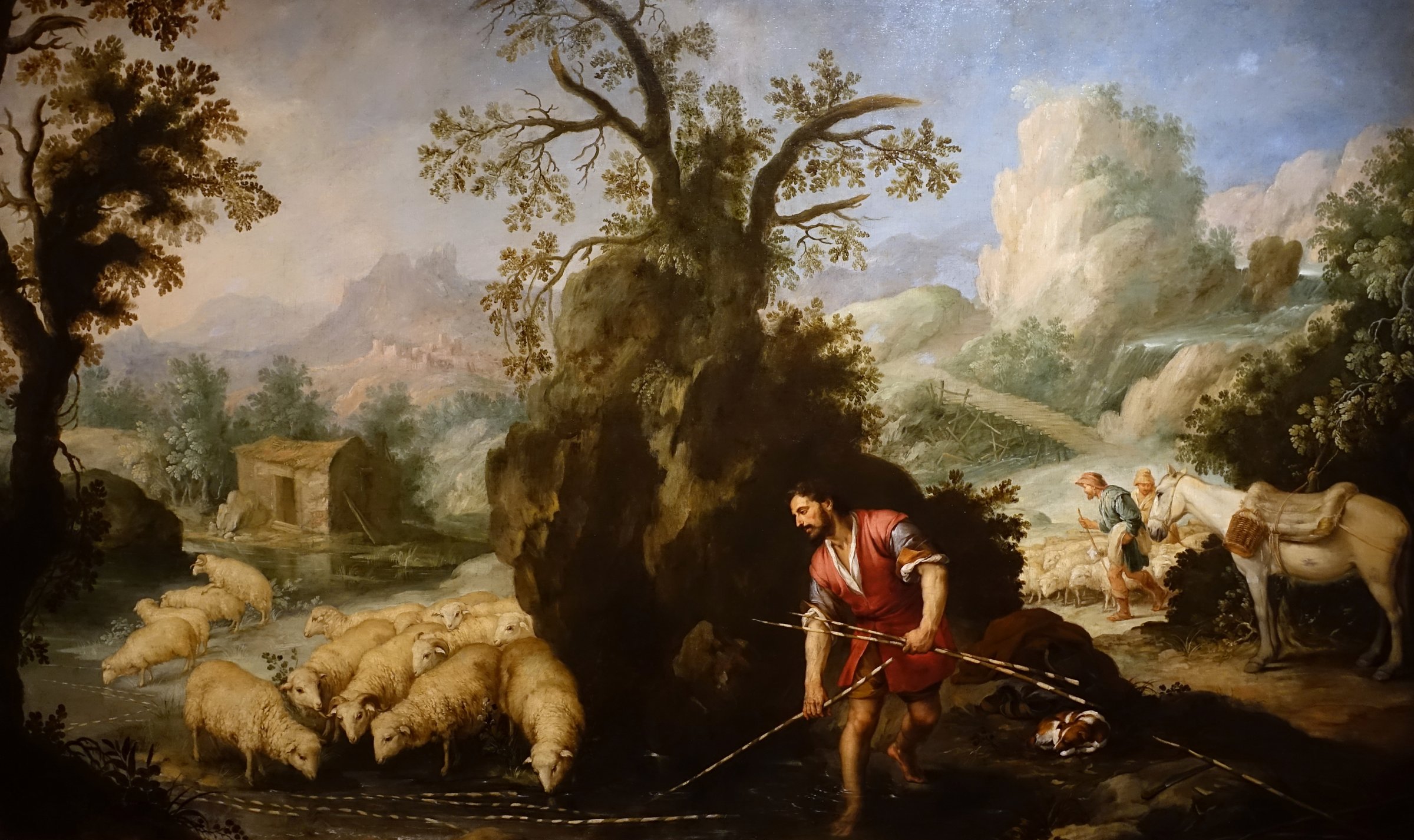
- The peeled branchesLong branches striped pale where the bark is peeled lie across the water.Genesis 30:37
- JacobJacob stands barefoot in the stream in a red tunic and lays the branches down.Genesis 30:41
- The flock at the waterSheep have come down to the stream at the left to drink.Genesis 30:38
- The rest of the flockTwo herdsmen are driving more sheep down a path at the right.Genesis 30:36
Murillo, Jacob Laying Peeled Rods before the Flocks of Laban, about 1665. Public domain.
Oil on canvas, about 1665, Meadows Museum, Southern Methodist University, Dallas.
The Staff Through Scripture
Fourteen places in canon order, from Genesis 32 to the rider of Revelation 19.
The shepherd's stick of Genesis ends in the hand of the King who rules the nations.
- Genesis 32Jacob's prayer before meeting Esau, Genesis 32:10
- Genesis 38Judah's pledge, Genesis 38:18
- Genesis 49The staff between Judah's feet, Genesis 49:10
- Exodus 4What is that in your hand, Exodus 4:2
- Exodus 7Aaron's staff swallows the others, Exodus 7:12
- Exodus 14The staff lifted over the sea, Exodus 14:16
- Numbers 17Aaron's staff buds, Numbers 17:8
- Numbers 20The rock struck twice, Numbers 20:11
- Psalm 2An iron scepter, Psalm 2:9
- Psalm 23Your rod and Your staff, Psalm 23:4
- IsaiahAssyria the rod of My anger, Isaiah 10:5
- MicahShepherd with Your staff, Micah 7:14
- HebrewsJacob leaning on his staff, Hebrews 11:21
- RevelationHe will rule them with an iron scepter, Revelation 19:15
Each stop opens its verse in the reader.
The staff that became a snakeExodus 4:3 to 4 and Exodus 7:10
“Throw it on the ground,” said the LORD. So Moses threw it on the ground, and it became a snake, and he ran from it. “Stretch out your hand and grab it by the tail,” the LORD said to Moses, who reached out his hand and caught the snake, and it turned back into a staff in his hand.The first sign is done with the one thing Moses already held as a shepherd.
So Moses and Aaron went to Pharaoh and did just as the LORD had commanded. Aaron threw his staff down before Pharaoh and his officials, and it became a serpent.The sign given at the bush is repeated before Pharaoh's court.
Said Outright, and Heard by Readers
Three verses that say what the rod is for.
A ROD IN GOD'S HAND
God names a foreign army as the rod He uses on His own people.
THE ROD OF DISCIPLINE
The proverb ties correction to a father's love for his son.
PASSING UNDER THE ROD
The shepherd's counting of the flock becomes a picture of God gathering His people.
Two sayings set beside the textProverbs 13:24 and Numbers 20:8
Each saying adds words or a deed the verse does not have.
| Verse | The saying | What the text says |
|---|---|---|
| Proverbs 13:24 | Spare the rod and spoil the child is a verse of Scripture. | The verse reads that he who spares the rod hates his son, and the saying about spoiling is not in the Bible's words. |
| Numbers 20:8 | Moses struck the rock at Meribah as he was told. | The LORD told Moses to take the staff and speak to the rock, and Numbers 20:11 says he struck it twice. |
The Shepherd's Tools
The staff in the hand of a shepherd and of a ruler.
Jamieson, Fausset and Brown, in their Commentary Critical and Explanatory, take the staff of Exodus 4:2 to be the shepherd's crook. Among the Arabs, they write, it was a long staff with a curved head from three to six feet long. Albert Barnes, in his Notes, Explanatory and Practical, notes that men in positions of authority carry such a long staff on the Egyptian monuments, and that it was usually made of acacia wood. The same stick could guide sheep and mark rank.
Every tenth animal from the herd or flock that passes under the shepherd’s rod will be holy to the LORD.The law uses the shepherd's habit of counting the flock under his rod to set apart the tithe.
Matteh, Shebet, Maqqel and Mishenah
The Hebrew and Greek words behind rod and staff, with their counts.
James Strong's concordance gives two of the Hebrew words a second sense that English keeps apart, so the twelve tribes of Israel are called by the word for a staff. The Greek New Testament has one word for rod, staff and scepter alike.
matteh
a branch; a tribe; a rod or staff
shebet
a stick for punishing, ruling or walking; a clan
maqqel
a shoot, a stick for walking or striking
mishenah
a support, a walking stick
rhabdos
a stick, a cane, a baton of royalty
The lexicon in full1 table or figure
Matteh is the commonest of the four words, and it names a tribe as often as a stick.
| Word | Meaning | Uses |
|---|---|---|
| matteh, H4294 | a branch; a tribe; a rod or staff | 252 |
| shebet, H7626 | a stick for punishing, ruling or walking; a clan | 190 |
| maqqel, H4731 | a shoot, a stick for walking or striking | 18 |
| mishenah, H4938 | a support, a walking stick | 12 |
| rhabdos, G4464 | a stick, a cane, a baton of royalty | 12 |
What Scripture Does Not Say
Three things about the rod and the staff that the text leaves open.
Your Rod and Your Staff
The shepherd's two tools as a picture of the LORD's care.
Even though I walk through the valley of the shadow of death, I will fear no evil, for You are with me; Your rod and Your staff, they comfort me.David finds comfort in the dark valley in the two tools of his own first trade.
Shepherd with Your staff Your people, the flock of Your inheritance. They live alone in a woodland, surrounded by pastures. Let them graze in Bashan and Gilead, as in the days of old.The prayer that closes the book of Micah returns to the shepherd picture.
The iron scepter of Psalm 2 and Revelation 19Psalm 2:9, Revelation 19:15 and the Septuagint
You will break them with an iron scepter; You will shatter them like pottery.”Revelation takes up this verse for the rule of the rider over the nations.
And from His mouth proceeds a sharp sword with which to strike down the nations, and He will rule them with an iron scepter. He treads the winepress of the fury of the wrath of God the Almighty.The rider who holds the scepter is the one called Faithful and True.
The Greek Septuagint renders the verb of Psalm 2:9 as to shepherd, and Revelation 2:27 and 19:15 follow that wording, so the iron scepter is held by a shepherd.
Voices on the Rod and the Staff
Four teachers from the sixth century to the eighteenth on the shepherd's rod and Aaron's staff.
died 542 · Caesarius of Arles
Caesarius of Arles, in his Sermon 87, notes that Scripture gives Jacob no horses, donkeys or camels when he left home, only a staff in his hand.
1509 to 1564 · John Calvin
John Calvin, in his Commentaries, on Numbers 17:8, writes that a cut branch with no sap from a root could not bloom and bear fruit by any natural cause. The other staffs beside it stayed dry.
1662 to 1714 · Matthew Henry
Matthew Henry, in his Commentary on the Whole Bible, on Numbers 17:8, reads Aaron's budding rod as a type and figure of Christ and His priesthood.
1703 to 1791 · John Wesley
John Wesley, in his Explanatory Notes upon the Old Testament, on Micah 7:14, reads the rod as the pastoral staff by which shepherds guided their sheep.
Matthew Henry, John Wesley
Where Careful Readers Differ
Two questions about the staff and the rod that readers answer in different ways.
The head of the bed or the top of the staffAdam Clarke, Jerome, and Jamieson, Fausset and Brown
By faith Jacob, when he was dying, blessed each of Joseph’s sons and worshiped as he leaned on the top of his staff.Hebrews reads Jacob's last act of worship with the staff, as the Greek Old Testament does.
The Hebrew consonants of mittah, a bed, and matteh, a staff, are the same, and the vowels decide the word. Adam Clarke, in his Commentary on the Bible, keeps the bed and reads the old man lying back on his couch after the oath. Jerome, in his Hebrew Questions on Genesis, also reads the head of the bed from the Hebrew and rejects the reading that Jacob bowed to the top of Joseph's scepter. The objection to both is that Hebrews 11:21 reads the staff.
Jamieson, Fausset and Brown, in their Commentary Critical and Explanatory, read the top of his staff, as the apostle renders it, and hold that an Eastern bed of mats had no head. The objection is that Genesis 48:2 seats Jacob on his bed in the next scene.
A rod of correction or a shepherd's crook in Psalm 23:4Origen of Alexandria and Adam Clarke
Origen of Alexandria, in his Selections from the Psalms, holds that Scripture uses the rod for punishments and scourges, and that the mercy of God stays near the one it threatens. The objection is that the psalm says the rod and the staff comfort the one who walks through the valley.
Adam Clarke, in his Commentary on the Bible, on Micah 7:14, holds that the shebet in a shepherd's hand beside the word flock is the shepherd's crook and no rod of correction. The objection is that Proverbs 13:24 and Isaiah 10:5 use the same word for a rod that strikes.
Books to Read Next
Two public domain works, each with a free copy to read.
Expositions on the Psalms
Augustine of Hippo · before 430
His exposition of Psalm 23 reads the valley of the shadow of death as this present life.
Read at New AdventCommentary on the Bible
Adam Clarke · 1832
His note on Ezekiel 20:37 explains passing under the rod from the counting of sheep at the door of the fold.
Read at CCELThe God Who Shepherded Jacob
At the end of his life Jacob blessed his grandsons in the name of the God who had been his shepherd.
Then he blessed Joseph and said: “May the God before whom my fathers Abraham and Isaac walked, the God who has been my shepherd all my life to this day,The text asks the reader to trust that care to the end of life, as Jacob did.
Sources
Scripture is the Berean Standard Bible.
- James Strong, Exhaustive Concordance of the Bible, 1890, entries H4294, H7626, H4731, H4938, H4296 and G4464.
- The Septuagint of Psalm 2:9 in Brenton's translation, read beside Revelation 2:27 and 19:15.
- Jamieson, Fausset and Brown, Commentary Critical and Explanatory on the Whole Bible, 1871, on Exodus 4:2; on Genesis 47:31.
- Albert Barnes, Notes, Explanatory and Practical, on Exodus 4:2; on Hebrews 11:21.
- Caesarius of Arles, Sermon 87.2, on Genesis 32:10.
- John Calvin, Commentaries, 1554, on Numbers 17:8.
- Matthew Henry, Commentary on the Whole Bible, 1710, on Numbers 17:8; on Genesis 32:10.
- John Wesley, Explanatory Notes upon the Old Testament, 1765, on Micah 7:14.
- Adam Clarke, Commentary on the Bible, 1832, on Genesis 47:31; on Micah 7:14; on Ezekiel 20:37.
- Jerome, Hebrew Questions on Genesis, on Genesis 47:31.
- Origen of Alexandria, Selections from the Psalms, on Psalm 23:4.
- Augustine of Hippo, Exposition on Psalm 23, on Psalm 23:4.
Keep Studying
Studies6
People and groups6
Places1