
Genesis 13 to 2 Samuel 15 · Place · Featured Study
Hebron
The town in the hill country of Judah where the patriarchs were buried, Caleb took his inheritance and David first reigned.
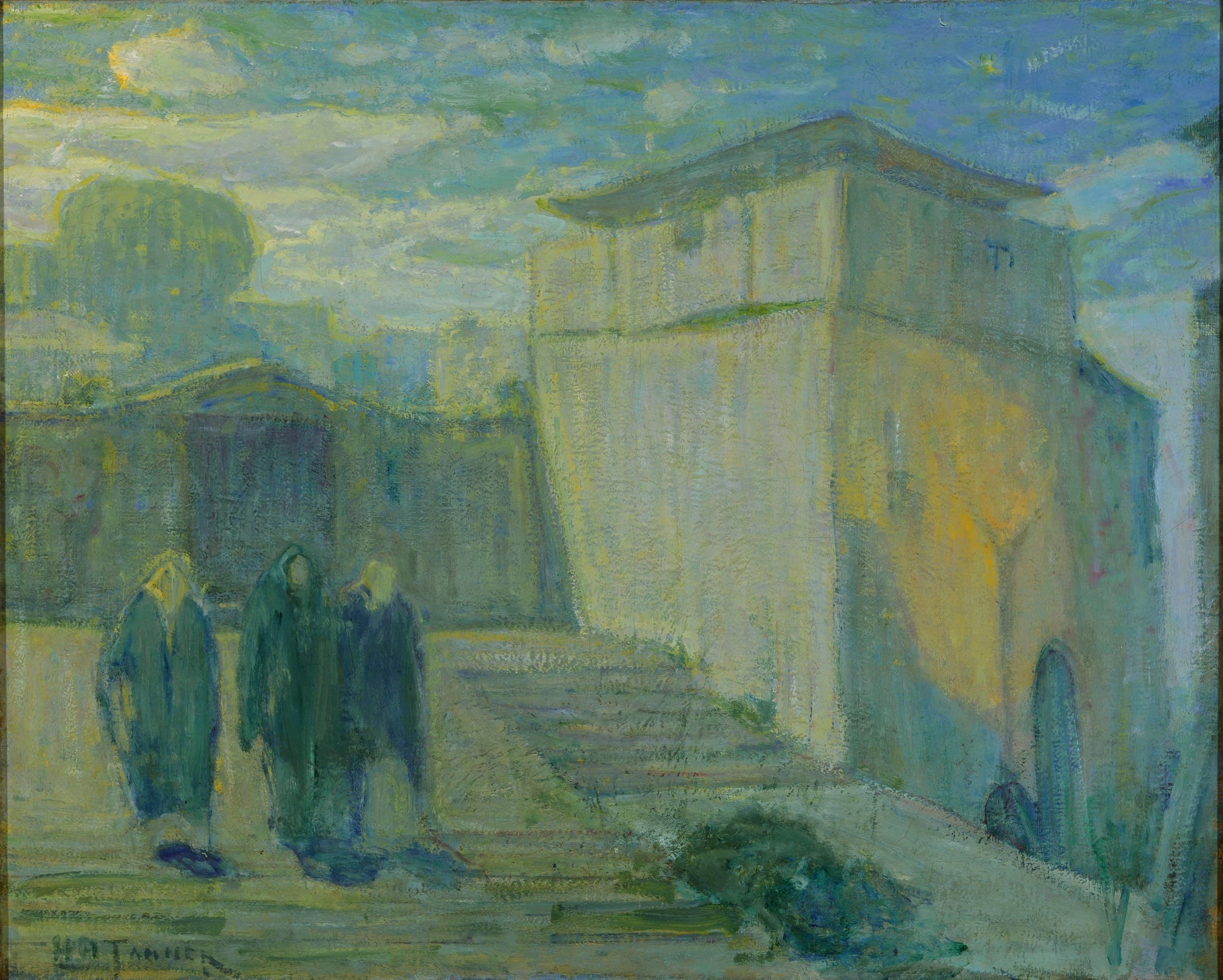
Henry Ossawa Tanner, Moonlight, Hebron, about 1907, Milwaukee Art Museum. Public domain, Wikimedia Commons File:Moonlight_Hebron%2C_by_Henry_Ossawa_Tanner.jpg.
THE ARTWORKHenry Ossawa Tanner painted Hebron by moonlight, with three robed figures going down a stone stair below the walls of the town.
The only ground Abraham ever owned in Canaan was a field with a cave at Hebron, bought for four hundred shekels of silver to bury Sarah.
Summary
Hebron, once called Kiriath-arba, lies beside the Oaks of Mamre, where Abraham pitched his tents and built an altar.
- The cave of Machpelah near the town held the graves of Abraham's family for three generations.
- The spies saw the descendants of Anak at Hebron, and forty-five years later Caleb received it as his inheritance.
- Joshua set it apart as a city of refuge and gave it to the priests, the descendants of Aaron.
- David was anointed king there and reigned over Judah from it for seven years and six months.
- Absalom began his revolt against David at Hebron.
Hebron in Scripture
Where the town enters the story, in Genesis 13 and 23
So Abram moved his tent and went to live near the Oaks of Mamre at Hebron, where he built an altar to the LORD.Hebron enters the story as the place where Abram settled after Lot chose the plain, and where he built an altar.
After this, Abraham buried his wife Sarah in the cave of the field at Machpelah near Mamre (that is, Hebron) in the land of Canaan.The verse joins the cave, Mamre and Hebron in one sentence, so the three names point to one place and its surroundings.
Hebron on the Map
The town in the hills of Judah, between Beersheba in the south and Jerusalem in the north
The spies came up to Hebron from Kadesh-barnea, and David later moved his throne from Hebron to Jerusalem.
- Located: the site is known
- Identified: the point stands for an area, or is rounded
- The route, in the order the text gives
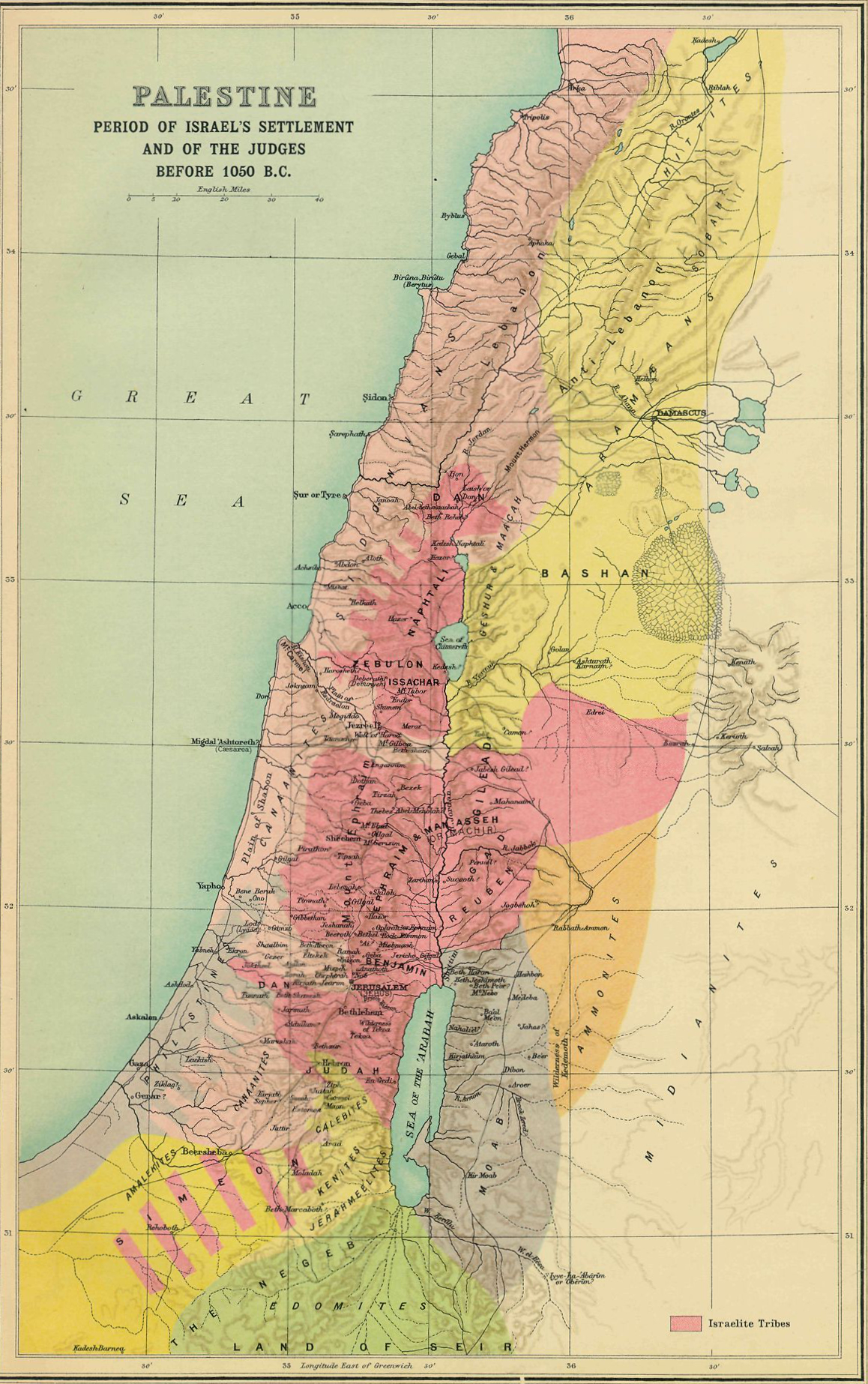
- 1Kadesh-barnea, The spies set out from the camp there. Numbers 13:26
- 2Hebron, The spies saw the descendants of Anak there. Numbers 13:22
- 3Jerusalem, David reigned there thirty-three years after Hebron. 2 Samuel 5:5
- 4Mamre, Abram pitched his tent by its oaks. Genesis 13:18
- 5Machpelah, Its cave became the family grave. Genesis 23:17
- 6Beersheba, Abraham lived there before Sarah's death at Hebron. Genesis 22:19
Base map: Israel's settlement and the period of the Judges, George Adam Smith, Atlas of the Historical Geography of the Holy Land (1915), public domain. Each place stands at its place page's coordinates, set on the plate by Jerusalem and Damascus, as the plate prints them.
Mamre, Machpelah and Beersheba are marked beside the line on George Adam Smith's plate of 1915.
Hebron from Abraham to the Return
From the patriarchs to the people of Judah who lived there after the exile
Hebron's story runs from Genesis to Nehemiah, through the patriarchs, the conquest and the kings.
- Abram builds an altar by the Oaks of Mamrethe patriarchsGenesis 13:18
- Abraham buys the field and cave of Machpelahthe patriarchsGenesis 23:16
- Isaac and Ishmael bury Abraham in the cavethe patriarchsGenesis 25:9
- Jacob is buried there, carried from Egyptthe patriarchsGenesis 50:13
- The spies see Ahiman, Sheshai and Talmaithe wildernessNumbers 13:22
- Joshua captures the town and its kingthe conquestJoshua 10:37
- Caleb receives it as his inheritancethe divisionJoshua 14:13
- It is set apart as a city of refugethe divisionJoshua 20:7
- Samson carries the gates of Gaza toward itthe judgesJudges 16:3
- The men of Judah anoint David kingDavid's reign2 Samuel 2:4
- The elders of Israel anoint David king of all IsraelDavid's reign2 Samuel 5:3
- Absalom proclaims himself king thereDavid's reign2 Samuel 15:10
- Rehoboam fortifies itthe divided kingdom2 Chronicles 11:10
- People of Judah live in Kiriath-arbaafter the exileNehemiah 11:25
The turns follow the order of the books; the era beside each names its part of the story.
The cave bought from EphronGenesis 23
Abraham agreed to Ephron’s terms and weighed out for him the price he had named in the hearing of the Hittites: four hundred shekels of silver, according to the standard of the merchants.Abraham pays the full price in the hearing of witnesses, so the purchase cannot later be called a gift.
So Ephron’s field at Machpelah near Mamre, the cave that was in it, and all the trees within the boundaries of the field were deeded over to Abraham’s possession in the presence of all the Hittites who had come to the gate of his city.The deed names the field, the cave and every tree inside its boundaries, in the form of a legal conveyance.
The town the spies fearedNumbers 13:22 and Joshua 10 and 15
They went up through the Negev and came to Hebron, where Ahiman, Sheshai, and Talmai, the descendants of Anak, dwelled. It had been built seven years before Zoan in Egypt.The note that Hebron was built seven years before Zoan in Egypt gives the town an age set against an Egyptian city.
They captured it and put to the sword its king, all its villages, and all the people. Joshua left no survivors, just as he had done at Eglon; he devoted to destruction Hebron and everyone in it.Joshua's campaign in the south reaches the town and its villages.
And Caleb drove out from there the three sons of Anak—the descendants of Sheshai, Ahiman, and Talmai, the children of Anak.The three names of Numbers 13:22 return when Caleb takes his grant.
Albert Barnes, in his Notes on Joshua 10:37, reads the phrase all its villages as marking Hebron as the chief town over smaller towns that depended on it.
The priests' city and the city of refugeJoshua 21:11 to 13
They gave them Kiriath-arba (that is, Hebron), with its surrounding pasturelands, in the hill country of Judah. (Arba was the father of Anak.) But they had given the fields and villages around the city to Caleb son of Jephunneh as his possession.The grant gives the town to the priests and keeps its fields for Caleb, so the gift of Joshua 14:13 still stands.
So to the descendants of Aaron the priest they gave these cities, together with their pasturelands: Hebron, a city of refuge for the manslayer, Libnah,Hebron stands first in the list, which ties the priests' line to the town of the patriarchs.
David's first capital2 Samuel 2 to 5
Some time later, David inquired of the LORD, “Should I go up to one of the towns of Judah?” “Go up,” the LORD answered. Then David asked, “Where should I go?” “To Hebron,” replied the LORD.The first move of David's reign is made on an answer from the LORD.
When Abner returned to Hebron, Joab pulled him aside into the gateway, as if to speak to him privately, and there Joab stabbed him in the stomach. So Abner died on account of the blood of Joab’s brother Asahel.Abner had come to Hebron to bring Israel over to David, so his death at its gate put the union of the kingdom at risk.
So all the elders of Israel came to the king at Hebron, where King David made with them a covenant before the LORD. And they anointed him king over Israel.The kingship of all Israel begins at Hebron with a covenant made before the LORD.
David reigned seven and a half years at Hebron and thirty-three at Jerusalem.
The 2 reigns, in years as a table
| Capital | Reigns, in years | Verse |
|---|---|---|
| Hebron | 7.5 | 2 Samuel 2:11 |
| Jerusalem | 33 | 2 Samuel 5:5 |
2 Samuel 5:5 gives both spans; John Gill notes that together they make forty years and six months.
Absalom's revolt2 Samuel 15:7 to 10
After four years had passed, Absalom said to the king, “Please let me go to Hebron to fulfill a vow I have made to the LORD.Absalom asks leave to go to Hebron on the ground of a vow, which hides his purpose from David.
“Go in peace,” said the king. So Absalom got up and went to Hebron. Then Absalom sent spies throughout the tribes of Israel with this message: “When you hear the sound of the horn, you are to say, ‘Absalom reigns in Hebron!’”The town where Absalom was born becomes the place his revolt is proclaimed.
What the Text Says
Three details of Genesis and 2 Samuel that retellings often pass over
EPHRON OFFERED THE FIELD AS A GIFT
Ephron offered the field and its cave for nothing, and Abraham insisted on paying.
DAVID'S MEN LIVED IN THE VILLAGES
David's men settled with their households in the towns near Hebron when he went up to reign there.
ABSALOM WAS BORN AT HEBRON
Absalom, son of Maacah, is listed among the sons born to David at Hebron.
The Family in the Cave
Three generations of Abraham's family, each burial with its verse
| Person | Tie and burial | Verse |
|---|---|---|
| Abraham | Buried by Isaac and Ishmael with Sarah. | Genesis 25:9 |
| Sarah | His wife, the first laid in the cave. | Genesis 23:19 |
| Isaac | Their son, buried there with Rebekah. | Genesis 49:31 |
| Rebekah | Isaac's wife. | Genesis 49:31 |
| Jacob | Isaac's son, buried there by his sons. | Genesis 50:13 |
| Leah | Jacob's wife, whom he buried there. | Genesis 49:31 |
Hebron in the Written Record
Six writers, from Josephus to Adam Clarke, add to what Scripture says of the town
Josephus on the town and its tombsAntiquities 2.8.2 and Jewish War 4.9.7 and 4.9.9
Josephus writes in his Antiquities that the sons of Jacob died in Egypt and that their descendants carried their bodies to Hebron for burial.
In the Jewish War he reports that the people of the country called Hebron older than Memphis in Egypt, and that monuments of Abraham's line, built of fine marble, were shown in the town. He also reports a great terebinth shown six furlongs from the town.
He records that the Roman commander Cerealis took Hebron by force and burned it.
The name Kiriath-arbaJoshua 15:13; Calvin, Clarke and Rashi
According to the LORD’s command to him, Joshua gave Caleb son of Jephunneh a portion among the sons of Judah—Kiriath-arba, that is, Hebron. (Arba was the forefather of Anak.)Joshua calls the town by its old name at the moment it passes to Caleb.
John Calvin, in his Commentaries on Genesis 23:2, notes that readers differ over the meaning of the name. Adam Clarke, on the same verse, gives its literal sense as the city of the four and reports the reading that four patriarchs or four couples were buried there.
Rashi, in his commentary on Joshua 14:15, gives both readings: Arba as the father of Ahiman, Sheshai and Talmai, and the four as the great men and their wives buried in the cave.
Jerome and Bede on the placeHebrew Questions on Genesis; Commentary on Genesis
Jerome, in his Hebrew Questions on Genesis, says Arba was once a great city with fields around it, while Hebron stands on a mountain. Bede, in his Commentary on Genesis, places Hebron about twenty-two miles south of Jerusalem.
What the Text Leaves Unsaid
The founding of the town, the inside of the cave and its later burials
Scripture tells nothing of who first built the town.
Genesis describes the cave by its field and its trees, and says nothing of its shape or size. After Jacob, Scripture records no further burial in it.
The Strangers Who Owned a Grave
Hebrews 11 reads the patriarchs buried at Hebron as people who died in faith
Abraham called himself a foreigner and an outsider among the Hittites when he asked to buy the cave. Hebrews 11 takes up the same thought.
By faith he dwelt in the promised land as a stranger in a foreign country. He lived in tents, as did Isaac and Jacob, who were heirs with him of the same promise. For he was looking forward to the city with foundations, whose architect and builder is God.The tents of the patriarchs at Mamre are read here as a sign that their hope lay beyond the land.
All these people died in faith, without having received the things they were promised. However, they saw them and welcomed them from afar. And they acknowledged that they were strangers and exiles on the earth.The patriarchs laid in the cave are among those who died without receiving the promises.
Voices on Hebron
Six quotations, from Origen in the third century to Matthew Henry in 1710
Sarah's burialMatthew Henry
“Abraham's mourning for her; and he was a true mourner. He did not only perform the ceremonies of mourning according to the custom of those time, as the mourners that go about the streets, but he did sincerely lament the great loss he had of a good wife, and gave proof of the constancy of his affection to her to the last. Two words are used: he came both to mourn and to weep.”
Matthew Henry · Commentary on the Whole Bible · on Genesis 23:2Puritan
“Observe, Though all the land of Canaan was Abraham's by promise, yet, the time of his possessing not having come, what he had now occasion for he bought and paid for. Note, Dominion is not founded in grace. The saints' title to an eternal inheritance does not entitle them to the possessions of this world, nor justify them in doing wrong.”
Matthew Henry · Commentary on the Whole Bible · on Genesis 23:16Puritan
Jacob's charge to be buried thereMatthew Henry
“His heart was very much upon it, not so much from a natural affection to his native soil as from a principle of faith in the promise of God, that Canaan should be the inheritance of his seed in due time.”
Matthew Henry · Commentary on the Whole Bible · on Genesis 49:31Puritan
Caleb's city and the fathers' gravesOrigen of Alexandria
“But Hebron means ‘union’ or ‘marriage.’ Perhaps this can be expressed by Hebron because the double cave purchased by the patriarch Abraham is there, and the remains of the fathers and their wives lie there: Abraham with Sarah, Isaac with Rebecca, and Jacob with Leah. Thus Caleb deserved to receive the remains of the fathers for an inheritance, because no doubt through the wisdom that was in him and by which he flourished both under Moses and under Jesus [Joshua], he had understood the nature of the union itself.”
Origen of Alexandria · Homilies on Joshua 18.3 · on Joshua 14:14Patristic
David's first throneMatthew Henry
“In all our motions and removals it is comfortable to see God going before us; and we may, if by faith and prayer we set him before us. God, according to the promise, directed his path, bade him go up, told him whither, unto Hebron, a priest's city, one of the cities of refuge, so it was to David, and an intimation that God himself would be to him a little sanctuary.”
Matthew Henry · Commentary on the Whole Bible · on 2 Samuel 2:1Puritan
“Thus the kingdom of the Messiah, the Son of David, is set up by degrees; he is Lord of all by divine designation, but we see not yet all things put under him, Heb. ii.”
Matthew Henry · Commentary on the Whole Bible · on 2 Samuel 2:4Puritan
The Tomb in Acts 7
Three readings of Stephen's words beside Genesis 23 and 33
Their bones were carried back to Shechem and placed in the tomb that Abraham had bought from the sons of Hamor at Shechem for a price he paid in silver.The place names of this verse are what readers have tried to set beside Genesis 23 and 33.
And the plot of ground where he pitched his tent, he purchased from the sons of Hamor, Shechem’s father, for a hundred pieces of silver.Genesis names Jacob as the buyer in the one purchase it records near that town.
Stephen joins two purchases in one sentenceJohn Wesley
John Wesley, in his Explanatory Notes on Acts 7:16, says Stephen was running quickly over a history his hearers knew well and did not stop to recite each part of it distinctly.
The objection is that the verse names Abraham as the buyer at Shechem, which Genesis 33:19 gives to Jacob.
Jacob at Hebron, his sons at ShechemJohn Gill
The sons buried at HebronJosephus; Adam Clarke
Adam Clarke, in his Commentary on Acts 7:16, cites Josephus for the burial of the brothers at Hebron, and sets it beside the burial of Jacob at Machpelah and of Joseph's bones at Shechem.
The objection is that Stephen names Shechem as the place where the fathers were laid.
Books to Read Next
Three books, from Josephus to Matthew Henry
The Antiquities of the Jews
Flavius Josephus, translated by William Whiston · about 94
Josephus tells the history from the patriarchs to the death of David in books 1 to 7, here in Whiston's English of 1737.
READ IT FREE AT PROJECT GUTENBERG →The Wars of the Jews
Josephus, in William Whiston's English · about 75
Josephus tells in book 4 how the war of his own day reached Idumea and the towns of Judea.
READ IT FREE AT PROJECT GUTENBERG →Commentary on the Whole Bible
Matthew Henry · 1710
Henry's second volume runs from Joshua to Esther, so it covers Caleb's grant, the city of refuge and David's reign at Hebron.
READ IT FREE AT CCEL →A Better Country
The patriarchs were buried in the land long before their children possessed it.
Instead, they were longing for a better country, a heavenly one. Therefore God is not ashamed to be called their God, for He has prepared a city for them.The verse answers the patriarchs' lifelong waiting with a promise of God.
Hebron asks the reader to live by the promises of God as the patriarchs did, and to look for the city God has prepared, which the New Testament opens to all who belong to Christ.
Keep studying
Read it5
Studies4
People8
Places7