
Genesis 17 to 35 · Person · Featured Study
Isaac
The life of Isaac, son of Abraham and Sarah, from the promise of his name in Genesis 17 to his burial at Mamre in Genesis 35, with the New Testament texts that name him.
God named Isaac a year before he was born, and centuries later Jesus read the name the God of Isaac as proof that the dead are raised.
- The name means
- laughter
- Born
- when Abraham was a hundred
- Died
- at 180
- Family
- father: Abraham; mother: Sarah; half-brother: Ishmael; wife: Rebekah; son: Esau; son: Jacob
- Places
- Moriah, Beersheba, Mamre, Hebron, Machpelah, Paddan-aram
- First named
- Genesis 17:19
- Last named
- James 2:21
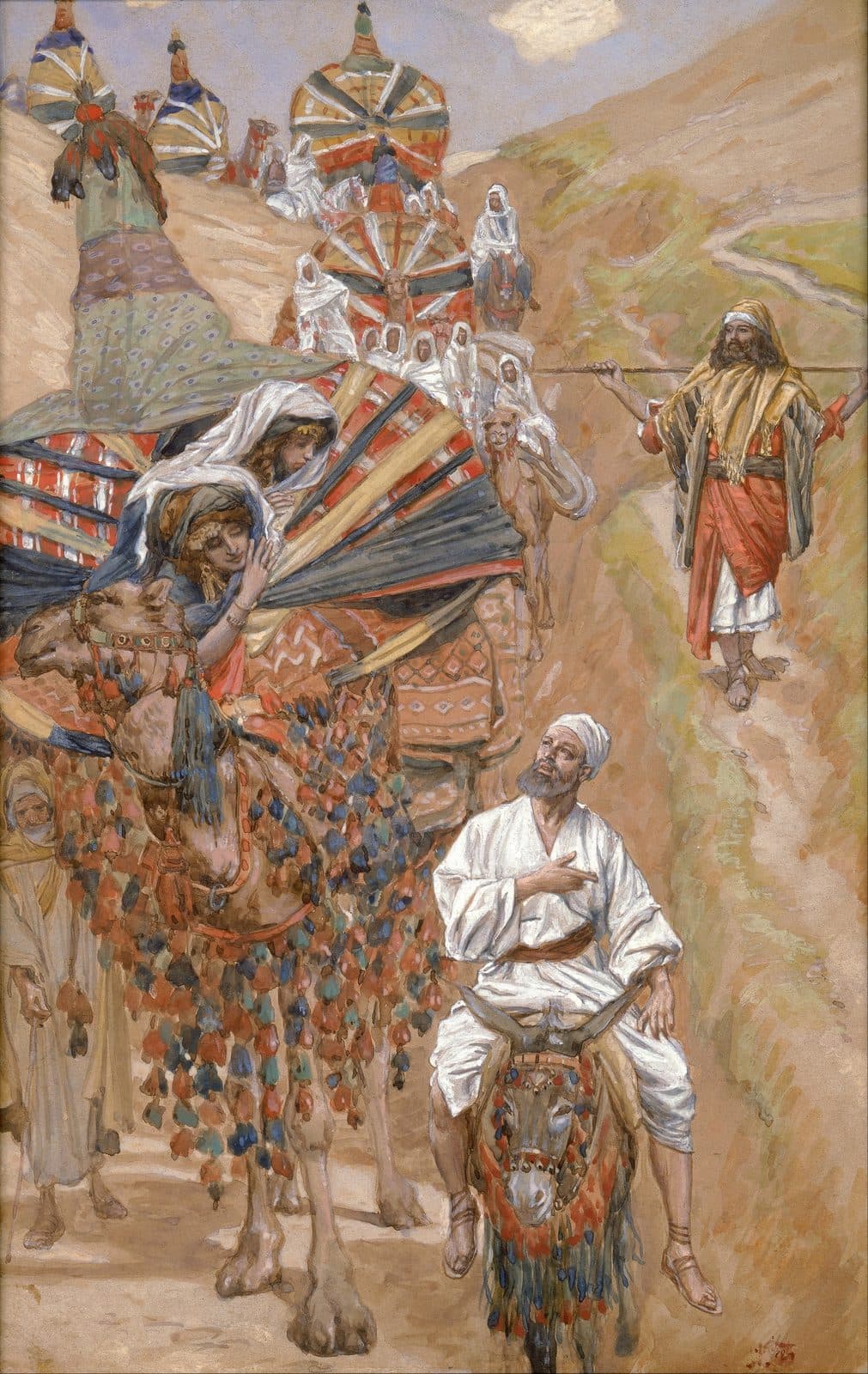
James Tissot, Rebecca Meets Isaac by the Way, about 1896 to 1902, the Jewish Museum, New York. Public domain by date, the painter having died in 1902 (Commons, PD-old-100-expired); via Wikimedia Commons.
THE ARTWORKTissot painted the caravan coming down the hillside at the moment Rebekah draws her veil, with Isaac standing on the path at the right, the scene of Genesis 24:64 to 65.
Summary
Isaac was the son God promised to Abraham and Sarah in their old age, the heir of the covenant and the father of Esau and Jacob.
- Abraham and Sarah each laughed at the promise of his birth, and at his birth Sarah said that God had made her laugh.
- At Gerar God confirmed to him the oath He had sworn to Abraham, of the land, of descendants as many as the stars and of blessing for all nations.
- At Gerar he called his wife his sister, as his father had done, and he gave up two disputed wells before he dug one that no one claimed.
- He meant the blessing for Esau and gave it to Jacob, and when he learned of the deceit he declared that the blessing would stand.
- Paul calls believers children of promise like Isaac in Galatians 4, and Hebrews 11:20 counts his blessing of his sons as faith.
Where Isaac Stands in Scripture
The Berean text names him in 132 verses
His name first stands in Scripture when God tells Abraham what to call the son Sarah will bear.
But God replied, “Your wife Sarah will indeed bear you a son, and you are to name him Isaac. I will establish My covenant with him as an everlasting covenant for his descendants after him.The covenant passes to Isaac by name, and the next verse gives Ishmael a separate blessing.
The last verse of Scripture to name him looks back to the altar on Moriah.
Was not our father Abraham justified by what he did when he offered his son Isaac on the altar?James points to the offering of Isaac as the deed that showed Abraham's faith.
The Life by the Years
From the promise of his name to his death at 180
- Named, with the covenant bound to hima year before his birth, Genesis 17:21
- Born to Abraham and Sarahnewborn, when Abraham was a hundred, Genesis 21:5
- Circumcised by his fathereight days, Genesis 21:4
- Weaned, with a great feastthe text gives no age, Genesis 21:8
- Bound on the altar on Moriahthe text gives no age, Genesis 22:9
- His mother Sarah dies at 12737, by Sarah's ninety years at his birth, Genesis 23:1
- Marries Rebekah40, Genesis 25:20
- Esau and Jacob are born60, Genesis 25:26
- Buries Abraham with Ishmael75, by Abraham's 175 years, Genesis 25:9
- Settles at Gerar in a faminethe text gives no age, Genesis 26:6
- Esau marries two Hittite women100, by Esau's forty years, Genesis 26:34
- Blesses Jacob in place of Esauold and nearly blind; the text gives no age, Genesis 27:1
- Sends Jacob to Paddan-aramthe same years, Genesis 28:5
- Jacob comes home to him at Mamrethe text gives no age, Genesis 35:27
- Dies, and Esau and Jacob bury him180, Genesis 35:29
The timeline draws fifteen turns of the life, with Isaac's age where Genesis gives it or its numbers yield it.
From the Promise to Mamre
Genesis 17 to 35, in the order Genesis tells it
Genesis tells Isaac's life between the long story of his father and the long story of his son, and most of his years pass in a few verses.
Genesis 26 tells his years at Gerar and Beersheba, the one stretch of his own life that Genesis tells at length.
The promise of his nameGenesis 17:15 to 21 and Genesis 18:9 to 15
Abraham fell facedown and laughed when God promised a son by Sarah, and a chapter later Sarah laughed to herself behind the tent door.
Is anything too difficult for the LORD? At the appointed time I will return to you—in about a year—and Sarah will have a son.”The LORD's answer to Sarah's laughter sets the time of the birth.
Birth, weaning and the sending away of IshmaelGenesis 21:1 to 12
Then Sarah said, “God has made me laugh, and everyone who hears of this will laugh with me.”Sarah's words at the birth return to the laughter of the promise.
“Isaac was born according to the promise. The Lord visited Sarah in mercy, as he had said. Note, No word of God shall fall to the ground; for he is faithful that has promised, and God's faithfulness is the stay and support of his people's faith.”
Matthew Henry · Commentary on the Whole Bible · on Genesis 21:1 to 2Puritan
At the weaning feast Sarah saw Hagar's son mocking Isaac and asked Abraham to send the mother and son away.
But God said to Abraham, “Do not be distressed about the boy and your maidservant. Listen to everything that Sarah tells you, for through Isaac your offspring will be reckoned.Abraham's distress over Ishmael is answered by the promise attached to Isaac's name.
Bound on MoriahGenesis 22; The Binding of Isaac
The Binding of Isaac page tells the chapter in full. From Isaac's side Genesis records that he carried the wood, asked his father where the lamb was, and was bound and laid on the altar until the angel of the LORD stopped Abraham's hand.
Then Isaac said to his father Abraham, “My father!” “Here I am, my son,” he replied. “The fire and the wood are here,” said Isaac, “but where is the lamb for the burnt offering?”This question is the only speech of Isaac's that the chapter records.
Rebekah in the fieldGenesis 24:62 to 67
Early in the evening, Isaac went out to the field to meditate, and looking up, he saw the camels approaching.Rebekah's first sight of her husband is this man in the field at evening.
“Merciful providences are then doubly comfortable, when they find us in the way of our duty: some think Isaac was now praying for good success in this affair, and meditating upon that which was proper to encourage his hope in God concerning it; and now when he sets himself, as it were, upon his watch-tower, to see what God would answer him, he sees the camels coming.”
John Wesley · Explanatory Notes upon the Old Testament · on Genesis 24:63Evangelical
And Isaac brought her into the tent of his mother Sarah and took Rebekah as his wife. And Isaac loved her and was comforted after his mother’s death.The marriage and the end of his mourning for Sarah are told in one verse.
“What an affectionate son he was to his mother: it was about three years since her death, and yet he was not, till now, comforted concerning it; the wound which that affliction gave to his tender spirit bled so long, and was never healed till God brought him into this new relation.”
Matthew Henry · Commentary on the Whole Bible · on Genesis 24:67Puritan
His father's graveGenesis 25:5 to 11
His sons Isaac and Ishmael buried him in the cave of Machpelah near Mamre, in the field of Ephron son of Zohar the Hittite.The burial lays Abraham in the cave of Machpelah, where Isaac too will be buried.
After Abraham's death God blessed Isaac, and he lived near the well where the angel of the LORD had found Hagar in Genesis 16:14.
Married at forty, a father at sixtyGenesis 25:19 to 28
“Isaac was forty years old when he was married; though he was an only son, and the person from whom the promised seed was to come, yet he made no haste to marry.”
Matthew Henry · Commentary on the Whole Bible · on Genesis 25:20 to 21Puritan
The twins' own story, the birthright and the stew, is told on the Jacob page.
Because Isaac had a taste for wild game, he loved Esau; but Rebekah loved Jacob.The text names the favorite son of each parent before the blessing divides the house.
The oath at Gerar, and the lieGenesis 26:1 to 11
Stay in this land as a foreigner, and I will be with you and bless you. For I will give all these lands to you and your offspring, and I will confirm the oath that I swore to your father Abraham.The LORD's first recorded speech to Isaac, begun in Genesis 26:2, hands him his father's promise.
“Abraham was a man of very intimate communion with God, and to him all places and conditions were alike; Isaac a very good man, but not cut out for hardship, therefore he is forbidden to go to Egypt; Jacob inured to difficulties, strong and patient, and therefore he must go down into Egypt, that the trial of his faith might be to praise, and honour, and glory.”
John Wesley · Explanatory Notes upon the Old Testament · on Genesis 26:2Evangelical
Isaac settled at Gerar and told the men of the place that Rebekah was his sister, until King Abimelech saw him caressing her from a window.
So Abimelech warned all the people, saying, “Whoever harms this man or his wife will surely be put to death.”The king who exposed the lie puts Isaac and his wife under his protection.
The harvest, the wells and the oath at BeershebaGenesis 26:12 to 33
Now Isaac sowed seed in the land, and that very year he reaped a hundredfold. And the LORD blessed him,Isaac's first harvest in the land he was told to stay in is counted as the LORD's blessing.
“He reaped a hundred fold; and there seems to be an emphasis laid upon the time: it was that same year when there was a famine in the land; while others scarcely reaped at all, he reaped thus plentifully.”
Matthew Henry · Commentary on the Whole Bible · on Genesis 26:12Puritan
The Philistines envied his flocks and herds, and Abimelech sent him away. He reopened his father's wells in the Valley of Gerar and moved on from each well that was disputed.
and that night the LORD appeared to him and said, “I am the God of your father Abraham. Do not be afraid, for I am with you. I will bless you and multiply your descendants for the sake of My servant Abraham.”The second appearance comes after the quarrels over the wells, on the night he came up to Beersheba.
Abimelech then came to Beersheba with his adviser and his commander to ask for a covenant, and Isaac made them a feast and sent them away in peace.
The blessingGenesis 27:1 to 4 and Genesis 27:30 to 40
Then prepare a tasty dish that I love and bring it to me to eat, so that I may bless you before I die.”Isaac sets the blessing for his older son, and this request starts the chapter's deception.
“Here is Isaac's design to declare Esau his heir. The promise of the Messiah and the land of Canaan was a great trust first committed to Abraham, inclusive and typical of spiritual and eternal blessings; this by divine direction he transmitted to Isaac.”
John Wesley · Explanatory Notes upon the Old Testament · on Genesis 27:1Evangelical
Rebekah overheard him and dressed Jacob in Esau's clothes, with goatskins on his hands and neck, and Jacob received the blessing; the Jacob page tells that side of the chapter.
Isaac began to tremble violently and said, “Who was it, then, who hunted the game and brought it to me? Before you came in, I ate it all and blessed him—and indeed, he will be blessed!”This is the moment Isaac learns that the son he blessed was Jacob.
His father Isaac answered him: “Behold, your dwelling place shall be away from the richness of the land, away from the dew of heaven above.Esau asks for a blessing of his own and receives a word that sets his life apart from his brother's.
“But the great difference is, that there is nothing in Esau's blessing that points at Christ, nothing that brings either him or his into the church, and without that the fatness of the earth, and the plunder of the field, will stand him in little stead. Thus Isaac by faith blessed them both, according as their lot should be.”
John Wesley · Explanatory Notes upon the Old Testament · on Genesis 27:39Evangelical
Jacob sent away with the blessing of AbrahamGenesis 27:46 to 28:5
And may He give the blessing of Abraham to you and your descendants, so that you may possess the land where you dwell as a foreigner, the land God gave to Abraham.”Isaac now hands Jacob the blessing of Abraham by name, knowing which son stands before him.
“At the same time he gave him a solemn blessing--pronounced before unwittingly, now designedly, and with a cordial spirit. It is more explicitly and fully given, and Jacob was thus acknowledged ‘the heir of the promise.’”
Jamieson, Fausset & Brown · Commentary Critical and Explanatory on the Whole Bible · on Genesis 28:1Reformed
“Those that are sojourners now shall be heirs for ever: and, even now, those do most inherit the earth (though they do not inherit most of it) that are most like strangers in it. Those have the best enjoyment of present things that sit most loose to them. This promise looks as high as heaven, of which Canaan was a type.”
Matthew Henry · Commentary on the Whole Bible · on Genesis 28:4Puritan
Death at MamreGenesis 35:27 to 29
Jacob returned to his father Isaac at Mamre, near Kiriath-arba (that is, Hebron), where Abraham and Isaac had stayed.The verse brings Jacob home after his twenty years with Laban and sets the last scene of Isaac's life at Hebron.
Then he breathed his last and died and was gathered to his people, old and full of years. And his sons Esau and Jacob buried him.Esau and Jacob bury their father together, as Isaac and Ishmael had buried Abraham.
Matthew Henry, in his Commentary on the Whole Bible, reckoned that Isaac lived on until about the time Joseph rose to power in Egypt, though Genesis records his death before Joseph's story begins.
What Genesis Records of Isaac Himself
Four records from Genesis 17 to 35
THE LORD HEARD HIS PRAYER
Isaac prayed to the LORD for his barren wife, and the LORD heard him and Rebekah conceived.
HIS FATHER LEFT HIM EVERYTHING
Abraham gave gifts to the sons of his concubines and sent them east, and left all he owned to Isaac.
HE CALLED ON THE NAME OF THE LORD
At Beersheba he built an altar, called on the name of the LORD and pitched his tent there.
HE OUTLIVED HIS FATHER
Isaac lived 180 years, five years longer than Abraham.
The World Behind the Text
The king of Gerar and the name Jacob gave his father's God
Abimelech and Phicol a second time
Abraham had already made a covenant at Beersheba with an Abimelech and a Phicol in Genesis 21. John Wesley's Explanatory Notes upon the Old Testament read Abimelech as the common name of the Philistine kings, as Caesar was of the Roman emperors. Wesley puts nearly a hundred years between the two visits. Jamieson, Fausset and Brown, in their Commentary Critical and Explanatory on the Whole Bible, count ninety years and read both names as official titles borne by different men.
The Fear of Isaac
May the God of Abraham and the God of Nahor, the God of their father, judge between us.” So Jacob swore by the Fear of his father Isaac.Jacob seals his covenant with Laban by the name of the God his father feared.
Jacob uses the name twice, here and in Genesis 31:42, and Scripture uses it nowhere else. The Hebrew word is pachad, a sudden alarm or the object that is feared.
The Family of Isaac
Eleven ties, each with its verse
| Person | Tie to Isaac | Verse |
|---|---|---|
| Abraham | His father, a hundred years old at his birth. | Genesis 21:5 |
| Sarah | His mother, who bore him at ninety. | Genesis 17:17 |
| Ishmael | His half-brother, Hagar's son, sent away after the weaning. | Genesis 21:10 |
| The sons of Keturah | His half-brothers, born to Abraham by Keturah. | Genesis 25:2 |
| Rebekah | His wife, the daughter of Bethuel. | Genesis 24:24 |
| Bethuel | Rebekah's father, son of Abraham's brother Nahor. | Genesis 22:23 |
| Laban | Rebekah's brother, to whose house Isaac sent Jacob. | Genesis 28:2 |
| Esau | His older son, whom he loved for his game. | Genesis 25:28 |
| Jacob | His younger son, who received the blessing. | Genesis 25:26 |
| Judith | Esau's Hittite wife, daughter of Beeri. | Genesis 26:34 |
| Basemath | Esau's Hittite wife, daughter of Elon. | Genesis 26:34 |
- Person
- Abraham
- Tie to Isaac
- His father, a hundred years old at his birth.
- Verse
- Genesis 21:5
- Person
- Sarah
- Tie to Isaac
- His mother, who bore him at ninety.
- Verse
- Genesis 17:17
- Person
- Ishmael
- Tie to Isaac
- His half-brother, Hagar's son, sent away after the weaning.
- Verse
- Genesis 21:10
- Person
- The sons of Keturah
- Tie to Isaac
- His half-brothers, born to Abraham by Keturah.
- Verse
- Genesis 25:2
- Person
- Rebekah
- Tie to Isaac
- His wife, the daughter of Bethuel.
- Verse
- Genesis 24:24
- Person
- Bethuel
- Tie to Isaac
- Rebekah's father, son of Abraham's brother Nahor.
- Verse
- Genesis 22:23
- Person
- Laban
- Tie to Isaac
- Rebekah's brother, to whose house Isaac sent Jacob.
- Verse
- Genesis 28:2
- Person
- Esau
- Tie to Isaac
- His older son, whom he loved for his game.
- Verse
- Genesis 25:28
- Person
- Jacob
- Tie to Isaac
- His younger son, who received the blessing.
- Verse
- Genesis 25:26
- Person
- Judith
- Tie to Isaac
- Esau's Hittite wife, daughter of Beeri.
- Verse
- Genesis 26:34
- Person
- Basemath
- Tie to Isaac
- Esau's Hittite wife, daughter of Elon.
- Verse
- Genesis 26:34
The Places of His Life
Eight places and four wells, from Moriah to the cave of Machpelah
20 km (12 miles)
- 1Moriah, His father bound him on an altar on a mountain there. Genesis 22:2
- 2Beer-lahai-roi, He was coming from this well when Rebekah arrived. Genesis 24:62
- 3Gerar, He settled there in a famine and called his wife his sister. Genesis 26:6
- 4The Valley of Gerar, He encamped in the valley and settled there. Genesis 26:17
- 5Beersheba, He went up there from the Valley of Gerar, and the city took its name from his well Shibah. Genesis 26:23
- 6Paddan-aram, He sent Jacob there to take a wife from Laban's daughters. Genesis 28:5
- 7Mamre, Jacob came home to him there, near Hebron. Genesis 35:27
- 8Machpelah, He and Rebekah were buried in the cave there. Genesis 49:31
Not located: Beer-lahai-roi, Gerar, The Valley of Gerar, Paddan-aram.
The coastline is simplified; each place stands at its place page's coordinates.
The map locates four of the eight places, and its key names all eight in the order Genesis reaches them in Isaac's life.
| Well | What happened | Verse |
|---|---|---|
| Esek | The herdsmen of Gerar claimed the water, and the name means strife. | Genesis 26:20 |
| Sitnah | They quarreled over the second well too, and Jerome, in his Hebrew Questions on Genesis, renders the name enmity. | Genesis 26:21 |
| Rehoboth | No one quarreled, and Isaac said the LORD had made room for them. | Genesis 26:22 |
| Shibah | His servants told him they had found water, on the day of the oath with Abimelech. | Genesis 26:33 |
- Well
- Esek
- What happened
- The herdsmen of Gerar claimed the water, and the name means strife.
- Verse
- Genesis 26:20
- Well
- Sitnah
- What happened
- They quarreled over the second well too, and Jerome, in his Hebrew Questions on Genesis, renders the name enmity.
- Verse
- Genesis 26:21
- Well
- Rehoboth
- What happened
- No one quarreled, and Isaac said the LORD had made room for them.
- Verse
- Genesis 26:22
- Well
- Shibah
- What happened
- His servants told him they had found water, on the day of the oath with Abimelech.
- Verse
- Genesis 26:33
Questions the Life Raises
Four questions answered from their verses
Why did Isaac repeat his father's lie?Genesis 26:7 to 10; Genesis 20:2
Isaac gives the reason himself when Abimelech confronts him: he thought he might die on account of her. Abraham had said the same of Sarah to an earlier king of Gerar in Genesis 20:2.
“What is this you have done to us?” asked Abimelech. “One of the people could easily have slept with your wife, and you would have brought guilt upon us.”A Philistine king states the wrong that Isaac's fear had risked.
Did Isaac mean to bless against the oracle?John Wesley; Jamieson, Fausset and Brown
John Wesley's Explanatory Notes upon the Old Testament read Genesis 27 as Isaac's design to make Esau his heir. On Genesis 27:33 Wesley says Isaac then saw that he had been in error. The Commentary Critical and Explanatory on the Whole Bible of Jamieson, Fausset and Brown puts the design down to natural affection in his age and infirmity. It allows that he may not have known Esau had sold his birthright.
and He declared to her: “Two nations are in your womb, and two peoples from within you will be separated; one people will be stronger than the other, and the older will serve the younger.”Both readings must answer this word, given to Rebekah before the twins were born.
Why did the blessing stand once it was given?Genesis 27:37; Hebrews 11:20
But Isaac answered Esau: “Look, I have made him your master and given him all his relatives as servants; I have sustained him with grain and new wine. What is left that I can do for you, my son?”Isaac treats the spoken blessing as given and beyond recall.
“But, notwithstanding all this, Isaac's faith recovered itself, and he ratified the blessing: I have blessed him yea, and he shall be blessed. Rebecca and Jacob are not to be justified in the indirect means they used to obtain this blessing, but God will be justified in overruling even the sins of men to serve the purposes of his glory.”
Matthew Henry · Commentary on the Whole Bible · on Hebrews 11:20Puritan
Did Isaac die soon after the blessing?Genesis 27:2; Genesis 35:28
“Look,” said Isaac, “I am now old, and I do not know the day of my death.Isaac speaks as a man near death, and Genesis records his death many years later.
John Gill, in his Exposition of the Old Testament, counts forty years from the blessing to his death at 180. Albert Barnes, in his Notes on the Old Testament, divides the life into seventy-five years with Abraham, sixty-one with Jacob at home and forty-four in old age.
What the Text Leaves Unsaid
Ishmael between the weaning and the burial, and Isaac's years after Jacob left
Genesis records no meeting between Isaac and Ishmael from the day of the weaning feast to the day they bury their father together, in Genesis 21:14 and Genesis 25:9.
From the day Jacob leaves for Laban's house until he comes home to Mamre in Genesis 35:27, the text records no act of Isaac's, and after that only his death.
The Son of Promise
How Romans 9, Galatians 4, Hebrews 11 and the words of Jesus read Isaac
Nor because they are Abraham’s descendants are they all his children. On the contrary, “Through Isaac your offspring will be reckoned.”Paul quotes the word God gave Abraham in Genesis 21:12 to show that the children of the promise are counted as offspring.
Now you, brothers, like Isaac, are children of promise.Paul's argument from Sarah and Hagar comes to rest on this verse.
Paul opens the argument of Romans 9 by saying that God's word has not failed, and he closes it in Romans 11:29 by saying that God's gifts and His call are irrevocable. In Romans 11:28 Paul adds that, as regards election, Israel is loved on account of the patriarchs.
Conceived by a promiseRomans 9:9; Genesis 18:14
For this is what the promise stated: “At the appointed time I will return, and Sarah will have a son.”Paul quotes the promise given at Mamre as the word that made Isaac the child of promise.
“It was through faith that Isaac was conceived, Heb. xi. Thus were the great mysteries of salvation taught under the Old Testament, not in express words, but by significant types and dispensations of providence, which to them then were not so clear as they are to us now, when the veil is taken away, and the types are expounded by the antitypes.”
Matthew Henry · Commentary on the Whole Bible · on Romans 9:9Puritan
Received back from deathHebrews 11:17 to 19
Abraham reasoned that God could raise the dead, and in a sense, he did receive Isaac back from death.Hebrews reads Isaac's return from the altar as a figure of resurrection.
The Binding of Isaac page sets out how the church has read the wood, the altar and the ram.
Jesus quotes Exodus 3:6 to the SadduceesExodus 3:6; Matthew 22:32
‘I am the God of Abraham, the God of Isaac, and the God of Jacob’? He is not the God of the dead, but of the living.”Jesus argues the resurrection from the name God spoke to Moses long after Isaac had died.
Voices on Isaac
Five quotations, from the second century to the fifth
Ambrose of Milan and Justin MartyrOn the Decease of His Brother Satyrus; Dialogue with Trypho
Ambrose held up Isaac's dealings with the men who drove him out of Gerar as a pattern for his hearers. Justin Martyr, arguing with Trypho, traced the promise of blessing for the nations from Isaac to Jacob and on to Christ.
“Let us imitate Isaac's goodness; let us imitate his purity. Isaac was certainly a good and virtuous man, devoted to God and faithful to his wife. He did not return evil for evil. He yielded to those who drove him out, but he received them again when they were sorry, being neither harsh to insolence nor obdurate to kindness. When he went away from others, he fled to avoid strife. When he received them again, he readily forgave them, and he was exceptionally kind when he pardoned. Men sought to associate with him, and he added a delightful feast.”
Ambrose of Milan · On the Decease of His Brother Satyrus, Book 2, Section 99 · on Genesis 26:30Patristic
“Observe, too, how the same promises are made to Isaac and to Jacob. For thus He speaks to Isaac: ‘And in thy seed shall all the nations of the earth be blessed.’ And to Jacob: ‘And in thee and in thy seed shall all families of the earth be blessed.’ He says that neither to Esau nor to Reuben, nor to any other; only to those of whom the Christ should arise, according to the dispensation, through the Virgin Mary. But if you would consider the blessing of Judah, you would perceive what I say.”
Justin Martyr · Dialogue with Trypho, Chapter CXX · on Genesis 26:4Patristic
Origen of Alexandria and Severian of GabalaHomilies on Genesis; Fragments on the Epistle to the Hebrews
Origen preached Isaac's growth as Abraham's growing joy and the reopened wells as Christ opening the law and the prophets. Severian of Gabala explains the order of the two names in Hebrews 11:20.
“Isaac, Scripture says, ‘grew’ and became strong; that is, Abraham's joy grew as he looked not at those things ‘which are seen but at the things which are not seen.’ For Abraham did not rejoice about present things or about the riches of the world and the activities of the age. But do you wish to hear why Abraham rejoiced? Hear the Lord saying to the Jews: ‘Abraham your father desired to see my day, and he saw it and was glad.’ In this way, therefore, ‘Isaac grew.’”
Origen of Alexandria · Homilies on Genesis 10.1 · on Genesis 21:8Patristic
“This Isaac, therefore, our Savior, when he has come into that valley of Gerar, first of all wishes to dig those wells that the servants of his father had dug; he wishes to renew the wells of the law, of course, and the prophets, which Philistines had filled with earth.Who are those who fill the wells with earth? Those, doubtless, who put an earthly and fleshly interpretation on the law and close up the spiritual and mystical interpretation so that neither do they themselves drink nor do they permit others to drink.”
Origen of Alexandria · Homilies on Genesis 13.2 · on Genesis 26:15Patristic
“‘By faith Isaac invoked future blessings on Jacob and Esau.’ First he gave it to Jacob, then to Esau, not according to the sequence of their birth but according to the order of spiritual blessing.”
Severian of Gabala · Fragments on the Epistle to the Hebrews 11.2 · on Hebrews 11:20Patristic
Isaac's Age at the Binding
Two numbers the tradition gives, each with its holders
Genesis 22 gives no age. The word for the boy at Genesis 22:5 and Genesis 22:12 is naar. Genesis 22:5 also uses it of Abraham's two servants, Genesis 37:2 of Joseph at seventeen, and Genesis 44:22 to 34 of Benjamin. Benjamin had ten sons when the family went down to Egypt in Genesis 46:21. Sarah's death at 127 in Genesis 23:1 puts a ceiling of thirty-seven on Isaac at the altar, if the binding came before it.
Twenty-five, in JosephusAntiquities of the Jews 1.13
Josephus states in book 1, chapter 13 of his Antiquities of the Jews that Isaac was twenty-five years old when his father built the altar. He has Isaac answer that he would not deserve to have been born if he refused the will of God and of his father, and go to the altar at once.
The objection: Genesis gives no number, and Josephus names no source for his.
Thirty-seven, in Rashi and Genesis RabbahRashi on Genesis 25:20; Genesis Rabbah 56:8
Rashi, the eleventh-century commentator of Troyes, counts thirty-seven in his note on Genesis 25:20. Sarah bore Isaac at ninety and died at 127, and Rashi, after the chronicle Seder Olam, sets her death at the news of the binding. Genesis Rabbah 56:8 asks who could bind a man of thirty-seven without his consent, gives twenty-six as a variant reading, and concludes that Isaac consented. Rashi on Genesis 22:1 reports from the Talmud, Sanhedrin 89b, that Isaac told Ishmael he would not refuse if God asked him for his life.
The objection: the count assumes that Sarah died in the year of the binding, and Genesis passes from Moriah to the news of Nahor's sons with the words some time later in Genesis 22:20.
Books to Read Next
Six books, from the first century to the twentieth
Antiquities of the Jews
Flavius Josephus, translated by William Whiston · about AD 93; translation 1737
Book 1, chapter 13 retells the binding and gives Isaac's age.
READ IT FREE AT GUTENBERG →Homilies on Genesis
Origen of Alexandria · third century
Origen preaches on Isaac's weaning in homily 10 and on the wells of Gerar in homily 13.
On Isaac, or the Soul
Ambrose of Milan · late fourth century
Ambrose reads the wells of the patriarchs as fountains of faith and devotion.
Commentary on Genesis, Volume 2
John Calvin · 1554
The second volume covers Genesis 24 to 50, Isaac's marriage to his death.
READ IT FREE AT CCEL →Commentary on the Whole Bible, Volume 1
Matthew Henry · 1706
Henry goes verse by verse through every chapter of Isaac's life.
READ IT FREE AT CCEL →The Death and Resurrection of the Beloved Son
Jon D. Levenson · 1993
Levenson traces the offered and restored son through Jewish and Christian reading.
In print: find it wherever books are sold.
The God of Isaac
Isaac's life rests on a promise from first to last. He was named before his conception, given back from the altar, and kept in the land while he dug wells and was driven from them. The blessing he meant for one son went to the other, and God's word to Rebekah stood.
Paul names Christ as the one offspring of Abraham to whom the promises were spoken. The text asks the reader to rest on what God has promised, as Isaac's life was given and kept by it.
Keep studying
Read it4
Studies5
Places7
Show the next 1 title
Doctrines5
Peoples and groups1