
Psalms 6, 32, 38, 51, 102, 130 and 143
The Penitential Psalms
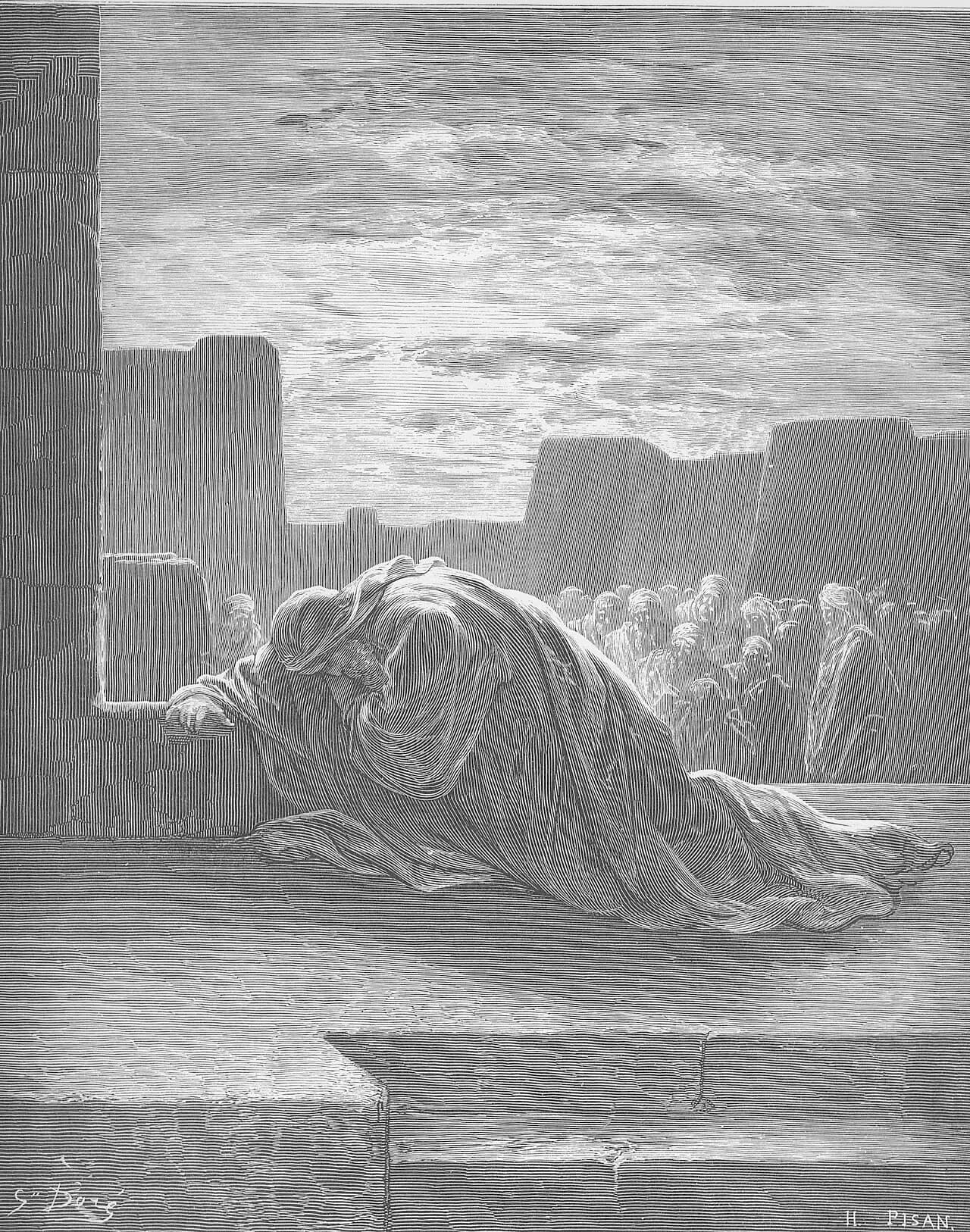
Gustave Doré, Ezra Kneels in Prayer, from La Grande Bible de Tours, 1866. Public domain.
THE ARTWORKDoré draws the confession of Ezra 9, where a man kneels on behalf of a people and states their guilt without defending it. The posture is the one these seven psalms are written from, and the plate is shown whole.
Summary
Summary
Seven psalms, one road. Each begins in trouble the psalmist owns, turns on a confession made without argument, and ends with pardon received rather than earned.
- Psalms 6, 32, 38, 51, 102, 130 and 143, numbered 6, 31, 37, 50, 101, 129 and 142 in the Greek and Latin.
- Cassiodorus is the earliest surviving writer to name the seven as a closed set, and he writes as though it already stood.
- Paul quotes Psalm 32:1-2 in Romans 4 to prove that righteousness is credited apart from works.
- Psalm 51 is tied by its heading to Nathan's visit to David in 2 Samuel 12.
Where the Grouping Comes From
a set of seven, and how far back it can actually be traced
THE NUMBERING
- The Greek and Latin count these as 6, 31, 37, 50, 101, 129 and 142.
- The difference starts at Psalm 10, where the Hebrew splits one poem in two.
- The Psalms, book by book
The seven have been read as a set for so long that the set is often treated as older than the evidence for it. The honest form of the claim is narrower. Cassiodorus wrote his exposition of the Psalms in the sixth century, and he is the earliest surviving writer who identifies these seven as a closed group. He writes about them as though the grouping already stood before him.
Augustine, a century and a half earlier, is the older and weaker thread. He knew a set of penitential psalms and used them, and which four they were has not survived. The set of seven hardened in the Western church over the centuries after Cassiodorus and was fixed in its liturgy by the thirteenth.
Luther gave the seven his first published work, Die sieben Bußpsalmen, in 1517. No text of it could be reached from the session that researched this page, so it is named here and not quoted.
The Seven
7 psalms, the movement each makes, and the verse that carries it
Psalm 6 in the Greek and Latin
The psalm opens under discipline and spends seven verses in weeping. At verse 8 it turns without warning and speaks to the psalmist's enemies instead of to God, on the ground that the weeping has been heard.
Depart from me, all you workers of iniquity, for the LORD has heard my weeping.Psalm 31 in the Greek and Latin
The only one of the seven that begins on the far side of pardon. It states the blessing first, then describes what silence cost, then puts confession at the hinge and pardon as the immediate answer to it.
Then I acknowledged my sin to You and did not hide my iniquity. I said, “I will confess my transgressions to the LORD,” and You forgave the guilt of my sin. SelahPsalm 37 in the Greek and Latin
Sickness and sin are described in the same breath, and the psalmist's friends and neighbours stand off. The confession when it comes is flat and without argument, and the psalm ends asking God not to leave.
Yes, I confess my iniquity; I am troubled by my sin.Psalm 50 in the Greek and Latin
The heading ties it to Nathan's visit after the matter of Bathsheba. The psalm appeals to mercy before it names the sin, and asks for a clean heart rather than a lighter sentence. It ends by naming the broken spirit as the sacrifice God accepts.
Create in me a clean heart, O God, and renew a right spirit within me.Psalm 101 in the Greek and Latin
The heading calls it the prayer of an afflicted man. It runs through personal wasting and loneliness and then turns to the LORD who endures and will build Zion, so that a private grief is answered with a public hope.
Hear my prayer, O LORD; let my cry for help come before You.Psalm 129 in the Greek and Latin
One of the songs of ascents, and the shortest road through the whole pattern. It runs from the depths, to the question no one could survive being answered, to forgiveness, to waiting, and to Israel told to wait the same way.
If You, O LORD, kept track of iniquities, then who, O Lord, could stand? But with You there is forgiveness, so that You may be feared.Psalm 142 in the Greek and Latin
The last of the seven asks God not to enter into judgment at all, on the ground that no living person would survive it. The plea rests on God's faithfulness rather than on the psalmist's case.
Do not bring Your servant into judgment, for no one alive is righteous before You.Psalm 51 and 2 Samuel 12
the one psalm in the seven with a named occasion
The heading of Psalm 51 ties it to the visit of Nathan the prophet after the matter of Bathsheba. The narrative in 2 Samuel 12 gives the confrontation and David's one sentence of admission. The psalm is the same admission at length. The two line up at the point that matters. In both, the offence is stated as an offence against God before anything else is said about it.
Then David said to Nathan, “I have sinned against the LORD.” “The LORD has taken away your sin,” Nathan replied. “You will not die.The narrative version: seven words from David, and the answer given before he finishes.
The sacrifices of God are a broken spirit; a broken and a contrite heart, O God, You will not despise.The psalm's own account of what God accepted, offered in place of the sacrifice the law would have required.
The psalm asks for a clean heart rather than a lighter sentence. That is the difference between penitence and regret, and it is the difference the whole group is built on.
Psalm 32 in Romans 4
the one place the New Testament quotes one of the seven at length
Paul is arguing that God credits righteousness apart from works, and he calls David as his second witness after Abraham. What he quotes is the opening of Psalm 32, the blessing pronounced on the man whose sin is covered and not counted against him.
Blessed is he whose transgressions are forgiven, whose sins are covered. Blessed is the man whose iniquity the LORD does not count against him, in whose spirit there is no deceit.The psalm as it stands in the Psalter, pronouncing a blessing on a man with a covered sin.
And David speaks likewise of the blessedness of the man to whom God credits righteousness apart from works: “Blessed are they whose lawless acts are forgiven, whose sins are covered. Blessed is the man whose sin the Lord will never count against him.”Paul quoting it, and reading the blessing as proof that the crediting happens apart from works.
The argument turns on a negative in the psalm. David blesses the man whose sin the LORD does not count against him, and Paul takes the not counting as the whole of what justification is.
The Pattern, in One Verse
what every one of the seven does, said by one of them
Then I acknowledged my sin to You and did not hide my iniquity.
Psalm 32:5· Berean Standard Bible, from the verse store
The hinge of the whole group, stated by one of its own psalms. Every one of the seven turns on the moment the psalmist stops hiding, and what follows in this verse is pardon in the same sentence.
Why the church put them in a row
Read one after another, the seven cover the ground a penitent actually walks. Psalm 6 carries the fear of God's anger and Psalm 32 the cost of hiding. Psalm 38 has the body failing under it and Psalm 51 the naming of the offence. Psalm 102 carries the loneliness and Psalm 130 the waiting. Psalm 143 asks that the case never be heard at all. The liturgy of Lent and the Divine Office set them in that order for that reason.
If You, O LORD, kept track of iniquities, then who, O Lord, could stand? But with You there is forgiveness, so that You may be feared.The question the group exists to answer, and the answer, in two verses.
Let me hear Your loving devotion in the morning, for I have put my trust in You. Teach me the way I should walk, for to You I lift up my soul.Where the seven end: not in relief, but in a request to be taught the way to walk next.
Keep studying
On this page