
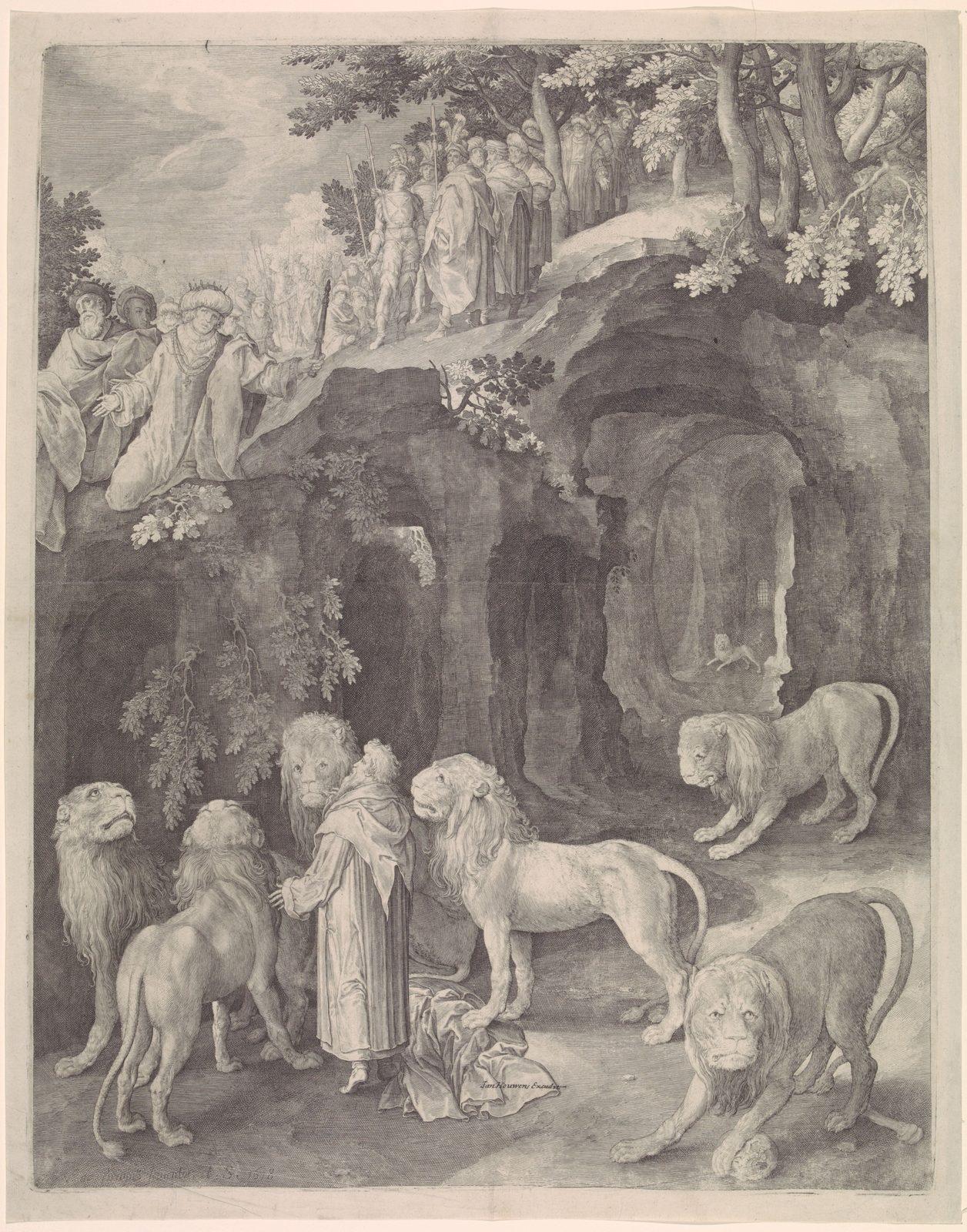
Nicolaes de Bruyn, King Darius Finds Daniel Unharmed in the Lions' Den, 1618. CC0.
Daniel 5:31, Daniel 6, Daniel 9:1 and Daniel 11:1 · Person · Featured Study
Darius the Mede
Darius the Mede ruled the kingdom of the Chaldeans after Belshazzar, and Daniel served at his court.
The king who signed the decree against prayer spent the night fasting and hurried to the lions' den at the first light of dawn.
Then King Darius wrote to the people of every nation and language throughout the land: “May your prosperity abound.
- Family
- father, in Daniel 9:1: Xerxes
- Places
- Babylon
- First named
- Daniel 5:31 “and Darius the Mede…”
- Last named
- Daniel 11:1 “…in the first year of Darius the Mede,…”
Summary
Only the book of Daniel names Darius the Mede. He received the kingdom on the night Belshazzar was slain.
- His father was Xerxes, and he was a Mede (Daniel 9:1).
- He told his whole kingdom to fear the God of Daniel (Daniel 6:26).
- Readers give four answers to the question of who he was.
Where Darius the Mede Stands in Scripture
The book of Daniel names him in chapters 5, 6, 9 and 11.
That very night Belshazzar king of the Chaldeans was slain, and Darius the Mede received the kingdom at the age of sixty-two.Belshazzar's death and the accession of Darius fall on one night, so the book leaves no gap between the two kings.
In the first year of Darius son of Xerxes, a Mede by descent, who was made ruler over the kingdom of the Chaldeans—Daniel dates his reading of Jeremiah by this king's first year, so Darius stands at the turn of the seventy years.
His Reign in the Book of Daniel
The book records his reign from the night he received the kingdom to the decree he sent to every nation.
Ten turns of his reign, in the order the book gives them.
- Receives the kingdomThe night Belshazzar diedDaniel 5:30 to 31
- Appoints 120 satraps and three administrators, Daniel among themNo time givenDaniel 6:1 to 2
- Plans to set Daniel over the whole kingdomNo time givenDaniel 6:3
- Signs the decree of thirty daysNo time givenDaniel 6:9
- Labors to rescue DanielUntil sundownDaniel 6:14
- Seals the den and goes to his palaceThat nightDaniel 6:17 to 18
- Hurries to the den and calls to DanielThe next morningDaniel 6:19 to 20
- Writes to every nation to fear the God of DanielAfter Daniel is lifted outDaniel 6:25 to 27
- Daniel reads the sacred books and praysThe first year of his reignDaniel 9:1 to 2
- An angel stands up to strengthen and protect himThe first year of Darius the MedeDaniel 11:1
Each turn with the time the text gives and its verse.
Hurries to the den and calls to Daniel, Writes to every nation to fear the God of Daniel, Daniel reads the sacred books and prays, An angel stands up to strengthen and protect him
The King and His Own Decree
Darius signed a law that could not be repealed and then labored to save the man it condemned.
The decree he signedDaniel 6:6 to 9
All the royal administrators, prefects, satraps, advisers, and governors have agreed that the king should establish an ordinance and enforce a decree that for thirty days anyone who petitions any god or man except you, O king, will be thrown into the den of lions. Therefore, O king, establish the decree and sign the document so that it cannot be changed—in accordance with the law of the Medes and Persians, which cannot be repealed.”The trap depends on a law the king himself cannot set aside once he signs.
Therefore King Darius signed the written decree.The king signs without a word recorded against it.
The law of the Medes and PersiansDaniel 6:12 to 15
As soon as the king heard this, he was deeply distressed and set his mind on delivering Daniel, and he labored until sundown to rescue him.The king's grief shows that he had not foreseen how the decree would fall on Daniel.
Then the men approached the king together and said to him, “Remember, O king, that by the law of the Medes and Persians no decree or ordinance established by the king can be changed.”His own officials hold him to the law he signed.
Matthew Henry noted that the text records no words of Daniel in his own defence.
“We are not told what Daniel said; the king himself is his advocate, he needs not plead his own cause, but silently commits himself and it to him that judges righteously.”
Matthew Henry · Commentary on the Whole Bible · on Daniel 6:15Puritan
The night and the dawnDaniel 6:16 to 20
So the king gave the order, and they brought Daniel and threw him into the den of lions. The king said to Daniel, “May your God, whom you serve continually, deliver you!”Before the stone is laid, the king hopes aloud for what he has no power to do himself.
Then the king went to his palace and spent the night fasting. No entertainment was brought before him, and sleep fled from him.The king's own night shows how little he wanted the sentence his decree had passed.
Theodoret of Cyrus read the words of Daniel 6:19 as a time before full light.
“‘King Darius rose early at daybreak,’ that is, while it was still dark, around dawn, so that there was even need of lamps (the meaning of ‘at daybreak’).”
Theodoret of Cyrus · Commentary on Daniel 6:19 · on Daniel 6:19Patristic
When he reached the den, he cried out in a voice of anguish, “O Daniel, servant of the living God, has your God, whom you serve continually, been able to deliver you from the lions?”The king calls Daniel's God the living God before he knows whether Daniel is alive.
What Daniel Says of the King
The text adds two details of the king's part in the night and the morning.
HIS OWN SIGNET RING
The king sealed the stone over the den with his own signet ring and with the rings of his nobles.
OVERJOYED AT DAWN
The king was overjoyed and gave orders to lift Daniel out of the den.
The Record Outside Daniel
The Babylonian chronicle names other men at the fall of the city, and Josephus and Xenophon give a Median king another name.
The Nabonidus Chronicle is a Babylonian record of the reign of Nabonidus. It says that on the sixteenth day Ugbaru, governor of Gutium, and the army of Cyrus entered Babylon without battle. Cyrus entered the city on the third day of the month Arahsamna, and Gubaru, his district officer, appointed the district officers in Babylon. Ugbaru died on the night of the eleventh of Arahsamna.
Josephus, writing in the first century, says that Darius was sixty-two when Babylon was taken. He calls him the son of Astyages and says that he had another name among the Greeks. William Whiston, his translator, gave that name as Cyaxares.
Xenophon's Cyropaedia names Cyaxares, the son of Astyages, as king of the Medes after his father, and has Cyrus call him uncle.
His House and His Court
Daniel 6:1 to 3 sets out the king's officers, and Daniel distinguished himself among them.
The king stood between his father, Xerxes, and the officers he set over the kingdom.
His father
- XerxesNamed in Daniel 9:1
The king
- Darius the MedeSon of Xerxes, king over the three and the 120
Over the satraps
- DanielOne of the three, whom the king planned to promote
- Two other administratorsWith the satraps they sought a charge against Daniel
Over the kingdom
- 120 satrapsAccountable to the three so that the king would not suffer loss
Five people and groups on four levels.
The Places of His Reign
The book places Darius in his palace, at the den of lions and over the kingdom of the Chaldeans.
Four places in the record of his reign.
| Place | What he did there |
|---|---|
| The kingdom of the Chaldeans | He was made ruler over it. |
| His palace | He went there for the night after the den was sealed. |
| The den of lions | Daniel, and later Daniel's accusers, were thrown into it at his command. |
| Every part of his kingdom | He wrote to all its peoples after Daniel was lifted out. |
What the King Confessed
The king whose decree forbade petitions to any god or man but himself later decreed that his kingdom must fear the God of Daniel.
I hereby decree that in every part of my kingdom, men are to tremble in fear before the God of Daniel: For He is the living God, and He endures forever; His kingdom will never be destroyed, and His dominion will never end. He delivers and rescues; He performs signs and wonders in the heavens and on the earth, for He has rescued Daniel from the power of the lions.”A Gentile ruler now tells his whole empire what Daniel's deliverance had shown him.
In the days of those kings, the God of heaven will set up a kingdom that will never be destroyed, nor will it be left to another people. It will shatter all these kingdoms and bring them to an end, but will itself stand forever.Daniel had told Nebuchadnezzar of a kingdom that will never be destroyed, and Darius uses the same words of God's kingdom.
Voices on Darius
Four writers from Hippolytus to Adam Clarke wrote about the king's court, his temper, his fasting and his first year.
Hippolytus of Rome (died 235)
Hippolytus of Rome, in his Commentary on Daniel, wrote that the satraps were set up so that the king would not be overburdened.
Ephrem the Syrian (died 373)
Ephrem the Syrian wrote on Daniel 6 that Darius loved quiet and found business unpleasing. He left the care of the empire to his prefects.
John Calvin (1509 to 1564)
John Calvin read Daniel 11:1 as the angel's work in moving the empire from the Babylonians to the Medes and then to the Persians.
Adam Clarke (1762 to 1832)
Adam Clarke noted that the king was at least sixty-two. His night without food or sleep showed, Clarke wrote, the depth of his concern for Daniel.
Who Was Darius the Mede?
Readers identify him in four ways, and each reading has its holders and an objection.
Cyaxares, the uncle of CyrusJohn Gill, Exposition of the Old Testament, on Daniel 5:31, with Barnes, Jamieson, Fausset and Brown, and Henry
John Gill held that Darius was Cyaxares, the son of Astyages and the uncle of Cyrus, who took the kingdom of Babylon with Cyrus's consent and reigned two years. Albert Barnes and Jamieson, Fausset and Brown gave the same name, Cyaxares II, and held that Cyrus took the city in his name.
Jamieson, Fausset and Brown read the words was made ruler in Daniel 9:1 as showing that Darius owed the kingdom to another man, Cyrus. Matthew Henry gave the reason the elder king stood first.
“They were partners in war and conquest, and so they were in dominion, ch. vi. Notice is taken of his age, that he was now sixty-two years old, for which reason Cyrus, who was his nephew, gave him the precedency.”
Matthew Henry · Commentary on the Whole Bible · on Daniel 5:31Puritan
Against this reading Herodotus has a courtier say that Astyages had no male children, which leaves no son of his to be Cyaxares.
Gubaru, the governor of BabylonJohn C. Whitcomb, Darius the Mede, 1959
Whitcomb identified Darius the Mede with the governor of Babylon and the Region beyond the River who appears as Gubaru in the cuneiform documents.
Against this reading Driver treated Gubaru and Ugbaru as one man, and the chronicle calls Gubaru a district officer where Daniel calls Darius king.
Cyrus under a second nameD. J. Wiseman, Notes on Some Problems in the Book of Daniel, 1965
Wiseman proposed in 1957 that Darius the Mede is Cyrus the Persian. He read Daniel 6:28 as Daniel prospering in the reign of Darius, that is, the reign of Cyrus the Persian, and he noted that Cyrus was about sixty-two when he received the kingdom.
Against this reading the book keeps the two apart, calling Darius a Mede in Daniel 9:1 and Cyrus the Persian in Daniel 6:28.
A figure the author drew from later kingsS. R. Driver, An Introduction to the Literature of the Old Testament
Driver found no room for a Darius the Mede between Nabonidus and Cyrus, since by all other authorities Cyrus followed Nabonidus directly. He held that the name Darius the Mede reflects the later Persian king Darius Hystaspis, joined with indistinct recollections of Gubaru, who first occupied Babylon for Cyrus.
Against this reading Whitcomb wrote that Darius the Mede is not a fictitious character and identified him with a governor the cuneiform documents name.
The Reign of Darius and the Reign of Cyrus
So Daniel prospered during the reign of Darius and the reign of Cyrus the Persian.The chapter of the den closes on Daniel's service, which outlasted the king who sent him there.
The book does not say how the reign of Darius ended. Daniel 7:14 gives an everlasting dominion to One like the Son of Man, and Jesus named Himself as that One before the high priest. The text asks the reader to fear that God, as the king commanded his own kingdom to do. It also asks the reader to serve the One to whom that dominion is given.
Sources
Scripture is the Berean Standard Bible.
- Commentaries on Daniel by Hippolytus, Ephrem, Theodoret, Calvin, Henry, Gill, Clarke, Barnes, and Jamieson, Fausset and Brown.
- The Nabonidus Chronicle (ABC 7), column iii, lines 15 to 22, translated by A. K. Grayson with later changes.
- Flavius Josephus, Antiquities of the Jews, book 10, chapter 11, translated by William Whiston (1737), with Whiston's note.
- Xenophon, Cyropaedia 1.5.2 and 5.5.8, translated by Walter Miller (1914)
- Herodotus, Histories 1.109, translated by A. D. Godley (1920)
- John C. Whitcomb, Darius the Mede: A Study in Historical Identification (1959), p. 3.
- D. J. Wiseman, Some Historical Problems in the Book of Daniel (Tyndale Press, 1965), pp. 12 and 15.
- S. R. Driver, An Introduction to the Literature of the Old Testament (New York, Scribner, 1910 printing), pp. 499 to 500.
Keep Studying
Read it5
Studies4
People and groups7
Places1
Go further8