
1 Timothy 1 to Titus 3 · Subject · Featured Study
The False Teaching at Ephesus
The doctrine Timothy was sent to stop, read from three of Paul's letters, with the four readings of who taught it.
Two teachers said the resurrection had already occurred, and Paul wrote to Timothy that their talk would spread like gangrene.
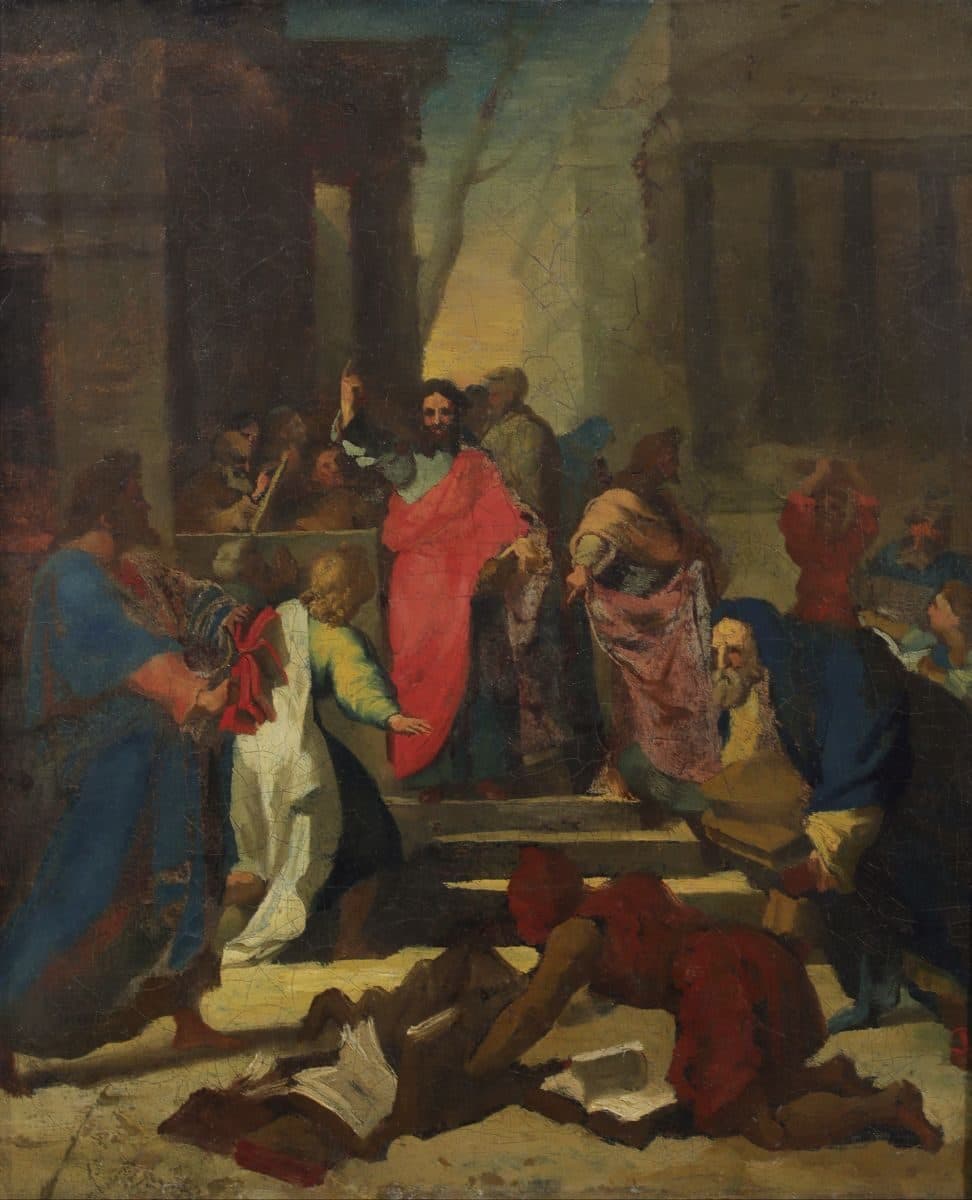
Théodore Géricault, The Preaching of Saint Paul at Ephesus, after Eustache Le Sueur, before 1824. Public domain, via Wikimedia Commons.
THE ARTWORKGéricault painted Paul at the centre on the steps of a temple, in a red cloak, one arm raised as he preaches. Men crowd the steps around him, and in the foreground others bend low over open books on the ground.
Summary
The letters to Timothy and Titus describe the teaching at Ephesus by its marks, and they name three of its teachers.
- Its teachers devoted themselves to myths and endless genealogies and wanted to be teachers of the law.
- The first letter foretells teachers who prohibit marriage and require abstinence from foods, and it warns of men who regard godliness as a means of gain.
- Paul calls their claim so-called knowledge and hands Hymenaeus and Alexander over to Satan.
- Chrysostom and Hort read it as Jewish speculation, and Irenaeus and Tertullian saw in it the Gnostic schools of the second century.
What the Letters Say They Taught
Eight passages give the teaching's marks, from 1 Timothy 1 to Titus 3.
As I urged you on my departure to Macedonia, you should stay on at Ephesus to instruct certain men not to teach false doctrines or devote themselves to myths and endless genealogies, which promote speculation rather than the stewardship of God’s work, which is by faith.This charge is the reason Timothy stayed behind, and it names the first marks of the teaching.
Some have strayed from these ways and turned aside to empty talk. They want to be teachers of the law, but they do not understand what they are saying or that which they so confidently assert.Their claim to teach the law is the ground of the reading that the teachers were Jewish.
Now the Spirit expressly states that in later times some will abandon the faith to follow deceitful spirits and the teachings of demons, influenced by the hypocrisy of liars, whose consciences are seared with a hot iron. They will prohibit marriage and require abstinence from certain foods that God has created to be received with thanksgiving by those who believe and know the truth.It traces the teaching past its human teachers to a spiritual source.
If anyone teaches another doctrine and disagrees with the sound words of our Lord Jesus Christ and with godly teaching, he is conceited and understands nothing. Instead, he has an unhealthy interest in controversies and semantics, out of which come envy, strife, abusive talk, evil suspicions, and constant friction between men of depraved mind who are devoid of the truth. These men regard godliness as a means of gain.It ties the false doctrine to the character of the man who teaches it, so the test is moral as well as doctrinal.
O Timothy, guard what has been entrusted to you. Avoid irreverent, empty chatter and the opposing arguments of so-called “knowledge,” which some have professed and thus swerved away from the faith. Grace be with you all.It is the last charge of the letter, and it names the claim the later readings argue over most.
But avoid irreverent, empty chatter, which will only lead to more ungodliness, and the talk of such men will spread like gangrene. Among them are Hymenaeus and Philetus, who have deviated from the truth. They say that the resurrection has already occurred, and they undermine the faith of some.It is the only passage that ties a named teacher to a stated doctrine.
For many are rebellious and full of empty talk and deception, especially those of the circumcision, who must be silenced. For the sake of dishonorable gain, they undermine entire households and teach things they should not. As one of their own prophets has said, “Cretans are always liars, evil beasts, lazy gluttons.” This testimony is true. Therefore rebuke them sternly, so that they will be sound in the faith and will pay no attention to Jewish myths or to the commands of men who have rejected the truth.It is the only verse of the three letters that places the teachers among those of the circumcision.
But avoid foolish controversies, genealogies, arguments, and quarrels about the law, because these things are pointless and worthless.Titus receives the charge Timothy received, which shows the two men faced one kind of teaching.
The Marks and the Two Readings
The two main readings of who taught it agree on false doctrine and on gain, and part on the other five marks.
| Mark | Read as Jewish speculation | Read as later Gnostic teaching |
|---|---|---|
| False doctrines | Teaching at odds with the sound words of Christ | Teaching at odds with the sound words of Christ |
| Myths and endless genealogies | Jewish legends and family lines | The chain of spiritual beings in the Valentinian system |
| Teachers of the law | Men who claimed to expound the law of Moses | Hard to fit, since Marcion rejected the Old Testament |
| Marriage and foods forbidden | A strict Jewish party such as the Essenes | Marcion and his follower Apelles |
| Godliness as a means of gain | Teaching for dishonorable gain | Teaching for dishonorable gain |
| So-called knowledge | Deep lore of the law | The name the Gnostic schools claimed |
| The resurrection already past | An example of impiety, with no school named | A claim the Valentinians made of themselves |
- Mark
- False doctrines
- Read as Jewish speculation
- Teaching at odds with the sound words of Christ
- Read as later Gnostic teaching
- Teaching at odds with the sound words of Christ
- Mark
- Myths and endless genealogies
- Read as Jewish speculation
- Jewish legends and family lines
- Read as later Gnostic teaching
- The chain of spiritual beings in the Valentinian system
- Mark
- Teachers of the law
- Read as Jewish speculation
- Men who claimed to expound the law of Moses
- Read as later Gnostic teaching
- Hard to fit, since Marcion rejected the Old Testament
- Mark
- Marriage and foods forbidden
- Read as Jewish speculation
- A strict Jewish party such as the Essenes
- Read as later Gnostic teaching
- Marcion and his follower Apelles
- Mark
- Godliness as a means of gain
- Read as Jewish speculation
- Teaching for dishonorable gain
- Read as later Gnostic teaching
- Teaching for dishonorable gain
- Mark
- So-called knowledge
- Read as Jewish speculation
- Deep lore of the law
- Read as later Gnostic teaching
- The name the Gnostic schools claimed
- Mark
- The resurrection already past
- Read as Jewish speculation
- An example of impiety, with no school named
- Read as later Gnostic teaching
- A claim the Valentinians made of themselves
The Teachers from Miletus to Revelation
Six texts follow the teachers in order, from Acts 20 to Revelation 2.
THE WARNING AT MILETUS
Paul tells the elders of Ephesus that wolves will come in and that men from their own number will distort the truth.
TWO MEN HANDED OVER
Some have rejected a good conscience and shipwrecked their faith, and Paul hands Hymenaeus and Alexander over to Satan to be taught not to blaspheme.
THE DIVISIVE MAN
Titus is to reject a divisive man after a first and second admonition.
INTO THE HOUSEHOLDS
The teachers of the last days worm their way into households and captivate vulnerable women who are always learning.
EARS TURNED TO MYTHS
Paul warns that men will gather teachers to suit their own desires and turn aside to myths.
THE CHURCH THAT TESTED
In Revelation the church at Ephesus has tested and exposed as liars those who falsely claim to be apostles.
Ephesus and the Later Schools
Paul's years in the city, a Jewish party of his day, and the schools of the next century.
Paul taught at Ephesus for two years in the hall of Tyrannus, and he told the elders he had warned them for three years. Converts who had practised magic burned their books there in public.
Josephus describes the Essenes as a Jewish party that neglected wedlock and esteemed continence as virtue. A ban on marriage could therefore arise inside Judaism.
The schools that Irenaeus and Tertullian named came later. Marcion reached Rome about the year 140, and Valentinus taught there until the time of Anicetus and died about 160.
Irenaeus was sent to Rome in 177 or 178 and became bishop of Lyons, and his great work bore the title Detection and Overthrow of the False Knowledge. Tertullian wrote his Prescription Against Heretics about the year 200.
The Verses on the Teachers, Book by Book
Thirty-four verses of the three letters describe the teachers at Ephesus and in Crete or what they taught.
1 Timothy (15 verses)
Chapter 1 gives 1 Timothy 1:3 to 4, 1 Timothy 1:6 to 7 and 1 Timothy 1:19 to 20. Chapter 4 gives 1 Timothy 4:1 to 3 and 1 Timothy 4:7. Chapter 6 gives 1 Timothy 6:3 to 5 and 1 Timothy 6:20 to 21.
1 Timothy 4:7 sets training in godliness against the myths.
2 Timothy (12 verses)
Chapter 2 gives 2 Timothy 2:14, 2 Timothy 2:16 to 18 and 2 Timothy 2:23. Chapter 3 gives 2 Timothy 3:6 to 9 and 2 Timothy 3:13. Chapter 4 gives 2 Timothy 4:3 to 4.
2 Timothy 2:14 warns that quarreling over words leads the listeners to ruin, and 2 Timothy 2:23 that foolish and ignorant speculation breeds quarreling.
2 Timothy 3:8 to 9 compares the teachers to Jannes and Jambres, who opposed Moses, and says their folly will be plain to everyone.
2 Timothy 3:13 says evil men and imposters go from bad to worse, deceiving and being deceived.
Titus (7 verses)
Chapter 1 gives Titus 1:10 to 11 and Titus 1:14 to 16. Chapter 3 gives Titus 3:9 to 10.
Titus 1:15 to 16 says their minds and consciences are defiled, and that they profess to know God but deny Him by their actions.
The Words for the Teaching
Nine Greek words name the teaching and its claims, and six of them stand nowhere outside the letters to Timothy and Titus.
heterodidaskaleō (G2085)1 Timothy 6:3
A verb that means to teach another doctrine, found only at 1 Timothy 1:3 and 1 Timothy 6:3.
mythos (G3454)1 Timothy 4:7
genealogia (G1076)Titus 3:9
A noun for the tracing of a family line, found only at 1 Timothy 1:4 and Titus 3:9.
nomodidaskalos (G3547)1 Timothy 1:7
A noun for a teacher of the law, the title the teachers at Ephesus wanted.
pseudōnymos (G5581)1 Timothy 6:20
An adjective that means falsely named, used once, of the knowledge in 1 Timothy 6:20.
antithesis (G477)1 Timothy 6:20
A noun for an opposition or a conflict of views, used once, which the Berean renders opposing arguments.
gnōsis (G1108)1 Timothy 6:20
A noun for knowledge, found twenty-nine times in the New Testament and here the name of the teachers' claim.
graōdēs (G1126)1 Timothy 4:7
An adjective that means like an old woman, used once, of the silly myths of 1 Timothy 4:7.
porismos (G4200)1 Timothy 6:5
A noun for gain, used only at 1 Timothy 6:5 and 1 Timothy 6:6.
What the Text Leaves Unsaid
The letters leave open the teaching's name, its contents, its membership and its reach.
The letters give the teaching no name, and they never call it Gnostic or say what the myths and genealogies contained. They never tie it to the worship of Artemis, the goddess of the city.
They do not say that every mark belonged to one group of teachers. Hymenaeus is named with blasphemy and with the claim about the resurrection, and with none of the other marks.
The bans on marriage and foods are foretold for later times, and the letter leaves unsaid whether anyone at Ephesus already practised them.
The second letter says the teachers captivated women in their households, and it leaves unsaid whether those women taught.
What Paul Sets Against It
Three of the four answers stand in the verse after the error they meet.
The goal of our instruction is the love that comes from a pure heart, a clear conscience, and a sincere faith.Paul measures the teaching by what it produces, and his own instruction aims at love.
For every creation of God is good, and nothing that is received with thanksgiving should be rejected, because it is sanctified by the word of God and prayer.It answers the bans on marriage and foods with the goodness of what God made.
Of course, godliness with contentment is great gain. For we brought nothing into the world, so we cannot carry anything out of it.It answers men who traded on godliness by naming the gain that godliness truly brings.
Remember Jesus Christ, raised from the dead, descended from David, as proclaimed by my gospel,It answers the claim of Hymenaeus and Philetus with Christ raised from the dead.
Three Voices on the Teachers
Three voices, earliest first: Irenaeus of Lyons, John Chrysostom and Matthew Henry in 1710.
“In the first book, which immediately precedes this, exposing ‘knowledge falsely so called,’ I showed thee, my very dear friend, that the whole system devised, in many and opposite ways, by those who are of the school of Valentinus, was false and baseless. I also set forth the tenets of their predecessors, proving that they not only differed among themselves, but had long previously swerved from the truth itself.”
Irenaeus · Against Heresies Book II · on 1 Timothy 6:20Patristic
“‘O Timothy, keep that which is committed to thy trust.’ Let it not suffer diminution. It is not thy own. Thou art intrusted with the property of another, do not lessen it. ‘Avoiding profane and vain babblings, and oppositions of science falsely so called.’ Well did he thus call it. For where there is not faith, there is not knowledge; when anything springs from our reasonings, it is not knowledge. Or perhaps he says this, because some then assumed the name of Gnostics, as knowing more than others.”
John Chrysostom · Homily on 1 Timothy 18 · on 1 Timothy 6:20Patristic
“They did not deny the resurrection (for that had been boldly and avowedly to confront the word of Christ), but they put a corrupt interpretation upon that true doctrine, saying that the resurrection was past already, that what Christ spoke concerning the resurrection was to be understood mystically and by way of allegory, that it must be meant of a spiritual resurrection only.”
Matthew Henry · Commentary on the Whole Bible · on 2 Timothy 2:16Puritan
Who Were the Teachers?
Four readings of the teaching, each with its holders and the strongest objection, and two readings of the resurrection claim.
Jewish speculation on the lawJohn Chrysostom, Theodoret of Cyrus and F. J. A. Hort · Patristic and modern commentary
Chrysostom says there were false apostles at Ephesus, from among the Jews, who wished to bind the faithful to the law of Moses. He reads the genealogies as the reckoning of ancestors.
Ignatius of Antioch, who died between 98 and 117, warned the Magnesians against old fables and tied them to living by the Jewish law.
“‘Godless wives tales’ are Jewish speculations in the form of false interpretations of the law and its proper observance.”
Theodoret of Cyrus · Interpretation of the First Letter to Timothy · on 1 Timothy 4:7Patristic
Hort, in Judaistic Christianity of 1894, read the genealogies as Jewish legend and the quarrels about the law as Jewish casuistry.
The strongest objection is the ban on marriage in 1 Timothy 4:3.
An early form of the later Gnostic schoolsTertullian and F. C. Baur · Patristic polemic and nineteenth-century criticism
Tertullian reads the marks as the heresies of his own century and gives each mark a teacher.
“Thus runs Hebion's heresy. Such also as ‘forbid to marry’ he reproaches in his instructions to Timothy. Now, this is the teaching of Marcion and his follower Apelles.”
Tertullian · The Prescription Against Heretics · on 1 Timothy 4:3Patristic
F. C. Baur, in Die sogenannten Pastoralbriefe of 1835, argued that the opposing arguments Paul named could only be the Antitheses of Marcion, so the first letter to Timothy belongs to Marcion's time.
The strongest objection is Hort's, that a teaching of Marcion and a teaching of Valentinus cannot both be the one Paul meant.
Jewish speculation carrying the seeds of the later schoolsTertullian; Jamieson, Fausset and Brown · Patristic and Reformed commentary
Tertullian, in The Prescription Against Heretics, calls the errors of the apostles' day the seedlings of the heresies of his own. Jamieson, Fausset and Brown, in their Commentary Critical and Explanatory of 1871, connect the warning of 1 Timothy 4:1 with Gnostic errors whose seeds were already sown.
The objection is Hort's finding of no Gnostic term in the letters, since a seed of the Gnostic schools would leave one.
Useless curiosity in generalJohn Calvin · Reformed commentary
Calvin, in his commentary of 1556, reads the fables as trifles and the genealogies as one example of useless curiosity. He compares them to the curiosity that spent a whole life on the genealogy of Achilles and Ajax.
He calls the genealogies endless because vain curiosity has no limit. The objection is Hort's, that Titus 1:14 names the myths as Jewish.
What the resurrection claim meant2 Timothy 2:18
Beside the spiritual reading of Matthew Henry, Theodoret of Cyrus reports a second reading of the claim.
“The successions that happen through the procreation of children they unhappily call the resurrection.”
Theodoret of Cyrus · Interpretation of the Second Letter to Timothy · on 2 Timothy 2:18Patristic
Books on the Teaching
Five works on the teachers at Ephesus, each free to read.
Against Heresies
Irenaeus of Lyons · second century
It opens with the vain genealogies Paul warned of and sets out the Valentinian system it applies them to.
Read at New AdventThe Prescription Against Heretics
Tertullian · about 200
Its title names a Roman legal plea that cuts a case short before the other side's arguments are heard.
Read at New AdventHomilies on First Timothy
John Chrysostom · after 386
It gives the full course of his sermons on the letter, eighteen homilies in all.
Read at New AdventCommentaries on the Epistles to Timothy, Titus, and Philemon
John Calvin · 1556
It sets Calvin's Latin text beside William Pringle's English.
Read at the Christian Classics Ethereal LibraryJudaistic Christianity
F. J. A. Hort · 1894
Its seventh lecture is given to the Pastoral Epistles and fills pages 130 to 146.
Read at the Internet ArchiveGuard What Was Entrusted
The letters name one mediator between God and men, the man Christ Jesus, and the sound words Timothy was to guard are His words.
They ask the reader to guard what was entrusted, to turn from talk that breeds controversy, and to hold the hope that Christ Jesus came into the world to save sinners.
Keep studying
Read it4