
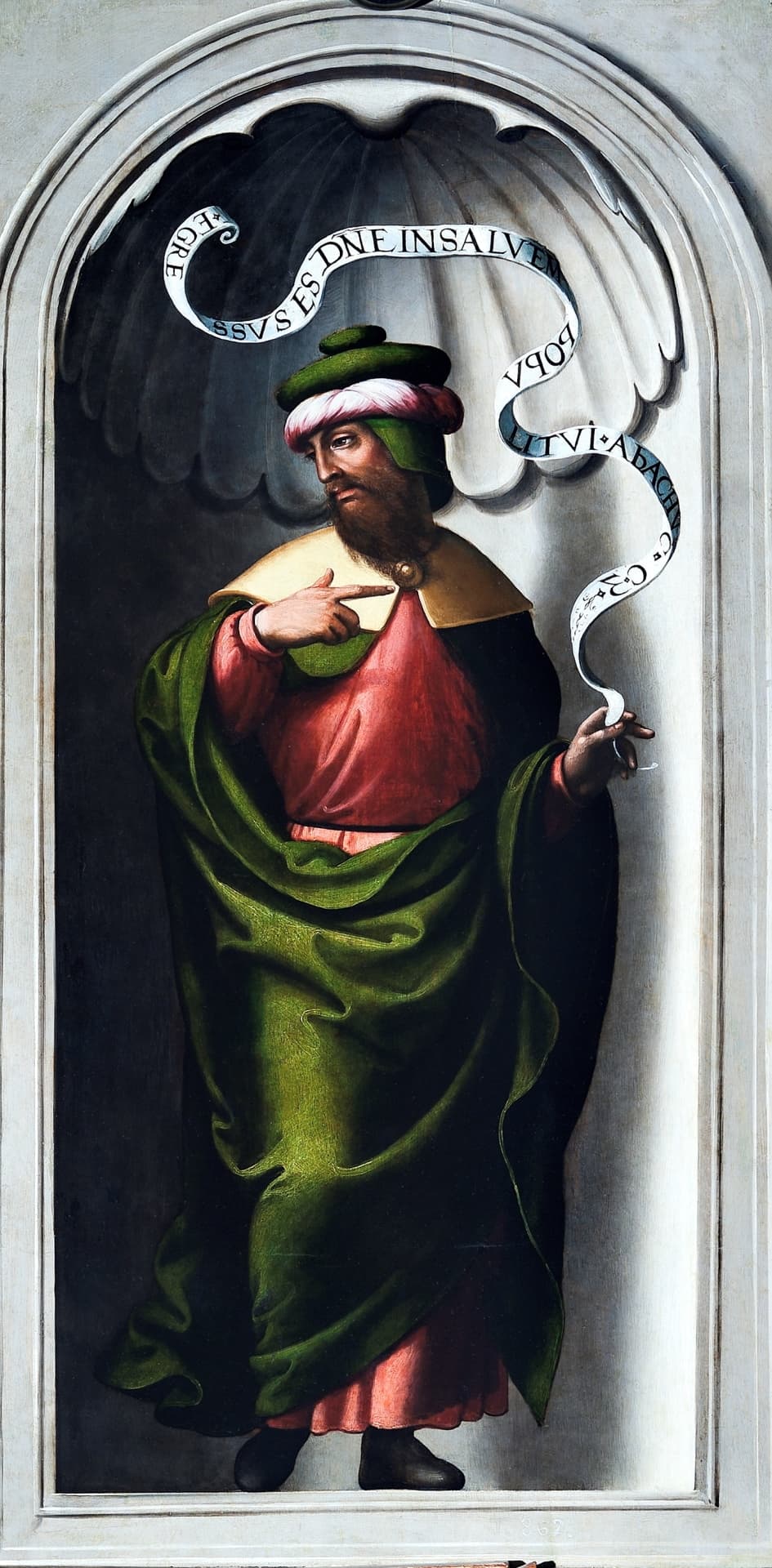
Habakkuk 1:2 · Passage · Injustice
How Long Must I Call for Help?
Habakkuk 1:1 to 2:4 records a prophet's prayer about violence and bent courts in Judah, and the LORD's replies to it.
Habakkuk asked God why the wicked went unpunished, and the first reply made his question harder.
How long, O LORD, must I call for help but You do not hear, or cry out to You, “Violence!” but You do not save?
- The passage
- Habakkuk 1:1 to 17, Habakkuk 2:1 to 4
- Book
- Habakkuk
- Hold in memory
- Habakkuk 1:13, Habakkuk 2:1
Summary
Habakkuk lived where the innocent were wronged and the courts gave no help. He took the wrong to God in plain words. He pressed his question a second time. Then he kept watch for the answer. The book shows that God sees the wrong, rules the nations, and has set a time for judgment. Until then the righteous one lives by faith.
- The first complaint is about wrong inside Judah, where violence and strife fill the streets and the courts bend justice.
- The LORD replies that He is raising up the Chaldeans, a cruel nation, to judge Judah.
- The second complaint asks how a God too pure to look on evil can stay silent while the wicked swallow the righteous.
- God tells Habakkuk to write the vision down, because it will come at its set time and will not be late.
The Burden and the First Cry
Habakkuk 1:1 to 4 names the wrong the prophet saw and the prayer he says God has left unanswered.
How Long Must I Call for Help? reads Habakkuk 1:1 to 2:4 as a prayer made in a land full of violence. It belongs to the trial of injustice, the wrong done to a person by force, fraud or a crooked court.
The question it answers is what Habakkuk said to God about that wrong and what God said back. It also asks what the prophet was told to do while he waited. It gives the passage in its order, from the burden to the watch, with the Hebrew of the cry and of the numb law. It sets out how teachers have read the complaint and the one question about it that divides them.
This is the burden that Habakkuk the prophet received in a vision:The verse calls the book a burden the prophet received in a vision, so the complaint that follows is set down as given to him.
Habakkuk uses two verbs for his prayer in Habakkuk 1:2. The first is shava, to cry for help, in a tense that looks back on a cry already made. The second is za'aq, to shriek from anguish or danger.
Albert Barnes, in his Notes on the Old Testament, wrote of the line, “Of this cry the Prophet expresses that it had already lasted long.”
Why do You make me see iniquity? Why do You tolerate wrongdoing? Destruction and violence are before me. Strife is ongoing, and conflict abounds.Habakkuk asks why God lets the wrong he sees stand, so the complaint is about God's patience as well as man's sin.
Barnes held that the words of the verse, violence, iniquity, strife and contention, “relate to domestic strife and wrong between man and man.”
Therefore the law is paralyzed, and justice never goes forth. For the wicked hem in the righteous, so that justice is perverted.The verse stands here because it names what the violence has done to the courts.
The verb for the law is pug, to be sluggish or numb, and it stands only four times in the Old Testament. The verse ends on me'uqqal, perverted, from 'aqal, to wrest or twist, and this is the one place that verb stands.
The same cry in a psalm and in Revelation2 verses
How long, O LORD? Will You forget me forever? How long will You hide Your face from me? How long must I wrestle in my soul, with sorrow in my heart each day? How long will my enemy dominate me?The psalmist asks how long four times in two verses, so Habakkuk's question stands in the prayers Israel already sang.
And they cried out in a loud voice, “How long, O Lord, holy and true, until You avenge our blood and judge those who dwell upon the earth?”The martyrs under the altar ask the Lord the same question, so the cry reaches to the end of the canon.
Two Complaints and Two Answers
The passage climbs from the prophet's cry to the verdict on the proud and the righteous.
Each word from the LORD meets the complaint before it, and the second complaint grows out of the first answer.
A ladder of four rungs, each with its verses in Habakkuk 1:2 to 2:4 and the Berean words that carry it.
The Answer and the Harder Question
The LORD names the Chaldeans, and Habakkuk asks how a holy God can use them.
“Look at the nations and observe—be utterly astounded! For I am doing a work in your days that you would never believe even if someone told you.The answer opens by telling Judah that God is already at work in their own days, in a way they would not believe.
God names the Chaldeans in Habakkuk 1:6 as a ruthless nation that seizes dwellings not its own. Of them the text says, “from themselves they derive justice and sovereignty” (Habakkuk 1:7), and “their own strength is their god” (Habakkuk 1:11). The rod God sends against Judah's lawlessness answers to no law but its own.
Are You not from everlasting, O LORD, my God, my Holy One? We will not die. O LORD, You have appointed them to execute judgment; O Rock, You have established them for correction.The second complaint begins with a confession of God as everlasting and holy, and it grants that He has appointed the Chaldeans for correction.
Habakkuk 1:13 opens, “Your eyes are too pure to look upon evil, and You cannot tolerate wrongdoing.” The prophet sets God's purity beside His silence, and the tension between them is the second complaint.
Habakkuk then pictures people as fish and the conqueror as a fisherman who “sacrifices to his dragnet” (Habakkuk 1:16). John Wesley, in his Explanatory Notes upon the Old Testament (1765), wrote of the picture that “the world, like the sea, is wholly oppression.”
The complaint ends on a question in Habakkuk 1:17, whether the conqueror will go on emptying his net without mercy. Habakkuk leaves it with God and gives no answer of his own.
The Watch and the Vision
Habakkuk 2:1 to 4 gives the prophet's post, the command to write, and the verdict on the proud and the righteous.
I will stand at my guard post and station myself on the ramparts. I will watch to see what He will say to me, and how I should answer when corrected.The verse moves the book from complaint to waiting, and its last words show Habakkuk ready to be corrected.
Look at the proud one; his soul is not upright—but the righteous will live by faith—The verse ends the LORD's reply with a verdict on two kinds of men, and the proud one comes first.
How the Passage Has Been Taught
John Chrysostom and Matthew Henry on God's purity in Habakkuk 1:13.
died 407 · John Chrysostom
Chrysostom joins Habakkuk 1:13 to Elihu's words in Job 35 and holds that God hates the wrong He has not yet punished.
“‘For the Lord does not desire to look upon wrongs, for he, the almighty one, observes all those who perform lawless deeds, and he will save me; and do you plead before him, if you can praise him, as it is possible even now.’ Not only did the Lord not countenance wrongs, but he did not even wish to see them, as another prophet said: ‘You who are of purer eyes than to behold evil and cannot look on wrong.’ You see, what providence, what protection, what comprehension! Even if he does not take vengeance, he nevertheless abhors actions.”
John Chrysostom · Commentary on Job 35 · on Habakkuk 1:13Patristic
1662 to 1714 · Matthew Henry
Henry draws from the same verse the difference between God's mercy to sinners and His hatred of sin.
“There is in the nature of God an antipathy to those dispositions and practices that are contrary to his holy law; and, though an expedient is happily found out for his being reconciled to sinners, yet he never will, nor can, be reconciled to sin.”
Matthew Henry · Commentary on the Whole Bible · on Habakkuk 1:13Puritan
Did the Complaint Accuse God?
Theodore of Mopsuestia and John Calvin read the prophet's words in two ways, and each reading meets an objection from the text.
The cry of a man in troubleTheodore of Mopsuestia
Theodore of Mopsuestia wrote a Commentary on Habakkuk. Of Habakkuk 1:2 he said, “It is not as though bringing a censure against God that the prophet says this”. He held that the prophet spoke as people speak who are in trouble or rightly angry at those who cause it.
The objection is Habakkuk 2:1, where the prophet waits to learn how he should answer “when corrected,” which grants that his words could need correcting.
A complaint that came near to doubting providenceJohn Calvin
John Calvin wrote on Habakkuk 2:1 that the faithful in that hour “might have thought that all things happened by chance”. They might have thought, he said, “that there was no divine providence”. He added, “even the Prophet uttered complaints of this kind”.
The objection is the LORD's reply in Habakkuk 2:2 to 4, which answers with a vision and gives the prophet no rebuke for asking.
The Woes and the Song
The rest of the book pronounces judgment on the oppressor and ends in the prophet's song.
Habakkuk 2:6 to 20 gives five woes on the conqueror, the first on him “who amasses what is not his” (Habakkuk 2:6). Each woe repays a wrong in kind. The chapter ends, “But the LORD is in His holy temple; let all the earth be silent before Him” (Habakkuk 2:20).
In Habakkuk 3 the prophet who began with a complaint ends with a song. Though the fig tree does not bud and the fields fail, he resolves, “yet I will exult in the LORD” (Habakkuk 3:18).
Paul calls the governing authority “an agent of retribution to the wrongdoer” (Romans 13:4). The cry to God stands beside that office.
Sources
Scripture is the Berean Standard Bible.
- STEP Bible, Translators Amalgamated Hebrew Old Testament (Tyndale House, Cambridge), CC BY 4.0.
- STEP Bible brief lexicons of Extended Strongs for Hebrew (Tyndale House, Cambridge), CC BY 4.0, with the Strong's glosses.
- Albert Barnes, Notes, Explanatory and Practical, on the Old Testament (1832 to 1869), on Habakkuk 1:2.
- John Wesley, Explanatory Notes upon the Old Testament (1765), on Habakkuk 1:14.
- John Calvin, Commentaries on the Twelve Minor Prophets, on Habakkuk 2:1.
- John Chrysostom, Commentary on Job, on Job 35.
- Matthew Henry, Commentary on the Whole Bible (1710), on Habakkuk 1:13.
- Theodore of Mopsuestia, Commentary on Habakkuk, on Habakkuk 1:2.
Keep Studying
In this trial6
People and groups7
Show the next 1 title
Places1
Symbols1
Doctrines1