
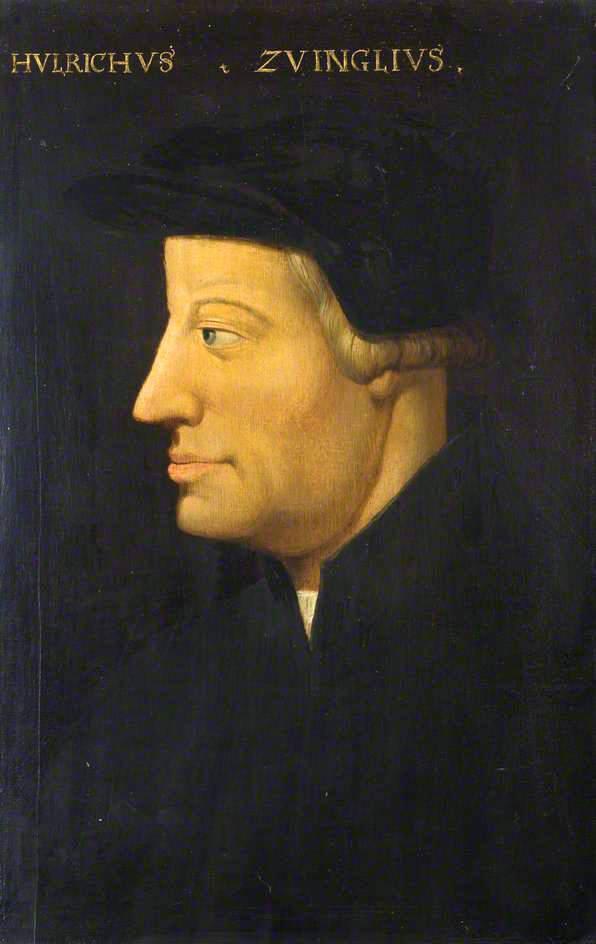
Hans Asper, Ulrich Zwingli, 16th century. Public domain.
Zurich, to 1531 · Person · Featured Study
Ulrich Zwingli
A Swiss priest, he made Scripture the rule of the churches of Zurich and fell in battle at Kappel.
He said he preached the gospel at Einsiedeln before Luther's name was known in Switzerland.
While they were eating, Jesus took bread, spoke a blessing and broke it, and gave it to the disciples, saying, “Take and eat; this is My body.”
While they were eating, Jesus took bread, spoke a blessing and broke it, and gave it to the disciples, saying, “Take and eat; this is My body.”
- Born
- 1 January 1484 at Wildhaus
- Died
- 11 October 1531 at Kappel
- Family
- wife: Anna Reinhart
- Places
- Wildhaus, Glarus, Einsiedeln, Zurich, Marburg, Kappel
Summary
Huldrych Zwingli was the chief pastor of the Great Minster at Zurich from 1519. He preached through whole books of Scripture, and the city council reformed its churches under that preaching. He broke with Luther at Marburg over the Lord's Supper and died at Kappel in 1531.
- The Zurich council drowned Felix Manz, a former follower of his, in January 1527.
- He held that "is" in "This is My body" means "signifies".
- Schaff leaves open whether he consented to the death sentence on Manz.
The Word and the Table
2 Timothy 3 stands under his preaching, and Matthew 26 stands under his quarrel with Luther.
The question of this life is what follows when a city takes Scripture as its only rule. His own first article sets that rule, and the magistrates of the city enforced what followed.
The rule divided those who held it. Luther and Zwingli read one sentence of Jesus two ways at Marburg, and Manz and Zwingli read baptism two ways at Zurich.
All Scripture is God-breathed and is useful for instruction, for conviction, for correction, and for training in righteousness,His articles of 1523 rest the teaching of the church on Scripture, and this verse names what Scripture is for.
The Life in Order
Schaff gives the dates from the Zurich records and the letters.
Twelve years at Zurich hold the whole of his public work.
- 1 January 1484He was born at WildhausSchaff, vol. 8, §6
- 1506 to 1516He was pastor at GlarusSchaff, vol. 8, §7
- 1515He saw the defeat at MarignanoSchaff, vol. 8, §7
- 1516 to 1518He served at Einsiedeln and copied Paul's epistlesSchaff, vol. 8, §§7 and 8
- 1 January 1519He began his duties at the Great MinsterSchaff, vol. 8, §11
- 1519He fell sick of the plague in Zurich at the end of SeptemberSchaff, vol. 8, §13
- Lent 1522His friends broke the Lenten fast with his supportSchaff, vol. 8, §14
- January 1523The first disputation heard his articlesSchaff, vol. 8, §§17 and 18
- April 1524He married Anna Reinhart openlySchaff, vol. 8, §15
- 5 January 1527Felix Manz was drowned in the LimmatSchaff, vol. 8, Anabaptists
- October 1529He met Luther at MarburgSchaff, vol. 7
- 11 October 1531He died at KappelSchaff, vol. 8, §47
Each step of the life stands with its place in Schaff's history.
Lent 1522, January 1523, April 1524, 5 January 1527, October 1529, 11 October 1531
From Wildhaus to Kappel
The account runs from an Alpine village through Zurich's pulpit to the battlefield.
Huldrych Zwingli was born on January 1, 1484, at Wildhaus in the Toggenburg valley of the Swiss Alps, seven weeks after Luther, in a mountain village where his father was the local magistrate. He studied at Vienna and Basel, took his master's degree, and was ordained in 1506.
His first parishes were Glarus and then Einsiedeln, a pilgrimage shrine. Three times he went out as a chaplain with Swiss mercenary troops in the Italian wars. What he saw at the slaughter of Marignano in 1515 turned him against the mercenary trade, then Switzerland's chief export. That stand cost him friends and eventually his post.
Two things changed him in those years. He got Erasmus's Greek New Testament in 1516 and in 1517 copied out the epistles of Paul by hand for constant use. And later he caught the plague at Zurich, nearly died, and wrote a hymn about lying helpless in the hands of God.
On his thirty-fifth birthday he took the pulpit of the Grossmünster in Zurich and did something the city had never heard. He set aside the assigned readings of the church calendar and announced that he would preach through the Gospel of Matthew from the first verse to the last. Then he did the same with Acts, the epistles, and the rest. He preached whole books, in order, letting the text explain itself.
Zurich changed under it. In Lent 1522 several of his friends, his publisher Froschauer among them, ate meat in defiance of the fast, and Zwingli defended them, arguing that Scripture nowhere commands a Lenten fast.
He petitioned for the right of priests to marry, and he had already secretly married Anna Reinhart, a widow. In January 1523 the city council held a public disputation; Zwingli brought sixty-seven articles, and the council ruled that preaching in Zurich must be from Scripture alone. Images came out of the churches in 1524. The Mass was abolished in 1525 and replaced by a plain service of the Lord's Supper at long tables.
He and Luther were on the same side and could not agree. At Marburg in 1529 they settled fourteen of fifteen articles and stuck on the Supper. Luther chalked "This is my body" on the table and would not move. Zwingli held that "is" means "signifies," and that Christ's body is in heaven, so the bread is memorial and pledge. They parted without fellowship; Luther said they were of a different spirit. Protestants have divided along that line ever since.
Zurich's reform pulled the Swiss cantons toward civil war. In October 1531 the Catholic cantons attacked, and Zwingli went out with the Zurich troops as chaplain. He was killed at Kappel at forty-seven. The victors quartered his body and burned it.
The Drowning of Felix Manz
The men who broke with him at Zurich began among his own followers.
He also faced men who thought he had stopped short. Former students of his own, Conrad Grebel and Felix Manz, argued that Scripture required believer's baptism and a church separate from the state. Zwingli opposed them, and the Zurich council drowned Manz in the Limmat. The Anabaptist movement was born out of that break.
Schaff writes that Manz was bound, carried to a boat and thrown into the river on 5 January 1527. Six executions in all took place in Zurich from then to 1532.
In Their Own Words
Two articles and a song stand in his own writing, and two sayings at Kappel stand on later report.
Ulrich Zwingli (died 1531)
The Sixty-seven Articles, article 1
The first article
“All who say that the gospel is nothing without the approbation of the Church, err and cast reproach upon God.”
Modern
About this saying1 paragraph
Schaff gives it in English from the German of 1523.
Ulrich Zwingli
The Sixty-seven Articles, article 2
The sum of the gospel
“The sum of the gospel is that our Lord Jesus Christ, the true Son of God, has made known to us the will of his heavenly Father, and redeemed us by his innocence from eternal death, and reconciled us to God.”
Modern
About this saying1 paragraph
The second article of 1523 follows it, in the same English.
Ulrich Zwingli
Song in the plague, the first part, the first lines
His song in the plague
“Help me, O Lord, My strength and rock; Lo, at the door I hear death's knock.”
Modern
About this saying1 paragraph
He wrote this in German when the sickness of 1519 began, and Schaff prints it with a free condensed translation.
Ulrich Zwingli
Heinrich Bullinger's report, as Schaff quotes it, volume 8, §47
To the men at Kappel, as Bullinger reports it
“fear not! Though we must suffer, our cause is good. Commend your souls to God: he can take care of us and ours. His will be done.”
Modern
About this saying1 paragraph
Schaff gives these words to the soldiers from Bullinger, on the day of the battle in 1531.
Ulrich Zwingli
Oswald Myconius, Life of Zwingli, chapter 12, as Schaff renders it, volume 8, §47
His last words, as Myconius reports them
“They may kill the body, but they cannot kill the soul.”
Modern
About this saying1 paragraph
Schaff's note says Oswald Myconius gives an eyewitness's report of his death in 1531, in Latin.
The People Around Him
His wife, his friends and his opponents stand in Schaff with the record of each tie.
Luther and his own followers opposed him from two sides.
| Person | Tie to Zwingli | The witness |
|---|---|---|
| Anna Reinhart | A widow with three children, she became his wife. | Schaff, vol. 8, §15 |
| Martin Luther | He met Zwingli at Marburg and refused him as a brother. | Schaff, vol. 7 |
| Johannes Oecolampadius | He stood beside Zwingli at Marburg. | Schaff, vol. 7 |
| Oswald Myconius | He was Zwingli's friend and biographer. | Schaff, vol. 8, §7 |
| Heinrich Bullinger | He wrote the history of Zurich's reform. | Schaff, vol. 8, §47 |
| Christoph Froschauer | This publisher ate meat in Lent and printed Zwingli's first book. | Schaff, vol. 8, §14 |
| Conrad Grebel | He led the first rebaptisms and died in 1526. | Schaff, vol. 8 |
| Felix Manz | A student of Zwingli's, he was the first Anabaptist put to death at Zurich. | Schaff, vol. 8 |
Conrad Grebel, Felix Manz
The Places of His Life
His life ran from the Toggenburg to Zurich, and it reached Germany once.
His public life ran through Glarus, Einsiedeln and Zurich.
| Place | What the record says | The witness |
|---|---|---|
| Wildhaus | The highest village of the Toggenburg was his birthplace. | Schaff, vol. 8, §6 |
| Glarus | He was pastor there for ten years. | Schaff, vol. 8, §7 |
| Marignano | The French defeated the Swiss army here. | Schaff, vol. 8, §7 |
| Einsiedeln | He copied Paul's epistles at this pilgrimage shrine. | Schaff, vol. 8, §§7 and 8 |
| Zurich | He preached at the Great Minster, the chief church of the city. | Schaff, vol. 8, §11 |
| Marburg | He met Luther there in October 1529. | Schaff, vol. 7 |
| Kappel | The Catholic cantons defeated Zurich here, and he fell in the battle. | Schaff, vol. 8, §47 |
What He Held
He made Scripture the court of the city, and he hoped for salvation wider than the church's bounds.
Schaff writes that Zwingli traced salvation exclusively to the sovereign grace of God, who is bound to no visible means. On that ground Zwingli expected to meet in heaven the saints of the Old Testament, and with them Socrates, Plato, Cato and Seneca.
His Lord's Supper was a commemoration of Christ's death and a spiritual communion with Him, received at long tables in wooden plates and wooden cups.
How the Key Verse Was Taught
Tertullian, John Wesley and John Charles Ryle read the words at the table.
Tertullian (died 220)
On Prayer
Tertullian tied the words to the daily bread of the Lord's Prayer.
“Then we find, too, that His body is reckoned in bread: ‘This is my body.’ And so, in petitioning for ‘daily bread,’ we ask for perpetuity in Christ, and indivisibility from His body.”
on Matthew 26:26Patristic
John Wesley (1703 to 1791)
Explanatory Notes upon the New Testament
John Wesley gave Scripture's other sentences in which "is" names what a thing stands for.
“Thus Gen. xl, 12, The three branches are three days. Thus Gal. iv, 24, St. Paul speaking of Sarah and Hagar, says, These are the two covenants. Thus in the grand type of our Lord, Exod. xii, 11, God says of the paschal lamb, This is the Lord's passover.”
on Matthew 26:26Evangelical
J.C. Ryle (1816 to 1900)
Expository Thoughts on the Gospels: Matthew
Ryle pointed to the evening Jesus chose for it.
“These verses describe the appointment of the sacrament of the Lord’s Supper. Our Lord knew well the things that were before him, and graciously chose the last quiet evening that he could have before his crucifixion as an occasion for bestowing a parting gift on his church. How precious must this ordinance have afterwards appeared to his disciples when they remembered the events of the night! How mournful is the thought that no ordinance has led to such fierce controversy, and been so grievously misunderstood, as the ordinance of the Lord’s Supper!”
on Matthew 26:26 to 35Reformed Evangelical
What the Witnesses Leave Open
Readers differ on the words at the table, on the refused hand, on the sentence on Manz and on his age when he came to Zurich.
The meaning of "This is My body"Luther; Zwingli and Oecolampadius
Luther held to the words as they stand and said, "This is our text: you have not yet driven us from it." Oecolampadius stood with Zwingli against the literal reading.
The refused hand at MarburgSchaff; Melanchthon, as Schaff cites him
Schaff tells that Zwingli held out his hand in tears and that Luther declined it. The earliest witness he cites, Melanchthon's letter of 12 October 1529, says the Swiss asked to be called brothers, and it leaves out the hand.
His part in the death of ManzSchaff; Egli; Keller; Baur
Schaff writes, "It is not known whether Zwingli really consented to the death sentence, but he certainly did not openly oppose it." Egli thinks that if he consented, it was with a reluctant heart. Keller says he preached in 1525 that Anabaptists should be beheaded, Schaff finds no proof of it, and Baur denies it.
His birthday at ZurichSchaff; the count from 1484
Schaff calls 1 January 1519 his thirty-sixth birthday, and the count from 1484 gives thirty-five years.
Books to Read Next
History of the Christian Church, volume 8
Philip Schaff · 1892
Schaff's sections on the Swiss Reformation give the life from the Zurich records.
Read Schaff free at CCELSelected Works of Huldreich Zwingli
Samuel Macauley Jackson, editor · 1901
Jackson prints the acts of the first Zurich disputation in English.
Read Jackson free at the Internet ArchiveModern Christianity: The German Reformation
Philip Schaff · 1910
This seventh volume of his History tells the Marburg Conference speech by speech.
Read Schaff's volume 7 free at CCELWhat Zwingli Left
Zwingli left a reformed city, sixty-seven articles and a reading of the Supper that still divides Protestants. Bullinger took up his work at Zurich.
Sources
Scripture is the Berean Standard Bible.
- The Holy Bible, Berean Standard Bible (read 2026)
- Philip Schaff, History of the Christian Church, volume 8, Modern Christianity: The Swiss Reformation (1892), sections 6 to 47 and the Anabaptist sections, with the Sixty-seven Articles and the song of 1519 in his English.
- Philip Schaff, History of the Christian Church, volume 7, Modern Christianity: The German Reformation, in the CCEL text of the 1910 edition, the Marburg Conference.
- Samuel Macauley Jackson, editor, Selected Works of Huldreich Zwingli (University of Pennsylvania, 1901)
- Tertullian, On Prayer, on Matthew 26:26.
- John Wesley, Explanatory Notes upon the New Testament (1755), on Matthew 26:26.
- J. C. Ryle, Expository Thoughts on the Gospels: Matthew (1856), on Matthew 26:26.
Keep Studying
People and groups7