
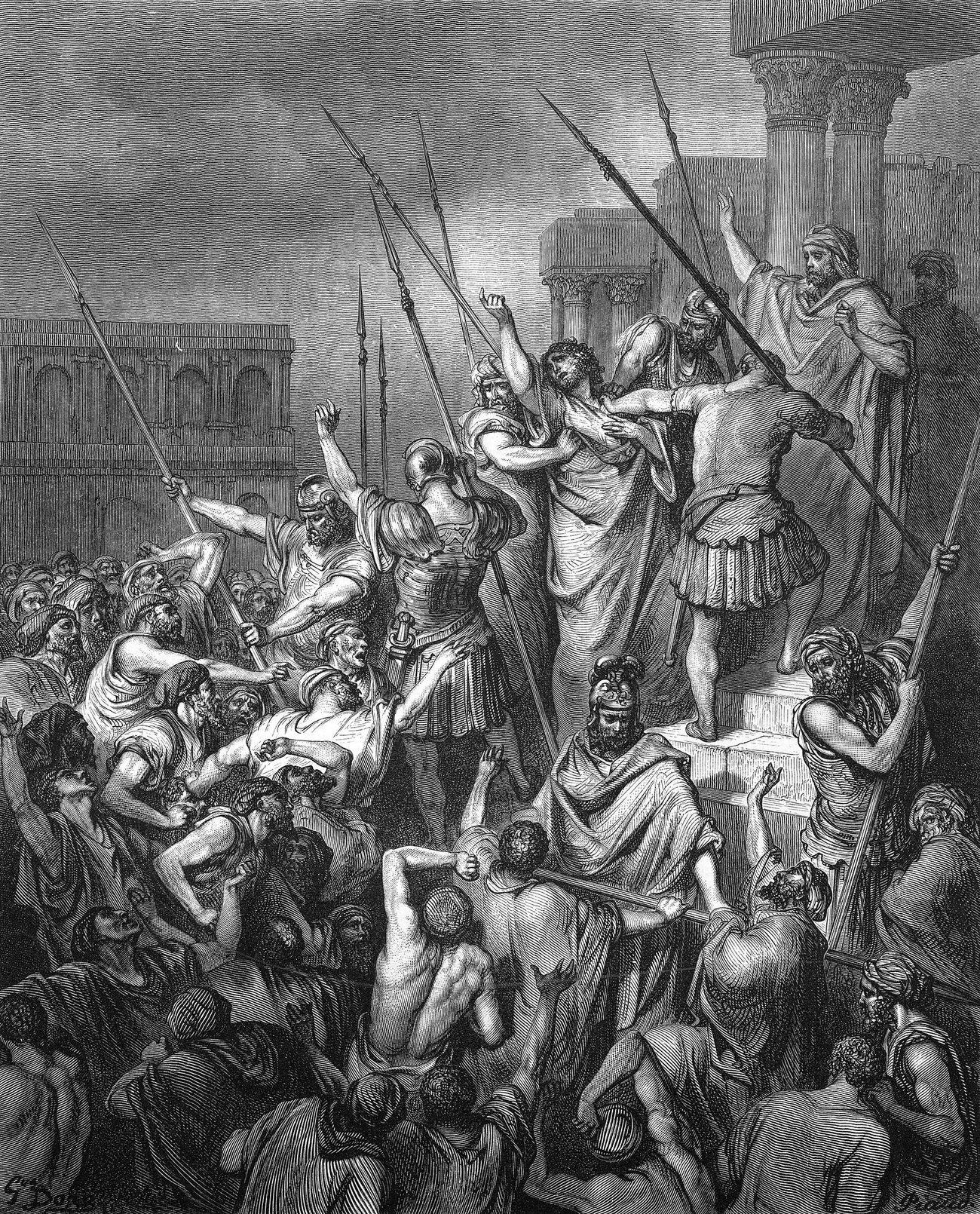
Gustave Doré, 1874. Public domain.
Acts 21 to 23 · Story · Featured Study
Paul's Arrest in the Temple
A riot in the temple court turned Paul from a visitor in Jerusalem into a prisoner of Rome.
A crowd dragged Paul out of the temple, and the gates were shut behind him.
The following night the Lord stood near Paul and said, “Take courage! As you have testified about Me in Jerusalem, so also you must testify in Rome.”
- Where
- Jerusalem, Caesarea
- Who
- Paul
- When
- Ramsay dates Paul's last voyage to Jerusalem to AD 57 (probable)
Summary
Paul went to the temple in Jerusalem to share a vow with four men. A mob attacked him there, and Roman soldiers took him into their barracks. Soon after, their commander sent him under guard to the governor at Caesarea.
- Conybeare and Howson read the commander's title as a commander of a thousand men.
- Josephus says Roman troops kept watch on the temple at each feast.
- The commander gives his name, Claudius Lysias, in his letter to Felix.
The Texts of the Arrest
Three verses carry the charge, the chains and Paul's own account of why he came.
Luke tells the arrest and what followed it in Acts 21:17 to 23:35, nearly three chapters.
crying out, “Men of Israel, help us! This is the man who teaches everywhere against our people and against our law and against this place. Furthermore, he has brought Greeks into the temple and defiled this holy place.”The cry in the temple court holds every charge the crowd brought against Paul.
The commander came up and arrested Paul, ordering that he be bound with two chains. Then he asked who he was and what he had done.The two chains answer the binding the prophet Agabus acted out with Paul's belt at Caesarea in Acts 21:11.
After several years, then, I returned to Jerusalem to bring alms to my people and to present offerings.Paul's defence before Felix supplies the purpose of the visit, which chapter 21 never states.
The Days From Jerusalem to Caesarea
Ten moments from Acts 21 to 23, each with its verse.
Luke marks most of the days from Paul's arrival in Jerusalem to his delivery at Caesarea.
- The day of arrivalJerusalemThe brothers welcomed Paul and his companyActs 21:17
- The next dayWith James and the eldersPaul told what God had done among the GentilesActs 21:19
- The day afterThe templePaul purified himself with the four menActs 21:26
- Some days laterThe temple courtThe crowd took hold of PaulActs 21:27
- The same dayThe barracks stepsPaul spoke to the crowd in HebrewActs 21:40
- The next dayBefore the SanhedrinThe council split over the resurrectionActs 23:7
- The following nightThe barracksThe Lord stood near PaulActs 23:11
- At daylightJerusalemMore than forty men swore to kill himActs 23:12
- The third hour of the nightThe road to AntipatrisSoldiers led Paul out of the cityActs 23:31
- The next dayCaesareaThe horsemen handed Paul to FelixActs 23:33
Before Felix, Paul said that no more than twelve days had passed since he went up to worship (Acts 24:11).
The following night, At daylight, The third hour of the night, The next day
The road from Jerusalem to Caesarea ran north through Antipatris.
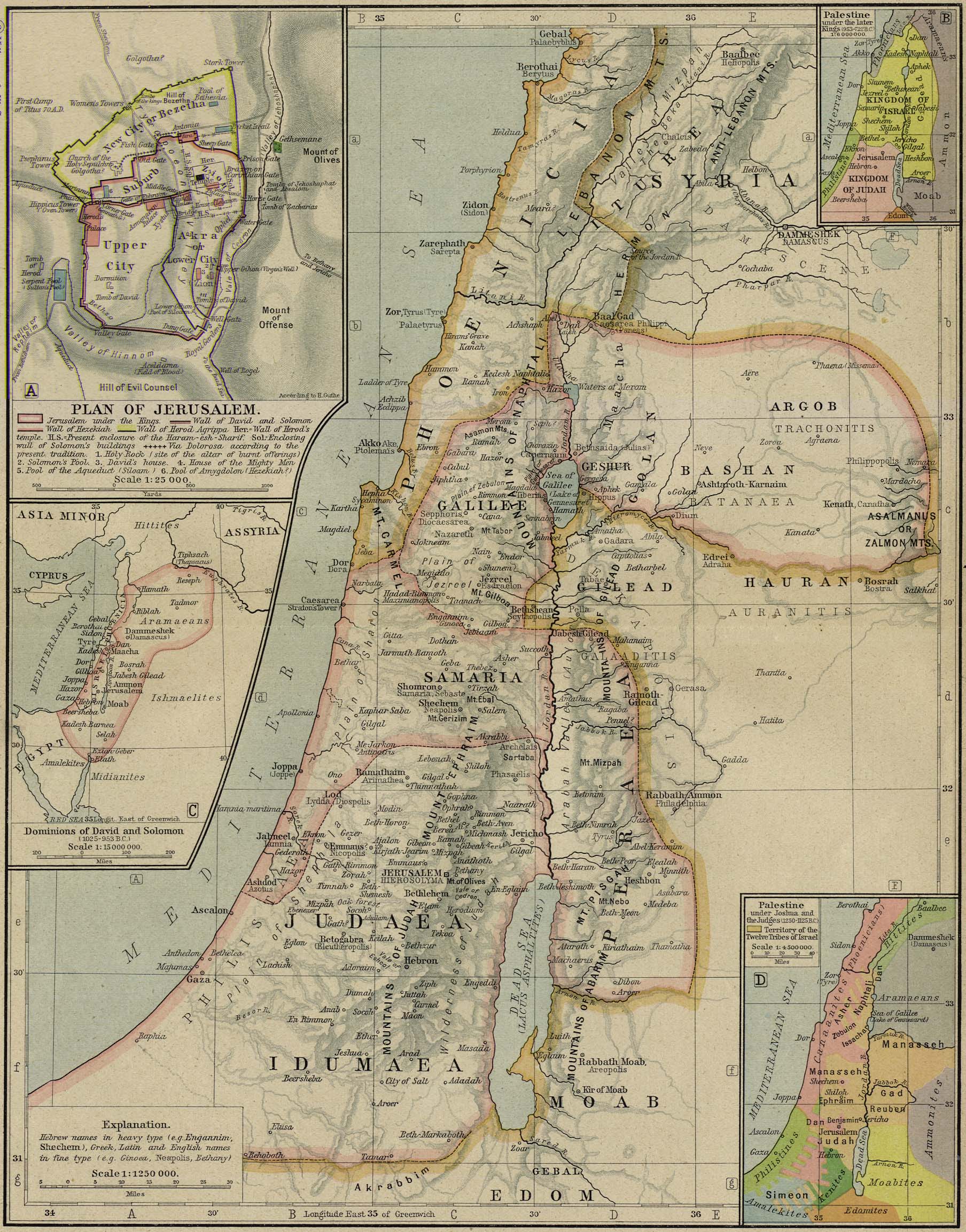
- Known: a score of 800 or more
- The route, in the order the text gives
- 1Jerusalem, The commander sent Paul out at night with a letter. Acts 23:23
- 2Antipatris, The foot soldiers turned back here. Acts 23:31
- 3Caesarea, Felix kept Paul in Herod's Praetorium. Acts 23:35
Base map: Reference map of ancient Palestine, Rand McNally reference map (1926), public domain. Places with a place page stand at its coordinates and the others at the point cited for each, set on the plate by Jerusalem and Damascus, as the plate prints them.
Three places on the Rand McNally reference map of ancient Palestine (1926). Each is known, with a score of 900 or more of 1,000 in the OpenBible identification data.
The Arrest Scene by Scene
Six scenes, from the elders' advice to the night ride north.
James and the elders praised God for Paul's report from the Gentile churches. They also warned him of a rumour among the thousands of Jewish believers in Jerusalem, that he taught Jews abroad to give up Moses.
Take these men, purify yourself along with them, and pay their expenses so they can have their heads shaved. Then everyone will know that there is no truth to these rumors about you, but that you also live in obedience to the law.The elders hoped one public act at the temple would end the rumour.
Paul was at the temple when the seven days were almost over, and Jews from the province of Asia knew him. They roused the crowd and seized him.
For they had previously seen Trophimus the Ephesian with him in the city, and they assumed that Paul had brought him into the temple.Luke shows that the worst charge rested on a guess about a Gentile friend.
Word reached the commander of the Roman regiment, who ran down with soldiers and centurions. He could not learn the facts in the uproar, so he ordered Paul taken into the barracks.
When Paul reached the steps, he had to be carried by the soldiers because of the violence of the mob.Luke names the steps because Paul stood on them to speak a moment later.
Paul spoke to the commander in Greek, and the commander asked whether he was the Egyptian who had led a revolt. Paul named Tarsus as his city and then told the crowd in Hebrew how he had met Jesus. When the commander then ordered him flogged, Paul named his Roman citizenship, and the flogging never began.
Then He said to me, ‘Go! I will send you far away to the Gentiles.’”The crowd heard Paul out until this word of the Lord sent him to the Gentiles.
The next day the commander brought Paul before the chief priests and the whole council. The high priest Ananias had him struck on the mouth, and Paul answered him sharply.
Then Paul, knowing that some of them were Sadducees and others Pharisees, called out in the Sanhedrin, “Brothers, I am a Pharisee, the son of a Pharisee. It is because of my hope in the resurrection of the dead that I am on trial.”Paul's cry set the council's two parties against each other, since they differed on the resurrection.
At daylight more than forty men swore to eat nothing until they had killed Paul. They planned to ambush him when the council asked for him again. The commander sent Paul to Caesarea that night with two hundred soldiers, seventy horsemen and two hundred spearmen.
But when the son of Paul’s sister heard about the plot, he went into the barracks and told Paul.Luke credits Paul's escape from the plot to a member of his own family.
Acts 21:35, Acts 22:21, Acts 23:6, Acts 23:16
The Barrier and the Fortress
Josephus describes the stone barrier the crowd accused Paul of breaking and the fortress the soldiers ran from.
Josephus, the Jewish historian of the first century, describes a stone barrier three cubits high around the inner courts. Pillars stood along it, giving the law of purity in Greek and in Latin. In his Antiquities he adds that the notice forbade any foreigner to go in, on pain of death.
The scholar Clermont-Ganneau found one of these notices in 1871. In Adolf Deissmann's translation, it warns that a foreigner caught inside the screen around the sanctuary will be the cause of his own death. A second, broken copy was found in 1936 by J. H. Iliffe and is now in the Israel Museum.
Josephus places the fortress Antonia at the corner of the temple's western and northern colonnades, on a rock fifty cubits high. Passages led down from it into both colonnades, the way the soldiers of Acts 21:32 ran down to the crowd.
The Egyptian the Commander Named
Josephus tells of the Egyptian false prophet in two books and gives two different numbers.
In his Jewish War, Josephus says an Egyptian who claimed to be a prophet gathered thirty thousand men. When the governor Felix attacked, the Egyptian ran away with a few others.
In the Antiquities, Josephus says Felix killed four hundred of the Egyptian's followers and took two hundred alive, and the Egyptian escaped. The commander in Acts 21:38 speaks of four thousand men, a third number.
What Luke Leaves Unrecorded
Two people and one rite in the story are left without an ending or a name.
The Voices
Three teachers on the vow, the chains and the commander's letter.
Tertullian (died 220)
Against Marcion Book V
Paul gave way for a time
“He therefore made some concession, as was necessary, for a time; and this was the reason why he had Timothy circumcised, and the Nazarites introduced into the temple, which incidents are described in the Acts.”
on Acts 21:23Patristic
Arator (died 544)
ON THE ACTS OF THE APOSTLES 2
Chains could not bind his mind
“Nevertheless the torments that lay harshly upon his constricted arms did not tie his mind, because Paul's epistle, full of light, proclaims that the servants can be bound [but] the faith cannot be bound, and the word is not allowed to be restrained by tortures.”
on Acts 21:33Patristic
Theophylact of Ohrid (died 1107)
Commentary on Acts
A Roman officer cleared him
“Here is a letter written in defense of him and in accusation of the Jews. Look: Paul is acknowledged as innocent not by the Jews, but by foreigners, just as Christ was by Pilate.”
on Acts 23:25Patristic
Where Readers Differ
Two questions about the arrest, with the writers who answer them.
Should Paul have joined the vow?2 paragraphs
W. J. Conybeare and J. S. Howson, in 1869, saw a customary vow of thanks. They took the four men to be believers under a Nazirite vow, the vow of Numbers 6 that ended with the shaving of the head. They thought the elders asked Paul to pay the men's costs from the fund he had brought.
John Calvin, in his Commentary upon the Acts, judged the men's vow itself superstitious. He held that Paul joined it with a free conscience, only to bear with weak brothers.
Is the temple barrier the wall of Ephesians 2:14?2 paragraphs
J. Armitage Robinson, in 1903, read Paul's dividing wall of hostility in Ephesians 2:14 as the barrier that marked how far a Gentile might go. He tied it to the notice Clermont-Ganneau found.
T. K. Abbott, in 1897, thought the figure probably came from the barrier and noted that Trophimus was an Ephesian. He weighed the objection that the wall still stood when the letter was written, and answered that Paul used it as an illustration.
Books to Read Next
Two works, each free to read online.
The Life and Epistles of Saint Paul
W. J. Conybeare and J. S. Howson · 1869 edition
The authors tell the vow, the riot and the rescue from the fortress in chapter 21.
Free at the Internet ArchiveLight from the Ancient East
Adolf Deissmann, translated by Lionel Strachan · 1910
Deissmann prints the temple notice with its text and a translation.
Free at the Internet ArchiveWhat the Arrest Began
The rest of Acts follows Paul in chains, before two governors and a king, and then on the sea road to Rome.
Sources
Scripture is the Berean Standard Bible.
- The Holy Bible, Berean Standard Bible (read 2026)
- Flavius Josephus, The Jewish War and The Antiquities of the Jews, in The Complete Works (CCEL text, print basis 1737)
- Adolf Deissmann, Light from the Ancient East, translated by Lionel R. M. Strachan (London, 1910)
- Wikipedia, Temple Warning inscription.
- W. J. Conybeare and J. S. Howson, The Life and Epistles of Saint Paul, People's Edition (Cincinnati, 1869), chapter 21.
- John Calvin, Commentary upon the Acts of the Apostles, volume 2 (1554), translated by Christopher Fetherstone, edited by Henry Beveridge (1844)
- J. Armitage Robinson, St Paul's Epistle to the Ephesians (London: Macmillan, 1903)
- T. K. Abbott, A Critical and Exegetical Commentary on the Epistles to the Ephesians and to the Colossians (Edinburgh, 1897)
- W. M. Ramsay, St. Paul the Traveller and the Roman Citizen (New York and London: Putnam, 1896), chapter 13.
- Tertullian, Against Marcion.
- Arator, On the Acts of the Apostles.
- Theophylact of Ohrid, Commentary on Acts.
- OpenBible.info, Bible-Geocoding-Data, ancient.jsonl.
- Rand McNally, Reference Map of Ancient Palestine (1926)
Keep Studying
Read it1
People and groups6
Doctrines1
Church history1
Subjects1