
Genesis 37, 40 and 41 · Subject · Featured Study
Dreams in Scripture and in Egypt
The dreams of Joseph, the cupbearer, the baker and Pharaoh, set beside the dreams of Daniel 2 and 4, the Egyptian dream book and the test the law gives a dreamer.
Pharaoh's magicians could not read his dreams, and a Hebrew prisoner told him that God would give the answer.
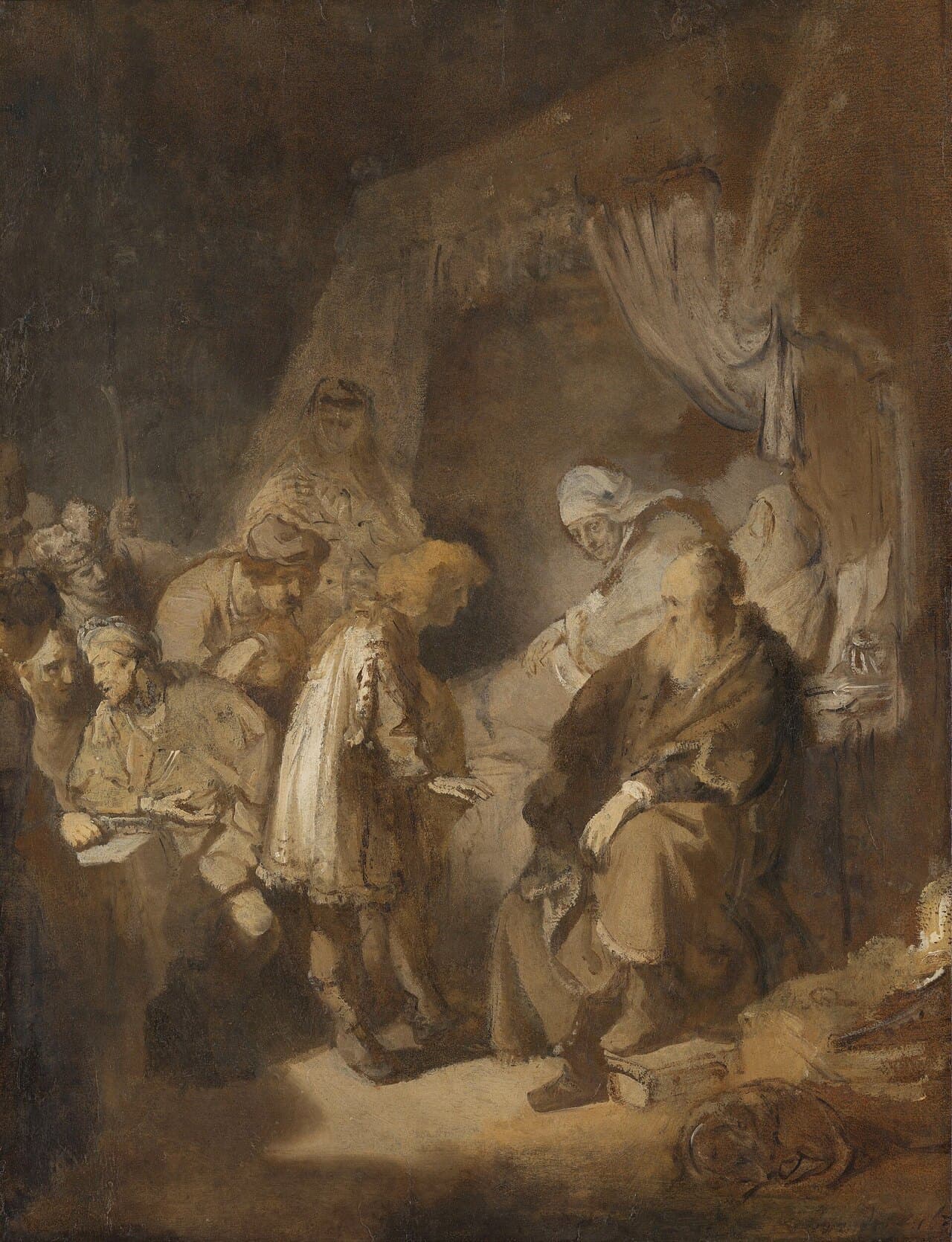
Rembrandt, Joseph Telling His Dreams, about 1633, Rijksmuseum, Amsterdam. Public domain by date, painted before 1930.
THE ARTWORKRembrandt painted Joseph telling his dreams to his family in Genesis 37. The boy stands in the light before Jacob, who sits by the bed and listens, and his brothers crowd together on the left and talk among themselves.
Summary
Scripture records dreams God gave to patriarchs, to foreign kings and to Joseph of Nazareth, and twice, in Egypt and in Babylon, a servant of God reads a king's dream.
- Joseph dreamed twice that his family bowed to him, and his brothers hated him the more for it.
- In prison Joseph read the dreams of Pharaoh's cupbearer and baker, and on the third day one was restored and the other hanged.
- Pharaoh's dreams of cows and grain were one in meaning, and Joseph said the doubling showed that God had decreed it.
- Egyptian scribes kept written dream books that judged each thing seen in a dream as good or bad.
- The law tests a dreamer by whom he leads Israel to follow, and Joel promises dreams when God pours out His Spirit.
Joseph and the Dreams
Genesis 37, 40 and 41 follow Joseph from the dreamer in Canaan to the reader in Pharaoh's court.
Then Joseph had a dream, and when he told it to his brothers, they hated him even more. He said to them, “Listen to this dream I had: We were binding sheaves of grain in the field, and suddenly my sheaf rose and stood upright, while your sheaves gathered around and bowed down to mine.” “Do you intend to reign over us?” his brothers asked. “Will you actually rule us?” So they hated him even more because of his dream and his statements.The brothers understood the first dream at once, and what it said made them hate Joseph more.
Then Joseph had another dream and told it to his brothers. “Look,” he said, “I had another dream, and this time the sun and moon and eleven stars were bowing down to me.” He told his father and brothers, but his father rebuked him and said, “What is this dream that you have had? Will your mother and brothers and I actually come and bow down to the ground before you?” And his brothers were jealous of him, but his father kept in mind what he had said.Jacob reads this dream himself by the question he asks, even as he rebukes his son.
Sold into Egypt and held in the king's prison, Joseph was put in charge of two officers of Pharaoh who had each had a dream on the same night.
“We both had dreams,” they replied, “but there is no one to interpret them.” Then Joseph said to them, “Don’t interpretations belong to God? Tell me your dreams.”Joseph gives the reading to God before he has heard either dream.
After two full years Pharaoh had a dream, woke, and fell back asleep to dream a second time.
In the morning his spirit was troubled, so he summoned all the magicians and wise men of Egypt. Pharaoh told them his dreams, but no one could interpret them for him.Only at this point does the chief cupbearer remember Joseph, who had read his dream two years before.
Pharaoh said to Joseph, “I had a dream, and no one can interpret it. But I have heard it said of you that when you hear a dream you can interpret it.” “I myself cannot do it,” Joseph replied, “but God will give Pharaoh a sound answer.”Pharaoh credits Joseph with the skill, and Joseph refuses the credit.
At this, Joseph said to Pharaoh, “The dreams of Pharaoh are one and the same. God has revealed to Pharaoh what He is about to do.Joseph's reading begins by joining the two dreams into one.
Who Dreamed and Who Read
The dreams of Genesis, of Daniel 2 and 4 and of Matthew, in the order of the canon.
| Dreamer | The dream | Reader | What it meant |
|---|---|---|---|
| Abimelech | God warns him over the woman he has taken | None needed | Return the man's wife and live |
| Jacob | A ladder to heaven, God's angels going up and down, the LORD at the top | None needed | The land for his descendants, and God with him wherever he goes |
| Jacob | The streaked, spotted and speckled males, and the angel of God | None needed | Leave this land and return to your native land |
| Laban | God warns him | None needed | Say nothing to Jacob, either good or bad |
| Joseph | His sheaf stands upright and his brothers' sheaves bow down to it | His brothers | That he would reign over them |
| Joseph | The sun, the moon and eleven stars bow down to him | Jacob | That his father, mother and brothers would bow before him |
| The chief cupbearer | A vine of three branches, and Pharaoh's cup in his hand | Joseph | Restored to his position within three days |
| The chief baker | Three baskets on his head, and birds eating from the top one | Joseph | Hanged within three days |
| Pharaoh | Seven thin cows devour seven well-fed cows | Joseph | Seven years of great abundance |
| Pharaoh | Seven thin heads of grain swallow seven plump ones | Joseph | Seven years of famine after the abundance |
| Nebuchadnezzar | A great statue of gold, silver, bronze, iron and clay, struck by a stone | Daniel | Kingdoms after his, and a kingdom of God that will never be destroyed |
| Nebuchadnezzar | A great tree cut down, with its stump left in the ground | Daniel | The king driven from mankind until he acknowledges that the Most High rules |
| Joseph of Nazareth | An angel of the Lord | None needed | Take Mary as your wife |
| The Magi | A warning | None needed | Do not return to Herod |
| Joseph of Nazareth | An angel of the Lord | None needed | Flee to Egypt with the Child and His mother |
| Joseph of Nazareth | An angel of the Lord in Egypt | None needed | Go to the land of Israel |
| Joseph of Nazareth | A warning | None needed | Withdraw to the district of Galilee |
| Pilate's wife | She suffered terribly because of Jesus | None needed | Have nothing to do with that innocent man |
- Dreamer
- Abimelech
- The dream
- God warns him over the woman he has taken
- Reader
- None needed
- What it meant
- Return the man's wife and live
- Dreamer
- Jacob
- The dream
- A ladder to heaven, God's angels going up and down, the LORD at the top
- Reader
- None needed
- What it meant
- The land for his descendants, and God with him wherever he goes
- Dreamer
- Jacob
- The dream
- The streaked, spotted and speckled males, and the angel of God
- Reader
- None needed
- What it meant
- Leave this land and return to your native land
- Dreamer
- Laban
- The dream
- God warns him
- Reader
- None needed
- What it meant
- Say nothing to Jacob, either good or bad
- Dreamer
- Joseph
- The dream
- His sheaf stands upright and his brothers' sheaves bow down to it
- Reader
- His brothers
- What it meant
- That he would reign over them
- Dreamer
- Joseph
- The dream
- The sun, the moon and eleven stars bow down to him
- Reader
- Jacob
- What it meant
- That his father, mother and brothers would bow before him
- Dreamer
- The chief cupbearer
- The dream
- A vine of three branches, and Pharaoh's cup in his hand
- Reader
- Joseph
- What it meant
- Restored to his position within three days
- Dreamer
- The chief baker
- The dream
- Three baskets on his head, and birds eating from the top one
- Reader
- Joseph
- What it meant
- Hanged within three days
- Dreamer
- Pharaoh
- The dream
- Seven thin cows devour seven well-fed cows
- Reader
- Joseph
- What it meant
- Seven years of great abundance
- Dreamer
- Pharaoh
- The dream
- Seven thin heads of grain swallow seven plump ones
- Reader
- Joseph
- What it meant
- Seven years of famine after the abundance
- Dreamer
- Nebuchadnezzar
- The dream
- A great statue of gold, silver, bronze, iron and clay, struck by a stone
- Reader
- Daniel
- What it meant
- Kingdoms after his, and a kingdom of God that will never be destroyed
- Dreamer
- Nebuchadnezzar
- The dream
- A great tree cut down, with its stump left in the ground
- Reader
- Daniel
- What it meant
- The king driven from mankind until he acknowledges that the Most High rules
- Dreamer
- Joseph of Nazareth
- The dream
- An angel of the Lord
- Reader
- None needed
- What it meant
- Take Mary as your wife
- Dreamer
- The Magi
- The dream
- A warning
- Reader
- None needed
- What it meant
- Do not return to Herod
- Dreamer
- Joseph of Nazareth
- The dream
- An angel of the Lord
- Reader
- None needed
- What it meant
- Flee to Egypt with the Child and His mother
- Dreamer
- Joseph of Nazareth
- The dream
- An angel of the Lord in Egypt
- Reader
- None needed
- What it meant
- Go to the land of Israel
- Dreamer
- Joseph of Nazareth
- The dream
- A warning
- Reader
- None needed
- What it meant
- Withdraw to the district of Galilee
- Dreamer
- Pilate's wife
- The dream
- She suffered terribly because of Jesus
- Reader
- None needed
- What it meant
- Have nothing to do with that innocent man
The Dream Readers of Egypt and Babylon
The trained readers of the royal courts and the written dream book of Egypt.
Genesis 41:8 calls Pharaoh's readers the magicians and wise men of Egypt, and Daniel 2:2 has Nebuchadnezzar summon the magicians, enchanters, sorcerers and astrologers to explain his dreams. John Wesley, on Genesis 41:8, says the rules of the magicians' art failed them, since Pharaoh's dreams did not fall within it.
Papyrus Chester Beatty III, the Egyptian dream bookAlan H. Gardiner, 1935; A. Leo Oppenheim, 1956
The best-known Egyptian dream book is Papyrus Chester Beatty III, copied in the reign of Ramesses II in the thirteenth century BC and now in the British Museum. Alan H. Gardiner published it in 1935 in Hieratic Papyri in the British Museum, Third Series.
Each entry opens with the words if a man sees himself in a dream, names what he saw, judges it good or bad, and gives what it means. The scribe wrote the word bad in red ink.
A. Leo Oppenheim, in The Interpretation of Dreams in the Ancient Near East (1956), set the Egyptian book beside the dream omens of Mesopotamia. He found the same form in both, a dream named and the outcome it was taken to portend.
A written book of this kind is consistent with the court readers of Genesis 41, who were expected to hear a dream and give its meaning.
The readers of Babylon in Daniel 21 passage
The readers of Babylon asked first to be told the dream. Albert Barnes, on Daniel 2:7, says they did not claim to recover a forgotten dream, only to explain a dream told to them.
The astrologers answered the king, “No one on earth can do what the king requests! No king, however great and powerful, has ever asked anything like this of any magician, enchanter, or astrologer. What the king requests is so difficult that no one can tell it to him except the gods, whose dwelling is not with mortals.”The astrologers' own answer shows the limit of their craft, since only the gods could tell a dream the king would not tell.
The Hebrew of Dreams and Their Reading
Five Hebrew words of Genesis 37, 40 and 41.
CHALOM (HEBREW, H2472)
Chalom is the word for a dream, and in Genesis 37:19 the brothers call Joseph baal hachalomot, the master of dreams.
PATHAR (HEBREW, H6622)
Pathar means to interpret a dream, and it stands nine times in seven verses of the Bible, all of them in Genesis 40 and 41.
PITHRON (HEBREW, H6623)
Pithron is the noun for an interpretation, and it stands five times, all of them in Genesis 40 and 41.
CHARTUMMIM (HEBREW, H2748)
Chartummim names the magicians, or diviner priests, of Pharaoh's court at Genesis 41:8 and 24 and in Exodus 7 to 9, and Daniel 1:20 and 2:2 use it of Babylon. Adam Clarke held it to be an Egyptian word whose etymology is unknown.
NAKHON (HEBREW, H3559)
Nakhon means established or certain, and the Berean text renders it decreed in Genesis 41:32.
What the Text Leaves Unsaid
Genesis leaves three questions about the dreams open.
Genesis says that God came to Abimelech and to Laban in a dream, and Joseph tells Pharaoh that God has revealed what He is about to do. The text never says who sent Joseph's own two dreams.
John Wesley, on Genesis 20:3, says God revealed Himself by dreams even to those outside His people, though usually with some regard to His own people.
Now Joseph was the ruler of the land; he was the one who sold grain to all its people. So when his brothers arrived, they bowed down before him with their faces to the ground. And when Joseph saw his brothers, he recognized them, but he treated them as strangers and spoke harshly to them. “Where have you come from?” he asked. “From the land of Canaan,” they replied. “We are here to buy food.” Although Joseph recognized his brothers, they did not recognize him. Joseph remembered his dreams about them and said, “You are spies! You have come to see if our land is vulnerable.”This is where the first dream of Genesis 37 comes to pass, many years after Joseph told it.
Genesis names no method the magicians used and no book they read.
The second dream counts Joseph's mother among those who bow, though Rachel had died on the way to Ephrath. Adam Clarke, on Genesis 37:9, held that any wife of Jacob was enough to fulfil that part of the dream.
The Reading Belongs to God
Joseph and Daniel give the reading to God, a doubled dream is decreed, and the law tests every dreamer.
Joseph and Daniel before two kings1 passage, 1 quotation
Jerome, in his Hebrew Questions on Genesis, notes that the Hebrew of Genesis 41:16 reads without me, and that Symmachus rendered it not I, but God. Rashi, in his commentary on Genesis, reads the word as saying that the wisdom to interpret dreams is not Joseph's own.
John Gill, on Genesis 40:12, observes that three branches are no more like three days than like three months or three years, so Joseph could know the count only by revelation.
Daniel answered the king, “No wise man, enchanter, medium, or magician can explain to the king the mystery of which he inquires. But there is a God in heaven who reveals mysteries, and He has made known to King Nebuchadnezzar what will happen in the latter days. Your dream and the visions that came into your mind as you lay on your bed were these:Daniel gives the king of Babylon the answer Joseph gave the king of Egypt.
Matthew Henry sets the captive's gift against the profession of the Chaldeans.
“What was hidden from the celebrated Chaldeans, who made the interpreting of dreams their profession, is revealed to Daniel, a captive-Jew, a babe, much their junior. God would hereby put honour upon the Spirit of prophecy just when he was putting contempt upon the spirit of divination.”
Matthew Henry · Commentary on the Whole Bible · on Daniel 2:23Puritan
The doubled dream of Genesis 41:321 passage, 1 quotation
Moreover, because the dream was given to Pharaoh in two versions, the matter has been decreed by God, and He will carry it out shortly.Joseph gives the reason the dream came to Pharaoh twice.
Rashi, on Genesis 41:26, reads the doubling as a sign that the thing is ready to happen. Sforno, on Genesis 41:24, says Pharaoh's interpreters failed because they took his dream for two.
Jamieson, Fausset & Brown, on Genesis 37:5, apply the same rule to Joseph's own two dreams, whose repetition under different emblems made their fulfilment certain.
Matthew Henry joins the doubled dream to the two unchangeable things of Hebrews 6:18.
“Thus God has often shown the immutability of his counsel by two immutable things, Heb. vi. The covenant is sealed with two sacraments; and in the one of them there are both bread and wine, wherein the dream is one, and yet it is doubled, for the thing is certain.”
Matthew Henry · Commentary on the Whole Bible · on Genesis 41:32Puritan
The test of a dreamer3 passages
He said, “Hear now My words: If there is a prophet among you, I, the LORD, will reveal Myself to him in a vision; I will speak to him in a dream.Visions and dreams are named as the usual way of revelation, and the next verses set Moses above them.
If a prophet or dreamer of dreams arises among you and proclaims a sign or wonder to you, and if the sign or wonder he has spoken to you comes about, but he says, “Let us follow other gods (which you have not known) and let us worship them,” you must not listen to the words of that prophet or dreamer. For the LORD your God is testing you to find out whether you love Him with all your heart and with all your soul.The test is where the dreamer leads, and a sign that comes about does not settle it.
Let the prophet who has a dream retell it, but let him who has My word speak it truthfully. For what is straw compared to grain?” declares the LORD.Jeremiah sets the dream beside the LORD's word as straw beside grain.
MannaFest's tradition, Wesleyan-Pentecostal, holds that God still speaks in dreams today and that every dream is held to that test.
Voices on the Dreams
Four teachers from the third century to the nineteenth.
The astrologers' admission, Daniel 2:10 to 11Hippolytus of Rome
“And so since they said that what the king sought was impossible to be recounted by a man, God showed them that the things which are impossible with men, are possible with God.”
Hippolytus of Rome · Commentary on Daniel 2.4 · on Daniel 2:10 to 11Patristic
The bowing of the second dream, Genesis 37:10Ambrose of Milan
“Moreover, Joseph saw another dream and told it to his father and brothers, that the sun and moon and eleven stars were bowing down to him. On this account his father reproved him and said, ‘What will be the meaning of this vision that you have dreamed? Can it be that I and your mother and your brothers will come and bow to the ground before you?’ Who is he before whom parents and brothers bowed down to the ground but Jesus Christ?”
Ambrose of Milan · On Joseph the Patriarch · on Genesis 37:10Patristic
A revelation given to Pharaoh, Genesis 41:1John Calvin
“It was certainly a singular honor to be instructed concerning an event yet fourteen years future: for truly the will of God was manifested to Pharaoh, just as if he had been taught by the word, except that the interpretation of it was to be sought elsewhere.”
John Calvin · Commentaries · on Genesis 41:1Reformed
Daniel called in last, Daniel 4:6 to 8Jamieson, Fausset & Brown
“It may seem strange that Daniel was not first summoned. But it was ordered by God's providence that he should be reserved to the last, in order that all mere human means should be proved vain, before God manifested His power through His servant; thus the haughty king was stripped of all fleshly confidences.”
Jamieson, Fausset & Brown · Commentary Critical and Explanatory on the Whole Bible · on Daniel 4:6Reformed
The Age of the Egyptian Detail
Readers date the Egyptian detail of Genesis 40 and 41, the dream readers among it, to two different millennia.
The traditional date, in the second millenniumKenneth A. Kitchen; James K. Hoffmeier
Kenneth A. Kitchen, in On the Reliability of the Old Testament (2003), reads the dream readers and the court titles as fitting Egypt of the second millennium BC. James K. Hoffmeier reads them the same way in Israel in Egypt (1997).
The objection, in Redford's terms, is that the Egyptian names at Genesis 41:45 are of a type common in the first millennium BC.
A later date, in the first millenniumDonald B. Redford
Donald B. Redford, in A Study of the Biblical Story of Joseph (1970), dated the Egyptian colour of the story to the first millennium BC.
The objection, in Kitchen's terms, is that the twenty shekels paid for Joseph at Genesis 37:28 match the price of a slave in the early second millennium BC.
Books on Dreams
Six works on dreams in Egypt, in Babylon and in the church.
On Joseph
Ambrose of Milan · fourth century
Ambrose finds the resurrection of the Lord Jesus revealed in the first dream, where Joseph's sheaf rose up and stood straight.
Hieratic Papyri in the British Museum, Third Series: Chester Beatty Gift
Alan H. Gardiner · 1935
The dream book of Papyrus Chester Beatty III stands on pages 9 to 23 of the first volume, with Gardiner's translation.
In print: find it wherever books are sold.
The Interpretation of Dreams in the Ancient Near East
A. Leo Oppenheim · 1956
Oppenheim's study fills pages 179 to 373 of the Transactions of the American Philosophical Society, volume 46, and it includes a translation of an Assyrian dream book.
In print: find it wherever books are sold.
Dreams and Visions
Jane Hamon · 2000
Hamon's guide helps a believer discern when a dream gives prophetic direction, what to do with a warning and how to recognize a false message.
In print: find it wherever books are sold.
Hearing God Through Your Dreams
Mark Virkler and Charity Virkler Kayembe · 2016
Mark Virkler and his daughter Charity give a practical guide to the language God speaks at night and to the messages in a believer's dreams.
In print: find it wherever books are sold.
Dream Language
James W. Goll and Michal Ann Goll · 2006
The Golls teach a reader to receive, interpret and apply dreams, and to tell Holy Spirit dreams from natural and demonic ones.
In print: find it wherever books are sold.
The Dreams Around Jesus
In Matthew the dreams gather around Jesus, from before His birth to the day of His trial.
But after he had pondered these things, an angel of the Lord appeared to him in a dream and said, “Joseph, son of David, do not be afraid to embrace Mary as your wife, for the One conceived in her is from the Holy Spirit.Joseph obeys the dream at once, for Matthew 1:24 says that when he woke he did as the angel of the Lord had commanded him.
Peter took up the promise of Joel 2:28 in his first sermon.
‘In the last days, God says, I will pour out My Spirit on all people. Your sons and daughters will prophesy, your young men will see visions, your old men will dream dreams.Where Joel 2:28 opens with “And afterward,” Peter says “In the last days,” and so places the promised dreams in the time that began at Pentecost.