
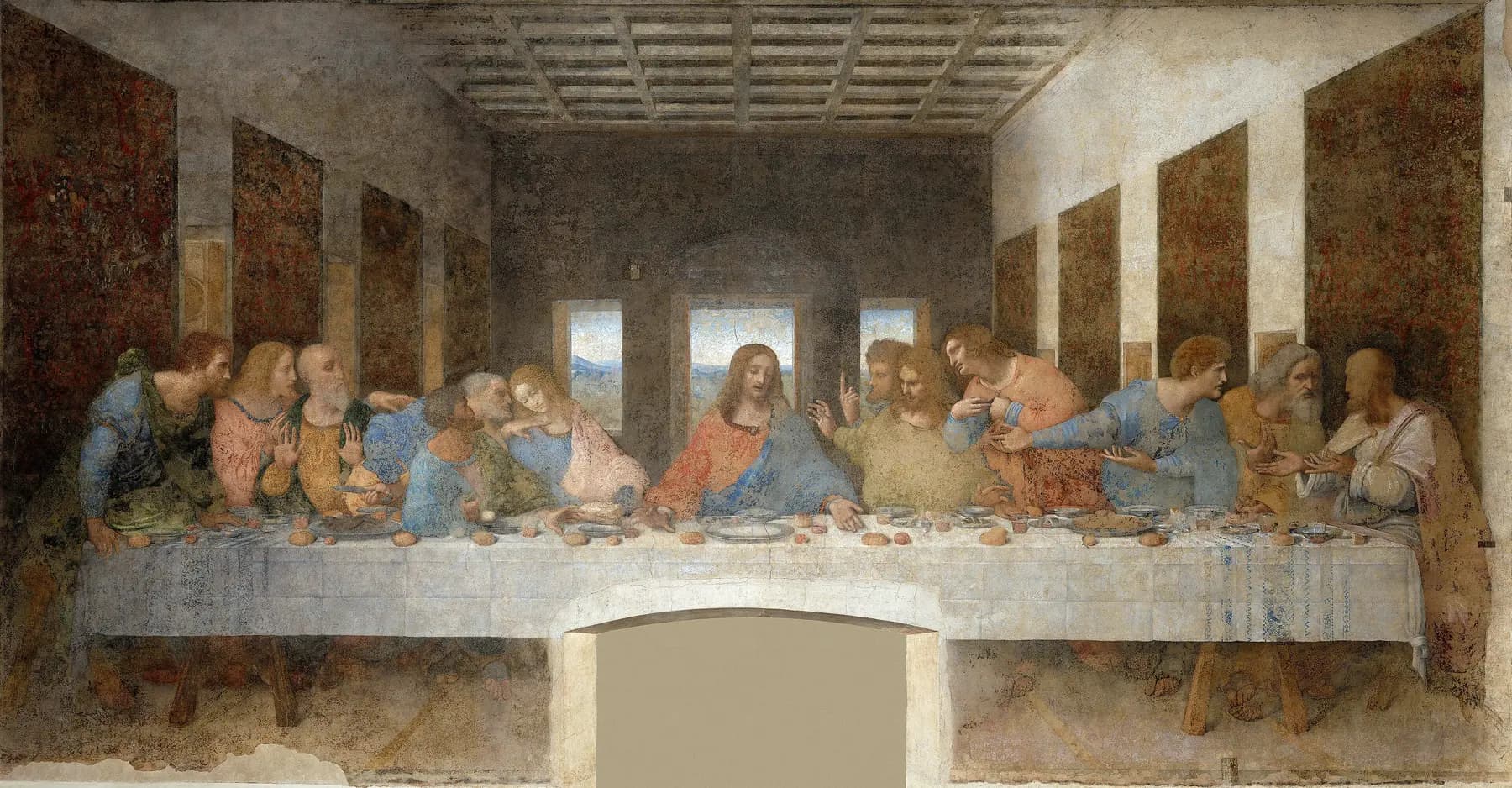
The Last Supper, Leonardo da Vinci, 1495 to 1498. Public domain.
New Testament · Book 46 of 66
1 Corinthians
1 Corinthians is Paul's letter to a divided church in Corinth, answering their questions and correcting their faults. He writes about unity, sexual conduct, worship, spiritual gifts, love and the resurrection of the dead.
1 Corinthians is Paul's letter to a divided church in Corinth, answering their questions and correcting their faults. He writes about unity, sexual conduct, worship, spiritual gifts, love and the resurrection of the dead.
What is 1 Corinthians about?
Paul wrote 1 Corinthians to the church he had planted in Corinth, rich in spiritual gifts and split into parties. He answers first what he has heard: quarrels over their teachers, a man living with his father's wife, and believers taking one another to court. He calls them back to the cross: “we preach Christ crucified” (1:23). He then takes up the questions they wrote to him, one by one: marriage, food offered to idols, the Lord's Supper and the gifts of the Spirit, and he sets love above every gift. The letter ends with the resurrection of Christ and of the body, and the collection for Jerusalem.
All 16 chapters
Every chapter of the book, in one grid. Each cell opens that chapter.
- The church divided and the crossChapters 1 to 4
- The report of what is done among youChapters 5 to 6
- The questions they wroteChapter 7
- Idols, the table and the assemblyChapters 8 to 11
- The gifts and the greater wayChapters 12 to 14
- The resurrection and the collectionChapters 15 to 16
The colour is the movement of the letter the chapter stands in, and every cell opens that chapter's Study level. Red to orange is what Paul heard; yellow to indigo is what they wrote about, then the resurrection.
Who wrote it, where, when, for whom, and why?
The letter opens in the names of Paul, called to be an apostle of Christ Jesus by the will of God, and Sosthenes his brother (1:1), and Paul writes the closing greeting in his own hand (16:21). He calls himself their father through the gospel (4:15). Acts tells how Paul came to Corinth from Athens, worked with Aquila and Priscilla as a tentmaker, and taught there a year and a half (Acts 18:1 to 11).
Even if you have ten thousand guardians in Christ, you do not have many fathers; for in Christ Jesus I became your father through the gospel.
1 Corinthians 4:15, Berean Standard Bible.
Paul writes from Ephesus, where he means to stay until Pentecost because a great door has opened to him (16:8 to 9), and the churches of the province of Asia send greetings (16:19). He plans to come to Corinth through Macedonia (16:5).
The letter was written after Paul's first stay in Corinth, while Gallio was proconsul of Achaia (Acts 18:12), and during his time in Ephesus, which Acts gives as more than two years (Acts 19:10). Paul had already written them an earlier letter (5:9).
The letter is sent to the church of God in Corinth, those sanctified in Christ Jesus and called to be holy, together with all who call on the name of the Lord everywhere (1:2). Most of them had been pagans led astray to mute idols (12:2), and not many were wise, powerful or of noble birth (1:26).
Paul writes because Chloe's household told him of quarrels (1:11), because a case of immorality was reported (5:1), and because the church had written him questions (7:1). Some were saying there is no resurrection of the dead (15:12), and the collection for the saints was to be gathered (16:1 to 2).
The letter names meat offered in idols' temples and sold in the market (8:10, 10:25), lawsuits before pagan judges (6:1), a shared meal where one goes hungry while another gets drunk (11:21), and the games, where runners race for a crown that fades (9:24 to 25).
Sources. 1 Corinthians 1:1, 1:2, 1:11, 1:26, 4:15, 5:1, 5:9, 6:1, 7:1, 8:10, 9:24 to 25, 10:25, 11:21, 12:2, 15:12, 16:1 to 2, 16:5, 16:8 to 9, 16:19 and 16:21; Acts 18:1 to 12; Acts 19:10. Every verse is read in the Berean Standard Bible.
How is 1 Corinthians arranged, and what is it for?
The six movements the letter falls into, then what it teaches and what it was written to do.
- The church divided and the crossChapters 1 to 4, 91 verses, the turn at 1:18
The quarrels over Paul, Apollos and Cephas answered by the message of the cross.
- The report of what is done among youChapters 5 to 6, 33 verses, the turn at 6:19
A man with his father's wife, lawsuits before unbelievers, and the body a temple.
- The questions they wroteChapter 7, 40 verses, the turn at 7:17
Marriage, the unmarried, the believer with an unbelieving spouse, virgins and widows.
- Idols, the table and the assemblyChapters 8 to 11, 107 verses, the turn at 10:31
Food offered to idols, Paul's rights laid down, Israel's examples and the Lord's Supper.
- The gifts and the greater wayChapters 12 to 14, 84 verses, the turn at 13:13
One Spirit and many gifts, one body and many members, love, prophecy and tongues.
- The resurrection and the collectionChapters 15 to 16, 82 verses, the turn at 15:20
The gospel received, the risen Christ the firstfruits, the body raised, and the collection.
The theme
The message of the cross is the power of God to those being saved, and it judges every boast the church made in its teachers, its knowledge, its freedom and its gifts. The church is God's temple and each believer's body is a temple of the Holy Spirit, bought at a price, so what is done in the body matters. Freedom yields to the weaker brother, every gift serves the one body, and love is the greatest. The gospel stands on Christ raised, the firstfruits of the dead, and the body will be raised imperishable.
The purpose
Paul wrote to a church he had planted to end its quarrels, to correct what had been reported to him, and to answer the questions it had sent him in writing. He wanted them united in mind and conviction (1:10), holy in the body, orderly in the assembly, sure of the resurrection, and ready with the collection for Jerusalem when he came.
What Paul heard, and what they wrote to ask
What Paul heard (4)
Reports brought to him, chapters 1 to 6 and 11.
- 1:11The quarrels. “there are quarrels among you” (1:11)
- 5:1The immorality. “It is actually reported that there is sexual immorality among you” (5:1)
- 6:1The lawsuits. “how dare he go to law before the unrighteous instead of before the saints” (6:1)
- 11:18The divisions at the table. “I hear that when you come together as a church, there are divisions among you” (11:18)
What they wrote about (6)
Each opened with now about, chapters 7 to 16.
- 7:1Marriage. “Now for the matters you wrote about” (7:1)
- 7:25Virgins. “Now about virgins” (7:25)
- 8:1Food offered to idols. “Now about food sacrificed to idols” (8:1)
- 12:1Spiritual gifts. “Now about spiritual gifts” (12:1)
- 16:1The collection. “Now about the collection for the saints” (16:1)
- 16:12Apollos. “Now about our brother Apollos” (16:12)
The church divided and the cross, 1 Corinthians 1 to 4
What the text says in these 91 verses, and the pages they open on.
Chloe's household has told Paul of quarrels, each saying I follow Paul, or Apollos, or Cephas, or Christ (1:11 to 12). He answers with the cross: God saves those who believe through what the world calls foolishness, Christ crucified, and he chose the weak so that no one may boast (1:18 to 31). The Spirit reveals the deep things of God (2:10). Paul and Apollos are servants: one planted, one watered, and God gave the growth; the church is God's field, building and temple (3:5 to 17). The servants are stewards judged by the Lord, and Paul writes as their father in the gospel (4:1 to 17).
For the message of the cross is foolishness to those who are perishing, but to us who are being saved it is the power of God.
- Study
1 Corinthians 1the greeting, the quarrels and Christ crucifiedShow the summary and 3 pagesShow summary, 3 pagesHide the summary
After greeting, Paul thanks God for the Corinthians' gifts, then confronts their factions. Paul, Apollos, Cephas, Christ. Is Christ divided? The preaching of the cross is to them that perish foolishness, but to us that are saved, the power of God. God has chosen the foolish, weak, base, and despised things of this world. That no flesh should glory in his presence. He that glorieth, let him glory in the Lord. Calvin reads the chapter as a frontal rebuke of pride in human teachers masquerading as zeal for the gospel.
On this chapter (3)
- Christ our wisdom
Christ made wisdom from God for us.
- Who were the parties of 1:12, and was there a Christ party?
Answered under Where do readers disagree, lower on this page, with each reading and who holds it.
- 1 Corinthians 1:18
The verse on its own page, with the commentators on it by era.
- Christ our wisdom
- Study
1 Corinthians 2Paul's weakness and the wisdom the Spirit revealsShow the summary and 2 pagesShow summary, 2 pagesHide the summary
Paul determined to know nothing among them but Jesus Christ and him crucified. He came not with excellency of speech but in demonstration of the Spirit and of power. We speak wisdom among the perfect. God's wisdom in a mystery, hidden, now revealed by the Spirit. The natural man receiveth not the things of the Spirit; the spiritual man judgeth all things. We have the mind of Christ. Henry notes the chapter's double rebuke. To the Greek philosopher and to the boastful Christian preacher.
On this chapter (2)
- Who the Holy Spirit is
The Spirit who searches the deep things of God.
- 1 Corinthians 2:10
The verse on its own page, with the commentators on it by era.
- Who the Holy Spirit is
- Study
1 Corinthians 3one plants, one waters; the field, the building, the templeShow the summary and 2 pagesShow summary, 2 pagesHide the summary
You are still carnal. Divisions prove it. Paul planted, Apollos watered, God gave the increase. The foundation is Jesus Christ; every man's work shall be tried by fire. Do you not know that you are the temple of God, and that the Spirit dwells in you? Let no man glory in men. All things are yours; and you are Christ's; and Christ is God's. JFB observes the reframing. Instead of Christians belonging to teachers, teachers and all things belong to Christians in Christ.
On this chapter (2)
- The church
God's field, building and temple.
- 1 Corinthians 3:16
The verse on its own page, with the commentators on it by era.
- The church
- Study
1 Corinthians 4stewards judged by the Lord; the father who sends TimothyShow the summary and 1 pageShow summary, 1 pageHide the summary
Paul answers the judgments of the Corinthian faction. It is a small thing to be judged of them; the Lord alone judges. The apostles are made a spectacle to the world, a show for angels and men. You are full, you are rich, you have reigned as kings without us. Paul sends Timothy to remind them of his ways in Christ. He will come shortly. Shall it be with a rod or in love and meekness? Calvin reads the chapter as the apostolic cross in contrast to the Corinthian enthronement.
On this chapter (1)
- 1 Corinthians 4:15
The verse on its own page, with the commentators on it by era.
- 1 Corinthians 4:15
The wisdom of the world and the message of the cross
| The pair | The world | The cross |
|---|---|---|
| The perishing and the saved | The world“foolishness to those who are perishing” (1:18) | The cross“to us who are being saved it is the power of God” (1:18) |
| The world's wisdom and what was preached | The world“Has not God made foolish the wisdom of the world?” (1:20) | The cross“God was pleased through the foolishness of what was preached to save those who believe” (1:21) |
| The Jews and the Greeks | The world“Jews demand signs and Greeks search for wisdom” (1:22) | The cross“Christ the power of God and the wisdom of God” (1:24) |
| The wise and the foolish | The world“Not many of you were wise by human standards” (1:26) | The cross“God chose the foolish things of the world to shame the wise” (1:27) |
| The strong and the weak | The world“not many were powerful” (1:26) | The cross“God chose the weak things of the world to shame the strong” (1:27) |
| The boast | The world“so that no one may boast in His presence” (1:29) | The cross“Let him who boasts boast in the Lord” (1:31) |
Characters (3)
Who the text names. A name with a page carries its door.
- Paul and Sosthenes
The senders; Paul planted the church (1:1, 3:6).
- Cephas
Peter; with Apollos, a name the parties used (1:12).
- Chloe's household
Those who told Paul of the quarrels (1:11).
Themes (3)
What these chapters raise, each on its own page where one stands.
- Christ our wisdom
Christ made wisdom from God for us (1:30).
- The church
God's field, building and temple (3:9 to 16).
- Take up your cross
The cross in the teaching of Jesus.
Where these chapters take up the Old Testament (5)each marked as a quotation or an allusion, with the evidence
- Explicit quotationIsaiah 29:14 at 1:19. God will destroy the wisdom of the wise. Introduced with for it is written; Isaiah says the wisdom of the wise will vanish.
- Explicit quotationJeremiah 9:24 at 1:31. Let him who boasts boast in the Lord. Introduced with as it is written; Jeremiah's verse goes on to knowing the LORD.
- Explicit quotationIsaiah 64:4 at 2:9. No eye has seen and no ear has heard what God has prepared. Introduced with as it is written, in words close to Isaiah's.
- Explicit quotationIsaiah 40:13 at 2:16. Who has known the mind of the Lord, so as to instruct Him? Isaiah asks who has directed the Spirit of the LORD.
- Explicit quotationJob 5:13 and Psalm 94:11 at 3:19 to 20. He catches the wise in their craftiness, and the Lord knows their thoughts are futile. Introduced with as it is written and and again.
Beside it: Acts 18:1 to 11, Paul's year and a half in Corinth, and Acts 18:24 to 19:1, Apollos at Corinth; 2 Corinthians 10 to 13 takes up Paul's weakness again.
The report of what is done among you, 1 Corinthians 5 to 6
What the text says in these 33 verses, and the pages they open on.
A man has his father's wife, and the church is proud when it should grieve (5:1 to 2). Paul tells them to hand him over to Satan so that his spirit may be saved (5:5), and to clear out the old leaven, for Christ, our Passover lamb, has been sacrificed (5:6 to 8). Brothers take each other to court before unbelievers, when the saints will judge the world (6:1 to 8). They were washed, sanctified and justified (6:11). The body is for the Lord: it will be raised, it is a member of Christ, and it is a temple of the Holy Spirit, bought at a price (6:13 to 20).
Do you not know that your body is a temple of the Holy Spirit who is in you, whom you have received from God? You are not your own;
- Study
1 Corinthians 5the man with his father's wife; the old leaven cleared outShow the summary and 4 pagesShow summary, 4 pagesHide the summary
Notorious fornication among them. A man has his father's wife. And they are puffed up instead of mourning. Paul commands the church, gathered in the name of the Lord Jesus, to deliver the man to Satan for the destruction of the flesh, that the spirit may be saved. Purge out the old leaven; Christ our passover is sacrificed for us. Keep the feast with sincerity and truth. Henry reads the chapter as the principle of church discipline, grounded in the gospel's moral seriousness.
On this chapter (4)
- Unleavened bread
The feast and the leaven cleared out.
- The Lamb
Christ, our Passover lamb.
- When and from where was 1 Corinthians written, and what was the earlier letter of 5:9?
Answered under Where do readers disagree, lower on this page, with each reading and who holds it.
- 1 Corinthians 5:7
The verse on its own page, with the commentators on it by era.
- Unleavened bread
- Study
1 Corinthians 6lawsuits before unbelievers; the body a temple, bought at a priceShow the summary and 3 pagesShow summary, 3 pagesHide the summary
Lawsuits before the unjust. Shame that they cannot judge between themselves. The unrighteous shall not inherit the kingdom of God. And such were some of you, but you were washed, sanctified, justified. All things are lawful for me, but not all expedient. Do you not know that your bodies are members of Christ? You were bought with a price; therefore glorify God in your body. Wesley stresses that the gospel's indicative: "you were washed". Produces the imperative: "glorify God with your body."
On this chapter (3)
- Discipline and lawsuits
Judging inside the church.
- Sanctification
Washed, sanctified, justified.
- 1 Corinthians 6:19
The verse on its own page, with the commentators on it by era.
- Discipline and lawsuits
The old leaven and the feast
Your boasting is not good. Do you not know that a little leaven works through the whole batch of dough? Get rid of the old leaven, that you may be a new unleavened batch, as you really are. For Christ, our Passover lamb, has been sacrificed. Therefore let us keep the feast, not with the old bread, leavened with malice and wickedness, but with the unleavened bread of sincerity and of truth.
For seven days you must eat unleavened bread. On the first day you are to remove the leaven from your houses. Whoever eats anything leavened from the first day through the seventh must be cut off from Israel. On the first day you are to hold a sacred assembly, and another on the seventh day. You must not do any work on those days, except to prepare the meals—that is all you may do. So you are to keep the Feast of Unleavened Bread, for on this very day I brought your divisions out of the land of Egypt. You must keep this day as a permanent statute for the generations to come. In the first month you are to eat unleavened bread, from the evening of the fourteenth day until the evening of the twenty-first day. For seven days there must be no leaven found in your houses. If anyone eats something leavened, that person, whether a foreigner or native of the land, must be cut off from the congregation of Israel. You are not to eat anything leavened; eat unleavened bread in all your homes.”
Characters (2)
Who the text names. A name with a page carries its door.
- The man with his father's wife
The case the church was proud of (5:1 to 2).
- The saints
Who will judge the world and angels (6:2 to 3).
Themes (3)
What these chapters raise, each on its own page where one stands.
- Unleavened bread
The feast behind the old leaven (5:7 to 8).
- Discipline and lawsuits
Judging inside the church, not outside it.
- Sanctification
Washed, sanctified and justified (6:11).
Where these chapters take up the Old Testament (3)each marked as a quotation or an allusion, with the evidence
- Probable allusionExodus 12:15 to 20 at 5:6 to 8. The old leaven cleared out, the unleavened batch and the feast kept. The Passover lamb and the seven days of unleavened bread, named without a formula.
- Explicit quotationDeuteronomy 17:7 at 5:13. Expel the wicked man from among you. The closing words of the Deuteronomy law, given without a formula.
- Explicit quotationGenesis 2:24 at 6:16. The two will become one flesh. Introduced with for it is said.
Beside it: 2 Corinthians 2:5 to 11, where Paul asks the church to forgive and comfort the one who caused grief.
The questions they wrote, 1 Corinthians 7
What the text says in these 40 verses, and the pages they open on.
Paul turns to the matters they wrote about (7:1). Husband and wife owe each other their bodies (7:2 to 5). The unmarried and widows do well to remain as he is, but it is better to marry than to burn with passion (7:8 to 9). The married are not to separate, by the Lord's command (7:10 to 11). A believer is not to divorce an unbelieving spouse, but is not bound if the unbeliever leaves (7:12 to 16). Each one should lead the life the Lord assigned, circumcised or not, slave or free (7:17 to 24). The virgins and the widows are given Paul's judgment, because the time is short (7:25 to 40).
Regardless, each one should lead the life that the Lord has assigned to him and to which God has called him. This is what I prescribe in all the churches.
- Study
1 Corinthians 7the married, the unmarried, the virgins and the widowsShow the summary and 2 pagesShow summary, 2 pagesHide the summary
Paul's extended counsel on marriage and singleness. It is good for a man not to touch a woman, yet to avoid fornication, let every man have his own wife. Render due benevolence. Let not the believing spouse depart from the unbelieving. Abide in the calling in which you were called. Paul recommends singleness for those without obligation, given the present distress, but warns against binding consciences. Calvin sees the chapter as pastoral wisdom applied to diverse circumstances under the gospel's freedom.
On this chapter (2)
- Marriage, singleness and divorce
Paul's counsel case by case.
- 1 Corinthians 7:17
The verse on its own page, with the commentators on it by era.
- Marriage, singleness and divorce
5 cases in chapter 7, and whose word each is
| Who | Verses | Whose word | The counsel |
|---|---|---|---|
| The married | Verses7:10 to 11 | Whose wordThe Lord's command (7:10) | The counsel“A wife must not separate from her husband” (7:10) |
| The unmarried and widows | Verses7:8 to 9 | Whose wordPaul's counsel | The counsel“It is good for them to remain unmarried, as I am” (7:8) |
| A believer with an unbelieving spouse | Verses7:12 to 16 | Whose wordPaul, not the Lord (7:12) | The counsel“he must not divorce her” (7:12) |
| The virgins | Verses7:25 to 38 | Whose wordPaul's judgment, no command (7:25) | The counsel“I think it is good for a man to remain as he is” (7:26) |
| The widow | Verses7:39 to 40 | Whose wordPaul's judgment (7:40) | The counsel“she is free to marry anyone she wishes, as long as he belongs to the Lord” (7:39) |
Characters (2)
Who the text names. A name with a page carries its door.
- The married and the unmarried
Counselled in turn (7:8 to 11).
- The virgins and the widows
Given Paul's judgment, not a command (7:25, 7:39).
Places (1)
Where the chapters stand.
- All the churches
Where Paul gives the same rule (7:17).
Themes (3)
What these chapters raise, each on its own page where one stands.
- Marriage, singleness and divorce
Paul's counsel in chapter 7, case by case.
- Divorce
What Jesus and Paul say of it.
- Marriage and family
The house as Scripture orders it.
Where these chapters take up the Old Testament (0)each marked as a quotation or an allusion, with the evidence
These chapters quote no Old Testament passage.
Beside it: Acts 18:2, where Aquila and Priscilla, a married couple, work beside Paul in Corinth.
Idols, the table and the assembly, 1 Corinthians 8 to 11
What the text says in these 107 verses, and the pages they open on.
Knowledge puffs up but love builds up (8:1). An idol is nothing, but a brother with a weak conscience may fall by what he sees, so Paul will not eat meat if it makes him stumble (8:4 to 13). Paul has an apostle's rights and uses none, becoming all things to all men to win some (9:1 to 23). Israel drank from the rock that was Christ, yet most fell in the wilderness, as examples for us (10:1 to 13). The cup of the Lord and the cup of demons cannot both be drunk (10:21). Paul then orders the head covering in prayer and prophecy (11:2 to 16) and corrects the divisions at the Lord's Supper (11:17 to 34).
So whether you eat or drink or whatever you do, do it all to the glory of God.
- Study
1 Corinthians 8knowledge puffs up, love builds up; the weak brotherShow the summary and 2 pagesShow summary, 2 pagesHide the summary
Meat offered to idols. Knowledge puffs up; charity builds up. We know that an idol is nothing in the world, and there is none other God but one. Yet some have conscience bound by idols, and through your knowledge the weak brother will perish, for whom Christ died. Paul declares: if meat make my brother to offend, I will eat no flesh while the world stands. Henry reads this chapter and the next two as the Christian-liberty principle bounded by love of the brother.
On this chapter (2)
- Food offered to idols
Knowledge, love and the weak brother.
- 1 Corinthians 8:1
The verse on its own page, with the commentators on it by era.
- Food offered to idols
- Study
1 Corinthians 9Paul's rights, the ox not muzzled, the race and the crownShow the summary and 1 pageShow summary, 1 pageHide the summary
Paul defends his apostolic right to support. A soldier goeth not a warfare on his own charges. Yet he uses not his right, lest he hinder the gospel. To the Jews he became as a Jew; to them under the law as under the law; to the weak as weak. All things to all men, that he might by all means save some. This I do for the gospel's sake. He runs not uncertainly, fights not as one beating the air; he keeps his body under. Calvin marks the apostle's self-denial for the gospel's sake.
On this chapter (1)
- 1 Corinthians 9:22
The verse on its own page, with the commentators on it by era.
- 1 Corinthians 9:22
- Study
1 Corinthians 10Israel's examples, the rock, the cup of the LordShow the summary and 2 pagesShow summary, 2 pagesHide the summary
Israel in the wilderness. All drank of the spiritual Rock that followed them, and that Rock was Christ. But with many of them God was not well pleased. Let him who thinks he stands take heed lest he fall. God is faithful, who will not suffer you to be tempted beyond what you are able. Flee from idolatry. The cup of blessing, the communion of the blood of Christ. Whatever you do, do all to the glory of God. JFB reads the chapter as Israel-typology applied to Christian conduct.
On this chapter (2)
- The rock in the wilderness
The rock that was Christ.
- 1 Corinthians 10:13
The verse on its own page, with the commentators on it by era.
- The rock in the wilderness
- Study
1 Corinthians 11the head covering; the Lord's Supper received unworthilyShow the summary and 4 pagesShow summary, 4 pagesHide the summary
Head coverings: the man the image and glory of God; the woman the glory of the man. But neither is the man without the woman, nor the woman without the man, in the Lord. Then. The Lord's Supper. Divisions at the table profane the feast. Paul repeats the institution: the Lord Jesus, the same night in which he was betrayed, took bread. Let a man examine himself; he that eateth and drinketh unworthily, eateth and drinketh damnation. Henry reads the chapter as the apostolic instruction on the proper observance of the ordinances.
On this chapter (4)
- Head coverings
The covering in prayer and prophecy.
- The Lord's Supper
What Paul received from the Lord.
- What is the head covering of 11:2 to 16, and what does because of the angels mean?
Answered under Where do readers disagree, lower on this page, with each reading and who holds it.
- 1 Corinthians 11:26
The verse on its own page, with the commentators on it by era.
- Head coverings
The Supper, in Paul and in Luke
For I received from the Lord what I also passed on to you: The Lord Jesus, on the night He was betrayed, took bread, and when He had given thanks, He broke it and said, “This is My body, which is for you; do this in remembrance of Me.” In the same way, after supper He took the cup, saying, “This cup is the new covenant in My blood; do this, as often as you drink it, in remembrance of Me.” For as often as you eat this bread and drink this cup, you proclaim the Lord’s death until He comes.
And He took the bread, gave thanks and broke it, and gave it to them, saying, “This is My body, given for you; do this in remembrance of Me.” In the same way, after supper He took the cup, saying, “This cup is the new covenant in My blood, which is poured out for you.
Characters (3)
Who the text names. A name with a page carries its door.
- The weak brother
Wounded by what he sees (8:10 to 12).
- Moses
Into whom Israel was baptized (10:2).
- Barnabas
Named with Paul as working for a living (9:6).
Places (2)
Where the chapters stand.
- The wilderness
Where most of Israel fell (10:5).
- An idol's temple
Where the weak brother sees another eat (8:10).
Themes (3)
What these chapters raise, each on its own page where one stands.
- Food offered to idols
The question of chapters 8 to 10.
- The rock in the wilderness
That rock was Christ (10:4).
- The Lord's Supper
What Paul received from the Lord.
Where these chapters take up the Old Testament (4)each marked as a quotation or an allusion, with the evidence
- Explicit quotationDeuteronomy 25:4 at 9:9. Do not muzzle an ox while it is treading out the grain. Introduced with it is written in the Law of Moses.
- Probable allusionExodus 17:6 and Numbers 20:11 at 10:4. The spiritual rock that accompanied them, and that rock was Christ. The water from the rock at Horeb and at Meribah, named without a formula.
- Explicit quotationExodus 32:6 at 10:7. The people sat down to eat and drink and got up to indulge in revelry. Introduced with as it is written, of the golden calf.
- Explicit quotationPsalm 24:1 at 10:26. The earth is the Lord's, and the fullness thereof. Given as the reason any meat sold in the market may be eaten.
Beside it: Acts 15:20 and 15:29, the letter of the council on things sacrificed to idols; 2 Corinthians 11:7 to 9, Paul's refusal of support again.
The gifts and the greater way, 1 Corinthians 12 to 14
What the text says in these 84 verses, and the pages they open on.
No one can say Jesus is Lord except by the Holy Spirit (12:3). There are different gifts but one Spirit, who gives each as he determines, from wisdom and healing to prophecy, tongues and their interpretation (12:4 to 11). The church is one body with many members, and the weaker members are indispensable (12:12 to 27). Without love every gift is nothing; love never fails, and when the perfect comes the partial passes away (13:1 to 12). Paul wishes they all spoke in tongues, but more that they prophesied, because prophecy builds up the church, and all is to be done in order (14:1 to 40).
And now these three remain: faith, hope, and love; but the greatest of these is love.
- Study
1 Corinthians 12one Spirit, many gifts; one body, many membersShow the summary and 2 pagesShow summary, 2 pagesHide the summary
Now concerning spiritual gifts, Paul will not have them ignorant. There are diversities of gifts, but the same Spirit. For as the body is one and has many members, so also is Christ. God has tempered the body together, that the members should have the same care one for another. Whether one member suffer, all suffer with it. Covet earnestly the best gifts. And yet I show you a more excellent way. Calvin marks the chapter as the charter of Christian community under gift-diversity.
On this chapter (2)
- Spiritual gifts
The gifts of the one Spirit.
- 1 Corinthians 12:7
The verse on its own page, with the commentators on it by era.
- Spiritual gifts
- Study
1 Corinthians 13the more excellent way of loveShow the summary and 2 pagesShow summary, 2 pagesHide the summary
The love chapter. Though I speak with tongues of men and angels, and have not charity, I am nothing. Charity suffers long and is kind; does not envy; does not boast; is not puffed up; does not behave rudely; does not seek her own. Charity never fails. Now we see through a glass darkly; but then face to face. And now faith, hope, charity abide, these three; but the greatest of these is charity. Wesley reads this as the crown of the Corinthian correctives. Every gift is nothing without love.
On this chapter (2)
- The love chapter
The more excellent way.
- 1 Corinthians 13:4
The verse on its own page, with the commentators on it by era.
- The love chapter
- Study
1 Corinthians 14prophecy and tongues; order in the assemblyShow the summary and 5 pagesShow summary, 5 pagesHide the summary
Prophecy edifies the church; tongues edify the speaker unless interpreted. Let all things be done for building up. I had rather speak five words with my understanding than ten thousand in an unknown tongue. God is not the author of confusion, but of peace. Let your women keep silence in the churches. Let all things be done decently and in order. Henry reads the chapter as the apostolic rulebook for public worship. Order serves edification, which serves love.
On this chapter (5)
- Speaking in tongues
The gift and its interpretation.
- Prophecy as a gift today
The gift that builds up.
- What are the tongues of chapters 12 to 14, and how are they used today?
Answered under Where do readers disagree, lower on this page, with each reading and who holds it.
- Is 14:34 to 35 original, and where do the manuscripts place it?
Answered under Where do readers disagree, lower on this page, with each reading and who holds it.
- 1 Corinthians 14:1
The verse on its own page, with the commentators on it by era.
- Speaking in tongues
One body and its members
What love does, and what it does not
Love does
Characters (2)
Who the text names. A name with a page carries its door.
- The prophets
Two or three speak, and the others weigh it (14:29).
- The one who speaks in a tongue
Speaks to God and prays to interpret (14:2, 14:13).
Places (1)
Where the chapters stand.
- The assembly
Where all is done in a fitting and orderly way (14:40).
Themes (3)
What these chapters raise, each on its own page where one stands.
- Spiritual gifts
The gifts of the one Spirit (12:4 to 11).
- The love chapter
Chapter 13 read whole.
- Speaking in tongues
The gift, its use and its interpretation.
Where these chapters take up the Old Testament (1)each marked as a quotation or an allusion, with the evidence
- Explicit quotationIsaiah 28:11 to 12 at 14:21. By strange tongues and foreign lips I will speak to this people. Introduced with it is written in the Law.
Beside it: Acts 19:6, tongues and prophecy at Ephesus, where this letter was written; Romans 12:4 to 8, the one body and its gifts.
The resurrection and the collection, 1 Corinthians 15 to 16
What the text says in these 82 verses, and the pages they open on.
Christ died for our sins, was buried, was raised on the third day according to the Scriptures, and appeared to many witnesses (15:3 to 8). If there is no resurrection of the dead, faith is futile and the dead have perished (15:12 to 19). But Christ has been raised, the firstfruits, and as in Adam all die, so in Christ all will be made alive, until the last enemy, death, is destroyed (15:20 to 28). The body is sown perishable and raised imperishable, and at the last trumpet we will all be changed (15:42 to 57). The letter closes with the collection for Jerusalem, Paul's plans and greetings (16:1 to 24).
But Christ has indeed been raised from the dead, the firstfruits of those who have fallen asleep.
- Study
1 Corinthians 15the gospel received, the witnesses, the body raisedShow the summary and 4 pagesShow summary, 4 pagesHide the summary
The gospel declared. Christ died for our sins according to the scriptures, was buried, rose again the third day according to the scriptures. Now if Christ be preached that he rose from the dead, how say some that there is no resurrection? If Christ be not risen, your faith is vain; you are still in your sins. But now is Christ risen from the dead, the firstfruits of them that slept. The last Adam a quickening spirit. Death is swallowed up in victory. Calvin reads this as the gospel's cornerstone chapter.
On this chapter (4)
- The resurrection chapter
Chapter 15 read whole.
- The two Adams
The first man and the last Adam.
- What is baptism for the dead in 15:29?
Answered under Where do readers disagree, lower on this page, with each reading and who holds it.
- 1 Corinthians 15:3
The verse on its own page, with the commentators on it by era.
- The resurrection chapter
- Study
1 Corinthians 16the collection, the plans, the greetingsShow the summary and 2 pagesShow summary, 2 pagesHide the summary
The collection for the saints. Upon the first day of the week let every one lay by him in store. Paul's travel plan: through Macedonia to them, perhaps wintering. A great door and effectual is opened to him at Ephesus, and there are many adversaries. Keep watch, stand firm in the faith, act like men, be strong. Let all your things be done with charity. If any man love not the Lord Jesus Christ, let him be Anathema Maranatha. Henry reads the chapter as the apostle's closing. Practical, pastoral, pointed to Christ.
On this chapter (2)
- The grace of giving
The collection for the saints.
- 1 Corinthians 16:2
The verse on its own page, with the commentators on it by era.
- The grace of giving
The 6 appearances Paul lists, in his order
- 1Cephas“He appeared to Cephas” (15:5)
- 2The Twelve“then to the Twelve” (15:5)
- 3More than five hundred“He appeared to more than five hundred brothers at once, most of whom are still living” (15:6)
- 4James“Then He appeared to James” (15:7)
- 5All the apostles“then to all the apostles” (15:7)
- 6Paul“last of all He appeared to me also” (15:8)
Characters (3)
Who the text names. A name with a page carries its door.
- Timothy and Apollos
Timothy may come; Apollos will come later (16:10 to 12).
- Stephanas and his companions
Fortunatus and Achaicus came with him from Corinth (16:17).
- Aquila and Prisca
The church in their house greets them (16:19).
Places (3)
Where the chapters stand.
- Ephesus
Where Paul stays until Pentecost (16:8).
- Jerusalem
Where the gift for the saints goes (16:3).
- Galatia, Macedonia and Achaia
The collection's direction and Paul's road (16:1 to 15).
Themes (3)
What these chapters raise, each on its own page where one stands.
- The resurrection chapter
Chapter 15 read whole.
- Firstfruits
Christ the firstfruits (15:20).
- The two Adams
The first man and the last Adam (15:45).
Where these chapters take up the Old Testament (4)each marked as a quotation or an allusion, with the evidence
- Explicit quotationPsalm 8:6 at 15:27. God has put everything under His feet. Read of the risen Christ, with the one exception of God himself.
- Explicit quotationIsaiah 22:13 at 15:32. Let us eat and drink, for tomorrow we die. The words of the feasters Isaiah condemns, given without a formula.
- Explicit quotationGenesis 2:7 at 15:45. The first man Adam became a living being. Introduced with so it is written.
- Explicit quotationIsaiah 25:8 and Hosea 13:14 at 15:54 to 55. Death swallowed up in victory, and where, O Death, is your sting? Introduced with the saying that is written will come to pass.
Beside it: Acts 18:12 to 17, Gallio and Sosthenes at Corinth; 2 Corinthians 8 to 9, the collection taken up again.
- Author
- Paul, with Sosthenes (1:1)
- Date
- c. AD 55, from Ephesus
- Audience
- The church at Corinth: a gifted, factious, morally compromised congregation
Where do readers disagree?
One list: the readings with their holders, and what the evidence does not settle.
When and from where was 1 Corinthians written, and what was the earlier letter of 5:9?
- From Ephesus, with an earlier letter now lost. Held by Robert Jamieson, A. R. Fausset and David Brown, Commentary Critical and Explanatory on the Whole Bible (1871), on 5:9 and 16:8, and by Ambrosiaster, Commentary on Paul's Epistles, on 5:9.
- An answer to a letter from Corinth, in the order of its questions. Held by John C. Hurd, The Origin of I Corinthians (1965).
- Now about marks a new subject, not always their letter. Held by Margaret M. Mitchell, 'Concerning PERI DE in 1 Corinthians', Novum Testamentum 31 (1989).
- The letter of 5:9 is this letter. Held by Theodoret of Cyrus, Commentary on the First Epistle to the Corinthians, on 5:9, and by Adam Clarke, Commentary on the Bible (1832), on 5:9.
What the evidence does not settle: The letter names Ephesus and Pentecost but no year; the year is reached through Gallio's term in Acts 18:12, and no copy of an earlier letter survives.
The argument in full
From Ephesus, with an earlier letter now lost. Paul says he will stay in Ephesus until Pentecost (16:8), and nothing earlier in this letter tells them not to associate with the immoral, so 5:9 points to a letter before this one.
An answer to a letter from Corinth, in the order of its questions. The Corinthians wrote back after Paul's earlier letter, and each section opened with now about takes up one of their questions in turn (7:1, 7:25, 8:1, 12:1, 16:1, 16:12).
Now about marks a new subject, not always their letter. The phrase introduces a topic both writer and readers know, so only 7:1 is tied to their letter by Paul's own words.
The letter of 5:9 is this letter. Paul has just said that a little leaven works through the whole batch (5:6), and I wrote can refer to what he has written above.
Who were the parties of 1:12, and was there a Christ party?
- Four parties, one of them claiming Christ. Held by Adam Clarke, Commentary on the Bible, on 1:12, and by F. C. Baur, 'Die Christuspartei in der korinthischen Gemeinde', Tübinger Zeitschrift für Theologie (1831).
- The names are a figure for the real leaders of the parties. Held by Theodoret of Cyrus, Commentary on the First Epistle to the Corinthians, on 1:12, and by Ambrosiaster, Commentary on Paul's Epistles, on 1:12.
- Those who said I follow Christ spoke well but despised their teachers. Held by John Wesley, Explanatory Notes upon the New Testament, on 1:12.
What the evidence does not settle: The letter never describes what each group taught; after 1:12 only Paul and Apollos are named together as servants (3:4 to 6).
The argument in full
Four parties, one of them claiming Christ. The verse gives four sayings in one form, and Is Christ divided? in the next verse answers the fourth as much as the others.
The names are a figure for the real leaders of the parties. Paul says he has applied these things to himself and Apollos for their benefit (4:6), so the names are a figure for others.
Those who said I follow Christ spoke well but despised their teachers. Following Christ is what Paul asks of all, so the fault was in using his name against the teachers God gave.
What is the head covering of 11:2 to 16, and what does because of the angels mean?
Head coverings, argued in full→- A covering worn in worship, and the angels present at it. Held by Matthew Henry, Commentary on the Whole Bible (1710), on 11:10, who says the ministering angels are present in the assemblies.
- A covering because of the angels who fell. Held by Tertullian in On Prayer, chapter 22, where he ties the verse to the angels who revolted on account of the daughters of men.
- A sign of that church's custom. Held by Albert Barnes, Notes, Explanatory and Practical, on the Old and New Testaments (1832), on 11:10.
What the evidence does not settle: Whether the covering is a veil or long hair, since 11:15 says hair is given as a covering, and which angels 11:10 means, since the verse says only 'because of the angels'.
The argument in full
A covering worn in worship, and the angels present at it. Paul grounds the practice in creation (11:8 to 9) and in the angels, not only in custom.
A covering because of the angels who fell. Genesis 6:2 tells of the sons of God who took the daughters of men, and the covering is a guard in worship.
A sign of that church's custom. Paul appeals to what nature itself teaches and to the practice of the churches of God (11:14 to 16), which points to the sign as that age read it.
What are the tongues of chapters 12 to 14, and how are they used today?
Speaking in tongues→- Languages given by the Spirit, spoken to God. Held by Thomas Aquinas, Commentary on 1 Corinthians, on 14:2, and by Robert Jamieson, A. R. Fausset and David Brown, Commentary Critical and Explanatory on the Whole Bible (1871), on 14:2, who say the speaker speaks to God, who alone understands all languages.
- Prayer and praise in the Spirit beyond the speaker's own mind. Held by Gordon D. Fee, God's Empowering Presence: The Holy Spirit in the Letters of Paul (1994).
- A sign for every believer and a gift for the assembly. Held by Donald Gee, Concerning Spiritual Gifts (1928).
What the evidence does not settle: Whether every tongue at Corinth was a human language, since 14:2 says no one understands him and 13:1 names the tongues of angels. This site's tradition, Wesleyan-Pentecostal, teaches that the gifts of chapters 12 to 14 are given today, until the perfect comes and we see face to face (13:10 to 12).
The argument in full
Languages given by the Spirit, spoken to God. At Pentecost the hearers heard their own languages (Acts 2:6 to 8), and Paul calls the gift different kinds of tongues (12:10).
Prayer and praise in the Spirit beyond the speaker's own mind. The one who speaks in a tongue utters mysteries in the Spirit and his mind is unfruitful (14:2, 14:14), and Paul names the tongues of men and of angels (13:1).
A sign for every believer and a gift for the assembly. Paul asks do all speak in tongues? (12:30) of the gift in the assembly, while he wishes they all spoke in tongues (14:5) and thanks God he speaks in tongues more than all of them (14:18).
What is baptism for the dead in 15:29?
- A practice of some at Corinth, cited without approval. Held by Ambrosiaster, Commentary on Paul's Epistles, on 15:29, who says some were baptized for the dead for fear the unbaptized would not rise.
- Baptized to fill the place of believers who have died. Held by John Wesley, Explanatory Notes upon the New Testament (1755), on 15:29.
- Baptized in the faith of the resurrection of the dead. Held by John Chrysostom in the Homilies on First Corinthians, homily 40.
What the evidence does not settle: The phrase stands only here in Scripture, and no other text of the first century describes the practice.
The argument in full
A practice of some at Corinth, cited without approval. Paul says those who are baptized, in the third person, and then turns to we in 15:30, so he names what others do and argues from it.
Baptized to fill the place of believers who have died. The next verses speak of danger every hour (15:30), so the verse is read of converts who take the place of those fallen in the cause of Christ.
Baptized in the faith of the resurrection of the dead. Every believer is baptized confessing the resurrection of the dead, and the confession is empty if the dead are not raised (15:29).
Is 14:34 to 35 original, and where do the manuscripts place it?
Women in ministry→- Original, in its place after 14:33. Held by Bruce M. Metzger, A Textual Commentary on the Greek New Testament (second edition, 1994), for the committee of the United Bible Societies.
- Added in the margin and copied into the text in two places. Held by Gordon D. Fee, The First Epistle to the Corinthians (1987).
- Original, and a rule for that congregation. Held by Kenneth E. Hagin, The Woman Question (1975).
What the evidence does not settle: Why a few copies place the verses after 14:40; no manuscript leaves them out.
The argument in full
Original, in its place after 14:33. Every Greek manuscript carries the two verses, and those that put them after 14:40 are a few copies of the Western text, which moved them.
Added in the margin and copied into the text in two places. Codex Claromontanus and a few other Western witnesses read the verses after 14:40, and they break the subject of prophecy running from 14:29 to 14:40.
Original, and a rule for that congregation. Paul has already spoken of women who pray and prophesy (11:5), so the silence of 14:34 is read as a rule for disorder in that assembly.
The Text and the Spade
- The Gallio inscription at Delphia letter of the emperor Claudius, dated by his imperial acclamations to AD 51 or 52
Fragments of a stone letter set up at Delphi name Lucius Junius Gallio as proconsul of Achaia, and the emperor's acclamation number dates it. This is the same Gallio before whom Paul was brought at Corinth in Acts 18:12, 'the Jews coordinated an attack on Paul and brought him before the judgment seat'. Proconsuls held office for a year, so the stone anchors Paul's eighteen months in Corinth to about AD 50 to 52 and this letter, written later from Ephesus, to the middle of that decade. It is the single most useful date in Pauline chronology.
- The bema in the Corinthian forumbuilt in the mid-first century AD; excavated by the American School of Classical Studies at Athens from 1896 onward
A monumental stone platform faced with marble stands in the middle of the forum, flanked by waiting rooms, where the Roman governor heard cases in the open air. The Greek word for it is the word Acts uses twice in the Gallio scene, rendered 'judgment seat' at 18:12 and again at 18:17. The structure is still standing, and it is the place where the charge against Paul was thrown out.
- The Erastus pavement inscriptionfound in 1929 near the theatre at Corinth; the paving is mid-first century AD
Large letters cut into a paving block record that Erastus laid the pavement at his own expense in return for his aedileship, a Roman city magistracy. Paul, writing to Rome from Corinth, sends greetings from 'Erastus, the city treasurer' (Romans 16:23), and 1 Corinthians assumes members of that social level in the congregation (1:26). Whether the two are the same man is genuinely disputed, because the Greek title in Romans is not the ordinary equivalent of aedile; Justin Meggitt argued against the identification (Novum Testamentum, 1996) and others accept it on the grounds that Corinthian titles moved between Latin and Greek loosely. The stone proves at least that a man of that name and rank was paying for public works in Corinth in the right decade.
- The macellum inscription from Corinth1st century AD; published by Henry J. Cadbury, 'The Macellum of Corinth' (Journal of Biblical Literature, 1934)
A Latin inscription from the excavations preserves the word macellum, the term for a Roman provision market, and the excavators identified a market building near the forum. The word behind 'meat market' at 10:25 is the Greek form of that same Latin word: 'Eat anything sold in the meat market without raising questions of conscience'. The instruction is about a specific building in the city Paul was writing to, where meat from temple sacrifices was sold alongside every other kind, and the find puts the reader in the doorway of it.
- The sanctuary of Poseidon at Isthmia and the biennial gamesthe sanctuary in use from the archaic period; the games administered by Roman Corinth in the 1st century AD
Corinth ran the Isthmian games, second in prestige only to Olympia, a few miles from the city. The athletic language of 9:24-27 is drawn straight from them: 'in a race all the runners run, but only one receives the prize' (9:24), the competitor who 'trains with strict discipline' (9:25), and above all the prize itself, 'a crown that is perishable', because the Isthmian victor was crowned with a wreath of greenery that withered within days. Paul sets an imperishable crown against a wreath his readers had watched go brown.
- The temple of Aphrodite on Acrocorinth and the city's reputationStrabo's report (Geography 8.6.20) written c. AD 7 to 23, describing the Greek city destroyed in 146 BC; excavation of the summit sanctuary from 1926
Strabo reports that the temple of Aphrodite on the mountain above old Corinth owned more than a thousand temple slaves who served as prostitutes, and that their trade filled the city. The report is real and it is ancient, and it is the origin of Corinth's byword reputation, which stands behind the vice list of 6:9-11 and the warning of 6:15-16. Two things have to be said honestly beside it. Strabo is describing the Greek city Rome destroyed a century before Paul, and the sanctuary excavated on the Roman summit is small. Sarah Pomeroy and others have questioned how much institutional temple prostitution the sources really establish anywhere in the Greek world. What is not in question is the Roman colony's own character as a port city with two harbors, or the plain reading of what Paul says some of his readers had been: 'And that is what some of you were. But you were washed, you were sanctified' (6:11).
The pages 1 Corinthians opens on
Studies149
- The Resurrection Chapter
- Spiritual Gifts
- The Love Chapter
- The Lord's Supper
- Speaking in Tongues
- Head Coverings
Show the next 6 titles
- Food Offered to Idols
- Christ Our Wisdom
- The Two Adams
- Women in Ministry
- Prophecy as a Gift Today
- 1 Thessalonians, the Study Guide
Show the next 6 titles
- Afterlife Vocabulary
- Discipline and Lawsuits
- Divorce: What Jesus Said
- Marriage, Singleness, and Divorce: 1 Corinthians 7
- Order in Worship
- Paul and the Poets
Show the next 6 titles
- Paul's Thorn
- Philemon, the Study Guide
- I Discipline My Body
- The Bible and Slavery
- The Body and Sexual Ethics in Scripture
- The Rock in the Wilderness
Show the next 6 titles
- The Wilderness Generation
- Power Made Perfect in Weakness: 2 Corinthians 12:7-10
- The Tabernacle
- The Bronze Serpent
- The Rapture: the Blessed Hope and the Four Timings
- The Ending of Mark: 16:9-20
Show the next 6 titles
- Second Adam
- The Words Emunah and Pistis
- Gideon's Fleece
- Infant Baptism and Believers' Baptism
- Irony in Scripture: More Than the Speaker Knows
- Judith
Show the next 6 titles
- The Christian Traditions
- Wisdom Before Christ
- Father, Forgive Them
- Who the Holy Spirit Is
- Fire
- God Dwelling with His People, from Eden to the New Jerusalem
Show the next 6 titles
- The Intermediate State
- The Judgment Seat of Christ
- Gold, Silver, Bronze & Iron
- Priscilla: She Explained the Way More Accurately
- Rewards
- The Retribution Teaching and Its Limits
Show the next 6 titles
Show the next 6 titles
- How Scripture Shapes Christian Ethics
- In the World, Not of It
- Passover
- The Appointed Times Read as a Calendar of Prophecy
- The Christian Year
- The Date of the Exodus
Show the next 6 titles
- The Exodus, Redemption's Master-Type
- The Lamb
- The Passover and the First Month
- The Second Passover
- The Seder, the Meal Exodus 12 Is Kept By
- The Three Pilgrim Feasts
Show the next 6 titles
- Unequally Yoked
- The Feast of Unleavened Bread
- Joseph and the Tale of Two Brothers
- Made Holy
- The Bride & the Jewish Wedding
- Vows in Israel
Show the next 6 titles
- Marriage and the Household
- The Words Enkrateia and the City Without Walls
- Work and Vocation
- The Deity of Christ
- Augustine's Three Answers
- Love Is Patient
Show the next 6 titles
- The Religion of Egypt: Its Gods and Practices
- The Shema
- The Trinity
- Barnabas, a Good Man
- The Crown
- The Nazirite Vow
Show the next 6 titles
Show the next 6 titles
- Grumbling, the Opposite of Thanks
- Manna
- Moses Strikes the Rock
- The Covenant of Phinehas
- Redemption
- Joseph and Potiphar's Wife
Show the next 6 titles
- The blood rule after the cross
- The Burning Bush: the Name Revealed
- The Crossing of the Jordan
- The Nile
- The Pillar of Cloud and Fire
- The Quail at Kibroth-hattaavah
Show the next 6 titles
- The Red Sea Crossing
- The Route out of Egypt
- The Solas of the Reformation
- The Song of Moses
- The Song of the Sea
- Upon This Rock
Show the next 6 titles
- Water
- The Words Todah, Yadah and Eucharisteo
- Discerning of Spirits
- Healing
- The Church
- The Spirit given for craft: Bezalel and Oholiab
Show the next 6 titles
- Words of Knowledge & Wisdom
- Blessed Are the Pure in Heart
- Love
- Mouth to Mouth: How God Spoke with Moses
- The Face
- The Golden Rule
Show the next 6 titles
- Paul
- True and false prophets
- The Seven Brothers and Their Mother
- Adam
- Adam to Noah
- The Numbers of Scripture
Show the next 6 titles
Words8
Books beside it6
Sources for this page
The movements, the chapter entries, the figures and the Context are read off the text of 1 Corinthians, with Acts 18 and 19 for the setting. The works behind the readings under Where do readers disagree are Tertullian, On Prayer (about 200); John Chrysostom, Homilies on First Corinthians (about 390); Ambrosiaster, Commentary on Paul's Epistles (about 380); Theodoret of Cyrus, Commentary on the First Epistle to the Corinthians (about 440); Thomas Aquinas, Commentary on 1 Corinthians (about 1270); Matthew Henry, Commentary on the Whole Bible (1710); John Wesley, Explanatory Notes upon the New Testament (1755); Adam Clarke, Commentary on the Bible (1832); Albert Barnes, Notes, Explanatory and Practical, on the Old and New Testaments, 1832 to 1869; F. C. Baur, Die Christuspartei in der korinthischen Gemeinde (1831); Robert Jamieson, A. R. Fausset and David Brown, Commentary Critical and Explanatory on the Whole Bible (1871); Donald Gee, Concerning Spiritual Gifts (1928); John C. Hurd, The Origin of I Corinthians (1965); Kenneth E. Hagin, The Woman Question (1975); Gordon D. Fee, The First Epistle to the Corinthians (1987) and God's Empowering Presence (1994); Margaret M. Mitchell, Concerning PERI DE in 1 Corinthians, Novum Testamentum 31 (1989); and Bruce M. Metzger, A Textual Commentary on the Greek New Testament (1994). Every verse quoted on this page is the Berean Standard Bible, read from the store.