
1 Samuel 16 to 1 Kings 2 · Person · Featured Study
David
The life of David from his anointing at Bethlehem to his burial in the City of David, told in 1 and 2 Samuel, 1 Kings, 1 Chronicles and the Psalms.
Every later king of Judah is measured against David, and the first verse of the New Testament calls Jesus the son of David.
- Died
- at about seventy
- Family
- father: Jesse; great-grandmother: Ruth; wife: Michal; wife: Abigail; wife: Bathsheba; son: Absalom; son: Solomon
- Places
- Bethlehem, The Valley of Elah, Nob, En-gedi, Ziklag, Mount Gilboa, Hebron, Zion, Jerusalem
- First named
- Ruth 4:17
- Last named
- Revelation 22:16
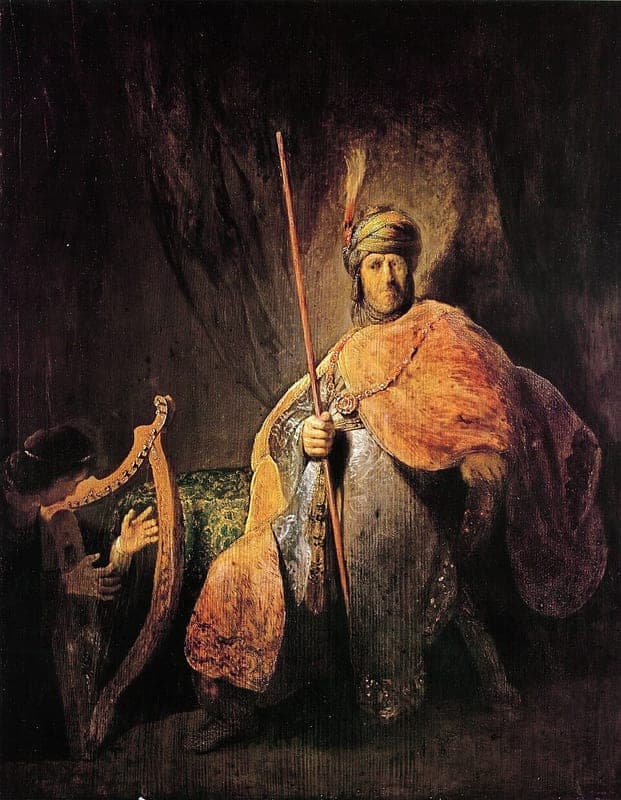
Rembrandt, David Playing the Harp before Saul, between 1629 and 1631. Public domain, via Wikimedia Commons.
THE ARTWORKRembrandt set the king in gold light with the spear upright in his hand and left the young musician in shadow at the edge, in the room where that spear would later be thrown.
Summary
David, the youngest son of Jesse of Bethlehem, was anointed by Samuel while he kept his father's sheep and reigned forty years over Judah and Israel.
- He served Saul as a musician and a soldier, then fled from him and twice refused to kill him.
- He reigned seven years and six months at Hebron and thirty-three years at Jerusalem, the fortress he took from the Jebusites.
- Through the prophet Nathan, God promised him a house and a throne established forever.
- He took Bathsheba, the wife of Uriah, and had Uriah killed; he confessed when Nathan confronted him, and he was forgiven.
Where David Stands in Scripture
His first line and his last
His name first stands at the close of Ruth, in the line of Boaz and Ruth.
The neighbor women said, “A son has been born to Naomi,” and they named him Obed. He became the father of Jesse, the father of David.His first line names his grandfather Obed.
The last chapter of the Bible returns to him.
“I, Jesus, have sent My angel to give you this testimony for the churches. I am the Root and the Offspring of David, the bright Morning Star.”Jesus calls Himself both the Root of David and his Offspring.
The Life, Turn by Turn
Each turn with the place where it happened, or his age where the text gives it
- Anointed by SamuelBethlehem, 1 Samuel 16:13
- Plays the harp for SaulSaul's court, 1 Samuel 16:23
- Kills the Philistine championthe Valley of Elah, 1 Samuel 17:50
- Makes a covenant with JonathanSaul's court, 1 Samuel 18:3
- Flees and eats the holy breadNob, 1 Samuel 21:6
- Spares Saul in the caveEn-gedi, 1 Samuel 24:4
- Serves Achish of GathZiklag, 1 Samuel 27:6
- Laments Saul and Jonathanafter Gilboa, 2 Samuel 1:17
- Anointed king over JudahHebron, age 30, 2 Samuel 2:4
- Takes the fortress of ZionJerusalem, 2 Samuel 5:7
- Brings up the arkthe City of David, 2 Samuel 6:15
- Receives the promise of a housethrough Nathan, 2 Samuel 7:16
- Takes Bathsheba, has Uriah killedJerusalem and Rabbah, 2 Samuel 11:27
- Flees from Absalomthe Mount of Olives, 2 Samuel 15:30
- Buys the threshing floorAraunah's floor, 2 Samuel 24:24
- Dies and is buriedthe City of David, after forty years, 1 Kings 2:10
The timeline draws sixteen turns of the life.
From the Sheepfold to the Throne
1 Samuel 16 to 1 Kings 2
Samuel comes to Bethlehem to anoint one of Jesse's sons, and the LORD passes over the tall firstborn Eliab for the youngest, who is out with the sheep.
In Saul's service David becomes the army's hero and marries Michal, until Saul's jealousy drives him into the wilderness.
After Saul and Jonathan fall in battle with the Philistines, Judah anoints David at Hebron, and later all Israel follows.
He takes Jerusalem and brings the ark into it, and after the sin against Uriah the rest of his reign is spent among the consequences in his own family.
Anointed at Bethlehem1 Samuel 16 and 17
But the LORD said to Samuel, “Do not consider his appearance or height, for I have rejected him; the LORD does not see as man does. For man sees the outward appearance, but the LORD sees the heart.”This is the measure the books of Kings later apply to the kings of Judah.
A chapter later a Philistine of great height defies Israel in the Valley of Elah, and David answers him in the name of the LORD.
But David said to the Philistine, “You come against me with sword and spear and javelin, but I come against you in the name of the LORD of Hosts, the God of the armies of Israel, whom you have defied.David names whose battle it is before he swings the sling.
Saul's court and the years on the run1 Samuel 18 to 30
The next day a spirit of distress sent from God came upon Saul, and he prophesied inside the house while David played the harp as usual. Now Saul was holding a spear, and he hurled it, thinking, “I will pin David to the wall.” But David eluded him twice.The court that heard his harp became the place he had to flee.
At Nob the priest Ahimelech gives the fugitive the holy bread, and Doeg the Edomite reports it. Saul has eighty-five priests killed and the town put to the sword.
Then David said to Abiathar, “I knew that Doeg the Edomite was there that day, and that he was sure to tell Saul. I myself am responsible for the lives of everyone in your father’s house.David tells the one surviving son of Ahimelech that the deaths are on him.
So he said to his men, “The LORD forbid that I should do such a thing to my master, the LORD’s anointed. May I never lift my hand against him, since he is the LORD’s anointed.”His reason is the anointing Saul still carries.
David, however, said to himself, “One of these days now I will be swept away by the hand of Saul. There is nothing better for me than to escape to the land of the Philistines. Then Saul will stop searching for me all over Israel, and I will slip out of his hand.”He decides to go over to the Philistines, and the text gives no word of God behind the decision.
King at Hebron, then at Jerusalem2 Samuel 2 to 6
David was thirty years old when he became king, and he reigned forty years. In Hebron he reigned over Judah seven years and six months, and in Jerusalem he reigned thirty-three years over all Israel and Judah.The reign divides between two capitals.
The first attempt to bring up the ark ends with Uzzah struck dead beside it. Chronicles records that the second attempt had the Levites carry it, as the law required.
And David, wearing a linen ephod, danced with all his might before the LORD,His wife Michal despises him for this dance before the LORD.
The promise of a house2 Samuel 7
And when your days are fulfilled and you rest with your fathers, I will raise up your descendant after you, who will come from your own body, and I will establish his kingdom. He will build a house for My Name, and I will establish the throne of his kingdom forever.Solomon builds the house, and the promise of forever reaches past him.
Then King David went in, sat before the LORD, and said, “Who am I, O Lord GOD, and what is my house, that You have brought me this far?David answers by asking who he is, and the question shows he takes the house as a gift he did not earn.
Kindness for Jonathan's sake2 Samuel 9
“Do not be afraid,” said David, “for surely I will show you kindness for the sake of your father Jonathan. I will restore to you all the land of your grandfather Saul, and you will always eat at my table.”Jonathan's lame son is given Saul's land and a seat at the king's table.
The word for the kindness David shows here is chesed, the word God used two chapters earlier for the loving devotion He would never remove from David's son.
Bathsheba, Uriah and Nathan2 Samuel 11 and 12
So David sent and inquired about the woman, and he was told, “This is Bathsheba, the daughter of Eliam and the wife of Uriah the Hittite.” Then David sent messengers to get her, and when she came to him, he slept with her. (Now she had just purified herself from her uncleanness.) Then she returned home.He is told whose wife she is, and then he sends for her.
In the letter he wrote: “Put Uriah at the front of the fiercest battle; then withdraw from him, so that he may be struck down and killed.”Uriah carries his own death sentence to the front.
And when the time of mourning was over, David had her brought to his house, and she became his wife and bore him a son. But the thing that David had done was evil in the sight of the LORD.After twenty-six verses without comment, the narrator gives one sentence of judgment.
Nathan tells the king of a rich man who took a poor man's one ewe lamb. David sentences the man in the story to death and to repay four times over, and Nathan answers that David is the man.
Then David said to Nathan, “I have sinned against the LORD.” “The LORD has taken away your sin,” Nathan replied. “You will not die.The confession and the forgiveness come in one verse.
Now, therefore, the sword will never depart from your house, because you have despised Me and have taken the wife of Uriah the Hittite to be your own.’The consequence Nathan announced before the confession is never lifted.
Rashi reads the fourfold repayment David had pronounced as paid in four of his children: the infant, Amnon, Tamar and Absalom.
The sword in his house2 Samuel 13 to 19
When King David heard all this, he was furious.Amnon violates his half-sister Tamar, and the king hears of it.
Two years later Absalom has Amnon killed. He later wins the hearts of Israel and drives his father out of Jerusalem, and Joab kills him in an oak tree.
The king was shaken and went up to the gate chamber and wept. And as he walked, he cried out, “O my son Absalom! My son, my son Absalom! If only I had died instead of you, O Absalom, my son, my son!”The king cries out for the son who rose against him.
The last years2 Samuel 23 and 24; 1 Kings 1 and 2
saying, “Far be it from me, O LORD, to do this! Is this not the blood of the men who risked their lives?” So he refused to drink it. Such were the exploits of the three mighty men.He pours out to the LORD the water three of his men risked their lives to bring him.
When David saw the angel striking down the people, he said to the LORD, “Surely I, the shepherd, have sinned and acted wickedly. But these sheep, what have they done? Please, let Your hand fall upon me and my father’s house.”In the plague after the census he calls himself the shepherd who sinned and asks that the blow fall on his own house.
“No,” replied the king, “I insist on paying a price, for I will not offer to the LORD my God burnt offerings that cost me nothing.” So David bought the threshing floor and the oxen for fifty shekels of silver.Chronicles names the site he bought as the place of the house of the LORD.
When Adonijah claims the throne, David keeps his oath to Bathsheba and has Solomon anointed, then charges him to walk in the ways of the LORD.
Records Beside the Hero
Six records from 1 and 2 Samuel and 1 Chronicles
A COMMANDER OF FOUR HUNDRED
The distressed, the indebted and the discontented gathered to him in the cave of Adullam, and he became their leader.
HIS MEN URGED THE KILLING
At En-gedi his men, and in Saul's camp Abishai, called the moment God's gift and pressed him to strike.
URIAH KEEPS FAITH WITH THE ARMY
Uriah refuses to sleep at home while the ark and the army are in tents.
OTHERS DIED WITH URIAH
The staged attack on Rabbah killed some of David's servants as well as Uriah the Hittite.
FOUR MORE GIANTS FROM GATH
Four descendants of Rapha from Gath fell to David and his servants in later wars with the Philistines.
CHRONICLES PASSES OVER THE FALL
Chronicles keeps the spring David stayed in Jerusalem and passes straight to the fall of Rabbah.
The Record Beside the Text
A stone from Dan, the ridge he took, the praise of Sirach and the tomb shown today
The Tel Dan Stele
The Tel Dan Stele came out of the mound at Dan in fragments in 1993 and 1994 and is dated to about 840 to 835 BC. On it an Aramean king boasts of killing kings of Israel and of the House of David. It is the earliest inscription found outside the Bible that names David's dynasty, carved by an enemy within about 150 years of David's lifetime.
What the stone names, and who has disputed it
The letters read bytdwd, house of David, so the stone names the dynasty and says nothing of David's own life.
Niels Peter Lemche and Thomas L. Thompson argued in the Journal for the Study of the Old Testament in 1994 that the inscription does not carry the weight put on it. Philip R. Davies argued in Biblical Archaeology Review the same year that bytdwd, written without a word divider, could be a place name like Bethlehem.
Avraham Biran and Joseph Naveh, who published the fragments in the Israel Exploration Journal in 1993 and 1995, read the letters as the house of David, and most epigraphers follow them. They answer that Aramaic inscriptions write compound names without dividers, and that the same lines name a king of Israel beside it.
The City of David and the palace dispute
Nevertheless, David captured the fortress of Zion (that is, the City of David).The fortress he took is the ridge excavators still call the City of David.
Eilat Mazar excavated massive walls at the top of the eastern ridge in 2005 and read them as one public building of the tenth century BC, the palace of 2 Samuel 5:11. She published the case in Biblical Archaeology Review in 2006.
Israel Finkelstein, Ze'ev Herzog, Lily Singer-Avitz and David Ussishkin answered in Tel Aviv in 2007. They hold that the walls may belong to more than one building and period, and that the finds do not carry a tenth-century date. Monumental Iron Age building on the slope is agreed; its date is disputed.
David in Sirach
Sirach, a Jewish book of the Second Temple period outside the Hebrew and Protestant canons, gives David eleven verses of praise. It says the Lord took away his sins and gave him a covenant of kings, and it passes over Bathsheba and Uriah.
The tomb on the western hill
Brothers, I can tell you with confidence that the patriarch David died and was buried, and his tomb is with us to this day.Peter tells the crowd at Pentecost that David's tomb is still with them.
Scripture buries David in the City of David on the eastern ridge. The tomb shown today on the western hill has no clear witness before Benjamin of Tudela, who reported it in his Itinerary about 1170. It stands on the hill that took the name Zion later.
The Family of David
Fifteen ties, each with its verse
| Person | Tie to David | Verse |
|---|---|---|
| Ruth | His great-grandmother, a Moabite. | Ruth 4:13 |
| Jesse | His father, of Bethlehem, with eight sons. | 1 Samuel 17:12 |
| Eliab, Abinadab and Shimea | His three eldest brothers. | 1 Chronicles 2:13 |
| Michal | Saul's daughter, given to him as a wife. | 1 Samuel 18:27 |
| Abigail | The widow of Nabal, who became his wife. | 1 Samuel 25:42 |
| Ahinoam | Mother of his firstborn, Amnon. | 2 Samuel 3:2 |
| Maacah | Mother of Absalom. | 2 Samuel 3:3 |
| Bathsheba | Uriah's widow, whom he took as his wife. | 2 Samuel 11:27 |
| Amnon | His firstborn, killed by Absalom's men. | 2 Samuel 13:28 |
| Absalom | His third son, who rose against him. | 2 Samuel 15:6 |
| Tamar | His daughter, Absalom's sister. | 2 Samuel 13:1 |
| Adonijah | His fourth son, who claimed the throne. | 2 Samuel 3:4 |
| Nathan | A son born at Jerusalem. | 2 Samuel 5:14 |
| Solomon | Bathsheba's son, who reigned after him. | 2 Samuel 12:24 |
| Jonathan | Saul's son, his sworn friend. | 1 Samuel 18:3 |
- Person
- Ruth
- Tie to David
- His great-grandmother, a Moabite.
- Verse
- Ruth 4:13
- Person
- Jesse
- Tie to David
- His father, of Bethlehem, with eight sons.
- Verse
- 1 Samuel 17:12
- Tie to David
- His three eldest brothers.
- Verse
- 1 Chronicles 2:13
- Person
- Michal
- Tie to David
- Saul's daughter, given to him as a wife.
- Verse
- 1 Samuel 18:27
- Person
- Abigail
- Tie to David
- The widow of Nabal, who became his wife.
- Verse
- 1 Samuel 25:42
- Person
- Ahinoam
- Tie to David
- Mother of his firstborn, Amnon.
- Verse
- 2 Samuel 3:2
- Person
- Maacah
- Tie to David
- Mother of Absalom.
- Verse
- 2 Samuel 3:3
- Person
- Bathsheba
- Tie to David
- Uriah's widow, whom he took as his wife.
- Verse
- 2 Samuel 11:27
- Person
- Amnon
- Tie to David
- His firstborn, killed by Absalom's men.
- Verse
- 2 Samuel 13:28
- Person
- Absalom
- Tie to David
- His third son, who rose against him.
- Verse
- 2 Samuel 15:6
- Person
- Tamar
- Tie to David
- His daughter, Absalom's sister.
- Verse
- 2 Samuel 13:1
- Person
- Adonijah
- Tie to David
- His fourth son, who claimed the throne.
- Verse
- 2 Samuel 3:4
- Person
- Nathan
- Tie to David
- A son born at Jerusalem.
- Verse
- 2 Samuel 5:14
- Person
- Solomon
- Tie to David
- Bathsheba's son, who reigned after him.
- Verse
- 2 Samuel 12:24
- Person
- Jonathan
- Tie to David
- Saul's son, his sworn friend.
- Verse
- 1 Samuel 18:3
The seventh son, and three more sons born at Hebron1 Chronicles 2:15; 2 Samuel 3:3 to 5
The Places of His Life
Nine places, from his father's town to his grave
- Located: the gazetteer fixes one site
- Placed: the point stands for an area, or is rounded
50 km (31 miles)
- 1Bethlehem, Samuel anointed him among his brothers. 1 Samuel 16:13
- 2Valley of Elah, He killed the Philistine with a sling and a stone. 1 Samuel 17:50
- 3Nob, The priest gave him the consecrated bread. 1 Samuel 21:6
- 4En-gedi, He cut the corner of Saul's robe in a cave. 1 Samuel 24:4
- 5Ziklag, Achish of Gath gave him the town. 1 Samuel 27:6
- 6Mount Gilboa, Saul and Jonathan fell there. 1 Samuel 31:1
- 7Hebron, Absalom later raised his revolt against him there. 2 Samuel 15:10
- 8Zion, He took the fortress and named it the City of David. 2 Samuel 5:7
- 9Jerusalem, His capital, where he was buried. 1 Kings 2:10
The coastline is simplified; each place stands at its place page's coordinates.
The map draws the places in the order 1 and 2 Samuel reach them.
Questions the Life Raises
Five questions answered from their verses
What does a man after God's own heart mean?Matthew Henry
Paul repeats Samuel's words in Acts 13:22 and adds that David will carry out all God's will. The words describe God's choice and commission, and the same books record 2 Samuel 11.
“This character was given of him before he was first anointed, 1 Sam. xiii. The Lord hath sought out a man after his own heart, such a one as he would have. Thirdly, That his conduct was divine, and under divine direction: He shall fulfil all my will.”
Matthew Henry · Commentary on the Whole Bible · on Acts 13:22Puritan
Why was David forgiven when Saul was not?Augustine of Hippo
Both kings said "I have sinned" to a prophet's face. Augustine sets the two confessions side by side.
“Similarity of words, dissimilarity of hearts. We may hear the similarity of the words with our ears, but we can only know the dissimilarity of hearts by the angel's declaration. David sinned, and when he was rebuked by the prophet, he said, ‘I have sinned,’ and was immediately told, ‘Your sin has been forgiven you.’ Saul sinned, and when he was rebuked by the prophet, he said, ‘I have sinned,’ and his sin was not forgiven, but the wrath of God remained upon him. What can this mean but similarity of words, dissimilarity of hearts? Human beings can hear words, God inspects hearts.”
Augustine of Hippo · SERMON 291.5 · on 2 Samuel 12:13Patristic
Who moved David to take the census?2 Samuel 24:1; 1 Chronicles 21:1
Again the anger of the LORD burned against Israel, and He stirred up David against them, saying, “Go and take a census of Israel and Judah.”Samuel's account looks above the king to the government of God.
Then Satan rose up against Israel and incited David to take a census of Israel.Chronicles' account names the agent who moved the king.
Both books lay the guilt on David, and he confesses that he has sinned greatly and acted foolishly.
Fifty shekels of silver, or six hundred of gold?Jamieson, Fausset and Brown
So David paid Ornan six hundred shekels of gold for the site.This is the larger sum, twelve times the weight and paid in gold.
Samuel gives fifty shekels of silver for the threshing floor and the oxen. Jamieson, Fausset and Brown read the fifty as the price of the threshing floor, the oxen and the wooden gear. They read the six hundred as the price of the whole hill, bought afterward for the temple.
Why could David not build the temple?1 Chronicles 22 and 28
but this word of the LORD came to me: ‘You have shed much blood and waged great wars. You are not to build a house for My Name because you have shed so much blood on the ground before Me.David tells Solomon the word of the LORD that barred him.
Chronicles gives the reason twice, here and at 1 Chronicles 28:3, and both times it names his wars and the blood he shed.
What the Text Leaves Unsaid
Bathsheba's mind, and David's age when he was chosen
The narrator of 2 Samuel 11 gives Bathsheba few acts: she comes, she conceives and sends word, and she mourns her husband. It records neither her consent nor her refusal.
The narrator also leaves the anointing at Bethlehem without a year. The first number of David's years comes when he is made king in Hebron, so any age a reader gives the shepherd boy is an estimate.
The Son of David
Five kings set beside him, and the heir promised to his house
SOLOMON
When he grew old, he was not wholeheartedly devoted to the LORD his God, as David had been.
ABIJAM
His heart was not as fully devoted to the LORD as the heart of David his forefather.
ASA
He did what was right in the eyes of the LORD, as David had done.
HEZEKIAH
He did what was right in the eyes of the LORD, just as David had done.
JOSIAH
He walked in all the ways of David and did not turn aside to the right or to the left.
He will be great and will be called the Son of the Most High. The Lord God will give Him the throne of His father David, and He will reign over the house of Jacob forever. His kingdom will never end!”Gabriel announces Jesus to Mary in the words of Nathan's promise in 2 Samuel 7:13 and 2 Samuel 7:16.
Paul, preaching at Pisidian Antioch, moves from David, whom God raised up as king, to the Savior God brought from David's descendants.
David's LordMatthew 22:41 to 46
“What do you think about the Christ? Whose son is He?” “David’s,” they answered. Jesus said to them, “How then does David in the Spirit call Him ‘Lord’? For he says: ‘The Lord said to my Lord, “Sit at My right hand until I put Your enemies under Your feet.”’ So if David calls Him ‘Lord,’ how can He be David’s son?”Psalm 110 gives the question its force, and no one in the crowd can answer it.
The shepherd kingEzekiel 34; John 10
God took David from following the flock to rule His people. Ezekiel promises Israel one shepherd, My servant David.
I am the good shepherd. The good shepherd lays down His life for the sheep.Jesus takes up the shepherd title that Ezekiel gave to David.
The oath to David standsPsalm 89
I will not violate My covenant or alter the utterance of My lips. Once and for all I have sworn by My holiness— I will not lie to David— his offspring shall endure forever, and his throne before Me like the sun,The psalm holds God to the oath of 2 Samuel 7 while the line of David lies under His judgment.
In Acts 13:34 Paul quotes the promise "I will give you the holy and sure blessings promised to David" and finds it kept in Jesus, whom God raised from the dead.
Voices on David
Seven teachers in their own words, from the third century to the nineteenth
Basil reads the throne of David as a kingdom no Herod could hold. Ambrose turned Nathan's words on the emperor Theodosius after the massacre at Thessalonica.
“However, the tribe of Judah did not fail until he came for whom it was reserved, who did not himself sit upon a material throne, for the kingdom of Judea had now been transferred to Herod, the son of Antipater, the Ascalonite, and to his sons, who divided Judea into four provinces when Pilate was governor and Tiberius held the power over the whole Roman province. But his indestructible kingdom he calls the throne of David on which the Lord sat. He himself is ‘the expectation of nations,’ not of the least part of the world.”
Basil of Caesarea · LETTER 236 · on 2 Samuel 7:12 to 13Patristic
“Are you ashamed, sir, to do as David did—David, the king and the prophet, the ancestor of Christ according to the flesh? He was told of the rich man who had a great number of flocks and yet, when a guest arrived, took the poor man's one ewe lamb and killed it; and when he recognized that he was himself condemned by the story, he said, ‘I have sinned against the Lord.’ Therefore do not take it ill, sir, if what was said to King David is said to you, ‘You are the man.’”
Ambrose of Milan · LETTER 51.7 · on 2 Samuel 12:13 to 14Patristic
Five more voicesTertullian, Gregory the Great, John Calvin, Matthew Henry, Charles Spurgeon
Tertullian, answering Marcion's claim that the God of Israel was another god than the Father of Jesus, argues that the son promised to David cannot be Solomon alone. Calvin and Henry each set the promise beside the death of the man who received it. Spurgeon reads Psalm 32 as David teaching from his own confession.
“That new dispensation, then, which is found in Christ now, will prove to be what the Creator then promised under the appellation of ‘the sure mercies of David,’ which were Christ's, inasmuch as Christ sprang from David, or rather his very flesh itself was David's ‘sure mercies,’ consecrated by religion, and ‘sure’ after its resurrection. Accordingly the prophet Nathan, in the first [book] of Kings [Samuel], makes a promise to David for his seed, ‘which shall proceed,’ he says, ‘from your own body.’ Now, if you explain this simply of Solomon, you will send me into a fit of laughter. For David will evidently have brought forth Solomon! But is not Christ here designated the seed of David, as of that womb which was derived from David, that is, Mary's? Now, because Christ rather than any other was to build the temple of God, that is to say, a holy manhood, wherein God's Spirit might dwell as in a better temple, Christ rather than David's son Solomon was to be looked for as the Son of God. Then, again, the throne forever with the kingdom forever is more suited to Christ than to Solomon, a mere temporal king.”
Tertullian · Against Marcion 3.20 · on 2 Samuel 7:12 to 13Patristic
“But sometimes, when the powerful of this world are taken to task, they are first to be searched by certain similitudes, as on a matter not concerning them; and, when they have pronounced a right sentence as against another man, then in fitting ways they are to be smitten with regard to their own guilt; so that the mind puffed up with temporal power may in no wise lift itself up against the reprover, having by its own judgment trodden on the neck of pride, and may not try to defend itself, being bound by the sentence of its own mouth.”
Gregory the Dialogist · The Book of Pastoral Rule, Part 3, Chapter 2 · on 2 Samuel 12:1 to 6Patristic
“The name of David is prominently mentioned, because it was to him that the continuance of the kingdom and Temple was promised, and though dead, this could not affect the truthfulness of God's word.”
John Calvin · Commentaries · on Psalm 132:1Reformed
“David's house and kingdom have long since come to an end; it is only the Messiah's kingdom that is everlasting, and of the increase of his government and peace there shall be no end. The supposition of committing iniquity cannot indeed be applied to the Messiah himself, but it is applicable (and very comfortable) to his spiritual seed.”
Matthew Henry · Commentary on the Whole Bible · on 2 Samuel 7:16Puritan
“David now gives us his own experience: no instructor is so efficient as one who testifies to what he has personally known and felt. He writes well who like the spider spins his matter out of his own bowels.”
Charles Spurgeon · The Treasury of David, Vol. 2 · on Psalm 32:3 to 5
Two Readings of 2 Samuel 11
Whether Bathsheba was still Uriah's wife, each reading with its holders
The narrator calls what David did evil, and the two readings below divide over whether the union itself was adultery.
Adultery and murder, as Nathan chargesMatthew Henry, 1710
Nathan charges two crimes in one verse, the killing of Uriah and the taking of his wife, and David answers that he has sinned.
“The sin he was guilty of was adultery, against the letter of the seventh commandment, and (in the judgment of the patriarchal age) a heinous crime, and an iniquity to be punished by the judges ( Job xxxi. 11 ), a sin which takes away the heart, and gets a man a wound and dishonour, more than any other, and the reproach of which is not wiped away.”
Matthew Henry · Commentary on the Whole Bible · on 2 Samuel 11:1Puritan
Rashi's custom of the soldier's writ stands against it.
A writ of divorce before the battleRashi, on 2 Samuel 11:15
Rashi, the eleventh-century commentator of Troyes, reports the custom that every soldier going to war wrote his wife a conditional writ of divorce. He reads 2 Samuel 11:15 by it: a man who fell in battle had divorced her retroactively, so David did not lie with a married woman. He gives the same explanation on the Talmud at Ketubot 9b.
Nathan's charge stands against it.
Why then have you despised the command of the LORD by doing evil in His sight? You put Uriah the Hittite to the sword and took his wife as your own, for you have slain him with the sword of the Ammonites.This is the verse both readings must answer.
Books to Read Next
Six books: early, classic and archaeological
Against Marcion
Tertullian · early third century
Tertullian argues in the third book against Marcion from the prophets.
The Book of Pastoral Rule
Gregory the Great · about 590
Part 3 uses Nathan's parable to teach how a ruler is rebuked.
Commentary on the Whole Bible
Matthew Henry · 1710
Henry goes verse by verse through the whole life in 1 and 2 Samuel.
READ IT FREE AT CCEL →The Treasury of David
Charles Spurgeon · 1869 to 1870 for Psalms 1 to 57
Spurgeon reads the psalms that bear David's name verse by verse.
Digging Up Jerusalem
Kathleen Kenyon · 1974
Kenyon reports her excavation of the terraces on the ridge David took.
In print: find it wherever books are sold.
Excavations at the City of David I
Yigal Shiloh · 1984
Shiloh reports the seasons from 1978 to 1985 on the same slope.
In print: find it wherever books are sold.
The Everlasting Covenant
David's last words rest his house on the everlasting covenant God made with him rather than on his own record. Paul says David served God's purpose in his generation and saw decay, and the One God raised from the dead did not.
Psalm 51, the prayer David made after Nathan came to him, names the sacrifice God does not despise: a broken and contrite heart.
Keep studying
Read it4
Studies13
Places11
Symbols1
Peoples and groups1