
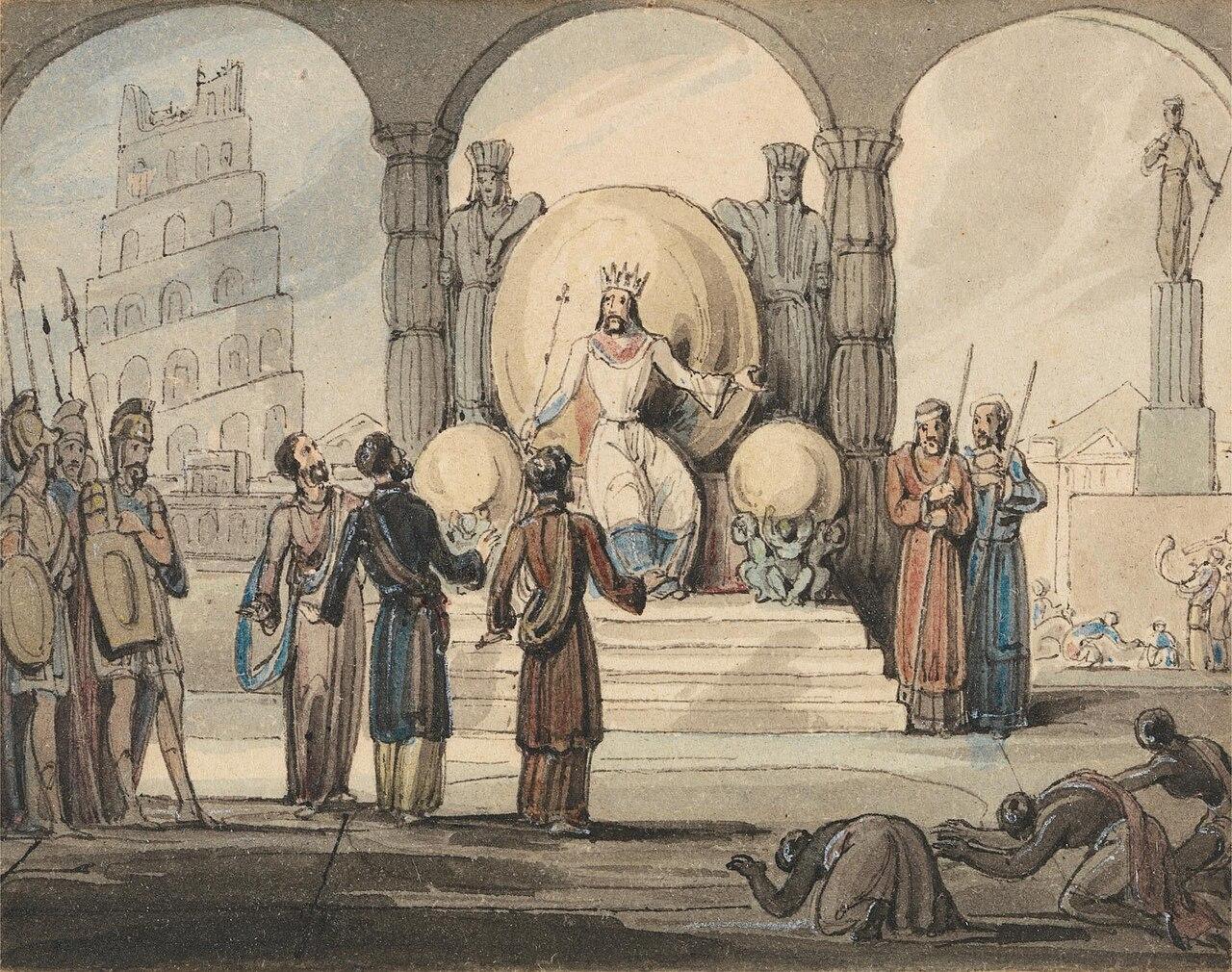
John Martin, Shadrach, Meshack and Abed-Nego before Nebuchadnezzar, before 1854. CC0.
Daniel 1 to 4 and 2 Kings 24 to 25 · Person · Featured Study
Nebuchadnezzar
Nebuchadnezzar ruled Babylon in the years of Jeremiah, Ezekiel and Daniel.
But at the end of those days I, Nebuchadnezzar, looked up to heaven, and my sanity was restored to me. Then I praised the Most High, and I honored and glorified Him who lives forever: “For His dominion is an everlasting dominion, and His kingdom endures from generation to generation.
- Family
- father: Nabopolassar, by the Babylonian Chronicle and Berossus; son: Evil-merodach, by Berossus (Against Apion 1.20)
- Places
- Babylon, Carchemish, Jerusalem, Riblah, Tyre, Egypt
- First named
- 2 Kings 24:1 “During Jehoiakim’s reign, Nebuchadnezzar king of…”
- Last named
- Daniel 5:18 “…High God gave your father Nebuchadnezzar sovereignty and…”
God called the king who would burn His temple My servant.
Summary
Nebuchadnezzar was king of Babylon. Scripture tells of three sieges of Jerusalem under him, and he carried its kings and people into exile. In the book of Daniel he is troubled by dreams and rages at the faithful. He is driven from men and at last restored.
- Daniel and his three friends served at his court.
- A Babylonian historian credits him with conquering Egypt, Syria, Phoenicia and Arabia.
- Readers part over whether the madness of Daniel 4 was first told of another king.
Where Scripture Names Him
Kings meets him as an invader, and the prophets name him as God's instrument.
During Jehoiakim’s reign, Nebuchadnezzar king of Babylon invaded. So Jehoiakim became his vassal for three years, until he turned and rebelled against Nebuchadnezzar.He first appears in Kings as the king Jehoiakim served.
This is the word that came to Jeremiah concerning all the people of Judah in the fourth year of Jehoiakim son of Josiah king of Judah, which was the first year of Nebuchadnezzar king of Babylon.The prophet sets Judah's calendar beside Babylon's.
For this is what the Lord GOD says: ‘Behold, I will bring against Tyre from the north Nebuchadnezzar king of Babylon, king of kings, with horses and chariots, with cavalry and a great company of troops.The prophet's title shows the reach of his power.
Strong's dictionary lists two Hebrew spellings of his name and gives Nebuchadrezzar as a second English form.
His Reign in Scripture
The drawing follows the king through Kings, Jeremiah, Ezekiel and Daniel in the order of events.
He beat Egypt, brought Judah's kings under him, burned the temple, laboured against Tyre and was humbled in Babylon.
- Jeremiah 46:2Defeats the army of Pharaoh Neco at CarchemishJeremiah 46:2
- Daniel 1:1 to 2Besieges Jerusalem and carries temple vessels to ShinarDaniel 1:2
- Daniel 2:1Dreams of a great statue in the second year of his reignDaniel 2:1
- 2 Kings 24:10 to 17Takes King Jehoiachin captive and makes Zedekiah king2 Kings 24:12
- Daniel 3:1Sets up a golden statue on the plain of DuraDaniel 3:1
- 2 Kings 25:1 to 2Besieges Jerusalem again in Zedekiah's ninth year2 Kings 25:1
- 2 Kings 25:8 to 9His captain burns the temple in the king's nineteenth year2 Kings 25:8
- Jeremiah 39:11 to 12Orders that Jeremiah be kept from harmJeremiah 39:12
- Ezekiel 29:18 to 20Labours against Tyre without wages, and is given EgyptEzekiel 29:18
- Daniel 4:28 to 33Boasts on his palace roof and is driven from menDaniel 4:30
Each event stands with the verse that tells it.
2 Kings 25:8 to 9, Jeremiah 39:11 to 12, Ezekiel 29:18 to 20, Daniel 4:28 to 33
Nebuchadnezzar Outside Scripture
A Babylonian chronicle and the history of Berossus record his rise and his building.
The chronicle tablet known as ABC 5 dates the battle to the twenty-first year of Nabopolassar. His eldest son Nebuchadnezzar, the crown prince, led the army to Carchemish on the Euphrates and defeated the Egyptian army. After his father died, he returned to Babylon and sat on the royal throne. The tablet's translators date his accession to September 605 BC.
Berossus, whose history of Babylon Josephus quotes in Against Apion, says the young prince returned home on his father's death. He took the whole of his father's dominions. Berossus adds that he built three walls around the inner city and three around the outer, and a new palace beside his father's.
In that palace, Berossus says, he raised high terraces planted with trees to look like mountains. He did it to please his queen, who had grown up in Media.
His Father and His Sons
A Babylonian chronicle and Berossus name his father and his heir.
His father founded the kingdom he inherited, and his son freed Judah's captive king.
| Person | Tie to Nebuchadnezzar | Verse |
|---|---|---|
| Nabopolassar | His father, king of Babylon for twenty-one years | ABC 5, obverse 9 |
| Evil-merodach | His son by Berossus's account, who reigned after him and released Jehoiachin | Jeremiah 52:31 |
| Belshazzar | The book of Daniel calls Nebuchadnezzar his father | Daniel 5:2 |
My Servant Nebuchadnezzar
God names a foreign king as the one who does His work.
So now I have placed all these lands under the authority of My servant Nebuchadnezzar king of Babylon. I have even made the beasts of the field subject to him.The verse gives the title this section explains.
You, O king, are the king of kings, to whom the God of heaven has given sovereignty, power, strength, and glory.Daniel answers the question the title raises.
Albert Barnes notes that Jeremiah gives him the title my servant three times. It is the title of Moses and of the Messiah, and Barnes reads it as the measure of the task God gave him.
Voices on Nebuchadnezzar
Two Protestant teachers weighed the king's confession.
John Calvin (1509 to 1564)
Commentaries
John Calvin doubted that the king's praise meant a turning of heart.
“But at the same time some pretense to piety was joined with it; for he pretended that he wished to worship God. Hence, also, what I formerly mentioned appears more clear, namely, -- King Nebuchadnezzar was not truly and heartily converted, but rather remained fixed in his own errors, when he was attributing glory to the God of Israel.”
on Daniel 3:1Reformed
Matthew Henry (1662 to 1714)
Commentary on the Whole Bible
Matthew Henry set the king's praise beside the flattery of his court.
“His flatterers often complimented him with, O king! live for ever. But he is now convinced that no king lives for ever, but the God of Israel only, who is still the same. That his kingdom is like himself, everlasting, and his dominion from generation to generation; there is no succession, no revolution, in his kingdom.”
on Daniel 4:34Puritan
What Befell the King in Daniel 4?
Daniel says the king was driven from men for seven times, and readers have taken the account three ways.
At that moment the sentence against Nebuchadnezzar was fulfilled. He was driven away from mankind. He ate grass like an ox, and his body was drenched with the dew of heaven, until his hair grew like the feathers of an eagle and his nails like the claws of a bird.The verse every reading below must explain.
A madness that fell on NebuchadnezzarEllicott, Keil and Delitzsch, and John Gill
Ellicott, and Keil and Delitzsch, read it as a mania in which a man takes himself for a beast. Gill holds it was the hand of God taking away the king's reason, beyond any natural disease.
The objection: Berossus records no such illness, and Ellicott grants his silence.
A parable of the fall of SatanOrigen, as John Gill reports
Gill reports that Origen read the chapter as an allegory of the fall of Lucifer.
The objection: the chapter is a dated proclamation in the king's own name, twelve months after the dream.
A story first told of NabonidusWolfram von Soden and André Lemaire; the Prayer of Nabonidus, 4Q242
A fragment from Qumran Cave 4 has Nabonidus, a later king of Babylon, struck with an ulcer for seven years at Tayma. An exorcist, a Jew, pardons his sins and bids him write the account to glorify the most high God. Wolfram von Soden argued in 1935 that the Daniel stories drew on a Babylonian tradition about Nabonidus. André Lemaire writes that most commentators hold the Prayer to be older than Daniel 4, and that Daniel 4 may have moved its story from Nabonidus to Nebuchadnezzar.
The objection: a few scholars dissent, and Lemaire names Andrew Steinmann's article of 2002 among them.
The King of Heaven
Daniel gives the king's own words the last word on his pride.
Now I, Nebuchadnezzar, praise and exalt and glorify the King of heaven, for all His works are true and all His ways are just. And He is able to humble those who walk in pride.The last words Daniel records from him.
Sources
Scripture is the Berean Standard Bible.
- Strong's dictionary, H5019 and H5020, from the STEP Bible lexicon.
- ABC 5, the Jerusalem Chronicle, obverse lines 1 to 13, translation adapted from A. K. Grayson (1975) and J.-J. Glassner (2004)
- Josephus, Against Apion 1.19 to 20, quoting Berossus, translated by William Whiston.
- 4Q242, the Prayer of Nabonidus, in the translation printed by Livius.
- Wolfram von Soden, Eine babylonische Volksüberlieferung von Nabonid in den Danielerzählungen, Zeitschrift für die alttestamentliche Wissenschaft 53 (1935), 81 to 89, as reported by Wikipedia, Prayer of Nabonidus.
- André Lemaire, Nabonide et Gilgamesh: l'araméen en Mésopotamie et à Qoumrân, page 127 and its note 4.
- Ellicott's Commentary for English Readers, John Gill's Exposition and Keil and Delitzsch, on Daniel 4:33.
- John Calvin, Commentaries on Daniel (1554); Matthew Henry, Commentary on the Whole Bible (1710); Albert Barnes, Notes, on Jeremiah 25:9.
Keep Studying
Read it4
Studies8
People and groups7
Show the next 1 title
Doctrines1
Subjects4