
Genesis 41 and 47 · The Seven Years of Famine · Featured Study
Egypt's Famine Years and the Land of Pharaoh
Genesis 41 and 47 tell how Egypt stored grain in seven years of plenty and how the land of Egypt became Pharaoh's in the famine that followed.
The fifth of the harvest that Joseph took for Pharaoh in the famine became a law of Egypt, and Genesis says it was still in force in the writer's own day.
- Where
- Egypt, Goshen, Canaan
- Who
- Joseph, Jacob, Pharaoh
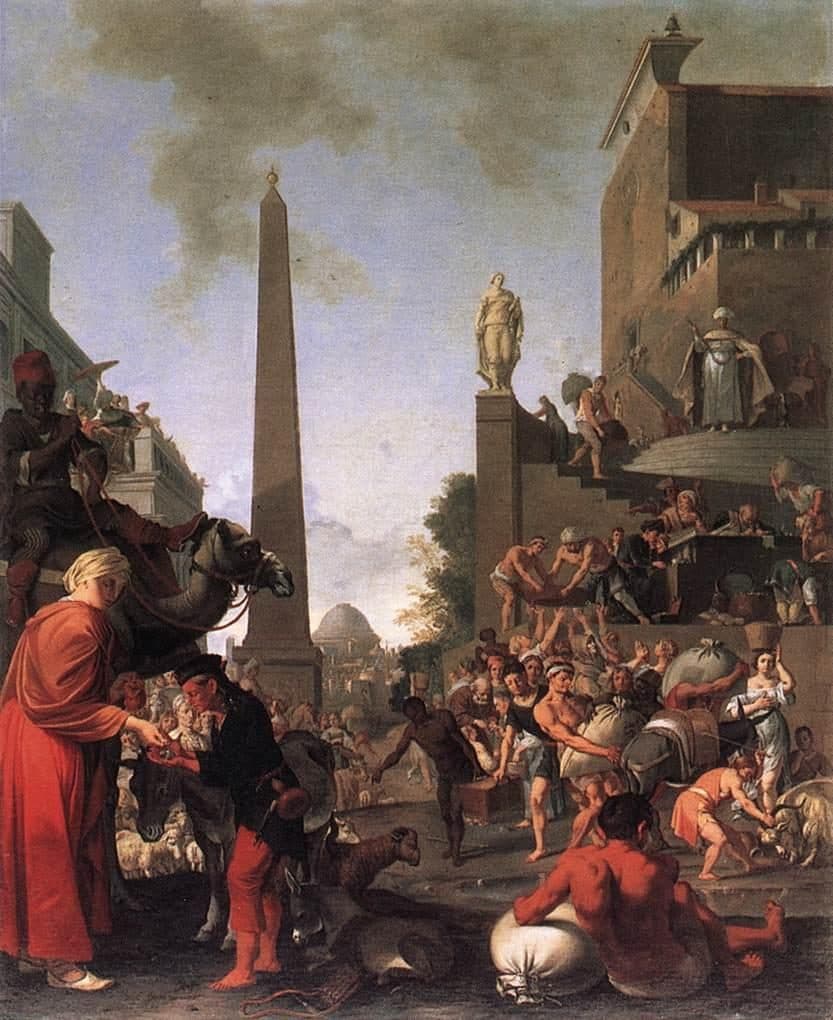
Bartholomeus Breenbergh, Joseph Selling Wheat to the People, 1655, oil on canvas. Public domain, via Wikimedia Commons.
THE ARTWORKBreenbergh set the sale of grain in Genesis 41:56 in a crowded square, where porters carry sacks down the granary steps below the official who oversees them.
Summary
Joseph read Pharaoh's two dreams as one warning from God and counseled him to lay up grain against the famine they foretold.
- In the famine the Egyptians paid for grain in four stages, first with their money, then their livestock, then their land and themselves, and last with a fifth of every harvest.
- The priests kept their land because Pharaoh gave them rations, and Greek writers on Egypt also report priestly land free of tax.
- The famine brought Jacob's household down from Canaan to the district of Rameses, where Israel acquired property.
- The chapter itself gives no verdict on Joseph's policy.
Seven Years of Plenty and a Fifth Stored
Genesis 41:25 to 57 runs from Joseph's reading of the dreams to a famine over all the earth.
Joseph tells Pharaoh that God has revealed what He is about to do (Genesis 41:25).
Let Pharaoh take action and appoint commissioners over the land to take a fifth of the harvest of Egypt during the seven years of abundance. Under the authority of Pharaoh, let them collect all the excess food from these good years, that they may come and lay up the grain to be preserved as food in the cities. This food will be a reserve for the land during the seven years of famine to come upon the land of Egypt. Then the country will not perish in the famine.”Joseph's counsel fixes the share to be taken and the cities where it is kept before the first good harvest is gathered.
Pharaoh put Joseph in charge, and Joseph carried out his own counsel while the harvests were plentiful (Genesis 41:41 and Genesis 41:47 to 48).
So Joseph stored up grain in such abundance, like the sand of the sea, that he stopped keeping track of it; for it was beyond measure.The grain stored past counting is what later allowed Egypt to sell to the nations around it.
The famine comes in every country as Joseph said, and when the Egyptians cry out to Pharaoh for food he sends them to Joseph (Genesis 41:54 to 55).
When the famine had spread over all the land, Joseph opened up all the storehouses and sold grain to the Egyptians; for the famine was severe in the land of Egypt. And every nation came to Joseph in Egypt to buy grain, because the famine was severe over all the earth.Joseph sold the grain, and that sale is the ground of every stage Genesis 47 records.
The famine spreads to Canaan, and Jacob sends ten of his sons down to Egypt to buy grain (Genesis 42:1 to 5). When Joseph makes himself known, he sends word to Jacob to come down to Goshen with all he has. He promises to feed the family there through the years still to come (Genesis 45:9 to 11).
For the famine has covered the land these two years, and there will be five more years without plowing or harvesting.This verse dates Joseph's words to the second year of the famine and counts the five years that remain.
Money, Livestock, Land and the Fifth
Genesis 47:13 to 24 records four stages by which the Egyptians paid for grain.
| Stage | What the Egyptians gave | What they received |
|---|---|---|
| 1. Money | All the money of Egypt and Canaan, brought into Pharaoh's palace | Grain |
| 2. Livestock | Their horses, flocks, herds and donkeys | Food for that year |
| 3. Land and persons | Their fields and themselves, to be slaves to Pharaoh | Food in the famine |
| 4. The fifth | A fifth of each harvest to Pharaoh | Seed to sow, and four-fifths of each harvest |
- Stage
- 1. Money
- What the Egyptians gave
- All the money of Egypt and Canaan, brought into Pharaoh's palace
- What they received
- Grain
- Stage
- 2. Livestock
- What the Egyptians gave
- Their horses, flocks, herds and donkeys
- What they received
- Food for that year
- Stage
- 3. Land and persons
- What the Egyptians gave
- Their fields and themselves, to be slaves to Pharaoh
- What they received
- Food in the famine
- Stage
- 4. The fifth
- What the Egyptians gave
- A fifth of each harvest to Pharaoh
- What they received
- Seed to sow, and four-fifths of each harvest
So Joseph established a law that a fifth of the produce belongs to Pharaoh, and it is in effect in the land of Egypt to this day. Only the priests’ land does not belong to Pharaoh.The fourth stage became a standing law, and this verse sets the priests' land outside it.
The People Speak to Joseph
Genesis 47:15 to 25 tells the purchase through what the Egyptians said to Joseph.
When the money from the lands of Egypt and Canaan was gone, all the Egyptians came to Joseph and said, “Give us food. Why should we die before your eyes? For our funds have run out!”The people come to Joseph first, and their question shows they had nothing left to pay with.
A year later they came to him again.
When that year was over, they came to him the second year and said, “We cannot hide from our lord that our money is gone and all our livestock belongs to you. There is nothing left for our lord except our bodies and our land. Why should we perish before your eyes—we and our land as well? Purchase us and our land in exchange for food. Then we, along with our land, will be slaves to Pharaoh. Give us seed that we may live and not die, and that the land may not become desolate.”Calvin reads the plea for seed as a sign that the people knew from Joseph's word that the end of the famine was near.
“You have saved our lives,” they said. “We have found favor in our lord’s eyes, and we will be Pharaoh’s servants.”The people's own words call the bargain their rescue and name themselves Pharaoh's servants.
Who Paid and Who Was Fed
Genesis 47 records who was fed without payment, and its verse 21 is read in two ways.
Joseph also provided his father and brothers and all his father’s household with food for their families.The verse shows Joseph keeping the promise of Genesis 45:11 to provide for his father's household through the famine.
How is Genesis 47:21 read?Genesis 47:21
The Berean text of Genesis 47:21 says that Joseph reduced the people to servitude from one end of Egypt to the other. John Calvin and Keil and Delitzsch, commenting on the Hebrew text before them, read the verse as a removal of the people to the cities. Josephus also says the people were moved from one place to another.
Why did Rashi credit Joseph with the move?Genesis 47:21
Rashi, in his commentary on Genesis, reads the move from city to city as told to Joseph's credit. Once every Egyptian lived in a city not his own, none could call Joseph's brothers strangers.
The Priests' Land in the Greek Writers
Herodotus, Diodorus and Josephus describe how the land of Egypt was held and what its priests received.
However, he did not acquire the priests’ portion of the land, for it had been given to them by Pharaoh. They ate the rations that Pharaoh supplied; so they did not sell their land.Genesis gives its own reason the priests kept their land, which is the portion and the rations Pharaoh gave them.
| Writer and place | What it reports |
|---|---|
| Herodotus, Histories 2.37 | The priests spend nothing of their own, for sacred bread is baked for them and meat and wine are given them each day. |
| Herodotus, Histories 2.168 | Apart from the priests, only the warrior class held land free from taxes, twelve yokes of land to each man. |
| Herodotus, Histories 2.109 | A king divided the land into equal square plots and took a yearly rent from each holder. |
| Diodorus, Library of History 1.73 | The land is in three parts, held by the priests, the king and the soldiers, and the priests pay no public taxes. |
| Josephus, Antiquities 2.7.7 | When all other land passed to the king, the lands of the priests stayed in their own possession. |
- Writer and place
- Herodotus, Histories 2.37
- What it reports
- The priests spend nothing of their own, for sacred bread is baked for them and meat and wine are given them each day.
- Writer and place
- Herodotus, Histories 2.168
- What it reports
- Apart from the priests, only the warrior class held land free from taxes, twelve yokes of land to each man.
- Writer and place
- Herodotus, Histories 2.109
- What it reports
- A king divided the land into equal square plots and took a yearly rent from each holder.
- Writer and place
- Diodorus, Library of History 1.73
- What it reports
- The land is in three parts, held by the priests, the king and the soldiers, and the priests pay no public taxes.
- Writer and place
- Josephus, Antiquities 2.7.7
- What it reports
- When all other land passed to the king, the lands of the priests stayed in their own possession.
Keil and Delitzsch read the Greek reports as indirect support for Joseph's reform, and in their view the later writers credit to Sesostris an arrangement that Joseph made.
They add, after Wilkinson's Manners and Customs, that on the Egyptian monuments only kings, priests and warriors are shown holding land.
The District of Rameses
Genesis 47:11 and Exodus 1:11 both name Rameses.
Joseph settled his father and brothers in the best part of the land, the district of Rameses, as Pharaoh had commanded (Genesis 47:11).
Now the Israelites settled in the land of Egypt, in the region of Goshen. They acquired property there and became fruitful and increased greatly in number.Israel acquired property in Goshen in the same chapter in which the Egyptians sold their fields to Pharaoh.
So the Egyptians appointed taskmasters over the Israelites to oppress them with forced labor. As a result, they built Pithom and Rameses as store cities for Pharaoh.A later Pharaoh set taskmasters over Israel, and one of the store cities they built bears the name of the district where Jacob's household settled.
The name Rameses and the counts of years between Joseph and the exodus are weighed on the page on the date of the exodus.
What the Chapter Leaves Unsaid
Genesis 47 leaves four questions about the purchase and the law of the fifth unanswered.
Does Genesis praise or blame the purchase?Genesis 47:20 to 26
The narrator records the purchase, the people's thanks and the law that followed, and adds no word of praise or blame for Joseph.
In which year of the famine did each stage fall?Genesis 47:18 and Genesis 45:6
Genesis says the people came again in the second year without saying where that count begins. Calvin and Keil and Delitzsch count it from the year the money ran out, and Adam Clarke takes it as the last year of the famine. Rashi reads it as the second year of the famine and holds, after the Tosefta, that the famine ended when Jacob came to Egypt.
How long did the law of the fifth stand?Genesis 47:26
No year is named for the end of the fifth. Josephus says the tax lasted until the later kings of Egypt.
Why did Pharaoh give the priests rations?Genesis 47:22
Genesis gives no reason for the grant. Calvin calls it doubtful whether the allowance met the need of the famine or was an older custom, and Keil and Delitzsch hold that it probably lasted only through the years of famine.
The Famine in Psalm 105 and Acts 7
Psalm 105 and Stephen's speech in Acts 7 both return to the famine of Joseph's day.
He called down famine on the land and cut off all their supplies of food. He sent a man before them— Joseph, sold as a slave.The psalm names the LORD as the One who called down the famine and sent Joseph before it.
Then famine and great suffering swept across Egypt and Canaan, and our fathers could not find food. When Jacob heard that there was grain in Egypt, he sent our fathers on their first visit.Stephen sets the famine within his account of how God kept Abraham's family through its wanderings.
Psalm 105:21 says the king made Joseph master of his household and ruler over all his substance, the office Genesis 41:40 to 41 describes.
How the Famine Has Been Taught
Jamieson, Fausset & Brown, Matthew Henry and Origen read the dreams, the famine and the priests' land in three quotations.
The Nile set the scene of the dreams
“The fertility of Egypt being wholly dependent on the Nile, the scene is laid on the banks of that river; and oxen being in the ancient hieroglyphics symbolical of the earth and of food, animals of that species were introduced in the first dream.”
Jamieson, Fausset & Brown · Commentary Critical and Explanatory on the Whole Bible · on Genesis 41:17Reformed
Pharaoh's word to his people and the gospel's word
“The people in distress cried to Pharaoh, as that woman to the king of Israel ( 2 Kings vi. 26 ), Help, my lord, O king: he sent them to his treasurer, Go to Joseph. Thus God in the gospel directs those that apply to him for mercy and grace to go to the Lord Jesus, in whom all fulness dwells; and, What he saith to you, do.”
Matthew Henry · Commentary on the Whole Bible · on Genesis 41:55Puritan
Land for Pharaoh's priests and the LORD for His own
“Indeed, do you wish to know what the difference is between the priests of God and the priests of Pharaoh? Pharaoh grants lands to his priests. The Lord, on the other hand, does not grant his priests a portion in the land but says to them: ‘I am your portion.’”
Origen of Alexandria · Homilies on Genesis 16.5 · on Genesis 47:26Patristic
In the same homily Origen sets the fifth that the Egyptians paid to Pharaoh beside the tithe that Israel paid to its priests.
Two Judgments of Joseph's Policy
Adam Clarke observed that Joseph's conduct in the famine has been as strongly censured by some as it has been applauded by others.
Just provision for a starving peopleheld by John Calvin, Matthew Henry, Keil and Delitzsch and Josephus
Calvin, in his commentary on Genesis, finds no cruelty in the purchase, because no wiles, force or threats brought the Egyptians to it and they asked for the bargain themselves. He calls the fifth an equitable condition in a land that yields its fruit with less labor than others. Keil and Delitzsch judge that Joseph served the people's good and the crown's interest alike. In a land where the harvest regularly came thirty-fold, they judge, a fifth could not be an oppressive burden. Josephus says the people rejoiced to become owners of their land again.
“If afterwards the Egyptians thought it hard to pay so great a duty to the king out of their lands, they must remember, not only how just, but how kind, the first imposing of it was. They might thankfully pay a fifth where all was due. It is observable how faithful Joseph was to him that appointed him.”
Matthew Henry · Commentary on the Whole Bible · on Genesis 47:26Puritan
The other reading answers that the people sold themselves as slaves to Pharaoh only because they had no other way to live (Genesis 47:19).
The enslaving of a nationheld by Thomas Morgan in The Moral Philosopher
Thomas Morgan, writing as Philalethes, a Christian deist, in The Moral Philosopher (second edition, 1738), charged that in fourteen years Joseph had enslaved the whole nation and ruined the richest kingdom then in the world. He held that by exempting the priests Joseph made the priesthood of Egypt independent of the crown, and he tied the exemption to Joseph's marriage to the high priest's daughter.
Calvin, answering the charge of cruelty long before Morgan wrote, held that Joseph left the people their personal liberty and restored to them both the lands and the implements.
Read the Great Books
Five older works on the famine and on the land of Egypt, each free to read online.
Commentaries on the First Book of Moses Called Genesis, volume 2
John Calvin · 1554
This second volume is John King's English translation of Calvin's notes on Genesis 24 to 50.
Read it at the Christian Classics Ethereal LibraryBiblical Commentary on the Old Testament: The Pentateuch, volume 1
C. F. Keil and F. Delitzsch · 1878
The first volume of the commentary reads Genesis verse by verse from the Hebrew text.
Read it at the Internet ArchiveAntiquities of the Jews
Flavius Josephus, translated by William Whiston · 1737
Book 2, chapters 5 to 7, is Josephus' retelling of the dreams, the famine and the purchase of the land.
Read it at Project GutenbergThe History of Herodotus, volume 1
Herodotus, translated by G. C. Macaulay · 1890
Book 2 is Herodotus' account of Egypt, its priests, its soldiers and its land.
Read it at Project GutenbergThe Historical Library of Diodorus the Sicilian, volume 1
Diodorus Siculus, translated by G. Booth · 1814
Book 1 describes the three parts into which the land of Egypt was divided.
Read it at the Internet ArchiveGrain for Every Nation
God sent Joseph ahead of the famine, and every nation that came to him in Egypt found grain (Psalm 105:17; Genesis 41:57).
The account asks the reader to see the hand of God in the famine and in the provision alike. It asks the reader also to come to Christ, the bread of life, who said that whoever comes to Him will never hunger (John 6:35).