
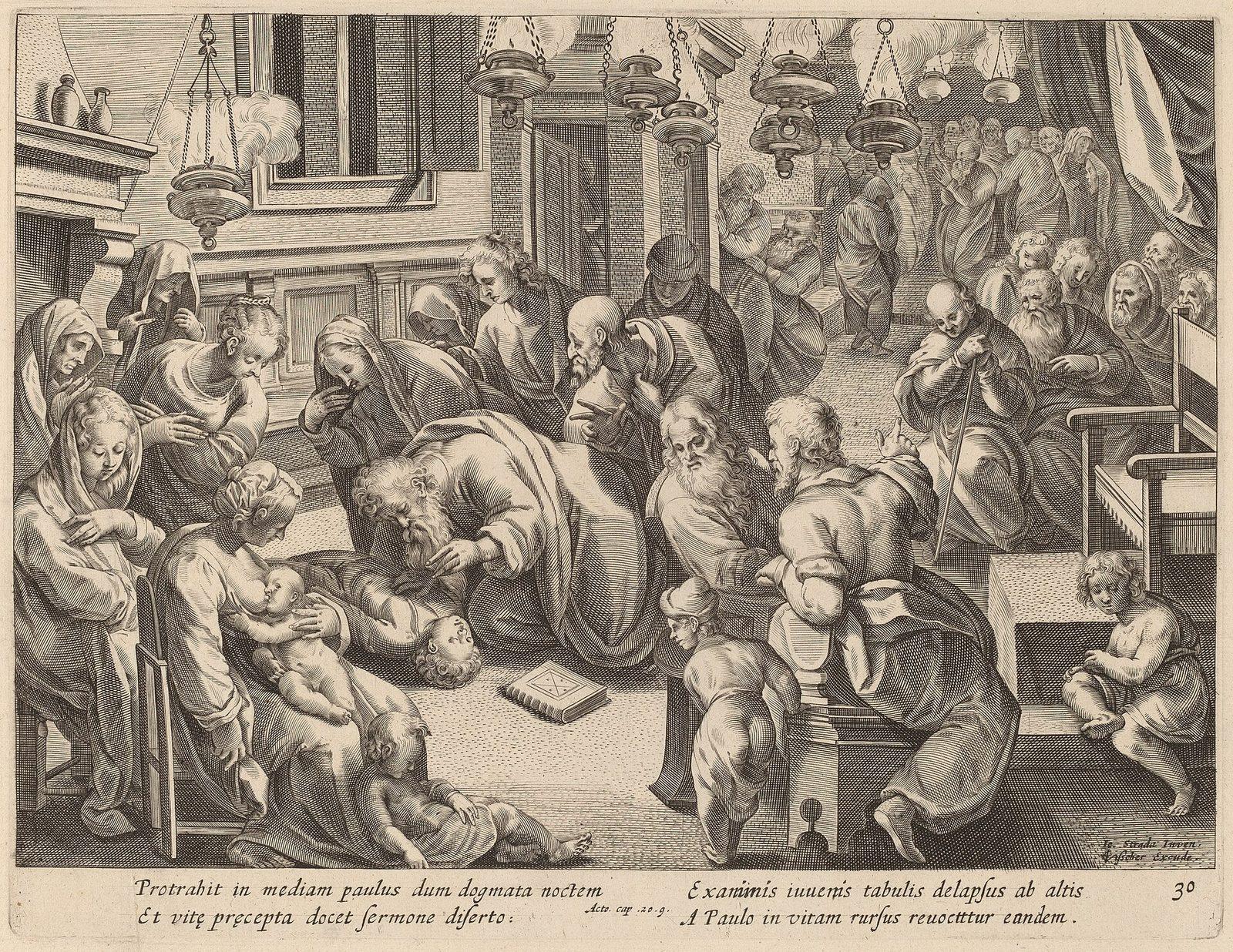
Philip Galle after Jan van der Straet, The Fall of Eutychus. CC0.
Acts 20 to 24 · Story · Featured Study
The Collection for Jerusalem
Paul's letters and the book of Acts follow money raised by Gentile believers for the saints at Jerusalem.
For Macedonia and Achaia were pleased to make a contribution for the poor among the saints in Jerusalem.
- Where
- Jerusalem, Corinth
- Who
- Paul, Titus
Paul meant to sail on to Spain once he had delivered the gift at Jerusalem.
Summary
The leaders of the church at Jerusalem asked Paul to remember their poor. Later Paul asked his churches in Galatia, Macedonia and Achaia to put money aside for them. Paul carried the gift with men the churches chose. It reached Jerusalem a few days before Paul was seized in the temple.
- Paul asked the church at Rome to pray that the gift would be welcome.
- Luke names seven men who went with Paul when he left Greece.
- Titus went to Corinth to help the church there finish its giving.
The Texts of the Collection
Three verses give the reasons Paul offers for the gift.
Paul argues for the gift from Christ, from the debt of the Gentiles and from the thanks it will raise.
For you know the grace of our Lord Jesus Christ, that though He was rich, yet for your sakes He became poor, so that you through His poverty might become rich.Paul grounds the giving in what Christ gave up for the givers.
They were pleased to do it, and indeed they owe it to them. For if the Gentiles have shared in their spiritual blessings, they are obligated to minister to them with material blessings.Paul gives the Romans his reason for going up to Jerusalem.
For this ministry of service is not only supplying the needs of the saints, but is also overflowing in many expressions of thanksgiving to God.Paul ends his appeal to the Corinthians on what the gift will do in Jerusalem.
The Gift's Road to Jerusalem
The stops from Greece to Jerusalem, as Luke tells the voyage in Acts 20 and 21.
Paul and the men of the churches took the gift from Greece by Macedonia and the sea to Jerusalem.
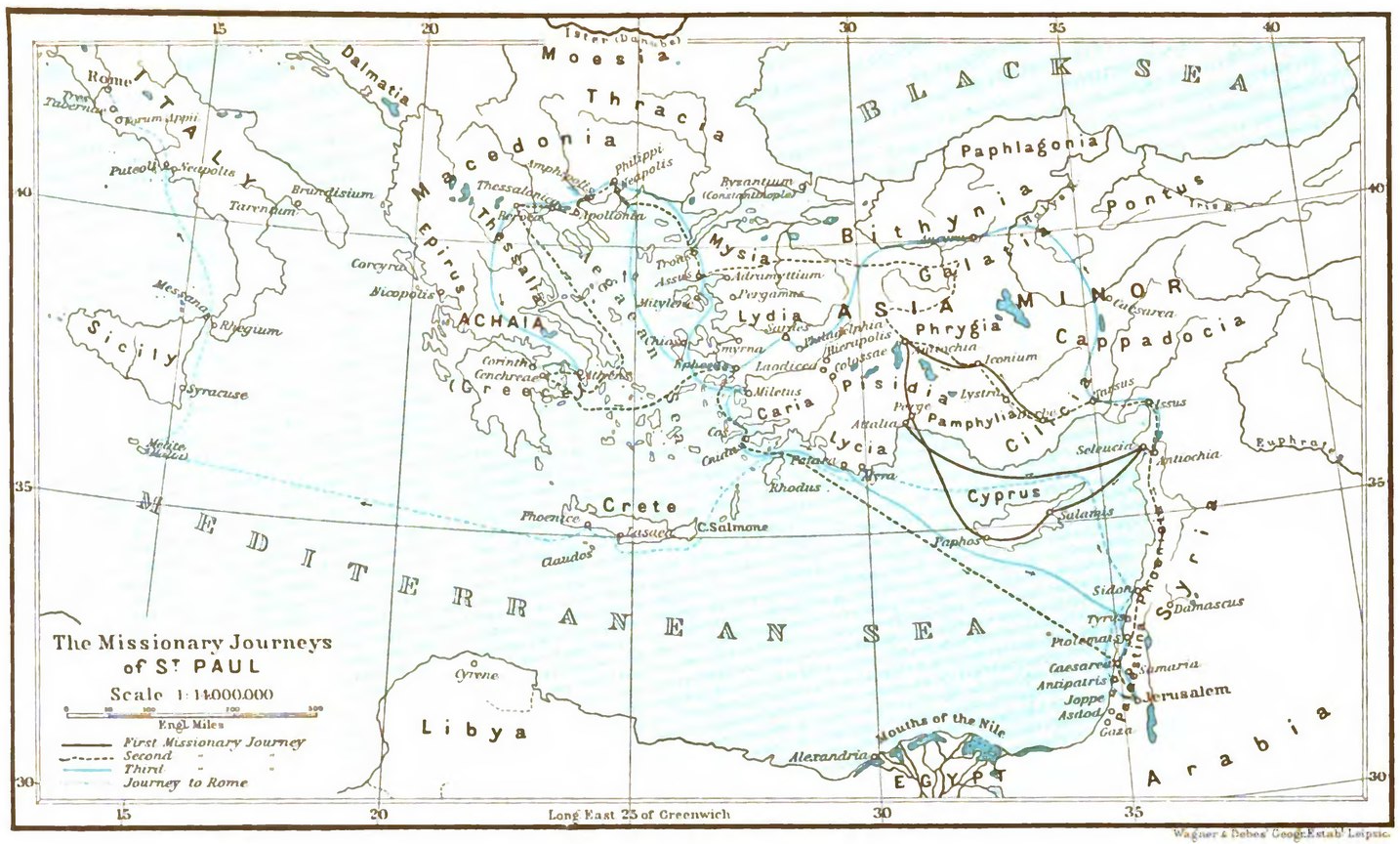
- Known: a score of 800 or more
- The route, in the order the text gives
- 1Corinth, Paul spent three months in Greece before setting out. Acts 20:3
- 2Philippi, Paul sailed after the Feast of Unleavened Bread. Acts 20:6
- 3Troas, The company met there and stayed seven days. Acts 20:6
- 4Miletus, Paul met the elders of Ephesus and said goodbye. Acts 20:17
- 5Patara, They found a ship crossing to Phoenicia. Acts 21:1
- 6Tyre, The disciples urged Paul not to go up. Acts 21:4
Caesarea, Jerusalem
- 7Caesarea, Agabus bound his own hands with Paul's belt. Acts 21:11
- 8Jerusalem, Paul met James and the elders the next day. Acts 21:18
Base map: The missionary journeys of St. Paul, F. J. Knecht, Practical Commentary on Holy Scripture, public domain. Places with a place page stand at its coordinates and the others at the point cited for each, set on the plate by Ephesus and Antioch, as the plate prints them.
Each stop carries its verse in Acts 20 and 21. Every place scores 1,000 of 1,000 in the OpenBible identification data.
The Gift From the Request to the Delivery
Five scenes across the letters and Acts.
Paul gave the churches a plan for the giving. The churches would choose men to carry the money, and Paul would send letters with them.
On the first day of every week, each of you should set aside a portion of his income, saving it up, so that when I come no collections will be needed.Paul set a regular day so the gift would be ready before he came.
Paul held up the churches of Macedonia to the Corinthians, who had been ready to give a year before.
In the terrible ordeal they suffered, their abundant joy and deep poverty overflowed into rich generosity.Paul gives the Macedonians' poverty as the measure of their generosity.
Paul took care that no one could find fault with how the money was handled. A brother chosen by the churches travelled with him and Titus.
We hope to avoid any criticism of the way we administer this generous gift.Paul names the reason for the chosen companions.
From Corinth Paul wrote to Rome that he was going to Jerusalem to serve the saints.
Pray that I may be delivered from the unbelievers in Judea, and that my service in Jerusalem may be acceptable to the saints there,The prayer Paul asks for names two dangers waiting at Jerusalem.
At Jerusalem Paul and his companions went in to James, and all the elders were present.
Paul greeted them and recounted one by one the things that God had done among the Gentiles through his ministry.Paul's report to James is the last scene before his arrest.
2 Corinthians 8:20, Romans 15:31, Acts 21:19
The Gift in Paul's Letters, in Order
The passages from the request at Jerusalem to the defense before Felix.
The gift runs through four of Paul's letters before Luke names it in Acts.
- The meeting at JerusalemThe request to remember the poorGalatians 2:10
- From EphesusPut money aside each week, and send it with chosen men1 Corinthians 16:1 to 4
- From Macedonia2 Corinthians 8 and 9Finish what you began, as Macedonia has given2 Corinthians 8:1
- From CorinthI go to Jerusalem to serve the saints; pray it is acceptedRomans 15:25 to 31
- Before Felix at CaesareaAlms for his people and offerings, named at his trialActs 24:17
The texts give no year for any of these events.
What the Gift Meant Between the Churches
Calvin, Chrysostom, and Sanday and Headlam weigh what the gift meant.
John Calvin read Romans 15:27 as a debt owed to the whole Jewish nation from which the gospel had come.
John Chrysostom read 2 Corinthians 9:12 to 13 as thanks for more than money. The saints at Jerusalem would rejoice that the Gentiles had submitted to the gospel, and their gift was the proof.
W. Sanday and A. C. Headlam, in 1895, called the collection Paul's olive branch to the church at Jerusalem.
The Voices
John Calvin writes on Paul's method, and John Chrysostom on the measure of the giving.
John Chrysostom (died 407)
Homily 17 on 2 Corinthians
Paul praised the poor givers without forcing the rest
“And yet Christ praised the contrary conduct in the widow's case, that she emptied out all of her living and gave out of her want. But because he was discoursing to Corinthians amongst whom he chose to suffer hunger; ‘for it were good for me rather to die, than that any man should make my glorying void;’ he therefore uses a tempered exhortation, praising indeed those who had done beyond their power, but not compelling these to do so; not because he did not desire it, but because they were somewhat weak. For wherefore doth he praise those, because ‘in much proof of affliction the abundance of their joy and their deep poverty abounded unto the riches of their liberality:’ and because they gave ‘beyond their power?’ is it not very evident that it is as inducing these also to this conduct? So that even if he appears to permit a lower standard; he doth so, that by it he may raise them to this.”
on 2 Corinthians 8:13Patristic
John Calvin (1509 to 1564)
Commentaries
Paul set the churches an example to follow
“Now, however, he prescribes the method of relief; and that the Corinthians may accede to it the more readily, he mentions that he had already prescribed it to the Churches of Galatia; for they would necessarily be the more influenced by example, as we are wont to feel a natural backwardness to anything that is not ordinarily practiced.”
on 1 Corinthians 16:1Reformed
Where Readers Differ
Two questions of the collection, with the writers who answer them.
When did the collection begin?2 paragraphs
W. J. Conybeare and J. S. Howson, in 1869, read Galatians 2:10 as the agreement at the council of Jerusalem that started the collection.
W. M. Ramsay, in 1896, set Galatians 2:10 at the famine visit of Acts 11:30, when Antioch sent relief. He dated the planning of the wider collection to Paul's visit to Galatia on his third journey.
Did Jerusalem accept the gift?1 paragraph
Luke records a warm welcome in Acts 21:17 and does not say what became of the money. Sanday and Headlam held that Paul was unsure the Jewish Christians at Jerusalem would accept it as a peace offering. Calvin wrote that slanders made Paul fear the gift would be unwelcome because it came from his hands.
Books to Read Next
Three works, each free to read online.
A Critical and Exegetical Commentary on the Epistle to the Romans
W. Sanday and A. C. Headlam · 1895
Their introduction weighs what the collection meant to Paul and to Jerusalem.
Free at the Internet ArchiveHomilies on the Second Epistle to the Corinthians
John Chrysostom, in the Nicene and Post-Nicene Fathers, first series, volume 12 · 1889
Chrysostom preaches on 2 Corinthians 8 and 9 in his sixteenth to twentieth homilies.
Free at the Christian Classics Ethereal LibraryThe Life and Epistles of Saint Paul
W. J. Conybeare and J. S. Howson · 1869 edition
They follow the collection from the council at Jerusalem to the voyage of Acts 20 and 21.
Free at the Internet ArchiveSources
Scripture is the Berean Standard Bible.
- The Holy Bible, Berean Standard Bible (read 2026)
- John Chrysostom, Homilies 17 and 20 on 2 Corinthians, translated by Talbot W. Chambers, Nicene and Post-Nicene Fathers, first series, volume 12 (1889)
- John Calvin, Commentary on Romans, translated by John Owen, Calvin Translation Society, on Romans 15:26, 15:27 and 15:31.
- John Calvin, Commentary on the Epistles to the Corinthians, on 1 Corinthians 16:1.
- W. Sanday and A. C. Headlam, A Critical and Exegetical Commentary on the Epistle to the Romans (New York, 1895)
- W. J. Conybeare and J. S. Howson, The Life and Epistles of Saint Paul, People's Edition (Cincinnati, 1869)
- W. M. Ramsay, St. Paul the Traveller and the Roman Citizen (New York and London: Putnam, 1896)
- OpenBible.info, Bible-Geocoding-Data, ancient.jsonl.
- F. J. Knecht, Practical Commentary on Holy Scripture, the plate The Missionary Journeys of St. Paul.
Keep Studying
Read it5
People and groups4
Symbols1
Church history1
Subjects1
Values1