
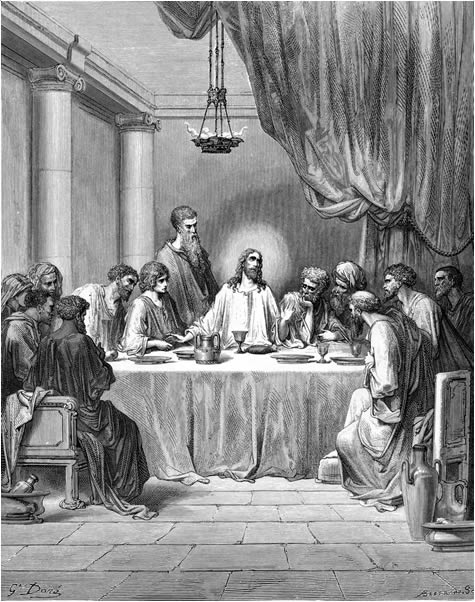
John 13–17 · The Book of Glory · Featured Study
The Upper Room & the Farewell
With the hour come, Jesus turns from the crowds to His own. He kneels with a towel, gives a new commandment, promises another Comforter of His own kind, calls Himself the true vine in whom alone they bear fruit, and then, praying aloud in their hearing, asks the Father for every believer who will ever come to Him through their word. It is the most intimate room in the Bible.
Summary
This page walks John 13-17 in three movements: the foot-washing and its new commandment, the Farewell Discourse's core claims about the Spirit, and the three widening circles of the High-Priestly Prayer.
- The foot-washing pairs two different Greek words for washing, read by JFB as justification and regeneration.
- Five keystone Farewell Discourse verses are laid out, including the "greater works" text and the naming of the Spirit as another Comforter of Christ's own kind.
- The High-Priestly Prayer is diagrammed as three concentric circles: Christ for Himself, for the Eleven, and for every future believer.
- Three contested points (the greater works, "the Father is greater than I," and the removed branch) are named with both readings, not settled.
The Foot-Washing
John 13 : deity on its knees
- 1Loved to the endJohn 13:1
“Having loved his own that were in the world, he loved them unto the end” : eis telos: to the last, and to the uttermost. Full foreknowledge of the cross does not cool His love; it perfects it.
- 2Two washingsJohn 13:5–10
He girds a slave's towel and washes feet. The Greek distinguishes niptō (wash a part) from louō (bathe the whole): “He that is bathed needeth not save to wash his feet.” JFB reads them as justification and regeneration.
- 3The patternJohn 13:12–17
The act becomes an ethic : hupodeigma, a pattern of humble mutual service. “A servant is not greater than his lord.” Blessing attaches to doing, not merely knowing.
- 4And it was nightJohn 13:26–30
He gives Judas the sop : a mark of honor, grace held out to the end. “He then having received the sop went out straightway: and it was night.”
Then the church's promised apologetic: “A new commandment I give unto you, that ye love one another” (13:34), new not in substance (Lev 19:18) but in measure (His own self-giving love), “By this shall all men know that ye are my disciples.”
The Farewell Discourse
John 14–16 : the way, the Paraclete, the vine
Not a path among others : the path identified with the Person.
The fullest identity-claim short of the Trinity's later formal language.
Greater in scope and reach, not power : given when the ascension sends the Spirit. A keystone text for the continuationist reading this site's tradition teaches.
Christ's departure is the precondition of Pentecost, not the obstacle (Acts 2:33).
nenikēka : the perfect tense: the victory declared finished before the cross is reached.
Another Comforter : of the same kind
allon paraklēton (14:16) : “another” of the same kind (allon, not heteron): not a lesser substitute but an Advocate like Jesus Himself, given “to be with you for ever.” Jesus is the first Paraclete (1 John 2:1); the Spirit is another like Him, already “with you,” soon “in you” (14:17), fulfilling Ezekiel's promise of an indwelling Spirit (Ezek 36:27). His whole ministry is Christ-centered: “He shall glorify me” (16:14).
The High-Priestly Prayer
John 17 : three concentric circles
For Himself
John 17:1–5“Glorify thy Son, that the Son may glorify thee” : glory through the cross. “This is life eternal, that they should know thee... and him whom thou didst send” (17:3): eternal life is relational knowledge, not mere duration. He asks for the glory “which I had with thee before the world was” (17:5).
For the Eleven
John 17:6–19That the Father keep them, that they be one “even as we are,” guarded from the evil one : not taken out of the world. “Sanctify them in the truth: thy word is truth” (17:17). “For their sakes I sanctify myself” : Christ consecrating Himself as the offering.
For all who believe
John 17:20–26“Neither for these only do I pray, but for them also that believe on me through their word” : the circle widens to every future believer, the reader included, prayed for in advance. The petition: unity modeled on the Father-Son indwelling, “that the world may believe.”
Contested and Settled Points
the position named, and the strongest case for the other side
The greater works (14:12) & the Spirit's gifts (16:13)
Where the readings meet: The continuationist reading takes the greater works and the Spirit's gifts as continuing to operate through the whole church age, not sealed off in the apostolic generation.
“The Father is greater than I” (14:28)
Where the readings meet: Read against 14:9, 11's affirmation of oneness, the historic Christian reading takes this as the office and state of the incarnate Son : sent, humbled, functioning as Mediator : not a statement about His nature; this is the Nicene and Chalcedonian reading, held against the subordinationist and Arian readings the councils rejected.
The removed branch (15:2, 6)
Where the readings meet: The Wesleyan-Arminian reading takes it as a real, abiding branch that can cease to abide. The Reformed reading takes it as a branch that was never savingly united to the vine, so that being cut off shows the connection was outward, not organic. Both readings agree fruitfulness is bound up with real, abiding connection to Christ (15:4–5); they differ on what it means to fall away from it.
Keep studying
Read it1
On this page
By subject
Stories11 pages