
Numbers 26 and 33 · Joshua 7, 14, 18 and 19 · Subject · Featured Study
The lot in Israel
How Israel divided the land by lot at Shiloh, the other matters Scripture records the lot deciding from Leviticus to Acts, and what Proverbs teaches about the lot's decision.
Joshua had all Israel come forward tribe by tribe, and the selection narrowed until it rested on one man of the tribe of Judah.
- Books
- Joshua, Numbers, Leviticus, Proverbs, Acts
- Hold in memory
- Proverbs 16:33, Psalm 16:5 to 6
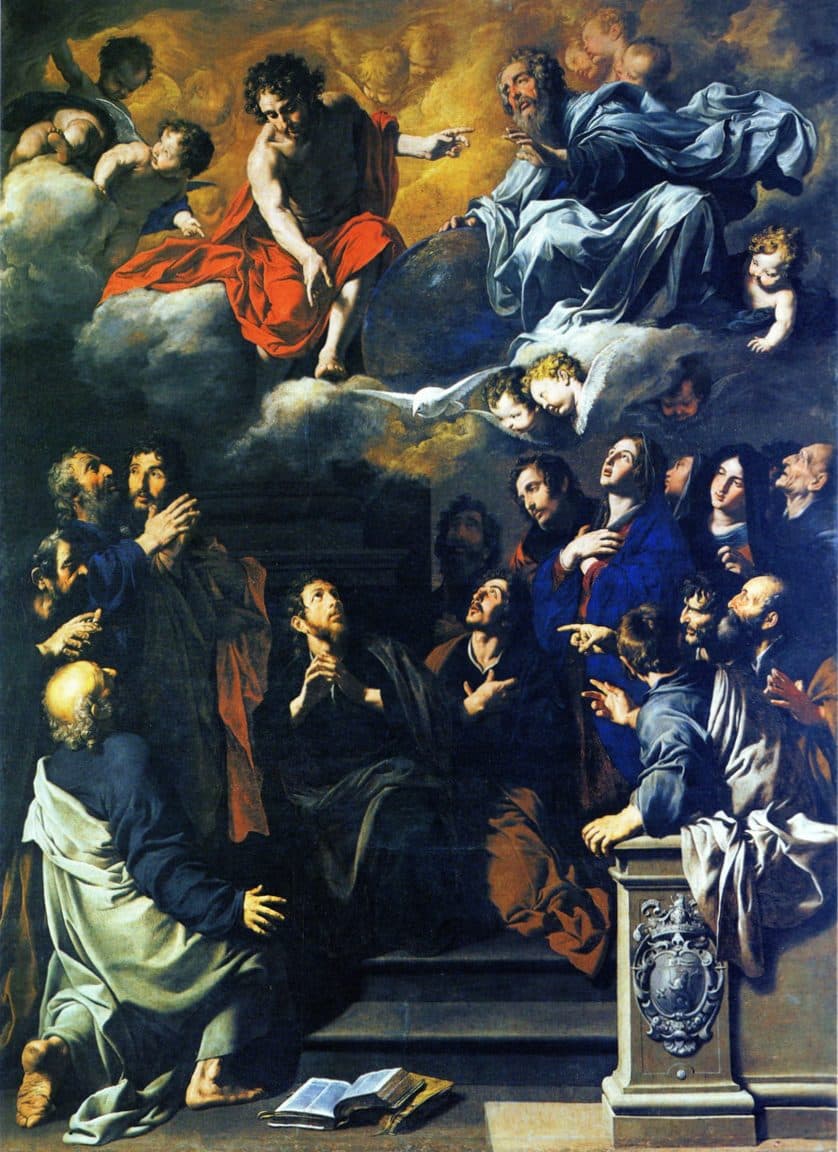
Pietro Novelli, The Election of Saint Matthias to the Apostleship, 1640 to 1642, oil on canvas, Leonforte, Church of the Capuchins. Public domain (painted before 1930), via Wikimedia Commons, File:Elezione_di_san_Mattia_all’apostolato_-_Novelli.jpg.
THE ARTWORKNovelli painted the choice of Matthias as a decision made in heaven. Christ and the Father sit above with the dove, and below them the apostles point to Matthias kneeling at the centre, so the picture gives the lot's decision to the LORD.
Summary
The lot was a token cast or drawn before the LORD, and Israel used it to settle a matter that no person was to choose.
- The LORD told Moses to divide the land by lot, and to give a larger inheritance to a larger clan.
- At Shiloh Joshua cast lots over a written survey of seven portions, with Eleazar the priest beside him.
- The lot chose the goat for the LORD on the Day of Atonement, set the order of the priests and fell on Jonah at sea.
- Haman cast the Pur to fix a day for destroying the Jews, and the feast of Purim takes its name from that word.
- The last lot in Scripture fell to Matthias in Acts 1:26, and the New Testament records no lot cast after Pentecost.
The Lot at Shiloh
Numbers 26 gave the command for the land, and Joshua 14, 18 and 19 record how it was carried out.
Nine and a half tribes received their land west of the Jordan by lot, because Moses had already given Reuben, Gad and half the tribe of Manasseh their inheritance east of it.
Increase the inheritance for a large tribe and decrease it for a small one; each tribe is to receive its inheritance according to the number of those registered. Indeed, the land must be divided by lot; they shall receive their inheritance according to the names of the tribes of their fathers. Each inheritance is to be divided by lot among the larger and smaller tribes.”The LORD gave Moses two rules for the land, the number of each tribe and the lot, and Joshua's division kept both.
As the men got up to go out, Joshua commanded them to map out the land, saying, “Go and survey the land, map it out, and return to me. Then I will cast lots for you here in Shiloh in the presence of the LORD.” So the men departed and went throughout the land, mapping it city by city into seven portions. Then they returned with the document to Joshua at the camp in Shiloh. And Joshua cast lots for them in the presence of the LORD at Shiloh, where he distributed the land to the Israelites according to their divisions.Joshua had the land surveyed and written down in seven portions before he cast a lot, so the lot fell on portions already described.
Now these are the portions that the Israelites inherited in the land of Canaan, as distributed by Eleazar the priest, Joshua son of Nun, and the heads of the families of the tribes of Israel. Their inheritance was assigned by lot for the nine and a half tribes, as the LORD had commanded through Moses.The allotment west of the Jordan opens by naming those who distributed it and the command it obeyed.
These are the inheritances that Eleazar the priest, Joshua son of Nun, and the heads of the families distributed by lot to the tribes of Israel at Shiloh before the LORD at the entrance to the Tent of Meeting. So they finished dividing up the land.The allotment closes by naming the place, the Tent of Meeting, and the presence of the LORD, and it says the division was finished.
Eleazar the priest stands before Joshua in both of those lists, and Jamieson, Fausset and Brown trace the order to the lot itself.
“In everything pertaining to civil government, and even the division of the land, Joshua was the acknowledged chief. But in a matter to be determined by lot, a solemn appeal was made to God, and hence Eleazar, as high priest, is named before Joshua.”
Jamieson, Fausset & Brown · Commentary Critical and Explanatory on the Whole Bible · on Joshua 14:1Reformed
The Lot That Found Achan
Joshua 7:14 gives the order of the selection, and verses 16 to 18 carry it out.
Each step of Joshua 7:16 to 18 took one group out of the group before it.
- Tribe by tribeAll IsraelThe tribe of JudahJoshua 7:16
- Clan by clanThe clans of JudahThe clan of the ZerahitesJoshua 7:17
- Family by familyThe clan of the ZerahitesThe family of ZabdiJoshua 7:17
- Man by manThe family of ZabdiAchan son of CarmiJoshua 7:18
A sequence of the four steps, each with the group that came forward, the one selected and the verse.
Joshua 7 does not name the instrument. 1 Samuel 14:42 uses the same Hebrew word for selected after Saul says, “Cast the lot between me and my son Jonathan.”
Albert Barnes, on Proverbs 16:33, cites the cases of Achan and Jonathan as lots guided by a higher will.
The lot or the breastpiece at Joshua 7Rashi; John Gill; Adam Clarke
Rashi gives both readings on the chapter. On Joshua 7:16 he says the tribes came before the breastpiece of the high priest, and the stone bearing Judah's name faded. On 7:17 he describes lots cast for the families and then for each household.
John Gill, on Joshua 7:16, names the fading stone as what some say and prefers the lot cast and falling on the tribe. Adam Clarke, on 7:14, calls the fading stone the most rational of the Jewish readings and ties it to the Urim and Thummim.
The Lot Through Scripture
The lot decided between two goats, among the tribes, among the priests, among a ship's crew and between two disciples.
Israel cast the lot for worship, land and office, and Haman, the sailors and the soldiers at the cross cast it as well.
- Leviticus 16Which goat was for the LORD and which was the scapegoatLeviticus 16:8
- Numbers 26Where each tribe's inheritance would lieNumbers 26:55
- Joshua 7The man who had taken the devoted thingsJoshua 7:16 to 18
- Joshua 18The seven portions for the seven tribes at ShilohJoshua 18:10
- 1 Samuel 10The king, Saul son of Kish, by the selecting of Joshua 71 Samuel 10:20 to 21
- 1 Samuel 14Jonathan, between Saul and his son1 Samuel 14:42
- 1 Chronicles 24The order of the divisions of the priests1 Chronicles 24:5
- Nehemiah 10The families who brought wood for the altarNehemiah 10:34
- Nehemiah 11One in ten to live in JerusalemNehemiah 11:1
- Esther 3Haman's day for the destruction, the twelfth monthEsther 3:7
- Psalm 22The sufferer's clothingPsalm 22:18
- Jonah 1The man responsible for the stormJonah 1:7
- Luke 1Zechariah, to burn incense in the templeLuke 1:9
- John 19Jesus' tunic, woven in one pieceJohn 19:24
- Acts 1Matthias, over Joseph called BarsabbasActs 1:26
A timeline of fifteen passages in canon order, each with what the lot decided and its verse.
Two lots drawn from an urn on the Day of AtonementLeviticus 16:8 and Mishnah Yoma 3:9 and 4:1
After Aaron casts lots for the two goats, one for the LORD and the other for the scapegoat, he shall present the goat chosen by lot for the LORD and sacrifice it as a sin offering. But the goat chosen by lot as the scapegoat shall be presented alive before the LORD to make atonement by sending it into the wilderness as the scapegoat.The lot decided which of two goats died as the sin offering and which carried the people's sins into the wilderness alive.
The Mishnah, compiled in about AD 190 to 230, describes the rite in the Second Temple. The two lots lay in an urn and were first made of boxwood, until the high priest Yehoshua ben Gamla made them of gold (Yoma 3:9).
The high priest drew one lot in each hand. One read For God and the other For Azazel, and he laid each on the goat standing at that hand (Yoma 4:1).
The priests' divisions and Zechariah's lot1 Chronicles 24 and Luke 1
As their brothers the descendants of Aaron did, they also cast lots in the presence of King David and of Zadok, Ahimelech, and the heads of the families of the priests and Levites—the family heads and their younger brothers alike.The lot gave the older and the younger houses the same footing, so no family claimed precedence by its age.
One day while Zechariah’s division was on duty and he was serving as priest before God, he was chosen by lot, according to the custom of the priesthood, to enter the temple of the Lord and burn incense.Luke 1:5 places Zechariah in the division of Abijah, which took the eighth place by lot in 1 Chronicles 24:10.
Haman's PurEsther 3:7 and 9:24 to 26
For Haman son of Hammedatha, the Agagite, the enemy of all the Jews, had plotted against the Jews to destroy them and had cast the Pur (that is, the lot) to crush and destroy them. But when it came before the king, he commanded by letter that the wicked scheme which Haman had devised against the Jews should come back upon his own head, and that he and his sons should be hanged on the gallows. Therefore these days are called Purim, from the word Pur. Because of all the instructions in this letter, and because of all they had seen and experienced,The book names the feast for the lot Haman cast, so Purim remembers a lot turned against the man who cast it.
Albert Barnes, on Esther 3:7, takes Pur for an old Persian word meaning part or lot, and he holds that a lot was cast for each day and each month to find the best one. Matthew Henry reads the month the lot chose as God's judgment on Haman.
“He that believeth the lot, much more that believeth the promise, will not make haste. But see how God's wisdom serves its own purposes by men's folly. Haman has appealed to the lot, and to the lot he shall go, which, by adjourning the execution, gives judgment against him and breaks the neck of the plot.”
Matthew Henry · Commentary on the Whole Bible · on Esther 3:7Puritan
Hebrew and Greek for the Lot
Four Hebrew words and one Greek word carry the subject.
GORAL
The Hebrew word for the lot, which Adam Clarke on Numbers 26:55 says some take to mean the stone or pebble once used for casting lots.
NACHALAH
The inheritance the lot assigned, the share of land a tribe and its families held.
LAKAD
To take or capture, as a city is taken, the word Joshua 7:14 to 18 uses for each one the LORD chose.
PUR
A foreign word for the lot, which the book of Esther explains for its reader as the lot.
KLEROS
The Greek word for the lot cast for Matthias, which also stands in Acts 1:25 in the Greek text Albert Barnes read, for the share of ministry the new apostle would take.
What the Text Leaves Unsaid
Scripture leaves three matters open.
Scripture never says what a lot was made of. Adam Clarke on Acts 1:26 names the simplest form he knew, stones, pieces of board, metal or slips of parchment bearing the names, put into an urn and drawn out after prayer.
Joshua 18:9 says the surveyors returned with the document, and it does not say who wrote it or where it was kept. Acts 1 gives the prayer before the lot, and Matthias is not named again after verse 26.
The Decision Is from the LORD
Proverbs 16 and 18 teach where a lot's outcome comes from and what it does for those who cast it.
The lot is cast into the lap, but its every decision is from the LORD.The proverb gives the LORD the outcome of the one act that looks most like chance, which is why Israel cast its lots before Him.
Casting the lot ends quarrels and separates strong opponents.A lot settled a dispute that neither side could win by argument. Adam Clarke on Joshua 19:51 holds that the lot cast before the LORD left no murmuring at Shiloh.
The LORD is my chosen portion and my cup; You have made my lot secure. The lines of my boundary have fallen in pleasant places; surely my inheritance is delightful.The psalmist takes the language of the allotment for himself, the lot and the boundary lines, and names the LORD as his portion.
An inheritance obtained by lotMatthew Henry on Joshua 14:2
Henry finds the allotment of Joshua 14:2 in the Greek of Ephesians 1:11.
“In allusion to this we are said to obtain an inheritance in Christ ( Eph. i. 11 ), eklerothemen -- we have obtained it by lot, so the word signified; for it is obtained by a divine designation. Christ, our Joshua, gives eternal life to as many as were given him, John xvii.”
Matthew Henry · Commentary on the Whole Bible · on Joshua 14:2Puritan
Voices on the Lot
Origen reads the lot at Shiloh as a figure of the inheritance in heaven, and Matthew Henry reads it as the Father's to give.
Origen, in his Homilies on Joshua, gives the drawing of the lots to the providence and foreknowledge of God.
“Therefore we must believe that also here, in imitation of these things, Scripture relates that lots are drawn by Jesus [Joshua], and the inheritance for each of the tribes is determined by divine dispensation; and that in this casting of lots, through the ineffable providence and foreknowledge of God, a model of the future inheritance in heaven is dimly sketched.”
Origen of Alexandria · Homilies on Joshua 23.4 · on Joshua 18:10Patristic
Christ and the disposal of the inheritanceMatthew Henry on Numbers 26:55
Matthew Henry sets Joshua's lot beside the answer Jesus gave when He was asked to give two disciples the seats at His right and left.
“And thus Christ, our Joshua, when he was urged to appoint one of his disciples to his right hand, another to his left in his kingdom, acknowledged the sovereignty of his Father in the disposal: It is not mine to give. Joshua must not dispose of inheritances in Canaan according to his own mind. But it shall be given to those for whom it is prepared of my Father.”
Matthew Henry · Commentary on the Whole Bible · on Numbers 26:55Puritan
Is the Lot Still a Guide?
Two readings of whether Christians may cast lots, each with its holders and the strongest objection
The lot may still be used in faithMatthew Henry; John Wesley; Augustine
Matthew Henry's note on 1 Chronicles 24:5 reaches from the lots of David's priests to the lot of Matthias.
“The lot is an appeal to God, and ought to be managed with corresponding reverence and sincerity. Matthias was chosen to the apostleship by lot, with prayer ( Acts i. 24, 26 ), and I know not but it might be still used in faith in parallel cases, as an instituted ordinance.”
Matthew Henry · Commentary on the Whole Bible · on 1 Chronicles 24:5Puritan
John Wesley wrote on Acts 1:23 in his Explanatory Notes upon the New Testament. He held that the believers went as far as consulting together could take them, and then used the lot for a weighty matter no ordinary means could settle. Augustine, in On Christian Doctrine 1.28.29, taught that when two people have equal claims and only one can be helped, nothing is fairer than to choose by lot.
The objection rests on the New Testament after Acts 1, which records no lot cast after the Spirit came at Pentecost. In Acts 6:3 the believers select seven men, and in Acts 13:2 and 15:28 the Holy Spirit's direction is named.
The lot of Acts 1 belonged to the calling of an apostleJohn Calvin
John Calvin, in his Commentary on Acts at 1:23, held that the believers cast lots so that Matthias would be chosen by the judgment of God. An apostle was called by God, he wrote, and a pastor was chosen by the church. He held that they did it as the Holy Spirit moved them, and that Luke's words, that Matthias was added to the eleven, clear the lot of any charge of rashness.
The objection rests on Calvin's own words at Acts 1:26, where he calls the lot lawful when rulers divide provinces or brothers divide an inheritance. It also rests on Proverbs 16:33, which says of the lot cast into the lap that its every decision is from the LORD.
Books on the Lot
Three works to read whole, earliest first
Antiquities of the Jews
Flavius Josephus, translated by William Whiston · about 94
Book 5 tells the history from the death of Moses to the death of Eli, and William Whiston translated it in 1737.
Read it free at Project GutenbergThe Mishnah, tractate Yoma
The sages of the land of Israel · about 190 to 230
The tractate gives the order of the high priest's service on the fast as the Second Temple kept it.
Read it free at SefariaCommentary upon the Acts of the Apostles
John Calvin · 1560
Calvin's notes on Acts 1:23 to 26 weigh the lot that chose Matthias and the lawful use of lots.
Read it free at the Christian Classics Ethereal LibraryAn Inheritance Kept in Heaven
John 19 on the lot at the cross and 1 Peter 1 on the inheritance of believers
So the history of the lot asks the reader to look past every portion on earth to the inheritance Christ gives.
So they said to one another, “Let us not tear it. Instead, let us cast lots to see who will get it.” This was to fulfill the Scripture: “They divided My garments among them, and cast lots for My clothing.” So that is what the soldiers did.The soldiers cast this lot at the cross before Jesus died in John 19:30, and it is the last lot in the Gospels.
Blessed be the God and Father of our Lord Jesus Christ! By His great mercy He has given us new birth into a living hope through the resurrection of Jesus Christ from the dead, and into an inheritance that is imperishable, undefiled, and unfading, reserved in heaven for you,Israel's inheritance was land drawn by lot at Shiloh, and Peter names an inheritance reserved in heaven, given through the resurrection of Jesus Christ.
Keep studying
Studies4
People8