
Genesis to Revelation · Doctrine · Featured Study
The Scarlet Thread
Scarlet yarn and wool in the rites of the Law, the cord in Rahab's window and the blood of the sacrifices are read together with the blood of Christ.
One mark, in blood or in scarlet dye, runs from a garden to a throne, and at the Passover and in Rahab's window it marks a household God has promised to spare.
- First taught
- Genesis 38:28 “…so the midwife took a scarlet thread and…”
- Fullest statement
- Hebrews 9:19 “…and goats, along with water, scarlet wool, and…”
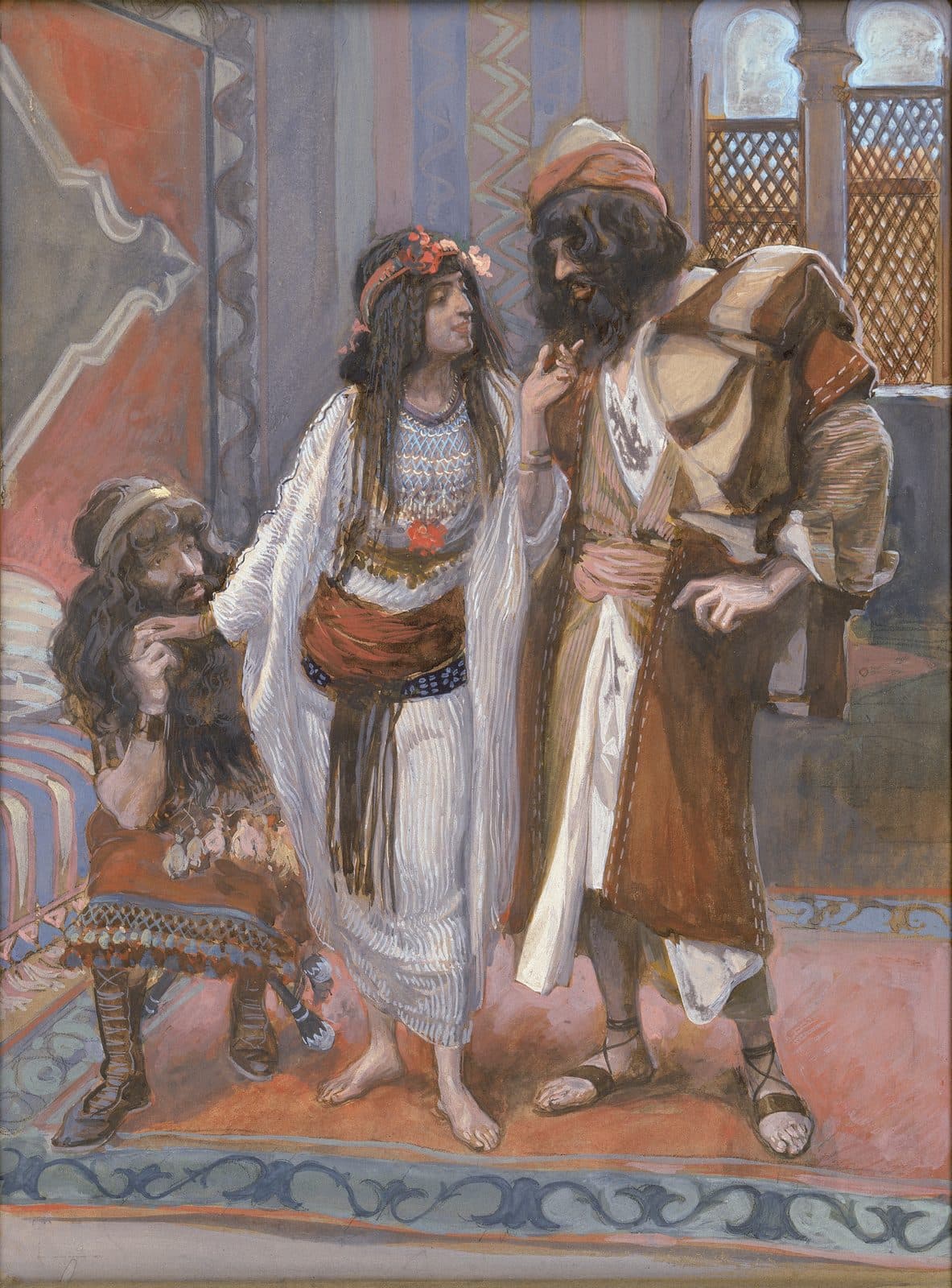
James Tissot, The Harlot of Jericho and the Two Spies, c. 1896-1902. Public domain.
Summary
Rahab's scarlet cord in Joshua 2:18 and 21 is named with tiqvah, the Hebrew word for hope.
- Scarlet is a color and blood is a substance, and the two stand together in one rite in the cleansings of Leviticus 14 and Numbers 19 and in Hebrews 9:19.
- The Mishnah tells of a crimson strip that turned white on the Day of Atonement, and the Talmud says it stopped turning white in the forty years before the Temple fell.
- The thread runs through fifteen scenes, from the coats of skin in Genesis 3:21 to the robes of Revelation 7:14.
Tiqvah: The Cord That Is Also Hope
Rahab's cord is named twice in Joshua 2, once as the spies give the sign and once as she ties it.
The Hebrew word for the cord is tiqvah. Brown-Driver-Briggs gives it the sense of hope in every other place it lists, Job 7:6 and Jeremiah 29:11 among them: the thing a person waits for, expects, holds onto.
unless, when we enter the land, you have tied this scarlet cord in the window through which you let us down, and unless you have brought your father and mother and brothers and all your family into your house.The spies make the cord the mark of the house whose people will be spared when Israel enters the land.
“Let it be as you say,” she replied, and she sent them away. And when they had gone, she tied the scarlet cord in the window.She acts at once, long before Jericho falls and her household is brought out (Joshua 6:23).
Strong's and Brown-Driver-Briggs trace tiqvah to the verb qavah (H6960), which carries two attested senses: to bind or twist together, and to wait for, to expect.
Brown-Driver-Briggs lists the cord of Joshua 2:18 and 21 and the word for hope as separate entries, and it gives twisting or stretching as the probable first sense of qavah.
1 Clement 12 and Rahab's signClement of Rome, about AD 96
“Moreover, they gave her a sign to this effect, that she should hang forth from her house a scarlet thread. And thus they made it manifest that redemption should flow through the blood of the Lord to all them that believe and hope in God. You see, beloved, that there was not only faith, but prophecy, in this woman.”
Clement of Rome · First Letter to the Corinthians, Chapter 12Patristic
Clement, writing about sixty years after the cross, gives the earliest surviving reading of the cord as redemption through Christ's blood. Rahab's story in full is told in the study Rahab and the Scarlet Cord.
The Whole Thread, Coats to the Lamb
Fifteen scenes run from Genesis 3 to Revelation 7, each marked as scarlet, blood or both.
A table of fifteen scenes in canon order.
| Scene | Reference | Strand |
|---|---|---|
| 01 Coats of skin | Genesis 3:21 | both, bound |
| 02 Abel's blood | Genesis 4:10 | blood, the substance |
| 03 The Passover lintel | Exodus 12:13 | blood, the substance |
| 04 Covenant blood at Sinai | Exodus 24:8 | blood, the substance |
| 05 The scarlet-and-blood rites | Leviticus 14:4 and Numbers 19:6 | both, bound |
| 06 Rahab's scarlet cord | Joshua 2:18 and 21 | scarlet, the symbol |
| 07 Scarlet turns white | Isaiah 1:18 | scarlet, the symbol |
| 08 The crimson worm | Psalm 22:6 | scarlet, the symbol |
| 09 The crimson strap | Leviticus 16:30 and Yoma 39b | scarlet, the symbol |
| 10 The mock scarlet robe | Matthew 27:28 | scarlet, the symbol |
| 11 The veil torn | Matthew 27:51 | both, bound |
| 12 Hebrews 9: the knot | Hebrews 9:19 | both, bound |
| 13 The cross | John 19:34 | blood, the substance |
| 14 The precious blood | 1 Peter 1:19 | blood, the substance |
| 15 Robes made white | Revelation 7:14 | both, bound |
07 Scarlet turns white, 08 The crimson worm, 09 The crimson strap, 10 The mock scarlet robe, 11 The veil torn, 12 Hebrews 9: the knot, 13 The cross, 14 The precious blood and 1 more
The Sign Applied: From the Garden to Sinai
Five scenes come before Rahab ties her cord, from the garden to the cleansing rites of the Law.
And the LORD God made garments of skin for Adam and his wife, and He clothed them.God clothes Adam and Eve with garments of skin after they have sewn fig leaves together to cover themselves (Genesis 3:7).
“What have you done?” replied the LORD. “The voice of your brother’s blood cries out to Me from the ground.Abel's is the first blood the text of Scripture names, and Hebrews 12:24 sets the blood of Jesus beside it.
The blood on the houses where you are staying will distinguish them; when I see the blood, I will pass over you. No plague will fall on you to destroy you when I strike the land of Egypt.Exodus 12:13 stands in the thread because here God himself names blood as a sign.
So Moses took the blood, sprinkled it on the people, and said, “This is the blood of the covenant that the LORD has made with you in accordance with all these words.”Moses reads the Book of the Covenant to the people before this rite (Exodus 24:7).
Abel's blood and the better wordHebrews 12:24
to Jesus the mediator of a new covenant, and to the sprinkled blood that speaks a better word than the blood of Abel.Hebrews calls the word of the sprinkled blood better, kreitton (G2909) in the Greek.
The Passover door and the hyssopExodus 12:22, with Doré's plate
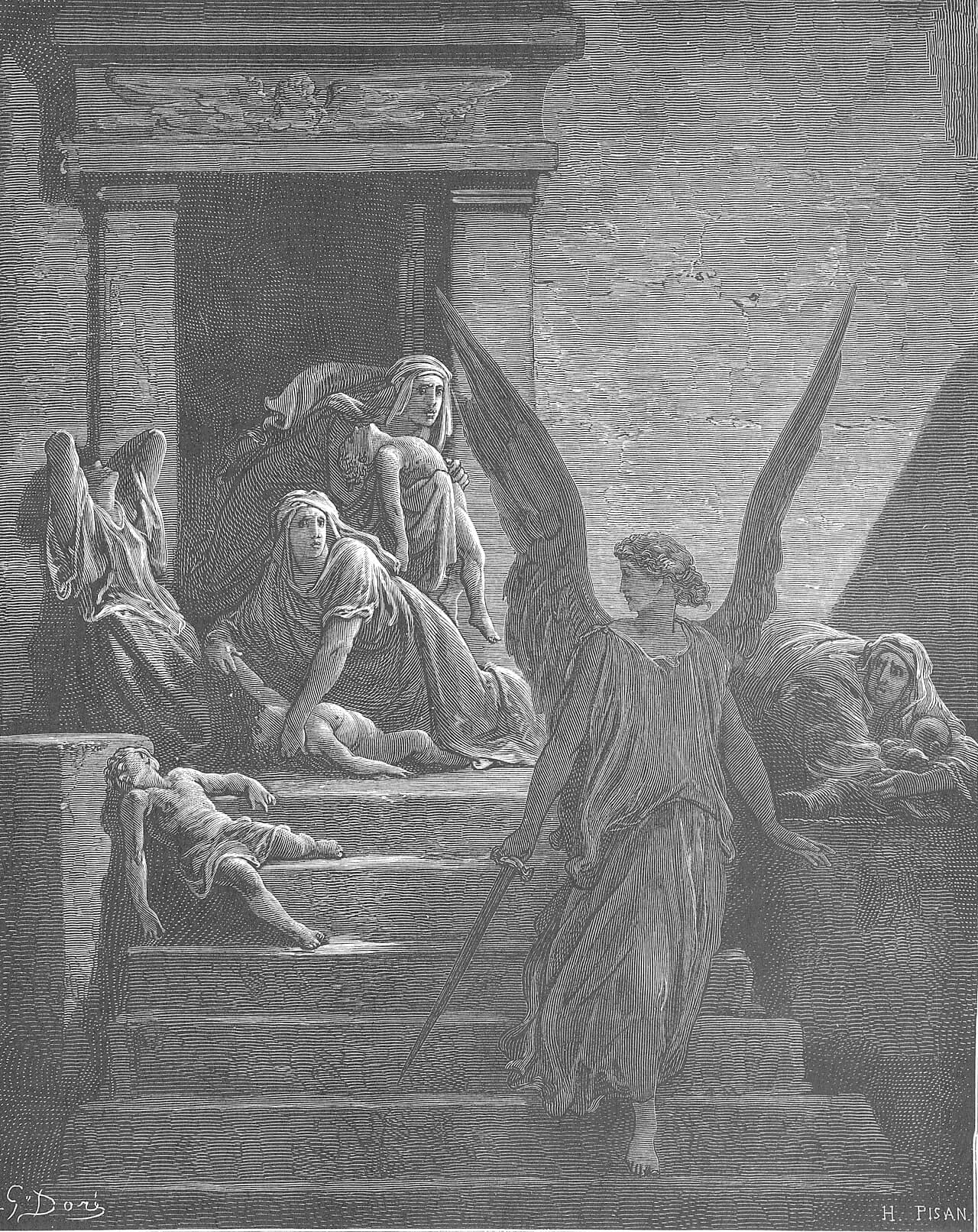
Gustave Doré, 1866, The Firstborn of the Egyptians Are Slain; public domain.
Doré drew the night of Exodus 12:29, when the firstborn of Egypt died and the houses marked with blood were passed over.
Take a cluster of hyssop, dip it into the blood in the basin, and brush the blood on the top and sides of the doorframe. None of you shall go out the door of his house until morning.Hyssop applies the blood to the doorframe, and the same plant returns in the cleansing rites of Leviticus 14 and Numbers 19.
“Not but that the destroying angel could have known an Israelite from an Egyptian in the street; but God would intimate to them that their safety was owing to the blood of sprinkling; if they put themselves from under the protection of that, it was at their peril.”
Matthew Henry · Commentary on the Whole Bible · on Exodus 12:22Puritan
The blood of the covenant, from Sinai to the Last SupperHebrews 9:20 and Matthew 26:28, with Doré's plate
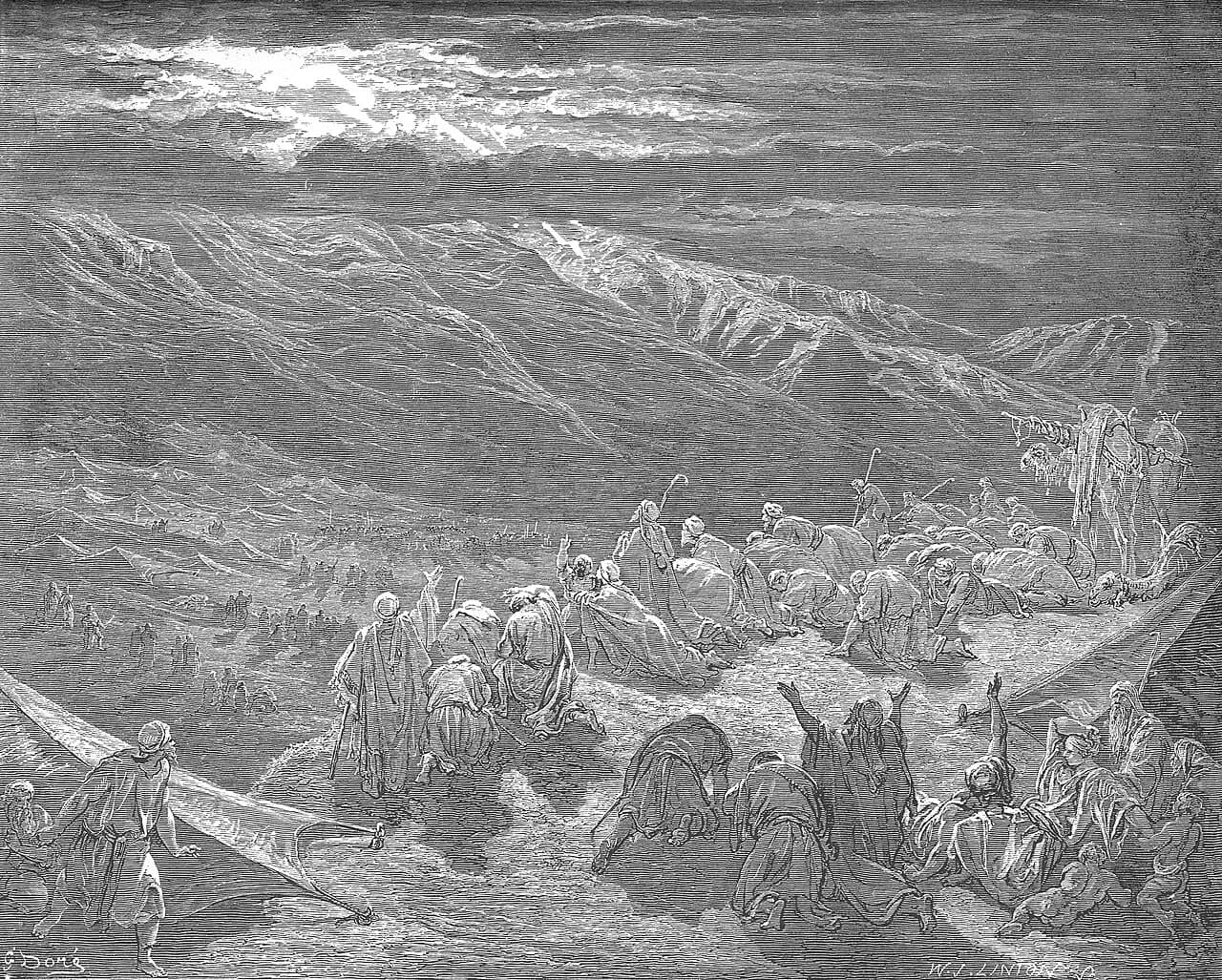
Gustave Doré, 1866, The Giving of the Law on Mount Sinai; public domain.
Doré drew Moses on the summit of Sinai, holding up the tablets of the law.
saying, “This is the blood of the covenant, which God has commanded you to keep.”Hebrews sets the Sinai rite inside its account of the first covenant, put into effect with blood (Hebrews 9:18).
This is My blood of the covenant, which is poured out for many for the forgiveness of sins.On the night before the cross Jesus takes up the words of Exodus 24:8 over the cup.
Scarlet and blood in the cleansing ritesLeviticus 14:4 and Numbers 19:6
the priest shall order that two live clean birds, cedar wood, scarlet yarn, and hyssop be brought for the one to be cleansed.The priest calls for cedar wood, scarlet yarn and hyssop to cleanse a person healed of a skin disease.
The priest is to take cedar wood, hyssop, and scarlet wool and throw them onto the burning heifer.The red heifer rite of Numbers 19 uses the same three things as the cleansing in Leviticus 14.
These two rites join scarlet and blood before Rahab ties her cord. The live bird and the scarlet yarn are dipped in the blood of the slain bird (Leviticus 14:6), and the heifer's blood is sprinkled before the scarlet wool is burned (Numbers 19:4 to 6).
“The cedar the stateliest plant, and hyssop the meanest, are here used together in this service (see 1 Kings iv. 33 ); for those of the lowest rank in the church may be of use in their place, as well as those that are most eminent, 1 Cor. xii. Some make the slain bird to typify Christ dying for our sins, and the living bird Christ rising again for our justification.”
Matthew Henry · Commentary on the Whole Bible · on Leviticus 14:6 to 7Puritan
Exodus 12:13, Exodus 24:8
The Color Turns: Isaiah to the Cross
Isaiah, the psalm of the cross, the Day of Atonement, the Gospels, Hebrews and Paul carry the thread from sins like scarlet to the cross.
“Come now, let us reason together,” says the LORD. “Though your sins are like scarlet, they will be as white as snow; though they are as red as crimson, they will become like wool.The LORD's call to Judah to reason together turns the color of sin from scarlet to the white of snow and wool.
But I am a worm and not a man, scorned by men and despised by the people.The psalm whose first line Jesus cries from the cross (Matthew 27:46) names the sufferer tola'at, the word for the worm that gave crimson dye.
Isaiah's call, in Doré's plateIsaiah 1:18
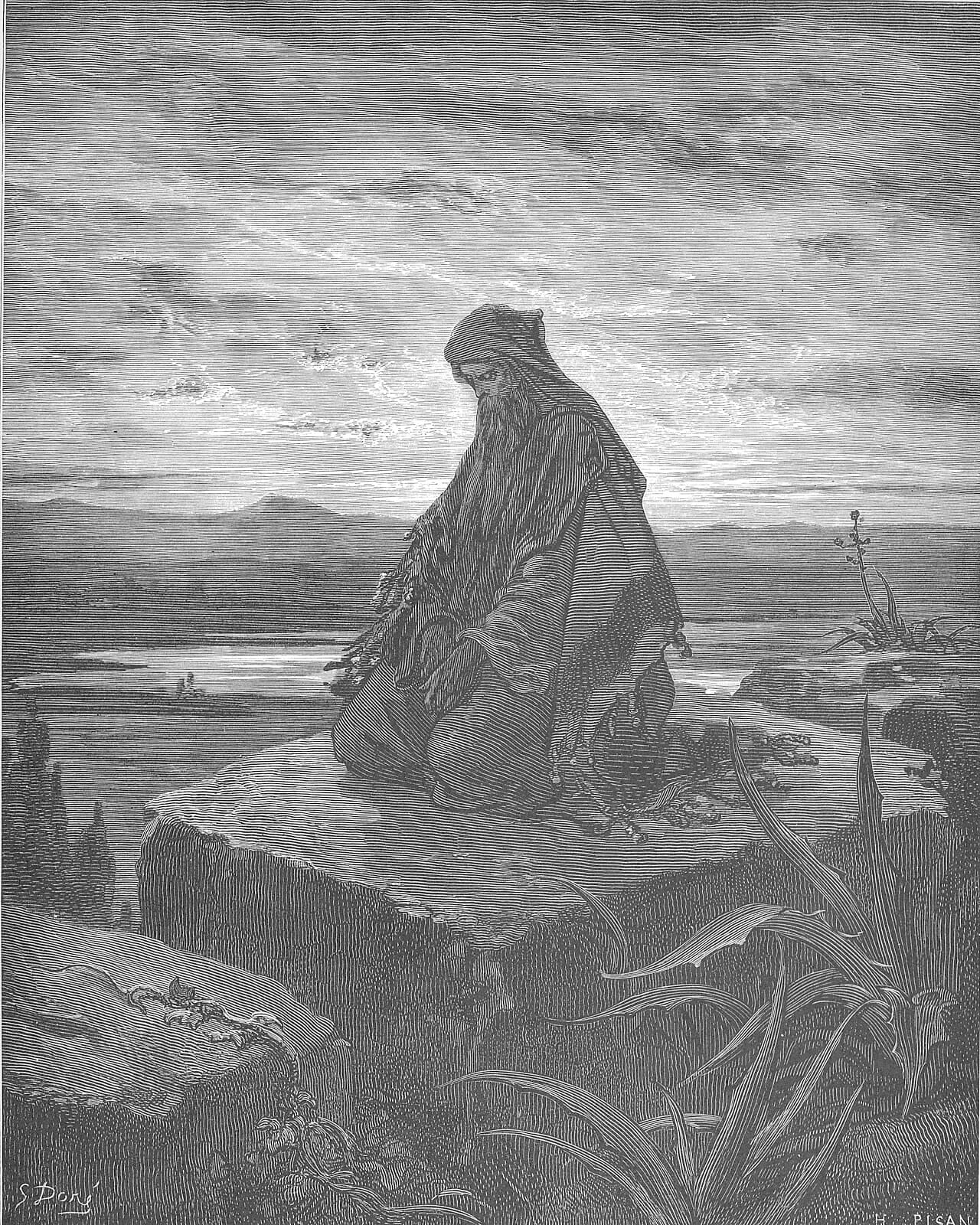
Gustave Doré, 1866, The Prophet Isaiah; public domain.
Doré drew the prophet whose first chapter calls Judah to reason with the LORD about sins like scarlet.
Kermes, the insect behind the dyeAlfred Ely Day's entry, volume 5
“‘But I am a worm, and no man.’ This verse is a miracle in language. How could the Lord of glory be brought to such abasement as to be not only lower than the angels, but even lower than men. What a contrast between ‘I AM’ and ‘I am a worm’! yet such a double nature was found in the person of our Lord Jesus when bleeding upon the tree. He felt himself to be comparable to a helpless, powerless, down-trodden worm, passive while crushed, and unnoticed and despised by those who trod upon him.”
Charles Spurgeon · The Treasury of David, Vol. 1 · on Psalm 22:6
The International Standard Bible Encyclopaedia (1915), in its entry Worm, names tola'at shani the scarlet worm, Kermes vermilio, a scale insect that feeds on the oak and gives a red dye. Its Arabic name, kirmiz, gave English the word crimson.
The entry describes the wingless female fixed to her plant by her beak, and her dead body sheltering the eggs laid beneath it. The entry gives no change of color in the insect's life.
The Yom Kippur crimson strap: did it stop turning white at the crucifixion?the Mishnah, Yoma 6:8, and the Talmud, Yoma 39b
because on this day atonement will be made for you to cleanse you, and you will be clean from all your sins before the LORD.On the Day of Atonement the people are made clean from all their sins, and the crimson strip of the Mishnah belongs to this day.
The Mishnah (Yoma 6:8) gives the word of Rabbi Yishmael that a strip of crimson tied at the entrance of the Sanctuary turned white when the goat reached the wilderness, and it cites Isaiah 1:18. The Babylonian Talmud (Yoma 39b) says that in the forty years before the Second Temple was destroyed, the strip of crimson wool tied to the head of the goat for Azazel did not turn white.
The Temple fell in AD 70, and forty years before it is AD 30. The Talmud sets the strip beside other signs of those years, the lot for God, the western lamp and the doors of the Sanctuary, and connects none of them to Jesus.
Alfred Edersheim, in The Temple: Its Ministry and Services (1874), tells where the scarlet was tied. A tongue of scarlet cloth went on the horn of the goat for Azazel, and a second band round the throat of the goat that was slain.
The scarlet robe and the purpleMatthew 27:28 and Mark 15:17
They stripped Him and put a scarlet robe on Him.The soldiers put a scarlet robe on Jesus to mock him as a king, hours before his blood is shed.
They dressed Him in a purple robe, twisted together a crown of thorns, and set it on His head.Mark names the robe purple where Matthew names it scarlet, kokkinos (G2847) in the Greek, and John 19:2 names it purple as well.
The dyes themselves are studied in Blue, Purple and Scarlet.
At that moment the veil of the temple was torn in two from top to bottom. The earth quaked and the rocks were split.The veil, woven with scarlet yarn (Exodus 26:31), is torn from top to bottom as Jesus dies.
For when Moses had proclaimed every commandment of the law to all the people, he took the blood of calves and goats, along with water, scarlet wool, and hyssop, and sprinkled the scroll and all the people,Of all the books from Matthew to Revelation, Hebrews 9:19 alone binds scarlet wool, blood, water and hyssop into a single rite.
The veil as his bodyHebrews 10:20
by the new and living way opened for us through the curtain of His body,Hebrews names the curtain his body, so the veil of scarlet yarn and the body whose blood is shed meet in one figure.
Blood and forgivenessHebrews 9:22
According to the law, in fact, nearly everything must be purified with blood, and without the shedding of blood there is no forgiveness.Hebrews 9:26 answers this rule with Christ, who appeared once for all to do away with sin by the sacrifice of himself.
A minority textual readinghyssop, or a javelin?
A jar of sour wine was sitting there. So they soaked a sponge in the wine, put it on a stalk of hyssop, and lifted it to His mouth.A stalk of hyssop lifts the sponge of sour wine to Jesus, the plant that brushed the Passover blood on the doorframes.
The Greek manuscripts read hyssōpōi, “hyssop,” the plant used for sprinkling in Exodus 12:22. One eleventh-century manuscript, the cursive numbered 476, reads hyssōi, “javelin,” a reading Camerarius had proposed by conjecture. The Passover echo rests on the hyssop reading, which J. H. Bernard's commentary of 1928 set aside for the javelin.
Instead, one of the soldiers pierced His side with a spear, and immediately blood and water flowed out.Blood and water flow from the side of Jesus, the blood every earlier scene pointed toward.
Christ redeemed us from the curse of the law by becoming a curse for us. For it is written: “Cursed is everyone who is hung on a tree.”Paul names the cross a tree, xylon in the Greek, and says Christ became a curse there for us.
Matthew 27:51, Hebrews 9:19, John 19:34, Galatians 3:13
The Hebrew and Greek Beneath the Thread
Seven Hebrew and Greek words carry the thread, from dam, blood, to xylon, the tree.
A table of seven words, three Hebrew and four Greek, each with its Strong's number and the texts where it carries the thread.
| Word | Strong's | Where it stands |
|---|---|---|
| dam: blood | H1818 | The Hebrew base word for blood: Abel, the lintel, the covenant, Leviticus 17:11. |
| tola'at: worm | H8438 | The dye-source worm: Leviticus 14:4, Isaiah 1:18 and Psalm 22:6. |
| shani: scarlet | H8144 | Scarlet, the dye itself: tabernacle textiles, Rahab's cord, Isaiah 1:18. |
| haima: blood | G129 | The New Testament's substance word: the cup, the precious blood, Revelation 5:9. |
| kokkinos: scarlet | G2847 | The New Testament color word: the mock robe, Hebrews 9:19's scarlet wool. |
| kreitton: better | G2909 | Better, more excellent: Hebrews 12:24, Christ's blood answering Abel's. |
| xylon: wood | G3586 | Tree or wood: the cross, in Galatians 3:13 and 1 Peter 2:24. |
Shani at its first useGenesis 38:28 to 30
Shani first names a thread in Genesis 38, at the birth of Tamar's twins, Perez and Zerah. Perez is the twin through whom Matthew 1:3 traces the line of Jesus.
And as she was giving birth, one of them put out his hand; so the midwife took a scarlet thread and tied it around his wrist. “This one came out first,” she announced.The thread marks the twin whose hand came out first, though his brother is born before him (Genesis 38:29).
“It should seem the birth was hard to the mother, by which she was corrected for her sin: the children also, like Jacob and Esau, struggled for the birth-right, and Pharez who got it, is ever named first, and from him Christ descended.”
John Wesley · Explanatory Notes upon the Old Testament · on Genesis 38:28Evangelical
The Witnesses
Albert Barnes and Matthew Henry set Rahab's cord beside the blood of the Passover.
1662 to 1714 · Matthew Henry
“This was like the blood sprinkled upon the door-post, which secured the first-born from the destroying angel, and, being of the same colour, some allude to this also to represent the safety of believers under the protection of the blood of Christ sprinkled on the conscience.”
Matthew Henry · Commentary on the Whole Bible · on Joshua 2:18Puritan
1798 to 1870 · Albert Barnes
“The ‘line’ or cord was spun of threads dyed with cochineal: i. e., of a deep and bright scarlet color. The color would catch the eye at once, and supplied an obvious token by which the house of Rahab might be distinguished. The use of scarlet in the Levitical rites, especially in those more closely connected with the idea of putting away of sin and its consequences (compare e. g., Lev 14:4, Lev 14:6, Lev 14:51; Num 19:6), naturally led the fathers, from Clement of Rome onward, to see in this scarlet thread, no less than in the blood of the Passover (Exo 12:7, Exo 12:13, etc.), an emblem of salvation by the Blood of Christ; a salvation common alike to Christ’s messengers and to those whom they visit.”
Albert Barnes · Notes, Explanatory and Practical, on the Old and New Testaments (1832 to 1869), on Joshua 2:18Evangelical
Modern authors and preachers2 paragraphs
Leon Morris, in his article The Biblical Use of the Term Blood (The Journal of Theological Studies, October 1952), argues that in Scripture the word blood stands for death.
W. A. Criswell preached The Scarlet Thread Through the Bible as a New Year's Eve sermon on December 31, 1961.
Where the Thread Is Contested
Two readings of the thread are disputed: Rahab's cord as the blood of Christ, and the coats of skin as the first sacrifice.
Rahab's scarlet cord as a sign of the blood of ChristTier A, an ancient reading
Clement of Rome holds it in 1 Clement 12. Justin Martyr, in his Dialogue with Trypho 111, calls the scarlet thread the symbol of the blood of Christ, and Origen and Ambrose read the house and the cord the same way.
“A harlot saw this; and she who in the destruction of the city lost all hope of any means of safety, because her faith had conquered, bound a scarlet thread in her window, and thus uplifted a sign of her faith and the banner of the Lord's passion; so that the semblance of the mystic blood, which should redeem the world, might be in memory. So, from outside the city, the name of Joshua was a sign of victory to those who fought. From within, the semblance of the Lord's passion was a sign of salvation to those in danger.”
Ambrose of Milan · Exposition of the Christian Faith 5.10.127 · on Joshua 2:21Patristic
“Also this commandment is given to the person who was once a prostitute: ‘All,’ it says, ‘who will be found in your house will be saved. But concerning those who go out from the house, we ourselves are free of them by your oath.’ Therefore, if anyone wants to be saved, let him come into the house of this one who was once a prostitute. Even if anyone from that people wants to be saved, let him come in order to be able to attain salvation.”
Origen of Alexandria · Homilies on Joshua 3.5 · on Joshua 2:19Patristic
Hebrews 11:31 praises her faith, James 2:25 her welcome of the spies, and Matthew 1:5 names her in the line of Jesus, and none of the three names the cord.
Adam Clarke, in his Commentary on the Bible (1832), reads the cord as a piece of red cloth hung from the window as a flag, the sign Rahab and the spies had agreed.
Joshua 2 itself names the cord scarlet and makes it the mark of the house.
Coats of skin as the Bible's first sacrificeTier A, an inference from Genesis 3:21
John Wesley, Adam Clarke and Jamieson, Fausset and Brown read the skins of Genesis 3:21 as taken from animals slain in sacrifice, the first blood shed to cover sin.
“The beasts whose skins they were, must be slain; slain before their eyes to shew them what death is. And probably 'tis supposed they were slain for sacrifice, to typify the great sacrifice which in the latter end of the world should be offered once for all. Thus the first thing that died was a sacrifice, or Christ in a figure.”
John Wesley · Explanatory Notes upon the Old Testament · on Genesis 3:21Evangelical
John Calvin, in his commentary on Genesis (1554), reads the skins as a covering meant to remind Adam and Eve of their sin, and he names no sacrifice. Genesis 3:21 says that God made garments of skin and clothed them, and it names no altar and no atonement.
Isaiah 61:10 takes up the figure of God clothing his people with garments of salvation.
The Thread Ends White
Peter and John name the blood of Christ as the price of redemption, and Revelation 7:14 ends the thread.
but with the precious blood of Christ, a lamb without blemish or spot.Peter names the price that redeemed his readers from the empty way of life they inherited (1 Peter 1:18).
and from Jesus Christ, the faithful witness, the firstborn from the dead, and the ruler of the kings of the earth. To Him who loves us and has released us from our sins by His blood,John opens Revelation by praising the one whose blood has released his people from their sins.
And they sang a new song: “Worthy are You to take the scroll and open its seals, because You were slain, and by Your blood You purchased for God those from every tribe and tongue and people and nation.The new song of heaven praises the Lamb for a people bought from every nation by his blood.
“Sir,” I answered, “you know.” So he replied, “These are the ones who have come out of the great tribulation; they have washed their robes and made them white in the blood of the Lamb.Revelation 7:14 answers Isaiah 1:18, where sins like scarlet were promised the whiteness of snow.
The text asks the reader to come to the Lamb whose blood makes robes white, and to stay under that blood as Rahab's household stayed inside the house with the scarlet cord (Joshua 2:19).
Revelation 5:9, Revelation 7:14
Sources
Scripture is the Berean Standard Bible.
- James Strong, Exhaustive Concordance of the Bible (1890), as the store holds its entries.
- Francis Brown, S. R. Driver and Charles A. Briggs, A Hebrew and English Lexicon of the Old Testament (1906)
- Clement of Rome, First Epistle to the Corinthians, in the Ante-Nicene Fathers.
- Justin Martyr, Dialogue with Trypho, in the Ante-Nicene Fathers.
- Mishnah Yoma, William Davidson edition.
- Babylonian Talmud, Yoma, William Davidson edition.
- Alfred Edersheim, The Temple: Its Ministry and Services (1874)
- The International Standard Bible Encyclopaedia, ed. James Orr (1915), volume 5, entry Worm, by Alfred Ely Day.
- John Calvin, Commentaries on the First Book of Moses Called Genesis (1554), tr. John King.
- Albert Barnes, Notes, Explanatory and Practical, on the Old and New Testaments (1832 to 1869)
- The Hebrew text of Jeremiah 29:11, Miqra according to the Masorah.
- The Catholic Encyclopedia (1910), Jerusalem (Before A.D. 71)
- J. H. Bernard, A Critical and Exegetical Commentary on the Gospel according to St. John (International Critical Commentary, 1928), volume 2.
- A. M. Stibbs, The Meaning of the Word Blood in Scripture (Tyndale New Testament Lecture, 1947; second edition 1954), reporting Leon Morris, The Biblical Use of the Term Blood, The Journal of Theological Studies, October 1952.
- W. A. Criswell, The Scarlet Thread Through the Bible (sermon, December 31, 1961)
Keep Studying
Read it1
Studies8
People and groups4
Symbols8
Doctrines14