
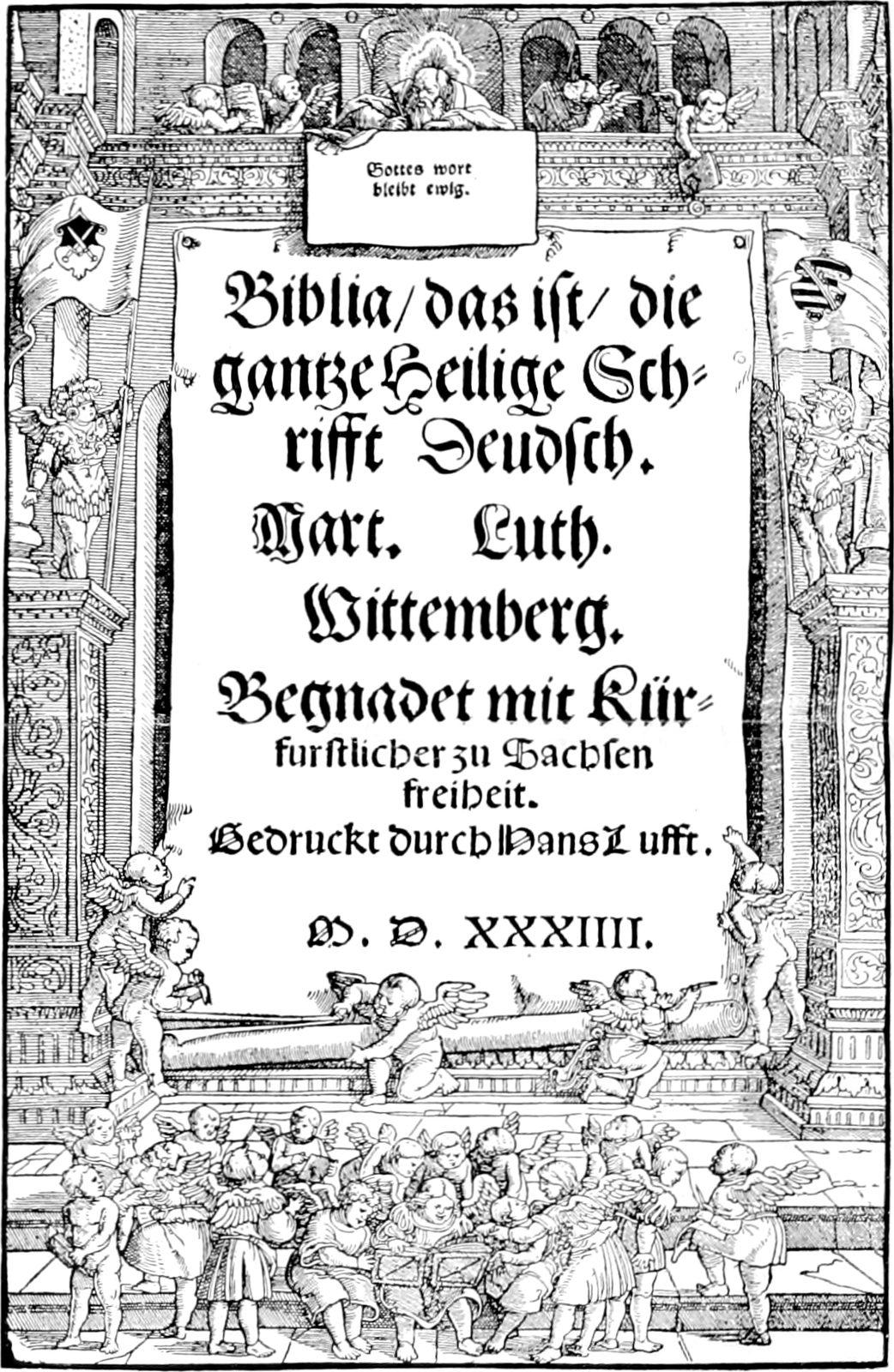
Title page of Luther's Bible, Wittenberg, 1534. Public domain.
1382 to 1960 · Subject · Featured Study
The Recovered Truths
Ten truths the churches say they recovered from Scripture between Wycliffe's day and the charismatic renewal, each dated and set beside the answer it met.
Each tradition named here says it found again what the apostles taught, and the oldest of these claims met churches that answered them in print.
Beloved, although I made every effort to write to you about the salvation we share, I felt it necessary to write and urge you to contend earnestly for the faith entrusted once for all to the saints.
Beloved, although I made every effort to write to you about the salvation we share, I felt it necessary to write and urge you to contend earnestly for the faith entrusted once for all to the saints.
- Books
- Jude, 2 Timothy, Acts
- Hold in memory
- Jude 1:3, Acts 17:11
Summary
From the 1300s to the 1900s, church after church said it had found again a truth the rest of the church had lost.
- Wycliffe's circle, Tyndale and Luther put the Bible into English and German.
- Later groups taught believers' baptism, the gathered church and heart religion, from 1525 to 1675.
- Wesley taught assurance and perfect love, and the Holiness churches carried it on.
- The last two claims began at Topeka in 1901 and at Van Nuys in 1960.
The Faith Once Delivered
The verses every recovering tradition appealed to, that the faith was given once and that Scripture is its rule.
Given once, and its rule
All Scripture is God-breathed and is useful for instruction, for conviction, for correction, and for training in righteousness,
Paul writes this to Timothy as the ground for the teaching every later tradition tested itself by.
Now the Bereans were more noble-minded than the Thessalonians, for they received the message with great eagerness and examined the Scriptures every day to see if these teachings were true.
Luke praises the Jews of Berea for testing Paul's preaching against the text.
Acts 17:11BSB
Ten Truths on One Line
Each bar is a span of years in which a tradition taught a truth it held recovered, with its door.
The ten claims run from the English Bible of Wycliffe's circle in the 1380s to the charismatic renewal, and the later spans overlap.
- Scripture in the people's tongue1382 to 1611Wycliffe's circle, Tyndale and the King James translators
- Justification by faith1517 to 1530Lutheran
- Believers' baptismFrom January 1525Anabaptist
- The gathered churchFrom 1580 or 1581Congregational
- The heart religionFrom 1675Pietist
- AssuranceFrom 24 May 1738Methodist
- Holiness1725 to 1777, and from 1843Wesleyan and Holiness
- Healing1915, and 1947 to 1958The healing revival
- The baptism in the Spirit1901 to 1906Pentecostal
- The gifts in the historic churchesFrom 1960Charismatic
A timeline of spans, earliest first. Each row opens its tradition's page.
Holiness, Healing, The baptism in the Spirit, The gifts in the historic churches
Each Truth and Its Record
What each tradition taught and when, from its own page, with its door.
Scripture in the people's tongue1382 to 1611
Wycliffe pressed for the Bible in English, and his circle made the version that bears his name. In May 1382 a synod at Blackfriars condemned 24 articles, the first on the bread and wine of the sacrament.
Read John Wycliffe 12 sections, 2 verses set out
Tyndale's New Testament1526
Tyndale put the New Testament into English and printed it at Worms in 1526. Copies were carried into England in secret and burned there, and his work fed the English Bibles that followed.
Read William Tyndale 12 sections, 2 verses set out
Justification by faith1530
On 25 June 1530 the Lutheran princes presented their confession to Charles V at Augsburg. Its fourth article teaches that a sinner is made right with God freely, for Christ's sake, through faith.
Read The Lutheran Churches 12 sections, 6 verses set out
Believers' baptism1525
In January 1525 some of Zwingli's own followers in Zurich baptized one another as believers. The Anabaptists baptized only those who confessed their faith, and their leaders were drowned, burned and beheaded.
Read The Anabaptists 10 sections, 7 verses set out
The gathered church1580 or 1581
At Norwich Robert Browne formed what Williston Walker calls the first Congregational church of the long series.
Read The Congregational Churches 11 sections, 9 verses set out
The heart religion1675
Spener's six proposals asked the Lutheran church for more Bible among the people and a faith of practice more than of knowledge.
Read The Pietists 9 sections, 8 verses set out
Assurance1738
In Georgia Spangenberg asked John Wesley whether the Spirit bore witness that he was a child of God. Wesley's Journal names the evening of 24 May 1738 in Aldersgate Street as the hour he first trusted Christ alone.
Read Aldersgate, 1738 11 sections, 4 verses set out
Holiness1725 to 1777
Christian perfection is Wesley's name for love of God and neighbour that rules the heart, received by faith in this life. The Holiness churches made it the centre of their teaching and called it entire sanctification.
Read Christian Perfection 8 sections, 16 verses set out
Healing1915 to 1958
A. B. Simpson taught healing in the atonement long before the healing revival. From 1947 to 1958 preachers held healing campaigns across America on the older belief that Christ bore sickness as He bore sin.
Read The Healing Revival 10 sections, 8 verses set out
The baptism in the Spirit1901 to 1906
On 1 January 1901 students at Parham's school at Topeka spoke in tongues. From April 1906 people spoke in tongues at the mission at 312 Azusa Street, and new churches grew from it.
Read Topeka, 1901 11 sections, 2 verses set out
The gifts in the historic churches1960
The charismatic renewal carried the gifts of 1 Corinthians 12 into churches that had held apart from Pentecostalism. Dennis Bennett told his congregation at Van Nuys in 1960, and the Catholic renewal began at Duquesne University in 1967.
Read The Charismatic Renewal 11 sections, 8 verses set out
Tyndale's New Testament (1526), Justification by faith (1530), Believers' baptism (1525), The gathered church (1580 or 1581), The heart religion (1675), Assurance (1738), Holiness (1725 to 1777), Healing (1915 to 1958) and 2 more
In Their Own Words
John Chrysostom (died 407)
Homilies on the Epistle to the Romans, Homily 2
Chrysostom taught a righteousness received as a gift.
“he adds also righteousness; and righteousness, not thine own, but that of God; hinting also the abundance of it and the facility. For you do not achieve it by toilings and labors, but you receive it by a gift from above, contributing one thing only from your own store, ‘believing.’”
Patristic
About this saying1 paragraph
Chrysostom preached at Antioch and became bishop of Constantinople in 398, more than a thousand years before Augsburg.
John Calvin (1509 to 1564)
Commentaries on the Epistle of Paul the Apostle to the Romans
Calvin read Romans 1 as righteousness received by faith.
“But instead of the expression he used before, ‘to every one who believeth,’ he says now, from faith; for righteousness is offered by the gospel, and is received by faith.”
Reformed
About this saying1 paragraph
Calvin wrote his commentary on Romans in the sixteenth century.
Adam Clarke (1762 to 1832)
Commentary on the Bible
Adam Clarke read the gospel as a power that breaks sin and cleans the heart.
“The Gospel of the grace of Christ, which is not only a law or rule of life, but affords that sovereign energy by which guilt is removed from the conscience, the power of sin broken, and its polluting influence removed from the heart.”
Methodist
About this saying1 paragraph
Clarke wrote this on Romans 8:2 in 1832, of guilt and the conscience.
Each Claim and Its Answer
Three questions show the claim and the answer side by side, each from its own record.
Three of the claims set beside the answers they met in print.
| The question | The claim | The answer |
|---|---|---|
| How is a sinner made just? | The Augsburg Confession, 1530: through faith, for Christ's sake | The Council of Trent, 1545 to 1563, gave the opposite answer |
| Whom should the church baptize? | The Anabaptists: those who confess their faith | Zwingli wrote against them in 1527, and Zurich ordered every infant baptized |
| Can love rule the heart in this life? | Wesley: perfect love, received by faith | The Westminster Confession holds sanctification imperfect in this life |
The site's tradition, Wesleyan-Pentecostal, receives assurance, holiness, healing and the baptism in the Spirit as the teaching of Scripture, and says so openly. It sets each answer beside the claim so that the reader meets both in the words of their own churches.
Books to Read Next
The Augsburg Confession, in the Triglot Concordia
The Lutheran confessors · 1530; the Triglot of 1921
Article IV states justification by faith as the Lutheran churches confessed it.
Free at BookOfConcord.orgA Plain Account of Christian Perfection
John Wesley · Last revised 1777
Wesley sets out what he taught on holiness from 1725 on.
Free at CCELThe Gospel of Healing
A. B. Simpson · Revised edition, 1915
Simpson teaches healing in the atonement a generation before the healing revival.
Free at the Internet ArchiveSources
Scripture is the Berean Standard Bible.
- The Holy Bible, Berean Standard Bible (read 2026)
- D. S. Schaff, History of the Christian Church, volume 6 (1910), and Gee and Hardy, Documents Illustrative of English Church History (1896)
- Robert Demaus, William Tindale, revised by Richard Lovett (1904)
- The Augsburg Confession in the Triglot (1921) and the Canons of Trent, translated by J. Waterworth (1848)
- Emil Egli, Actensammlung (1879), and Zwingli, Refutation of the Tricks of the Catabaptists (1527), English of 1901.
- Spener, Pia Desideria, Frankfurt printing of 1706.
- John Wesley, Journal, ed. Curnock (1909)
- Wesley, A Plain Account of Christian Perfection, in Works, ed. Jackson (1872), volume 11, and Phoebe Palmer, The Way of Holiness (1843)
- A. B. Simpson, The Gospel of Healing, revised edition (1915)
- The Topeka State Journal (January 1901) and Bartleman (1925)
- Dennis J. Bennett, Nine O'Clock in the Morning (1970), and Kevin and Dorothy Ranaghan, Catholic Pentecostals (1969)
- John Chrysostom, Homilies on the Epistle to the Romans, Homily 2; John Calvin, Commentaries on the Epistle of Paul the Apostle to the Romans; Adam Clarke, Commentary on the Bible (1832), on Romans 8:2.
Keep Studying
People and groups5
Doctrines1
Subjects5