
Exodus to Deuteronomy · Person · Featured Study
Moses
Moses led Israel out of Egypt and mediated the covenant at Sinai.
Moses asked to see the glory of God, and God hid him in a cleft of the rock and let him see His back.
- The name means
- Drawn out, as Pharaoh's daughter explains the name
- Born
- about 1526 BC on the early date of the Exodus (proposed)
- Died
- at 120 years, in Moab
- Family
- father: Amram; mother: Jochebed; brother: Aaron; sister: Miriam; wife: Zipporah; son: Gershom; son: Eliezer
- Places
- Egypt, Goshen, The Red Sea, Mount Sinai, Kadesh-Barnea, Moab, Mount Nebo
- First named
- Exodus 2:10
- Last named
- Revelation 15:3
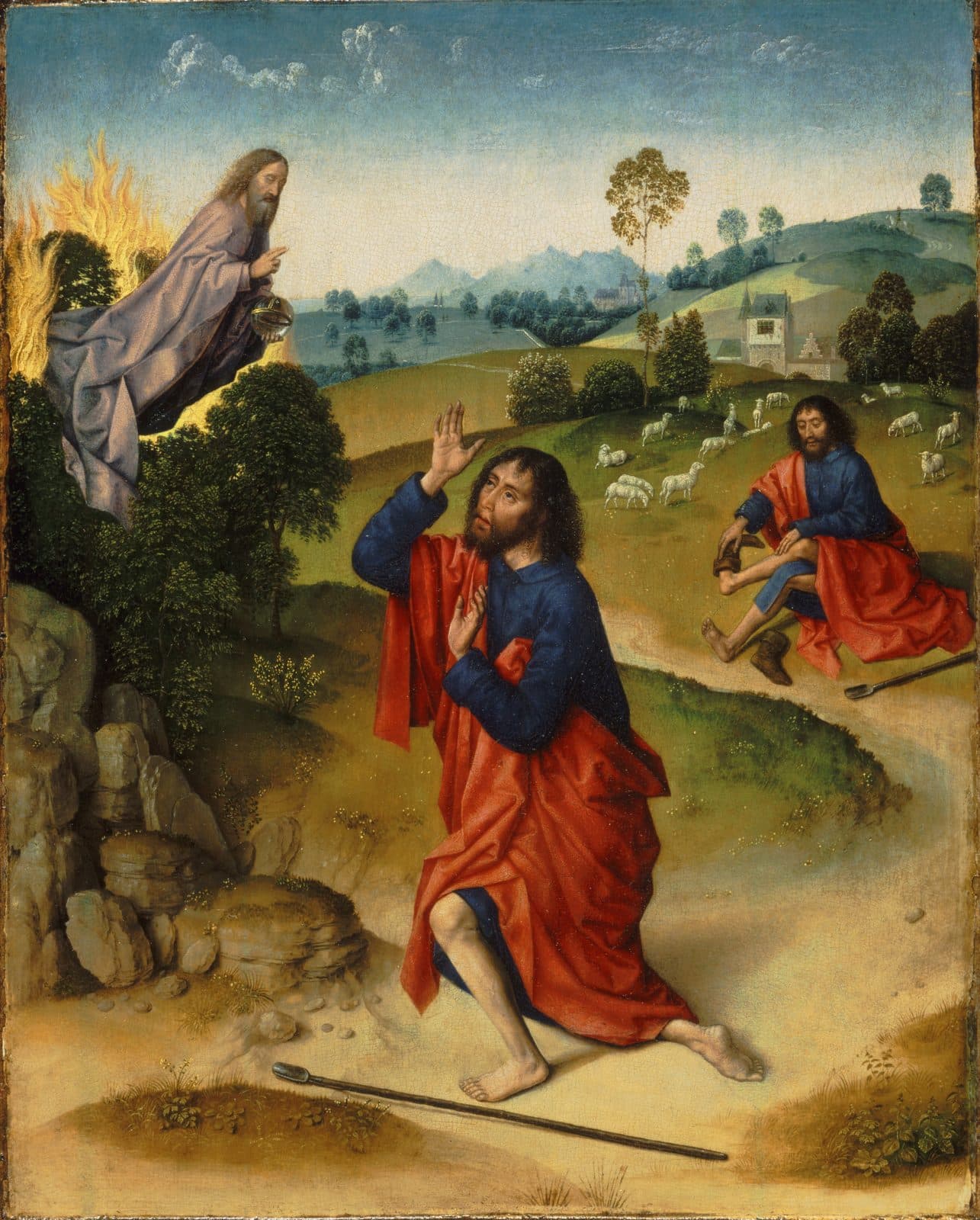
Attributed to Dieric Bouts the Elder, Moses and the Burning Bush, with Moses Removing His Shoes, about 1465, Philadelphia Museum of Art. Public domain, via Wikimedia Commons.
THE ARTWORKBouts painted Moses twice in one landscape. In the distance he sits beside the flock of Jethro and takes off his sandals. In front he kneels barefoot with his staff on the ground and raises his hand before God, who is drawn as a robed figure above the burning bush.
Summary
Moses was a Levite raised in Pharaoh's household and educated in all the wisdom of the Egyptians.
- God spoke with him face to face, and the Torah closes with no prophet risen like him.
- Deuteronomy promises a prophet like him, and Acts applies the promise to Jesus.
- Hebrews counts Jesus worthy of greater glory than Moses, as the builder of a house has greater honor than the house.
Where Moses Stands in Scripture
Four titles Scripture gives him, each with its verse
THE SERVANT OF THE LORD
The book of Joshua opens on the death of the LORD's servant Moses.
GOD'S CHOSEN ONE
A psalm calls him God's chosen one, who stood in the breach for Israel.
THE MAN OF GOD
Deuteronomy heads his blessing of the tribes with the title Scripture later gives to Elijah and Elisha.
A PROPHET
Hosea calls him a prophet without naming him, by the deliverance from Egypt.
The Life in Three Forties
Eleven turns in three forties: Egypt, Midian and the wilderness
- Hidden in a basket and drawn out of the NileEgypt, Exodus 2:3
- Kills an Egyptian and fleesage 40, Acts 7:23
- Keeps the flock of JethroMidian, Exodus 3:1
- Called from the burning bushage 80, Acts 7:30
- Stands before Pharaoh with Aaronage 80, Exodus 7:7
- Leads Israel through the seathe sea, Exodus 14:21
- Receives the two tablets of stoneSinai, Exodus 31:18
- Intercedes after the golden calfSinai, Exodus 32:32
- Strikes the rock and is barred from the landKadesh, Numbers 20:12
- Lays his hands on Joshuathe plains of Moab, Numbers 27:23
- Dies and is buried by the LORDage 120, Moab, Deuteronomy 34:7
At his death, Deuteronomy adds, his eyes were not weak and his vitality had not diminished.
How God Spoke with Moses
Numbers 12, Deuteronomy 34 and Exodus 33
When Miriam and Aaron criticize Moses for his Cushite wife, the LORD calls the three of them out to the Tent of Meeting and answers for him.
But this is not so with My servant Moses; he is faithful in all My house. I speak with him face to face, clearly and not in riddles; he sees the form of the LORD. Why then were you unafraid to speak against My servant Moses?”Numbers 12:6 gives the rule for a prophet, visions and dreams; these verses make Moses the exception.
Since that time, no prophet has risen in Israel like Moses, whom the LORD knew face to face— no prophet who did all the signs and wonders that the LORD sent Moses to do in the land of Egypt to Pharaoh and to all his officials and all his land, and no prophet who performed all the mighty acts of power and awesome deeds that Moses did in the sight of all Israel.These verses join two marks that no later prophet matched: the LORD knew Moses face to face, and sent him to do the signs in Egypt.
Thus the LORD would speak to Moses face to face, as a man speaks to his friend. Then Moses would return to the camp, but his young assistant Joshua son of Nun would not leave the tent.This verse shows that face to face means speech as a man speaks to his friend, the closeness Numbers 12:8 claims for Moses alone.
But He added, “You cannot see My face, for no one can see Me and live.”This verse sets the limit of that closeness: God speaks with Moses as a friend and still refuses him the sight of His face.
What the Text Says of Him
Four things often said of Moses, each set beside its verse
A SHINING FACE
When Moses came down the mountain with the two tablets, his face was radiant, and afterward he veiled it. The Hebrew verb at Exodus 34:29 is qaran, which the lexicon gives as to shoot out horns and figuratively rays.
A MEEK MAN
Numbers calls him the most humble man on the face of the earth. In that chapter he speaks once, to pray that Miriam be healed.
FAITHFUL IN THE HOUSE
Hebrews calls Moses faithful as a servant in all God's house, testifying to what would be spoken later. Christ is faithful as the Son over that house.
LAW AND GRACE
John writes that the law was given through Moses and that grace and truth came through Jesus Christ. The verse before says that from His fullness we have all received grace upon grace.
The World Behind Moses
What the record outside the Bible supplies
The Merneptah Stele, from about 1208 BC, carries the first mention of Israel outside the Bible. The date of the Exodus is disputed. Eugene Merrill in Kingdom of Priests and Bryant Wood in The Rise and Fall of the 13th-Century Exodus-Conquest Theory read 1 Kings 6:1 to give about 1446 BC. Douglas Petrovich holds the same date in The Master's Seminary Journal of 2006. Kenneth Kitchen in On the Reliability of the Old Testament and James Hoffmeier in Israel in Egypt place it in the thirteenth century, under Ramesses II.
Writers outside Scripture name him only much later. Josephus, in the first century AD, quotes in Against Apion the Egyptian priest Manetho, whose story makes Moses a priest of Heliopolis named Osarsiph who changed his name.
The Family of Moses
Each tie with the verse that names it
AMRAM AND JOCHEBED
Amram married Jochebed, his father's sister, and she bore him Aaron and Moses.
AARON
He was the brother of Moses, three years older, and God made him the prophet who spoke for Moses before Pharaoh.
MIRIAM
She was the sister of Moses and Aaron, a prophetess, and she led the women with tambourines and dancing after the sea.
ZIPPORAH
She was a daughter of the priest of Midian, and her father gave her to Moses in marriage in his years of exile.
GERSHOM
He was the elder son, and Moses named him for his own life as a foreigner in a foreign land.
ELIEZER
He was the younger son, and Moses named him because the God of his father was his helper against the sword of Pharaoh.
Questions the Life Raises
Two questions, each answered from its verse
What did Moses write down?Exodus to Deuteronomy
The Torah records Moses writing at God's command: the war with Amalek, the words of the LORD at Sinai, the stages of the march, and the law he gave the priests.
When Moses had finished writing in a book the words of this law from beginning to end, he gave this command to the Levites who carried the ark of the covenant of the LORD: “Take this Book of the Law and place it beside the ark of the covenant of the LORD your God, so that it may remain there as a witness against you.This is the Torah's plainest statement that Moses wrote the law in a book, and it names where the book was kept.
Why was Moses kept out of the land?Numbers 20
At Meribah God told Moses to speak to the rock, and he struck it twice.
But the LORD said to Moses and Aaron, “Because you did not trust Me to show My holiness in the sight of the Israelites, you will not bring this assembly into the land that I have given them.”The LORD names the fault as a failure to trust Him, and the sentence falls on Aaron as well as on Moses.
What the Text Leaves Unsaid
Five matters Scripture does not settle
Exodus names no Pharaoh, and Pharaoh's daughter is given no name. Deuteronomy says that no one knows where Moses is buried. Exodus 4:10 has Moses call himself slow of speech and tongue, and gives no cause. Jude tells of the archangel Michael disputing with the devil over the body of Moses, and names no source for the account.
The Prophet Like Moses
Deuteronomy 18, Acts 3 and Luke 9
Stephen quotes the promise of Deuteronomy 18:15 again in Acts 7:37, in the speech that ends with his stoning.
The LORD your God will raise up for you a prophet like me from among your brothers. You must listen to him.Moses gives the promise in answer to Israel's plea at Horeb not to hear the voice of God again.
For Moses said, ‘The Lord your God will raise up for you a prophet like me from among your brothers. You must listen to Him in everything He tells you.Peter quotes the promise to the crowd in Solomon's Colonnade, who had seen the lame man walk in the name of Jesus.
Suddenly two men, Moses and Elijah, began talking with Jesus. They appeared in glory and spoke about His departure, which He was about to accomplish at Jerusalem.Luke's word for the departure Moses and Elijah spoke of is exodos, which the lexicon gives as an exit and figuratively death.
Voices on Moses
Four teachers from the sixteenth century to the twentieth
“Moses again repeats, that consolation was afforded him in his anxiety, and a remedy given for his want of faith; since he was both armed himself with divine authority, and Aaron was appointed as his companion and assistant. For that he was ‘made a god to Pharaoh,’ means that he was furnished with supreme authority and power, whereby he should cast down the tyrant's pride.”
John Calvin · Commentaries · on Exodus 7:1Reformed
“Moses now returned to the door of the tabernacle, as an important supplicant for two favours, and prevails for both: herein he was a type of Christ the great intercessor, whom the Father heareth always. He is earnest with God for a grant of his presence with Israel in the rest of their march to Canaan.”
John Wesley · Explanatory Notes upon the Old Testament · on Exodus 33:12Evangelical
“What warmth of affection did he evince for his brethren! How fully was he animated with the true spirit of a patriot, when he professed his willingness to die for them. But Christ actually died for His people (Ro 5:8).”
Jamieson, Fausset & Brown · Commentary Critical and Explanatory on the Whole Bible · on Exodus 32:32Reformed
“Boy, if I'd taken a stick and divided the Red Sea, I'd thought I'd seen all the glory I needed. If I hit a rock and it split open and it followed the nation wherever they went, I'd say, look at the magic.”
Leonard Ravenhill · Moses and Exodus 33 - Part 1 · on Exodus 33:18Charismatic
Who Wrote the Torah?
Two answers, each with its holders
Joshua 8:31 names the Book of the Law of Moses, and the question is how much of the five books that title covers.
Moses, with a later hand at the closeBabylonian Talmud, Bava Batra 14b
The baraita in Bava Batra 14b says that Moses wrote his own book, the portion of Balaam and Job. Joshua, it says, wrote his own book and the eight verses of the Torah that describe the death of Moses. On the next page Rabbi Shimon answers that Moses wrote those verses too, at God's dictation, with tears.
So Moses the servant of the LORD died there in the land of Moab, as the LORD had said.This verse reports the death of Moses and is one of the eight closing verses the baraita gives to Joshua.
Later sources, gathered after the kingdomJulius Wellhausen, 1883
Wellhausen's Prolegomena to the History of Israel divides the Pentateuch into three strata, Deuteronomy, the Priestly Code and the Jehovist, and dates the Levitical law after the fall of Judah. On this view the Mosaic history begins the history of Judaism.
If you had believed Moses, you would believe Me, because he wrote about Me.Jesus says that Moses wrote about Him, and the traditional answer sets this verse against the later dating.
Books to Read Next
Four works, from the first century to the nineteenth
The Life of Moses
Gregory of Nyssa · about 395
Gregory reads the life of Moses as the soul's climb toward God.
Against Apion
Flavius Josephus · about 97
Josephus defends the antiquity of the Jews against their Greek and Egyptian critics.
READ IT FREE AT PROJECT GUTENBERG →Harmony of the Law
John Calvin · sixteenth century
Calvin arranges the law of Moses as a harmony and comments on it.
READ IT FREE AT CCEL →Prolegomena to the History of Israel
Julius Wellhausen · 1883
Wellhausen argues first from the history of Israel's worship: the sacrifices, the feasts and the priesthood.
READ IT FREE AT PROJECT GUTENBERG →Listen to Him
At the transfiguration the voice from the cloud told the disciples to listen to Jesus, the charge Moses gave Israel about the prophet to come.
Keep studying
Studies13
Symbols1