
Genesis 39 · Subject · Featured Study
Joseph and the Tale of Two Brothers
Genesis 39 set beside the story of Anpu and Bata, copied on an Egyptian papyrus of the Nineteenth Dynasty.
Joseph ran from the house, and in the prison the LORD gave him favor.
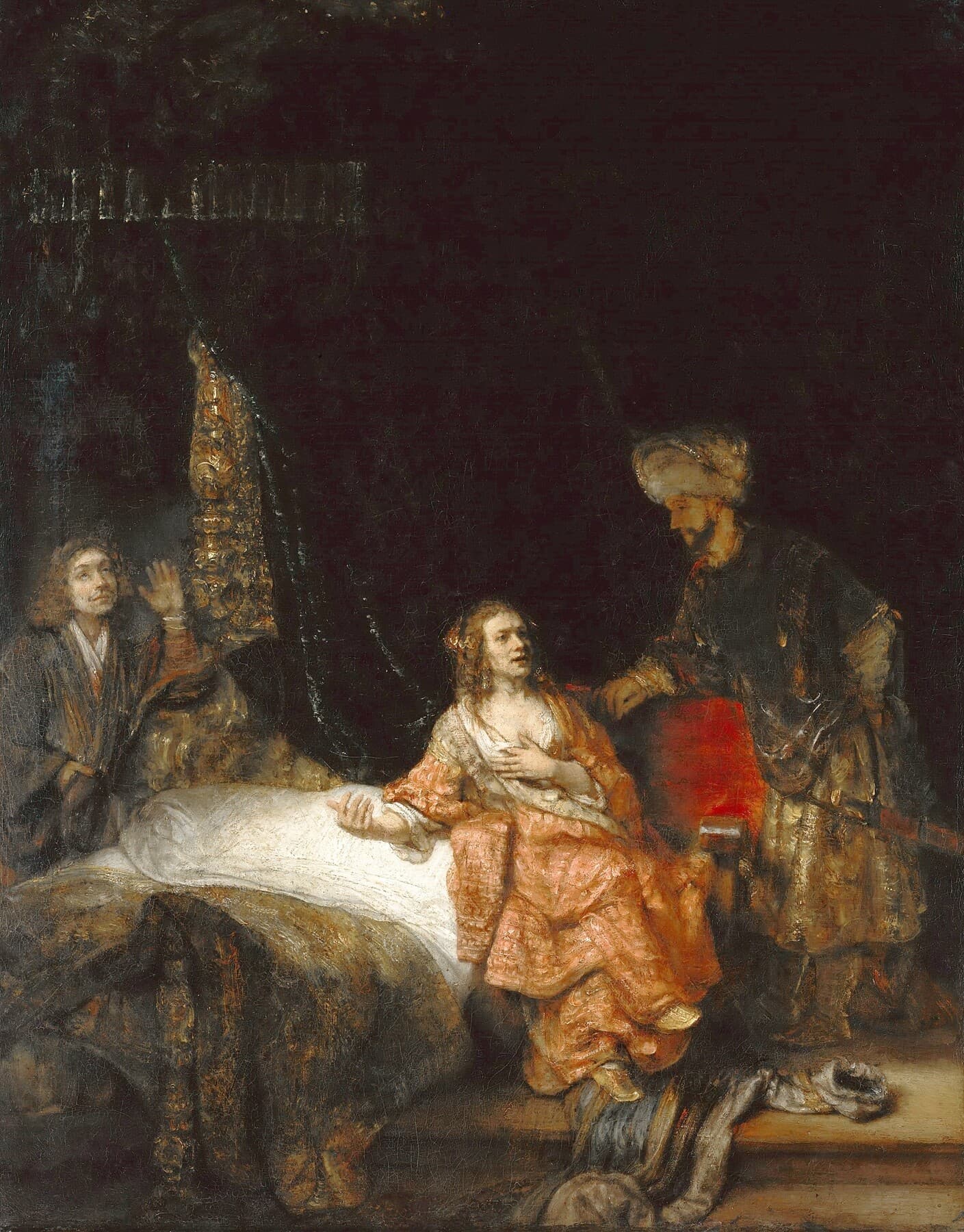
Rembrandt, Joseph Accused by Potiphar's Wife, 1655, Gemäldegalerie, Berlin. Public domain, via Wikimedia Commons, File:Rembrandt_-_Potiphars_vrouw_klaagt_Jozef_aan_bij_haar_man_%281655%29.jpg.
THE ARTWORKRembrandt painted Potiphar's wife at the bedside bringing her false charge to Potiphar, with Joseph standing beyond the bed (Genesis 39:16 to 18). It stands here because that charge is at the centre of Genesis 39 and of the Tale of Two Brothers.
Summary
Genesis 39 tells how Joseph, a slave in Potiphar's house, refused his master's wife, was accused by her and was put in the king's prison.
- Psalm 105 and Stephen's speech in Acts 7 read Joseph's years in Egypt as God's sending and God's presence.
- In the Egyptian Tale of Two Brothers a younger brother is tempted by his elder brother's wife and falsely accused.
- Scholars read the likeness either as a folk motif the Hebrew story borrowed or as the meeting of two different kinds of writing.
Genesis 39 in Four Movements
The chapter moves from Potiphar's house to the refusal, the false charge and the prison.
Meanwhile, Joseph had been taken down to Egypt, where an Egyptian named Potiphar, an officer of Pharaoh and captain of the guard, bought him from the Ishmaelites who had taken him there. And the LORD was with Joseph, and he became a successful man, serving in the household of his Egyptian master. When his master saw that the LORD was with him and made him prosper in all he did, Joseph found favor in his sight and became his personal attendant. Potiphar put him in charge of his household and entrusted him with everything he owned. From the time that he put Joseph in charge of his household and all he owned, the LORD blessed the Egyptian’s household on account of him. The LORD’s blessing was on everything he owned, both in his house and in his field. So Potiphar left all that he owned in Joseph’s care; he did not concern himself with anything except the food he ate. Now Joseph was well-built and handsome,The first movement shows why Joseph had everything to lose, since his master had trusted him with all he owned.
and after some time his master’s wife cast her eyes upon Joseph and said, “Sleep with me.” But he refused. “Look,” he said to his master’s wife, “with me here, my master does not concern himself with anything in his house, and he has entrusted everything he owns to my care. No one in this house is greater than I am. He has withheld nothing from me except you, because you are his wife. So how could I do such a great evil and sin against God?” Although Potiphar’s wife spoke to Joseph day after day, he refused to go to bed with her or even be near her. One day, however, Joseph went into the house to attend to his work, and not a single household servant was inside. She grabbed Joseph by his cloak and said, “Sleep with me!” But leaving his cloak in her hand, he escaped and ran outside.The second movement holds the only words Joseph speaks in the chapter, his answer to his master's wife.
When she saw that he had left his cloak in her hand and had run out of the house, she called her household servants. “Look,” she said, “this Hebrew has been brought to us to make sport of us. He came to me so he could sleep with me, but I screamed as loud as I could. When he heard me scream for help, he left his cloak beside me and ran out of the house.” So Potiphar’s wife kept Joseph’s cloak beside her until his master came home. Then she told him the same story: “The Hebrew slave you brought us came to me to make sport of me, but when I screamed for help, he left his cloak beside me and ran out of the house.” When his master heard the story his wife told him, saying, “This is what your slave did to me,” he burned with anger. So Joseph’s master took him and had him thrown into the prison where the king’s prisoners were confined. While Joseph was there in the prison,In the third movement Potiphar's wife turns the household against Joseph by calling him "this Hebrew" brought "to make sport of us."
the LORD was with him and extended kindness to him, granting him favor in the eyes of the prison warden. And the warden put all the prisoners under Joseph’s care, so that he was responsible for all that was done in the prison. The warden did not concern himself with anything under Joseph’s care, because the LORD was with Joseph and gave him success in whatever he did.The last movement answers the false charge with the LORD's kindness to Joseph inside the prison.
The Two Stories Side by Side
Genesis 39 and the Egyptian tale share a household, a temptation, a refusal and a false charge, and they part after the charge.
| Element | Genesis | The Tale of Two Brothers (Petrie, Egyptian Tales) |
|---|---|---|
| The trusted house | Potiphar puts Joseph in charge of his household and all he owns. | Bata, the younger brother, is to his elder brother Anpu "as it were a son", makes his clothes and does all the work of his fields. |
| The approach | His master's wife asks him to sleep with her. | Sent from the field to fetch corn, Bata finds Anpu's wife dressing her hair, and she says, "Come, stay with me, and it shall be well for thee, and I will make for thee beautiful garments." |
| The refusal | Joseph refuses and calls the act a great evil and a sin against God. | Bata answers, "Behold thou art to me as a mother, thy husband is to me as a father," and promises to tell no one. |
| The false charge | She keeps his cloak and tells the household and her husband that he came to sleep with her. | She takes "a parcel of fat", makes herself "like one who is evilly beaten", and tells her husband that Bata asked her to stay with him and beat her to keep her silent. |
| The husband's anger | Potiphar burns with anger. | Anpu becomes "as a panther of the south", sharpens his knife and waits behind the stable door to kill his brother. |
| The accused | Joseph is put in the prison where the king's prisoners are confined. | Warned by his cows, Bata flees, and Anpu pursues him with the knife. |
| The help that comes | The LORD is with Joseph and grants him favor with the prison warden. | Bata cries to Ra Harakhti, who makes "a wide water" full of crocodiles between the brothers; at dawn Bata tells Anpu the truth, and Anpu goes home and kills his wife. |
| What follows | Pharaoh brings Joseph out of the prison and sets him over all the land of Egypt. | Bata sets his soul on the flower of an acacia and dies when it is cut down, lives again as a bull, as two Persea trees and as the son of Pharaoh's wife, and reigns thirty years as king of Egypt. |
- Element
- The trusted house
- Genesis
- Potiphar puts Joseph in charge of his household and all he owns.
- The Tale of Two Brothers (Petrie, Egyptian Tales)
- Bata, the younger brother, is to his elder brother Anpu "as it were a son", makes his clothes and does all the work of his fields.
- Element
- The approach
- Genesis
- His master's wife asks him to sleep with her.
- The Tale of Two Brothers (Petrie, Egyptian Tales)
- Sent from the field to fetch corn, Bata finds Anpu's wife dressing her hair, and she says, "Come, stay with me, and it shall be well for thee, and I will make for thee beautiful garments."
- Element
- The refusal
- Genesis
- Joseph refuses and calls the act a great evil and a sin against God.
- The Tale of Two Brothers (Petrie, Egyptian Tales)
- Bata answers, "Behold thou art to me as a mother, thy husband is to me as a father," and promises to tell no one.
- Element
- The false charge
- Genesis
- She keeps his cloak and tells the household and her husband that he came to sleep with her.
- The Tale of Two Brothers (Petrie, Egyptian Tales)
- She takes "a parcel of fat", makes herself "like one who is evilly beaten", and tells her husband that Bata asked her to stay with him and beat her to keep her silent.
- Element
- The husband's anger
- Genesis
- Potiphar burns with anger.
- The Tale of Two Brothers (Petrie, Egyptian Tales)
- Anpu becomes "as a panther of the south", sharpens his knife and waits behind the stable door to kill his brother.
- Element
- The accused
- Genesis
- Joseph is put in the prison where the king's prisoners are confined.
- The Tale of Two Brothers (Petrie, Egyptian Tales)
- Warned by his cows, Bata flees, and Anpu pursues him with the knife.
- Element
- The help that comes
- Genesis
- The LORD is with Joseph and grants him favor with the prison warden.
- The Tale of Two Brothers (Petrie, Egyptian Tales)
- Bata cries to Ra Harakhti, who makes "a wide water" full of crocodiles between the brothers; at dawn Bata tells Anpu the truth, and Anpu goes home and kills his wife.
- Element
- What follows
- Genesis
- Pharaoh brings Joseph out of the prison and sets him over all the land of Egypt.
- The Tale of Two Brothers (Petrie, Egyptian Tales)
- Bata sets his soul on the flower of an acacia and dies when it is cut down, lives again as a bull, as two Persea trees and as the son of Pharaoh's wife, and reigns thirty years as king of Egypt.
The Papyrus and the Court of Pharaoh
Genesis sets Joseph in the house of a royal officer and then at Pharaoh's court, and the tale set beside it comes from one Egyptian papyrus.
The Tale of Two Brothers, whose first part runs beside Genesis 39, survives on the papyrus the British Museum bought from Madame d'Orbiney in 1857. The papyrus had belonged to Sety II while he was crown prince, so the copy was made in the Nineteenth Dynasty. P. Le Page Renouf translated the tale in Records of the Past, volume 2, and W. M. Flinders Petrie published a translation by Griffith as Anpu and Bata in Egyptian Tales, Second Series, first issued in 1895.
Meanwhile, the Midianites sold Joseph in Egypt to Potiphar, an officer of Pharaoh and captain of the guard.This verse names Joseph's buyer before the account of Judah in Genesis 38 interrupts the story.
The prison Joseph entered held the king's prisoners, and Genesis 40:3 places it in the house of the captain of the guard.
When Pharaoh raised Joseph, he gave him the Egyptian name Zaphenath-paneah and a wife, Asenath daughter of Potiphera, priest of On.
An older story lengthened in the Ramesside ageW. M. Flinders Petrie, nineteenth century
Petrie judged that an older household story, the part that runs beside Genesis 39, was lengthened by a writer of the Ramesside age. He wrote that in the later part "marvel is piled on marvel in pointless profusion."
Saris can mean a eunuchAdam Clarke, nineteenth century
Adam Clarke, in his Commentary on the Bible, notes that saris, the Hebrew word for Potiphar's office in Genesis 37:36, rendered officer, can mean a eunuch, and that eunuchs in the East could keep wives.
Accused men held until their hearingJamieson, Fausset and Brown, nineteenth century
Jamieson, Fausset and Brown, in their commentary on Genesis 39:20, note that accused persons were held in such prisons until the charges against them could be investigated.
What Genesis 39 Leaves Unsaid
Genesis records no defense from Joseph, no hearing of the charge and no end for Potiphar's wife.
The chapter gives no word of Potiphar's own judgment of the charge beyond his anger.
Genesis gives no length for Joseph's time in the prison before the cupbearer and the baker joined him there.
Whether the captain of the guard who assigned those two prisoners to Joseph was Potiphar himself is left unsaid.
Potiphar's wife is never named.
The LORD Was with Joseph
Three texts carry Joseph out of the prison and read his years in Egypt, Genesis 41:14, Psalm 105:17 to 19 and Acts 7:9 to 10.
So Pharaoh sent for Joseph, who was quickly brought out of the dungeon. After he had shaved and changed his clothes, he went in before Pharaoh.This verse closes the prison years that Genesis 39:20 opened, two full years after the cupbearer was set free (Genesis 41:1).
He sent a man before them— Joseph, sold as a slave. They bruised his feet with shackles and placed his neck in irons, until his prediction came true and the word of the LORD proved him right.The psalm sets Joseph's irons at the start of the road that brought Israel into Egypt (Psalm 105:23).
Because the patriarchs were jealous of Joseph, they sold him as a slave into Egypt. But God was with him and rescued him from all his troubles. He granted Joseph favor and wisdom in the sight of Pharaoh king of Egypt, who appointed him ruler over Egypt and all his household.Stephen gave this reading of Joseph's years in Egypt in his defense before the council, in a history of Israel that runs from Abraham to Solomon.
Charles Spurgeon, in his sermon A Miniature Portrait of Joseph of 1881, took the words God was with him as Joseph's whole life summed up in a single sentence.
Gratitude to his master and the fear of GodAdam Clarke, nineteenth century
Adam Clarke, in his Commentary on the Bible, counts two reasons in Joseph's answer of Genesis 39:8 to 9, gratitude to his master and the fear of God.
The law given to the sons of NoahRashi, eleventh century
Rashi, in his commentary on Genesis, explains why lying with his master's wife would be a sin against God for Joseph in Egypt. The command against immorality, he writes, was given to all the sons of Noah.
A guard against those who would exploit himObadiah Sforno, sixteenth century
Sforno, in his commentary on the Torah, reads the LORD's presence in Genesis 39:2 as protection from anyone who would take advantage of Joseph.
Voices on Joseph in Egypt
Teachers from the fourth century to the eighteenth wrote on Joseph's refusal, his prison and his rise as a figure of Christ.
The refusal and the prisonAmbrose of Milan, fourth century
“Further, she said to him, ‘Lie with me.’ The first weapons of the adulteress are those of the eyes, the second those of words, but one who is not seduced by the eyes can resist the word. A defense is at hand when the passions are still free. And so it is written that ‘he refused.’ Therefore Joseph first overcame her attack through a struggle in his heart and drove her back with the shield of his soul, so to speak; then he launched his word like a spear to force her retreat.”
Ambrose of Milan · On Joseph the Patriarch · on Genesis 39:12Patristic
“Therefore I might say Joseph was happier when he was put into prison, because he was giving witness on behalf of chastity. For modesty is a good gift but one of lesser merit when it involves no risk. Where, however, it is maintained at the risk of one's safety, there it wins a more abundant crown. With his case unheard, his truthfulness unexamined, Joseph is sent into prison as if guilty of a crime. But the Lord did not abandon him even in prison.”
Ambrose of Milan · On Joseph the Patriarch · on Genesis 39:20Patristic
The steward of the houseMatthew Henry and John Calvin, eighteenth and sixteenth centuries
“The Jews have a proverb, ‘If the world did not know the worth of good men, they would hedge them about with pearls.’ He was sold to an officer of Pharaoh, with whom he might get acquainted with public persons and public business, and so be fitted for the preferment for which he was designed.”
Matthew Henry · Commentary on the Whole Bible · on Genesis 39:1Puritan
“Here that which has been lately alluded to more clearly appears, that the grace of God shone forth in Joseph, in no common or usual manner; since it became thus manifest to a man who was a heathen, and, in this respect, blind.”
John Calvin · Commentaries · on Genesis 39:3Reformed
The mistress and her chargeCaesarius of Arles and Matthew Henry, sixth and eighteenth centuries
“The young man is desired by his mistress but is not provoked to lust. He is asked and runs away. She who commanded in other matters, in this one thing coaxes and pleads. She loved him, or was it rather herself?”
Caesarius of Arles · SERMON 90.2 · on Genesis 39:10Patristic
“Observe, When she speaks of her husband, she does not call him her husband, or her lord, but only he; for she had forgotten the covenant of her God, that was between them.”
Matthew Henry · Commentary on the Whole Bible · on Genesis 39:14Puritan
In the king's prisonJohn Wesley and Matthew Henry, eighteenth century
“But the Lord was with Joseph and shewed him mercy. God despiseth not his prisoners, Psalm lxix, 33. No gates nor bars can shut out his gracious presence from his people.”
John Wesley · Explanatory Notes upon the Old Testament · on Genesis 39:21Evangelical
“Note, Wisdom and virtue will shine in the narrowest spheres. A good man will do good wherever he is, and will be a blessing even in bonds and banishment; for the Spirit of the Lord is not bound nor banished, witness St. Paul, Phil. i.”
Matthew Henry · Commentary on the Whole Bible · on Genesis 39:22 to 23Puritan
Joseph as a figure of ChristMatthew Henry and John Wesley, eighteenth century
“And herein Joseph was a type of Christ, ‘who took upon him the form of a servant,’ and yet then did that which made it evident that ‘God was with him,’ who was tempted by Satan, but overcame the temptation, who was falsely accused and bound, and yet had all things committed to his hand.”
Matthew Henry · Commentary on the Whole Bible · on Genesis 39:21 to 23Puritan
“The brightest glories of the upper world are upon him, the highest trusts lodged in his hand, and all power given him both in heaven and earth. He is gatherer, keeper, and disposer of all the stores of divine grace, and chief ruler of the kingdom of God among men.”
John Wesley · Explanatory Notes upon the Old Testament · on Genesis 41:44Evangelical
Books on Joseph and the Tale
Five works read Genesis 39 or the Egyptian tale at length.
On Joseph the Patriarch
Ambrose of Milan · fourth century
Ambrose reads the whole life of Joseph as a lesson in chastity and a figure of Christ.
A Miniature Portrait of Joseph, Sermon 1610
Charles Spurgeon · 1881
Spurgeon preached on Genesis 39:2 and joined it to Stephen's words in Acts 7:9.
Egyptian Tales, Second Series
W. M. Flinders Petrie · 1895; second edition 1913
Petrie's volume gives the tale whole, with his notes on the Egyptian farm life its opening describes.
A Study of the Biblical Story of Joseph
Donald B. Redford · 1970
Redford's study reads the whole of Genesis 37 to 50.
In print: find it wherever books are sold.
On the Reliability of the Old Testament
Kenneth A. Kitchen · 2003
Kitchen's seventh chapter sets Joseph in the East Delta of Egypt in the Thirteenth to Fifteenth Dynasties.
In print: find it wherever books are sold.
Faithful When No One Saw
Joseph's refusal cost him his place in Potiphar's house and his freedom.
Flee from sexual immorality. Every other sin a man can commit is outside his body, but he who sins sexually sins against his own body.Paul's command to flee asks of the reader what Joseph did when he ran from the house.
For we do not have a high priest who is unable to sympathize with our weaknesses, but we have one who was tempted in every way that we are, yet was without sin.The verse stands at the close because it gives the reader who faces Joseph's temptation a high priest who faced it too.
Keep studying
Read it1
Symbols1
Places2