
Hosea 1 to 2, Romans 9 and 1 Peter 2 · Subject · Featured Study
Not My People becomes My People
Readers since the church fathers have differed on how Paul and Peter could give words first spoken of Israel to the Gentile believers in their churches.
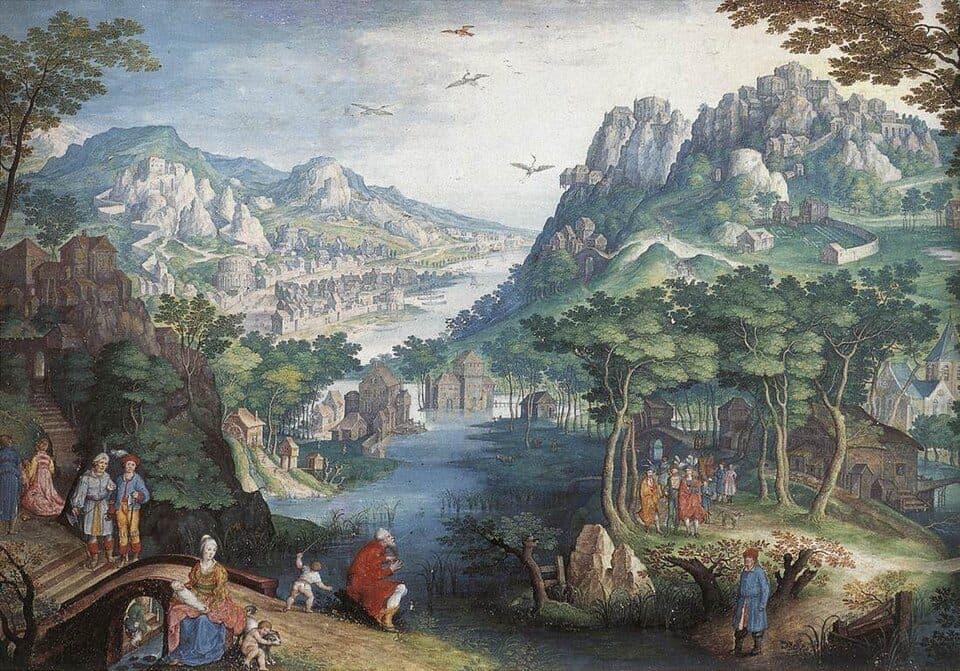
Gillis van Coninxloo, Mountain Landscape with River Valley and the Prophet Hosea, 16th century, watercolour on parchment, Museum Mayer van den Bergh, Antwerp. Public domain, via Wikimedia Commons.
THE ARTWORKConinxloo painted a wide river valley with towns, a castle and travellers on the roads. In the foreground a woman sits with small children by a bridge and an old man in a red cloak sits at the water's edge. The painter's title names the prophet Hosea in this crowded, ordinary country.
God named Hosea's son Not My People as a verdict on Israel, and in the next breath promised to take the name back.
Summary
Hosea gave his three children the names Jezreel, Lo-ruhamah and Lo-ammi at God's command.
- Hosea promises that Judah and Israel will be gathered together under one leader.
- Paul quotes the promise in Romans 9 of a people called from the Jews and from the Gentiles.
- Peter applies the names Lo-ammi and Lo-ruhamah to his readers in 1 Peter 2:10.
- Hosea 3:5 promises that the people of Israel will return and seek the LORD their God.
The Verdict and the Promise
Seven passages, from Hosea's verdict to the apostles' use of it.
Gomer again conceived and gave birth to a daughter, and the LORD said to Hosea, “Name her Lo-ruhamah, for I will no longer have compassion on the house of Israel, that I should ever forgive them.Her name is the second verdict of the chapter, after Jezreel, and Hosea 2:23 reverses it.
And the LORD said, “Name him Lo-ammi, for you are not My people, and I am not your God.This is the verdict whose words both apostles answer, Paul with My People and Peter with the people of God.
Yet the number of the Israelites will be like the sand of the sea, which cannot be measured or counted. And it will happen that in the very place where it was said to them, ‘You are not My people,’ they will be called ‘sons of the living God.’ Then the people of Judah and of Israel will be gathered together, and they will appoint for themselves one leader, and will go up out of the land. For great will be the day of Jezreel.Paul's second quotation in Romans 9:26 comes from verse 10, where the reversal is first promised.
“Say of your brothers, ‘My people,’ and of your sisters, ‘My loved one.’Here the people are told to speak the new names of one another before the promise is kept.
And I will sow her as My own in the land, and I will have compassion on ‘No Compassion.’ I will say to those called ‘Not My People,’ ‘You are My people,’ and they will say, ‘You are my God.’”Both apostles quote from this verse, Paul in Romans 9:25 and Peter in 1 Peter 2:10.
including us, whom He has called not only from the Jews, but also from the Gentiles? As He says in Hosea: “I will call them ‘My People’ who are not My people, and I will call her ‘My Beloved’ who is not My beloved,” and, “It will happen that in the very place where it was said to them, ‘You are not My people,’ they will be called ‘sons of the living God.’”Paul counts himself among the called, the people Hosea's promise now names.
Once you were not a people, but now you are the people of God; once you had not received mercy, but now you have received mercy.The titles of the verse before, a chosen people and a royal priesthood, rest on this mercy.
Three Children, Three Names
Hosea reverses all three names in chapter 2, and the apostles quote two of them.
| Name | The verdict | The reversal in Hosea | Paul, Romans 9 | Peter, 1 Peter 2 |
|---|---|---|---|---|
| Jezreel | Judgment on the house of Jehu and the end of the kingdom, Hosea 1:4 to 5 | I will sow her as My own in the land, Hosea 2:22 to 23 | Not quoted | Not quoted |
| Lo-ruhamah | I will no longer have compassion on the house of Israel, Hosea 1:6 | I will have compassion on No Compassion, Hosea 2:23 | I will call her My Beloved who is not My beloved, Romans 9:25 | Once you had not received mercy, 1 Peter 2:10 |
| Lo-ammi | You are not My people, and I am not your God, Hosea 1:9 | Sons of the living God, Hosea 1:10; You are My people, Hosea 2:23 | I will call them My People who are not My people, Romans 9:25 | Once you were not a people, 1 Peter 2:10 |
- Name
- Jezreel
- The verdict
- Judgment on the house of Jehu and the end of the kingdom, Hosea 1:4 to 5
- The reversal in Hosea
- I will sow her as My own in the land, Hosea 2:22 to 23
- Paul, Romans 9
- Not quoted
- Peter, 1 Peter 2
- Not quoted
- Name
- Lo-ruhamah
- The verdict
- I will no longer have compassion on the house of Israel, Hosea 1:6
- The reversal in Hosea
- I will have compassion on No Compassion, Hosea 2:23
- Paul, Romans 9
- I will call her My Beloved who is not My beloved, Romans 9:25
- Peter, 1 Peter 2
- Once you had not received mercy, 1 Peter 2:10
- Name
- Lo-ammi
- The verdict
- You are not My people, and I am not your God, Hosea 1:9
- The reversal in Hosea
- Sons of the living God, Hosea 1:10; You are My people, Hosea 2:23
- Paul, Romans 9
- I will call them My People who are not My people, Romans 9:25
- Peter, 1 Peter 2
- Once you were not a people, 1 Peter 2:10
How Paul and Peter Use Hosea
Romans 9 and 1 Peter 2 each quote the reversal at a turn in the letter's argument.
Paul opens his quotation with the words I will call, the verb he has just used for God's calling.
Paul turns next to Isaiah, who cries out concerning Israel that only the remnant will be saved.
The stone texts in both lettersRomans 9:33; 1 Peter 2:6 to 8
as it is written: “See, I lay in Zion a stone of stumbling and a rock of offense; and the one who believes in Him will never be put to shame.”Paul ends the chapter by explaining why Israel stumbled, so Hosea's promise stands inside that argument.
For it stands in Scripture: “See, I lay in Zion a stone, a chosen and precious cornerstone; and the one who believes in Him will never be put to shame.” To you who believe, then, this stone is precious. But to those who do not believe, “The stone the builders rejected has become the cornerstone,” and, “A stone of stumbling and a rock of offense.” They stumble because they disobey the word—and to this they were appointed.Peter quotes the same stone as Paul two verses before he gives Hosea's names to those who believe.
Love and mercy in the daughter's nameRomans 9:25; 1 Peter 2:10; Albert Barnes on Hosea 1:6
The two apostles give the daughter's name in different words, and Albert Barnes notes that the Hebrew verb holds both love and mercy.
Who Is Not My People?
Hosea's hearers, a rabbinic reading, Peter's readers, and a reading from the early church.
Hosea's first hearers were the northern kingdom. John Calvin, in his commentary on Romans, wrote that no one can deny the prophet speaks of the Israelites in Hosea 2:23.
A rabbinic reading of I will sow herBabylonian Talmud, Pesachim 87b
The Babylonian Talmud records a Jewish reading of Hosea 2:23, I will sow her as My own in the land. Rabbi Elazar taught that God exiled Israel among the nations so that converts would join them, as a man sows a little grain to gather much.
Peter's readers in his own words1 Peter 1:14 and 1 Peter 4:3
As obedient children, do not conform to the passions of your former ignorance.Ignorance of God before conversion is said of Gentiles elsewhere, as in Acts 17:30 and Ephesians 4:18.
For you have spent enough time in the past carrying out the same desires as the Gentiles: living in debauchery, lust, drunkenness, orgies, carousing, and detestable idolatry.Peter counts the ways of the Gentiles as his readers' own past, which points to readers from the Gentiles.
Bede and Calvin on Peter's readersBede on 1 Peter 2:10; John Calvin on 1 Peter 2:10
Bede, in his commentary on the Catholic Epistles, read the verse as written to those who came to faith from the Gentiles.
Calvin, in his commentary on the Catholic Epistles, read it of scattered Jews gathered in Christ.
Tertullian on the people who knew not GodTertullian, An Answer to the Jews
“But what is the ‘people’ which was ignorant of God, but ours, who in days bygone knew not God? and who, in the hearing of the ear, gave heed to Him, but we, who, forsaking idols, have been converted to God?”
Tertullian · An Answer to the Jews · on 1 Peter 2:10Patristic
Israel Scattered Among the Nations
The years of Hosea's prophecy, the exile that followed them, and the Hebrew Bible's numbering of the promise.
Hosea prophesied in the days of Jeroboam son of Joash, king of Israel, and of Uzziah, Jotham, Ahaz and Hezekiah, kings of Judah.
Samaria fell to Assyria in about 722 BC, and the people who had been named Not My People were scattered among the nations.
The fall of Samaria2 Kings 17:6
In the ninth year of Hoshea, the king of Assyria captured Samaria and carried away the Israelites to Assyria, where he settled them in Halah, in Gozan by the Habor River, and in the cities of the Medes.This deportation is the scattering that Rabbi Elazar's reading of I will sow her looks back on.
The verse numbers of the Hebrew BibleHosea 1:10 to 2:1 and Hosea 2:23
The Hebrew Bible numbers Hosea 1:10 to 2:1 as Hosea 2:1 to 3, and Hosea 2:23 as Hosea 2:25, so a Jewish source cites the promise by those numbers.
The Words of the Names
The Hebrew and Greek words the names and their quotations turn on.
RACHAM (HEBREW, H7355)
A verb meaning to have compassion, and Lo-ruhamah means she has not received compassion.
AM (HEBREW, H5971)
A noun meaning a people, and Lo-ammi means not My people.
EHYEH (HEBREW, H1961)
The verb in I am not your God, literally I will not be to you, in the form God uses of Himself in Exodus 3:14.
ZARA (HEBREW, H2232)
A verb meaning to sow, the root of the name Jezreel, used in I will sow her.
KALEO (GREEK, G2564)
A verb meaning to call or to name, used both for a summons and for the giving of a name.
AGAPAO AND ELEEO (GREEK, G25 AND G1653)
Verbs meaning to love and to have mercy.
What the Text Leaves Unsaid
One silence in Hosea and two in the letters.
What the Renaming Means
The names turn on the covenant formula God gave at the Exodus.
The covenant had two halves, the people's place and God's pledge. The name God gave Hosea's son in Hosea 1:9 denies both halves, and the promise of Hosea 2:23 speaks them again as promises.
In both letters the names show that God's people exist by His mercy and His call.
I will take you as My own people, and I will be your God. Then you will know that I am the LORD your God, who brought you out from under the yoke of the Egyptians.Leviticus 26:12 repeats this pledge, so the formula runs through the Law.
I ask then, did God reject His people? Certainly not! I am an Israelite myself, a descendant of Abraham, from the tribe of Benjamin. God did not reject His people, whom He foreknew. Do you not know what the Scripture says about Elijah, how he appealed to God against Israel:The verse shows the covenant formula still binding God to Israel after the names were reversed.
Matthew Henry on the Renaming
Whether the promise waits for a general turning of the Jews to Christ.
“Some think that these promises will not have their accomplishment, at least not in full, till the general conversion of the Jews in the latter days, which is expected yet to come, when the vast incredible numbers of Jews, that are now dispersed as the sand of the sea, shall be brought to embrace the faith of Christ and be incorporated in the gospel-church.”
Matthew Henry · Commentary on the Whole Bible · on Hosea 1:10 to 11Puritan
How Does a Promise to Israel Reach the Gentiles?
Five readings from the fourth century to the sixteenth, one of them rejected.
By likeness: God treats the outcast nations as He treated outcast IsraelTheophylact of Ohrid · Byzantine
Theophylact of Ohrid, in his commentary on Romans, argues that if God received back an Israel that had been ungrateful, the case for the Gentiles stands.
The objection is Calvin's, who called this reading defensible but somewhat strained.
Banished Israel was put on a level with the nationsJohn Calvin · Reformed
Calvin held, in his commentary on Romans, that the promise of mercy to banished Israel therefore reaches the Gentiles who stood on that same level.
The objection is Hosea 1:11, which names Judah and Israel as the ones gathered.
A direct prophecy of the calling of the GentilesJohn Chrysostom · Patristic
John Chrysostom, in his sixteenth homily on Romans, answered that the not-people are plainly the Gentiles.
The objection is Theodoret's, that the passage first applied to the Jews.
Israel first, and its promise still owedTheodoret of Cyrus · Patristic
Theodoret of Cyrus, in his commentary on Romans, held that God promised to call the rejected Jews back. On this reading Paul applies the pattern of that promise to the Gentiles, and the promise to Israel still stands.
The objection is that Paul quotes Hosea of those called from the Gentiles in Romans 9:24, without a word of likeness.
Rejected: Aphrahat's readingAphrahat · Syriac
Aphrahat, in his Demonstrations, read the reversal as God choosing the Gentiles to replace the people of the old covenant. Its strongest form points to Israel's titles given to the church in 1 Peter 2:9.
Romans 11:25 to 26 answers it, where all Israel will be saved.
Books to Read Next
Three public domain works that treat these verses at length.
Commentaries on the Epistle of Paul the Apostle to the Romans
John Calvin, translated by John Owen · 1849
Calvin comments on Romans 9:24 to 29 verse by verse.
Read at CCELCommentaries on the Catholic Epistles
John Calvin, translated by John Owen · 1855
Calvin comments on 1 Peter 2:9 to 10 together, the titles of the church and the names from Hosea.
Read at CCELGod's People, or Not God's People
Charles Spurgeon · 1893
Spurgeon's sermon on Hosea 2:23 and Romans 9:25, printed in 1893, marvels that the promise waited some eight hundred years between Hosea and Paul.
Read at CCELMy People, by Mercy
Keep studying
Read it4
Studies1
Doctrines9
Peoples and groups1