
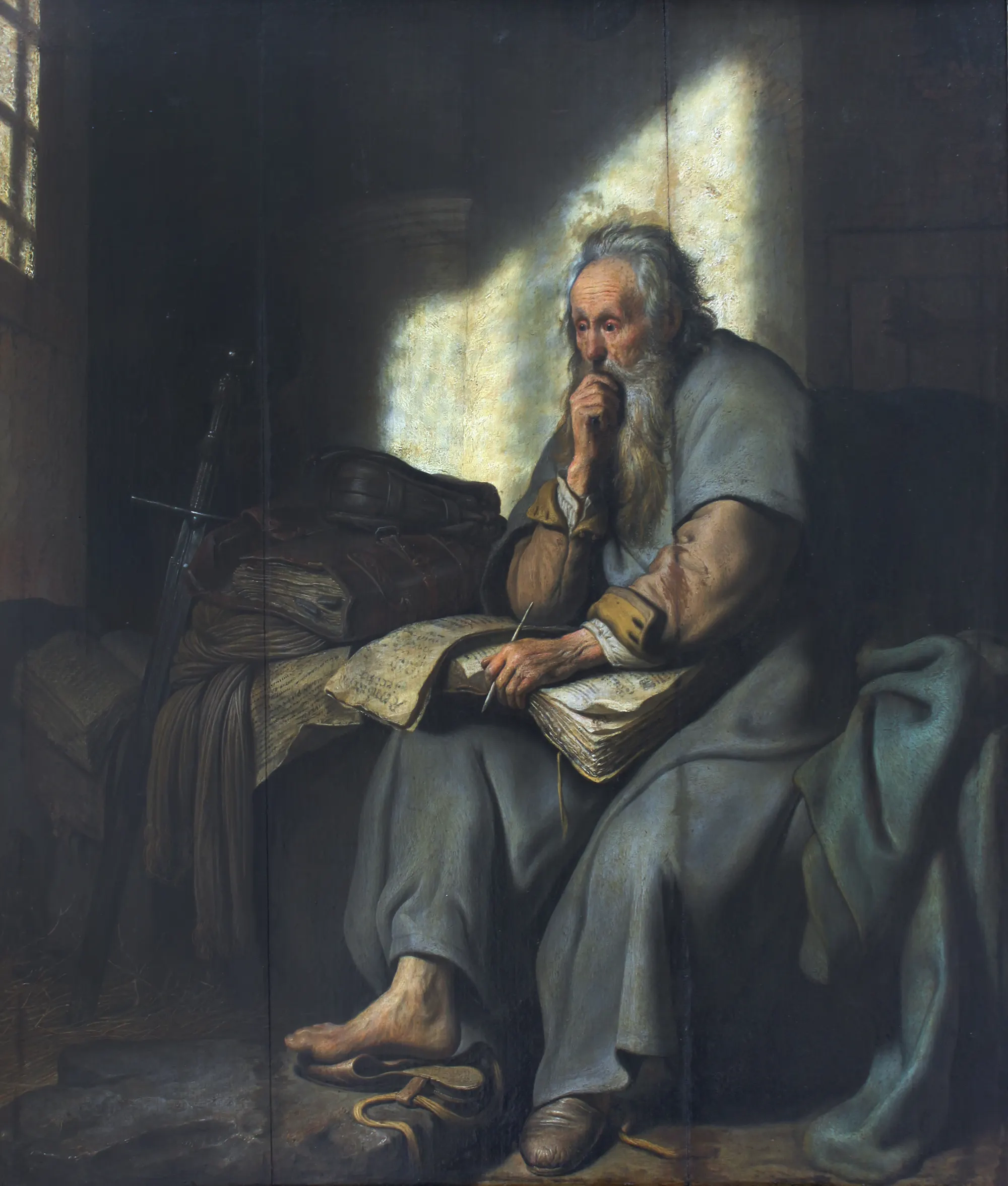
The Apostle Paul in Prison, Rembrandt, 1627. Public domain.
New Testament · Book 47 of 66
2 Corinthians
2 Corinthians is Paul's most personal letter, written to the church in Corinth after a painful visit. He defends his ministry, speaks of God's comfort in suffering and urges generous giving for the believers in Jerusalem.
2 Corinthians is Paul's most personal letter, written to the church in Corinth after a painful visit. He defends his ministry, speaks of God's comfort in suffering and urges generous giving for the believers in Jerusalem.
What is 2 Corinthians about?
2 Corinthians is Paul's letter to a church that had begun to doubt him, and he defends his work by what it cost him. He opens with the God of all comfort, who comforted him in trouble, and tells why he wrote in tears and waited for Titus. He serves a new covenant whose glory is carried in weak men, “this treasure in jars of clay” (4:7). He asks the church to finish its gift for the poor saints in Jerusalem. Against rivals who boast, he boasts as a fool of beatings and shipwrecks, and of a thorn the Lord would not remove. He ends by announcing a third visit.
All 13 chapters
Every chapter of the book, in one grid. Each cell opens that chapter.
- The God of all comfortChapters 1 to 2
- The ministry of the new covenantChapters 3 to 7
- The collection for the saintsChapters 8 to 9
- The fool's boast and the thornChapters 10 to 13
The colour is the movement of the letter the chapter stands in, and every cell opens that chapter's Study level.
Who wrote it, where, when, for whom, and why?
The letter names its writers in its first line, Paul, an apostle of Christ Jesus, and Timothy our brother (1:1). Paul speaks in his own name at 10:1, and says that he, Silvanus and Timothy first preached Christ at Corinth (1:19). Peter counts Paul's letters with the other Scriptures (2 Peter 3:15 to 16).
Paul, an apostle of Christ Jesus by the will of God, and Timothy our brother, To the church of God in Corinth, together with all the saints throughout Achaia:
2 Corinthians 1:1, Berean Standard Bible.
Paul writes from Macedonia. He left Troas for Macedonia to find Titus (2:13), had no rest there until Titus came (7:5 to 6), and writes of the Macedonian churches as the ones around him (8:1, 9:2 to 4). Acts records the same travels, from Ephesus to Macedonia and on to Greece for three months (Acts 20:1 to 3).
The letter stands between a second visit that was painful (2:1) and a third Paul is ready to make (12:14). The Corinthians had begun the collection the year before (8:10), after Paul ordered it in 1 Corinthians 16:1 to 3. Acts places these travels after the riot at Ephesus and before Paul's last voyage to Jerusalem (Acts 19:23 to 20:3).
The letter is written to the church of God in Corinth and to all the saints throughout Achaia. Paul had founded the church in a stay of a year and six months (Acts 18:11), and he writes to it as a father to his children (6:13).
Paul gives his reason: he writes while absent so that when he comes he will not need to be severe with the authority the Lord gave him. He also writes to confirm the church's love for the forgiven man (2:8), to finish the gift for the saints (8:11), and to answer those who take pride in appearances (5:12).
This is why I write these things while absent, so that when I am present I will not need to be severe in my use of the authority that the Lord gave me for building you up, not for tearing you down.
2 Corinthians 13:10, Berean Standard Bible.
Sources. 2 Corinthians 1:1, 1:19, 2:1, 2:8, 2:13, 5:12, 6:13, 7:5 and 6, 8:1, 8:10 and 11, 9:2 to 4, 10:1, 12:14 and 13:10; Acts 18:11, 19:23 to 20:3; 1 Corinthians 16:1 to 3; 2 Peter 3:15 and 16. Every verse is read in the Berean Standard Bible.
How is 2 Corinthians arranged, and what is it for?
The four movements the letter falls into, then what it teaches and what it was written to do.
- The God of all comfortChapters 1 to 2, 41 verses, the turn at 1:3 to 4
Comfort in trouble, the changed plan, the letter written in tears, and the open door at Troas.
- The ministry of the new covenantChapters 3 to 7, 91 verses, the turn at 5:17
The letter on hearts, the unveiled face, treasure in clay jars, reconciliation, and Titus's report.
- The collection for the saintsChapters 8 to 9, 39 verses, the turn at 8:9
The gift of Macedonia, the Lord who became poor, Titus and the brothers sent, and the cheerful giver.
- The fool's boast and the thornChapters 10 to 13, 86 verses, the turn at 12:9
The false apostles answered, the fool's speech, the third heaven, the thorn, and the third visit.
The theme
Paul defends his work as an apostle to a church that has begun to doubt him, and he defends it by what it has cost him. God comforts him in trouble so that he can comfort others, the glory of the new covenant is carried in clay jars, and the gift for Jerusalem follows the pattern of a Lord who became poor. When rivals boast of their standing, he boasts of his weakness, because the Lord told him that his power is perfected there.
The purpose
The letter was written to finish a reconciliation and to prepare for a visit. It thanks the church for the repentance Titus reported, asks it to forgive the man who caused the grief, and sends Titus and two brothers ahead to complete the collection. It warns those still following the false apostles, so that when Paul comes a third time he need not use his authority to tear down.
Four openings, and the hardships twice listed
- 1Comfort
“the God of all comfort”
1:3, chapters 1 to 2
- 2The new covenant
“ministers of a new covenant”
3:6, chapters 3 to 7
- 3The grace given
“the grace that God has given the churches of Macedonia”
8:1, chapters 8 to 9
- 4The appeal
“by the mildness and gentleness of Christ, I appeal to you”
10:1, chapters 10 to 13
As servants of God, 6:4 to 10 (7 stations)
Spoken for Paul and his companions, in the plural, as the ministry of reconciliation.
- 6:4
Rather, as servants of God we commend ourselves in every way: in great endurance; in troubles, hardships, and calamities;
- 6:5
in beatings, imprisonments, and riots; in labor, sleepless nights, and hunger;
- 6:6
in purity, knowledge, patience, and kindness; in the Holy Spirit and in sincere love;
- 6:7
in truthful speech and in the power of God; with the weapons of righteousness in the right hand and in the left;
- 6:8
through glory and dishonor, slander and praise; viewed as imposters, yet genuine;
- 6:9
as unknown, yet well-known; dying, and yet we live on; punished, yet not killed;
- 6:10
sorrowful, yet always rejoicing; poor, yet making many rich; having nothing, and yet possessing everything.
Speaking as a fool, 11:23 to 28 (6 stations)
Spoken by Paul alone, in the first person, against the false apostles.
- 11:23
Are they servants of Christ? I am speaking like I am out of my mind, but I am so much more: in harder labor, in more imprisonments, in worse beatings, in frequent danger of death.
- 11:24
Five times I received from the Jews the forty lashes minus one.
- 11:25
Three times I was beaten with rods, once I was stoned, three times I was shipwrecked. I spent a night and a day in the open sea.
- 11:26
In my frequent journeys, I have been in danger from rivers and from bandits, in danger from my countrymen and from the Gentiles, in danger in the city and in the country, in danger on the sea and among false brothers,
- 11:27
in labor and toil and often without sleep, in hunger and thirst and often without food, in cold and exposure.
- 11:28
Apart from these external trials, I face daily the pressure of my concern for all the churches.
The God of all comfort, 2 Corinthians 1 to 2
What the text says in these 41 verses, and the pages they open on.
Paul and Timothy greet the church at Corinth and the saints of Achaia, and Paul blesses the God who comforts him so that he can comfort others. In Asia he had despaired even of life, and learned to trust the God who raises the dead (1:8 to 9). He answers the charge that he changed his plans lightly: in Christ every promise of God is Yes. He stayed away to spare them a second painful visit and wrote instead through many tears (2:4). The man who caused the grief has been punished enough and is to be forgiven. At Troas a door stood open, but Paul could not rest without Titus and went on to Macedonia, and he breaks off to thank God who leads him in triumph.
Blessed be the God and Father of our Lord Jesus Christ, the Father of compassion and the God of all comfort, who comforts us in all our troubles, so that we can comfort those in any trouble with the comfort we ourselves have received from God.
- Study
2 Corinthians 1the God of all comfort, and every promise Yes in ChristShow the summary and 2 pagesShow summary, 2 pagesHide the summary
Paul and Timothy greet the Corinthian and Achaian saints. Blessed be God, the Father of mercies, the God of all comfort. Who comforteth us in all our tribulation, that we may comfort others. Paul shares his pressed-out-of-measure trouble in Asia, despairing of life, that they should trust not in themselves but in God who raiseth the dead. He defends his change of travel plans: not yea and nay, but faithfulness to the gospel they heard. Henry reads the chapter as the theology of comfort grounded in Christ's trustworthiness.
On this chapter (2)
- The question of suffering
Why God lets his servants suffer.
- 2 Corinthians 1:4
The verse on its own page, with the commentators on it by era.
- The question of suffering
- Study
2 Corinthians 2the letter in tears, the forgiven man, and the fragrance of ChristShow the summary and 1 pageShow summary, 1 pageHide the summary
If I should come again, I should make you sorry. So Paul wrote the painful letter instead. The offender has been punished enough; now confirm your love toward him. Satan's devices are known. Paul went to Troas to preach the gospel, and a door was opened to him by the Lord, but he had no rest because Titus his brother had not arrived. Thanks be to God who always causes us to triumph in Christ. Not as many, corrupting the word. Calvin reads the chapter as apostolic tenderness married to apostolic firmness.
On this chapter (1)
- 2 Corinthians 2:14
The verse on its own page, with the commentators on it by era.
- 2 Corinthians 2:14
The chain of comfort in 1:3 to 7
- 1God
The source of the comfort.
“who comforts us in all our troubles”
- 2Paul and his companions
Comforted in order to comfort.
“so that we can comfort those in any trouble”
- 3The Corinthians
Sharers in the sufferings and in the comfort.
“so also you will share in our comfort”
Characters (3)
Who the text names. A name with a page carries its door.
Places (3)
Where the chapters stand.
Themes (2)
What these chapters raise, each on its own page where one stands.
- Comfort in affliction
Comfort received from God is given to be passed on (1:4).
- The question of suffering
Why God lets his servants suffer, read across Scripture.
Where these chapters take up the Old Testament (0)each marked quotation or allusion, with Acts and 1 Corinthians beside it
These chapters quote no Old Testament passage.
Beside it in Acts and 1 Corinthians: the riot at Ephesus in the province of Asia (Acts 19:23 to 41), and the plan to come through Macedonia (1 Corinthians 16:5 to 7).
The ministry of the new covenant, 2 Corinthians 3 to 7
What the text says in these 91 verses, and the pages they open on.
Paul needs no letter of recommendation, because the Corinthians are his letter, written by the Spirit on human hearts (3:3). He serves a new covenant that gives life, and its glory surpasses the fading glory Moses veiled; whenever anyone turns to the Lord the veil is taken away (3:16). The treasure is carried in jars of clay, pressed but not crushed, while the outer self wastes away and the inner self is renewed. The earthly tent will give way to a building from God, and all must appear before the judgment seat of Christ. God reconciled the world to himself in Christ, and Paul pleads as his ambassador. He lists what his service has cost, calls them out from idols, and tells of the comfort Titus brought from Corinth and the godly sorrow that led to repentance.
Therefore if anyone is in Christ, he is a new creation. The old has passed away. Behold, the new has come!
- Study
2 Corinthians 3a letter written on hearts, and the veil taken awayShow the summary and 4 pagesShow summary, 4 pagesHide the summary
Need we epistles of commendation? You are our epistle, written in our hearts. God has made us able ministers of the new testament. Not of the letter, but of the spirit. If the ministration of death, written and engraven in stones, was glorious, how much more the ministration of the spirit? We all, with open face beholding as in a glass the glory of the Lord, are changed into the same image from glory to glory, even as by the Spirit of the Lord. JFB marks the chapter as the new-covenant ministry's charter.
On this chapter (4)
- The new covenant
The covenant promised in Jeremiah 31.
- The unveiled face
The veil taken away in Christ.
- The veil
The veil in the tabernacle and on Moses' face.
- 2 Corinthians 3:18
The verse on its own page, with the commentators on it by era.
- The new covenant
- Study
2 Corinthians 4treasure in jars of clay, and the unseen thingsShow the summary and 1 pageShow summary, 1 pageHide the summary
We have this treasure in earthen vessels, that the excellency of the power may be of God, and not of us. Troubled on every side, yet not distressed; perplexed, but not in despair; persecuted, but not forsaken; cast down, but not destroyed. Our light affliction, which is but for a moment, worketh for us a far more exceeding and eternal weight of glory. We look not at the things which are seen, but at the things which are not seen. Wesley reads this chapter as the apostle's own testimony to dying-yet-living ministry.
On this chapter (1)
- 2 Corinthians 4:17
The verse on its own page, with the commentators on it by era.
- 2 Corinthians 4:17
- Study
2 Corinthians 5the tent and the building, the judgment seat, and reconciliationShow the summary and 5 pagesShow summary, 5 pagesHide the summary
We know that if our earthly house were dissolved, we have a building of God. We are confident, willing rather to be absent from the body, and to be present with the Lord. The love of Christ compels us. If any man be in Christ, he is a new creature. God was in Christ, reconciling the world to himself; now we are ambassadors for Christ. He made him to be sin for us, who knew no sin; that we might be made the righteousness of God in him. Calvin reads this as the apostolic charter of reconciliation.
On this chapter (5)
- The judgment seat of Christ
Where all must appear.
- Reconciliation
God reconciling the world to himself.
- Imputation
Him who knew no sin made sin for us.
- How does 5:1 to 10 relate to 1 Corinthians 15 on the body after death?
Answered under Where do readers disagree, lower on this page, with each reading and who holds it.
- 2 Corinthians 5:21
The verse on its own page, with the commentators on it by era.
- The judgment seat of Christ
- Study
2 Corinthians 6the day of salvation, the hardships, and the unequal yokeShow the summary and 3 pagesShow summary, 3 pagesHide the summary
We then, as workers together with him, urge you not to receive the grace of God in vain. Behold, now is the accepted time; behold, now is the day of salvation. Giving no offence in any thing, that the ministry be not blamed. By pureness, by knowledge, by longsuffering, by kindness. Paul's heart is enlarged; be not unequally yoked with unbelievers. Come out from among them, and be separate. I will receive you, and will be a Father to you. Henry reads the chapter as the apostolic plea for reciprocal openness of heart.
On this chapter (3)
- Unequally yoked
The call to come out and be separate.
- Is 2 Corinthians one letter or several?
Answered under Where do readers disagree, lower on this page, with each reading and who holds it.
- 2 Corinthians 6:2
The verse on its own page, with the commentators on it by era.
- Unequally yoked
- Study
2 Corinthians 7Titus arrives, and godly sorrow leads to repentanceShow the summary and 1 pageShow summary, 1 pageHide the summary
Having these promises, let us cleanse ourselves from all filthiness of flesh and spirit, perfecting holiness in the fear of God. Paul rejoices that his painful letter produced godly sorrow worketh repentance to salvation not to be repented of. The sorrow of the world worketh death. Titus has returned with a good report. Paul's boasting concerning them is found true. He rejoices in their care, indignation, zeal. Calvin reads this as the anatomy of godly sorrow contrasted with worldly regret.
On this chapter (1)
- 2 Corinthians 7:10
The verse on its own page, with the commentators on it by era.
- 2 Corinthians 7:10
The veil in Exodus and in Paul
Moses comes down from the mountain, veil 3 times
And when Moses came down from Mount Sinai with the two tablets of the Testimony in his hands, he was unaware that his face had become radiant from speaking with the LORD. Aaron and all the Israelites looked at Moses, and behold, his face was radiant. And they were afraid to approach him. But Moses called out to them; so Aaron and all the leaders of the congregation returned to him, and Moses spoke to them. And after this all the Israelites came near, and Moses commanded them to do everything that the LORD had told him on Mount Sinai. When Moses had finished speaking with them, he put a veil over his face. But whenever Moses went in before the LORD to speak with Him, he would remove the veil until he came out. And when he came out, he would tell the Israelites what he had been commanded, and the Israelites would see that the face of Moses was radiant. So Moses would put the veil back over his face until he went in to speak with the LORD.
Paul reads the scene, veil 5 times
Now if the ministry of death, which was engraved in letters on stone, came with such glory that the Israelites could not gaze at the face of Moses because of its fleeting glory, will not the ministry of the Spirit be even more glorious? For if the ministry of condemnation was glorious, how much more glorious is the ministry of righteousness! Indeed, what was once glorious has no glory now in comparison to the glory that surpasses it. For if what was fading away came with glory, how much greater is the glory of that which endures! Therefore, since we have such a hope, we are very bold. We are not like Moses, who would put a veil over his face to keep the Israelites from gazing at the end of what was fading away. But their minds were closed. For to this day the same veil remains at the reading of the old covenant. It has not been lifted, because only in Christ can it be removed. And even to this day when Moses is read, a veil covers their hearts. But whenever anyone turns to the Lord, the veil is taken away. Now the Lord is the Spirit, and where the Spirit of the Lord is, there is freedom. And we, who with unveiled faces all reflect the glory of the Lord, are being transformed into His image with intensifying glory, which comes from the Lord, who is the Spirit.
Characters (2)
Who the text names. A name with a page carries its door.
Places (2)
Where the chapters stand.
- Macedonia
Where Paul found no rest until Titus came (7:5 to 6).
- Corinth
The city of the church the letter is written to (1:1, 1:23).
Themes (7)
What these chapters raise, each on its own page where one stands.
- The new covenant
The covenant promised in Jeremiah 31 and served by Paul (3:6).
- The unveiled face
The veil taken away when anyone turns to the Lord (3:16 to 18).
- Treasure in jars of clay
The power is from God, and the vessel shows it (4:7).
- The judgment seat of Christ
Where all must appear to receive their due (5:10).
Show the next 3
- Reconciliation
God reconciling the world to himself in Christ (5:18 to 20).
- Imputation
Him who knew no sin made sin for us (5:21).
- Unequally yoked
The call to come out from idols (6:14 to 7:1).
Where these chapters take up the Old Testament (8)each marked quotation or allusion, with Acts and 1 Corinthians beside it
- Probable allusion2 Corinthians 3:3 at Exodus 31:18; Jeremiah 31:33. The tablets of stone of Exodus 31:18 and the law written on hearts of Jeremiah 31:33 stand behind the letter written on tablets of human hearts, taken up in Paul's own sentence.
- Probable allusion2 Corinthians 3:13 at Exodus 34:33 to 35. Moses putting a veil over his face is told in Exodus 34:33 to 35, and the chapter retells it in Paul's own words.
- Probable allusion2 Corinthians 4:6 at Genesis 1:3. God who said, Let light shine out of darkness, recalls the first word of creation, in wording that is Paul's own.
- Explicit quotation2 Corinthians 4:13 at Psalm 116:10. Introduced as what is written, and marked a quotation in the store's table.
- Explicit quotation2 Corinthians 6:2 at Isaiah 49:8. Introduced with For He says, and marked a quotation in the store's table.
- Explicit quotation2 Corinthians 6:16 at Leviticus 26:12. Introduced with As God has said, and marked a quotation in the store's table, which notes Ezekiel 37:27 beside it.
- Explicit quotation2 Corinthians 6:17 at Isaiah 52:11. Marked a quotation in the store's table; the verse closes with says the Lord.
- Explicit quotation2 Corinthians 6:18 at 2 Samuel 7:14. The promise to David's son, widened to sons and daughters, marked a quotation in the store's table.
Beside it in Acts and 1 Corinthians: Paul leaves Ephesus for Macedonia (Acts 20:1 to 2), and the church as God's temple (1 Corinthians 3:16 to 17).
The collection for the saints, 2 Corinthians 8 to 9
What the text says in these 39 verses, and the pages they open on.
Paul tells the church of the grace God gave the churches of Macedonia, who gave out of deep poverty and begged to share in the service to the saints (8:1 to 4). Corinth began the gift a year before, and he asks them to finish it according to their means, for the sake of equality, as the manna was shared in the wilderness (8:15). Titus and two brothers chosen by the churches will carry it, so that no one can fault how the gift is handled. Paul has boasted of Achaia to the Macedonians and does not want the boast to fail. The one who sows generously reaps generously, God loves a cheerful giver, and the gift will overflow in thanks to God for his indescribable gift (9:15).
For you know the grace of our Lord Jesus Christ, that though He was rich, yet for your sakes He became poor, so that you through His poverty might become rich.
- Study
2 Corinthians 8the Macedonian example, the Lord who became poor, and Titus sentShow the summary and 3 pagesShow summary, 3 pagesHide the summary
The grace of God bestowed on the Macedonian churches. In a great trial of affliction, their deep poverty abounded in the riches of their liberality. They first gave themselves to the Lord. Paul urges the Corinthians to abound in this grace also. You know the grace of our Lord Jesus Christ. Though he was rich, yet for your sakes he became poor, that you through his poverty might be rich. Titus and a brother will gather the collection. JFB reads the chapter as the apostolic theology of Christian giving grounded in Christ's self-impoverishment.
On this chapter (3)
- The grace of giving
Giving as a grace, from Macedonia to Jerusalem.
- Manna
The bread of the wilderness, quoted at 8:15.
- 2 Corinthians 8:15
The verse on its own page, with the commentators on it by era.
- The grace of giving
- Study
2 Corinthians 9the gift made ready, the cheerful giver, and thanks to GodShow the summary and 2 pagesShow summary, 2 pagesHide the summary
The ministering to the saints. Paul boasted of the Corinthians' readiness to the Macedonians. He sends the brethren ahead that their bounty be ready, not as covetousness. He who sows sparingly will also reap sparingly; he who sows bountifully will also reap bountifully. God loves a cheerful giver. Thanks be to God for his unspeakable gift. Henry reads the chapter as a compact doctrine of Christian stewardship. Its motive in grace received, its manner cheerful, its measure bountiful.
On this chapter (2)
- The grace of giving
Giving as a grace, from Macedonia to Jerusalem.
- 2 Corinthians 9:7
The verse on its own page, with the commentators on it by era.
- The grace of giving
The gift's road, Macedonia to Jerusalem
- 1MacedoniaPoor churches beg to share in the gift for the saints.
Now, brothers, we want you to know about the grace that God has given the churches of Macedonia. In the terrible ordeal they suffered, their abundant joy and deep poverty overflowed into rich generosity. For I testify that they gave according to their ability and even beyond it. Of their own accord, they earnestly pleaded with us for the privilege of sharing in this service to the saints.
2 Corinthians 8:1 to 4 - 2Achaia, with CorinthReady since last year, the boast Paul made in Macedonia.
For I know your eagerness to help, and I have been boasting to the Macedonians that since last year you in Achaia were prepared to give. And your zeal has stirred most of them to do likewise.
2 Corinthians 9:2 - 3JerusalemThe poor among the saints, to whom Paul carries the gift.
Now, however, I am on my way to Jerusalem to serve the saints there. For Macedonia and Achaia were pleased to make a contribution for the poor among the saints in Jerusalem.
Romans 15:25 to 26
Characters (3)
Who the text names. A name with a page carries its door.
- Titus
Paul's partner who carries news from Corinth and is sent back to finish the gift (7:6, 8:6, 8:23).
- The brother praised by all the churches
Praised by all the churches for his work in the gospel and chosen by them to travel with the gift (8:18 to 19).
- The brother proven earnest
The second brother sent with Titus (8:22).
Places (3)
Where the chapters stand.
- Macedonia
The churches that gave out of deep poverty (8:1 to 2).
- Achaia
The province of Corinth, ready to give since the year before (9:2).
- Jerusalem
Where the saints live for whom the gift is raised (9:1).
Themes (2)
What these chapters raise, each on its own page where one stands.
- The grace of giving
Giving as a grace God gives (8:1, 8:7).
- The manna
The equal share of the wilderness, quoted at 8:15.
Where these chapters take up the Old Testament (2)each marked quotation or allusion, with Acts and 1 Corinthians beside it
- Explicit quotation2 Corinthians 8:15 at Exodus 16:18. Introduced as what is written, the manna gathered in the wilderness, and marked a quotation in the store's table.
- Explicit quotation2 Corinthians 9:9 at Psalm 112:9. Introduced as what is written, and marked a quotation in the store's table.
Beside it in Acts and 1 Corinthians: the collection first ordered (1 Corinthians 16:1 to 4), and the men who travel with Paul toward Jerusalem (Acts 20:4).
The fool's boast and the thorn, 2 Corinthians 10 to 13
What the text says in these 86 verses, and the pages they open on.
Paul appeals by the gentleness of Christ and warns that his weapons tear down arguments and take every thought captive to Christ. Some say his letters are weighty but his presence unimpressive (10:10), and he will boast only within the field God assigned him. Against the false apostles, who masquerade as servants of righteousness, he speaks as a fool and boasts of labours, prisons, beatings, shipwrecks and dangers, and of being let down a wall in a basket at Damascus. He tells of a man caught up to the third heaven, and of a thorn in the flesh the Lord would not remove, because his power is perfected in weakness. He is coming a third time, tells them to examine themselves, and closes with the grace, the love and the fellowship of Father, Son and Spirit (13:14).
But He said to me, “My grace is sufficient for you, for My power is perfected in weakness.” Therefore I will boast all the more gladly in my weaknesses, so that the power of Christ may rest on me.
- Study
2 Corinthians 10weapons that tear down strongholds, and boasting within limitsShow the summary and 1 pageShow summary, 1 pageHide the summary
Here the tone shifts. I beseech you by the meekness and gentleness of Christ. Who in presence am base among you, but being absent am bold toward you. Though we walk in the flesh, we do not war after the flesh; the weapons of our warfare are mighty through God to the pulling down of strong holds. We will boast not of other men's labours. He that glorieth, let him glory in the Lord. Calvin marks the chapter as the beginning of the apostle's defense against the false apostles.
On this chapter (1)
- 2 Corinthians 10:5
The verse on its own page, with the commentators on it by era.
- 2 Corinthians 10:5
- Study
2 Corinthians 11the false apostles, the fool's speech, and the basket at DamascusShow the summary and 2 pagesShow summary, 2 pagesHide the summary
Paul, in the folly of necessity, boasts. I have espoused you to one husband, to present you a chaste virgin to Christ. I am jealous over you with godly jealousy. The false apostles. Ministers of Satan transformed as angels of light. Paul rehearses his sufferings. Stripes, prisons, shipwrecks, perils, weariness, painfulness. For the gospel's sake. If I must needs glory, I will glory of the things which concern mine infirmities. Wesley reads the chapter as the apostle's reluctant self-defense, crowned by weakness.
On this chapter (2)
- Who were the false apostles of chapter 11, and what did they preach?
Answered under Where do readers disagree, lower on this page, with each reading and who holds it.
- 2 Corinthians 11:14
The verse on its own page, with the commentators on it by era.
- Who were the false apostles of chapter 11, and what did they preach?
- Study
2 Corinthians 12the third heaven, the thorn, and the signs of an apostleShow the summary and 4 pagesShow summary, 4 pagesHide the summary
Paul's vision. Caught up to the third heaven, hearing unspeakable words. Lest he should be exalted, there was given him a thorn in the flesh, a messenger of Satan. He besought the Lord thrice; the Lord answered: My grace is sufficient for you; for my strength is made perfect in weakness. Most gladly therefore will I rather glory in my infirmities, that the power of Christ may rest upon me. I fear, when I come, I shall not find you such as I would. Calvin reads the chapter as the paradox of apostolic strength.
On this chapter (4)
- Power in weakness
The thorn and the grace that is enough.
- What was the thorn in the flesh?
Answered under Where do readers disagree, lower on this page, with each reading and who holds it.
- What is the third heaven of 12:2, and was the man Paul?
Answered under Where do readers disagree, lower on this page, with each reading and who holds it.
- 2 Corinthians 12:10
The verse on its own page, with the commentators on it by era.
- Power in weakness
- Study
2 Corinthians 13the third visit, examine yourselves, and the benedictionShow the summary and 2 pagesShow summary, 2 pagesHide the summary
Paul's third visit. By the mouth of two or three witnesses shall every word be established. Examine yourselves, whether you are in the faith; prove your own selves. He prays for their perfection. Finally, brethren, farewell. Be perfect, be of good comfort, be of one mind, live in peace; and the God of love and peace shall be with you. The grace of the Lord Jesus Christ, and the love of God, and the communion of the Holy Ghost, be with you all. Henry reads the closing as a benediction of the Trinity upon the restored church.
On this chapter (2)
- The Trinity
One God in three persons.
- 2 Corinthians 13:5
The verse on its own page, with the commentators on it by era.
- The Trinity
The fool's speech, counted (11)
- 1Descent“Are they Hebrews? So am I”11:22
- 2Labours“in harder labor”11:23
- 3Imprisonments“in more imprisonments”11:23
- 4Beatings“Five times I received from the Jews the forty lashes minus one”11:24
- 5Rods and stoning“Three times I was beaten with rods, once I was stoned”11:25
- 6Shipwrecks“three times I was shipwrecked”11:25
- 7Dangers“in danger from rivers and from bandits”11:26
- 8Toil“in labor and toil and often without sleep”11:27
- 9Hunger and cold“in hunger and thirst and often without food, in cold and exposure”11:27
- 10The churches“the pressure of my concern for all the churches”11:28
- 11Weakness“Who is weak, and I am not weak?”11:29
Characters (4)
Who the text names. A name with a page carries its door.
- Paul
The apostle who writes, defending his ministry by what it has cost him.
- The false apostles
Rivals who masquerade as apostles of Christ and servants of righteousness (11:13 to 15).
- Aretas
The king whose governor guarded Damascus to arrest Paul (11:32).
- Titus
Paul's partner who carries news from Corinth and is sent back to finish the gift (7:6, 8:6, 8:23).
Places (3)
Where the chapters stand.
Themes (3)
What these chapters raise, each on its own page where one stands.
- Power in weakness
My grace is sufficient for you (12:9).
- The marks of a true apostle
Signs, wonders and miracles performed with great perseverance (12:12).
- The Trinity
The closing blessing names the Lord Jesus Christ, God and the Holy Spirit (13:14).
Where these chapters take up the Old Testament (2)each marked quotation or allusion, with Acts and 1 Corinthians beside it
- Explicit quotation2 Corinthians 10:17 at Jeremiah 9:24. Marked a quotation in the store's table; Paul uses the same words at 1 Corinthians 1:31.
- Explicit quotation2 Corinthians 13:1 at Deuteronomy 19:15. The rule of two or three witnesses, marked a quotation in the store's table.
Beside it in Acts and 1 Corinthians: the escape from Damascus by the wall (Acts 9:23 to 25), and Paul as the least of the apostles (1 Corinthians 15:8 to 10).
- Author
- Paul, with Timothy (1:1)
- Date
- c. AD 55–56, from Macedonia
- Audience
- The Corinthian church, plus the wider Achaian churches
Where do readers disagree?
One list: the readings with their holders, and what the evidence does not settle.
Is 2 Corinthians one letter or several?
- One letter, written as it stands. Held by John Chrysostom, Homilies on Second Corinthians (about 392), who expounds the thirteen chapters as one letter, and by Charles Hodge, An Exposition of the Second Epistle to the Corinthians (1859).
- Chapters 10 to 13 are the letter written in tears. Held by Adolf Hausrath, Der Vierkapitelbrief des Paulus an die Korinther (1870), and James Houghton Kennedy, The Second and Third Epistles of St. Paul to the Corinthians (1900).
- Several letters joined, with 6:14 to 7:1 a fragment. Held by Gunther Bornkamm, Die Vorgeschichte des sogenannten Zweiten Korintherbriefes (1961), and by Joseph A. Fitzmyer on the paragraph, Qumran and the Interpolated Paragraph in 2 Cor 6:14 to 7:1, Catholic Biblical Quarterly (1961).
What the evidence does not settle: Every manuscript carries the letter as one, so every partition rests on the reading of tone and seams, and the unity rests on how far a change of audience explains them.
The argument in full
One letter, written as it stands. Every manuscript carries the thirteen chapters in this order, and the change of tone at chapter 10 is read as Paul turning from the repentant church to the rivals still at work in it.
Chapters 10 to 13 are the letter written in tears. The severe tone of the last four chapters is read as the painful letter of 2:4, placed after the reconciled letter when the two were joined.
Several letters joined, with 6:14 to 7:1 a fragment. The appeal of 6:13 reads on without a break at 7:2, and the paragraph between carries words Paul uses only there, so it is read as a piece set in from elsewhere.
What was the thorn in the flesh?
Power in Weakness→- A bodily ailment. Held by Tertullian, On Modesty, chapter 13, who names a pain of the ear or the head, and by William M. Ramsay, St. Paul the Traveller and the Roman Citizen (1895), who proposes recurring malaria.
- The men who opposed him. Held by John Chrysostom, Homilies on Second Corinthians, Homily 26.
- Every trial sent to humble him. Held by John Calvin, Commentary on the Second Epistle to the Corinthians (1548).
What the evidence does not settle: The text names the thorn's purpose, to keep Paul from becoming conceited (12:7), and the Lord's answer, that His grace is sufficient (12:9); each reading above names what the thorn was from that ground.
The argument in full
A bodily ailment. A thorn in the flesh is read as a pain of the body, and Galatians 4:13 names a weakness of the flesh in which Paul first preached.
The men who opposed him. The messenger of Satan is read as the adversaries Satan stirred up against Paul, and the list of sufferings before it names such men.
Every trial sent to humble him. The text gives the purpose, to keep Paul from becoming conceited (12:7), so the thorn is read as every kind of trial that served it.
Who were the false apostles of chapter 11, and what did they preach?
- Jewish believers from Judea who held to the law. Held by Ferdinand Christian Baur, Paul the Apostle of Jesus Christ (1845).
- Jewish preachers who showed their power by signs and speech. Held by Dieter Georgi, The Opponents of Paul in Second Corinthians (1964).
- Teachers of a higher knowledge. Held by Walter Schmithals, Gnosticism in Corinth (1956).
What the evidence does not settle: The letter reports what the rivals boasted of, their descent from Abraham among it (11:22), and readers weigh whether the super-apostles of 11:5 are the same men as the false apostles of 11:13.
The argument in full
Jewish believers from Judea who held to the law. They boast of being Hebrews, Israelites and descendants of Abraham (11:22), and carry letters of recommendation (3:1), which is read as the Judaizing party Paul meets in Galatia.
Jewish preachers who showed their power by signs and speech. They are compared by visions, eloquence and signs (10:10, 12:1, 12:12), and the letter says nothing of circumcision, so they are read as preachers who proved themselves by display.
Teachers of a higher knowledge. Another Jesus, a different spirit and a different gospel (11:4) are read as a teaching that set knowledge of the spirit above the crucified Jesus.
What is the third heaven of 12:2, and was the man Paul?
- Paul himself, taken into God's presence. Held by Augustine in The Literal Meaning of Genesis, Book 12, who reads the third heaven as the vision of God himself.
- The third of several heavens, where Paradise stands. Held by James D. Tabor, Things Unutterable: Paul's Ascent to Paradise (1986), read beside 2 Enoch 8, which sets Paradise in the third heaven.
- Another man in Christ. Held by Michael Goulder, Vision and Knowledge, Journal for the Study of the New Testament 56 (1994).
What the evidence does not settle: Whether the third heaven and Paradise are one place or two stages, and why Paul speaks of himself in the third person, if he does.
The argument in full
Paul himself, taken into God's presence. Paul says he will not boast of himself except in his weakness (12:5), then says the revelations were given to him and the thorn followed (12:7), so the man is Paul speaking of himself.
The third of several heavens, where Paradise stands. Jewish writings of the period counted heavens in stages, and the letter names the third heaven and Paradise together (12:2 and 4).
Another man in Christ. Paul says he will boast about such a man but not about himself (12:5), and the distinction is read as naming someone else.
How does 5:1 to 10 relate to 1 Corinthians 15 on the body after death?
The Two Resurrections→- Paul came to expect the new body at death. Held by R. H. Charles, A Critical History of the Doctrine of a Future Life (1899).
- The soul with the Lord, awaiting the resurrection. Held by the Westminster Confession of Faith, chapter 32 (1646), and by John Calvin, Commentary on the Second Epistle to the Corinthians (1548).
- One hope in both letters. Held by N. T. Wright, The Resurrection of the Son of God (2003).
What the evidence does not settle: Whether the naked state of 5:3 names a time between death and the resurrection, and whether we have in 5:1 speaks of now or of the last day.
The argument in full
Paul came to expect the new body at death. 1 Corinthians 15 places the change at the last trumpet, and 2 Corinthians 5:1 says we have a building from God when the tent is dismantled, which is read as a development in Paul's thought.
The soul with the Lord, awaiting the resurrection. To be away from the body is to be at home with the Lord (5:8), and the body is raised at the last day, so the two letters speak of two stages.
One hope in both letters. Both letters speak of mortality swallowed up by life (5:4 with 1 Corinthians 15:54), and 5:1 is read as the certainty of the future body rather than its timing.
The Text and the Spade
- The bema in the Corinthian forumbuilt in the mid-1st century AD; excavated by the American School of Classical Studies at Athens from 1896 onward
The Greek word for the raised platform where the Roman governor heard cases is the word Paul uses at 5:10, rendered 'judgment seat' in the Berean Standard Bible, and it is the same word Acts 18:12 uses of the place Paul was dragged to in that city. The Corinthians had stood in front of that platform in the forum and watched cases decided on it. When Paul writes 'we must all appear before the judgment seat of Christ' he is pointing at a building they knew.
- Nabatean Damascus under Aretas IVAretas IV Philopatris reigned c. 9 BC to AD 40; his coinage and inscriptions are known across the Nabatean kingdom, with Petra as its capital
Paul closes his list of hardships with an escape: 'In Damascus, the governor under King Aretas secured the city of the Damascenes in order to arrest me' (11:32), and 'I was lowered in a basket through a window in the wall and escaped his grasp' (11:33). Aretas IV is a well documented king whose reign is fixed by his coins, and the note gives one of the few hard dates in Paul's early life, since the escape must fall before AD 40. What kind of authority a Nabatean official held inside a Roman city is debated, with proposals ranging from Nabatean control of Damascus for a period to an ethnarch representing the Nabatean community there.
- The Erastus pavement inscription at Corinthfound in 1929 near the theatre; the paving is mid-1st century AD
Letters cut into a paving block record that Erastus laid the pavement at his own expense in return for his aedileship. The find matters to this letter because of the collection. Chapters 8 and 9 assume a congregation with real money in it and a public culture where paying for civic works bought honor, which is exactly the culture Paul refuses to work in when he takes no support from Corinth (11:9) and keeps the collection's handling above suspicion (8:20-21). Paul wrote Romans from Corinth shortly after this letter and sent greetings from 'Erastus, the city treasurer' (Romans 16:23); whether that is the man on the stone is genuinely disputed, since the Greek title is not the ordinary equivalent of aedile.
The pages 2 Corinthians opens on
Studies77
- Power in Weakness
- The Grace of Giving
- Reconciliation
- The New Covenant
- The Unveiled Face
- The Judgment Seat of Christ
Show the next 6 titles
- Imputation
- Unequally Yoked
- The Veil
- Israel and the Olive Tree
- The Question of Suffering
- The Two Resurrections
Show the next 6 titles
Show the next 6 titles
- Covenant Theology and Dispensationalism
- The Words Rachamim, Chesed and Eleos
- The Anointing
- The Rainbow
- The Seal & the Signet
- Vows in Israel
Show the next 6 titles
- Who the Holy Spirit Is
- Discipline and Lawsuits
- The Words Autarkes and Autarkeia
- The Image of God
- The New Heart and the New Spirit
- The Ten Commandments
Show the next 6 titles
- Gideon's Fleece
- Mouth to Mouth: How God Spoke with Moses
- The Names of Satan
- The Face
- The Gap Reading at Genesis 1:2
- The Glory That Filled the House
Show the next 6 titles
- The Lampstand
- Abigail
- Forgiving Yourself: What Scripture Says
- How the Cross Saves: The Views of the Atonement
- The Intermediate State
- Born Again
Show the next 6 titles
- The New Creation
- The Sin Offering and the Guilt Offering
- God Dwelling with His People, from Eden to the New Jerusalem
- Joy in Suffering
- Rejoice in the Lord Always
- The Words Simchah and Chara
Show the next 6 titles
- Jubilee
- The Holiness Code
- The Kingdom and Culture: Dominion, Transformation and Separation
- The Three Forbidden Mixtures
- The Yoke
- Learning Contentment
Show the next 6 titles
Words6
Books beside it6
Sources for this page
The movements, the chapter entries, the figures and the Context are read off the text of 2 Corinthians, and the Old Testament passages it takes up are the store's table of quotations. The works behind the readings under Where do readers disagree are Tertullian, On Modesty; Augustine, The Literal Meaning of Genesis; John Chrysostom, Homilies on Second Corinthians (about 392); John Calvin, Commentary on the Second Epistle to the Corinthians (1548); the Westminster Confession of Faith (1646); Ferdinand Christian Baur, Paul the Apostle of Jesus Christ (1845); Charles Hodge, An Exposition of the Second Epistle to the Corinthians (1859); Adolf Hausrath, Der Vierkapitelbrief des Paulus an die Korinther (1870); William M. Ramsay, St. Paul the Traveller and the Roman Citizen (1895); R. H. Charles, A Critical History of the Doctrine of a Future Life (1899); James Houghton Kennedy, The Second and Third Epistles of St. Paul to the Corinthians (1900); Walter Schmithals, Gnosticism in Corinth (1956); Gunther Bornkamm, Die Vorgeschichte des sogenannten Zweiten Korintherbriefes (1961); Joseph A. Fitzmyer, Qumran and the Interpolated Paragraph in 2 Cor 6:14 to 7:1 (1961); Dieter Georgi, The Opponents of Paul in Second Corinthians (1964); James D. Tabor, Things Unutterable (1986); Michael Goulder, Vision and Knowledge (1994); and N. T. Wright, The Resurrection of the Son of God (2003). Every verse quoted on this page is the Berean Standard Bible, read from the store.