
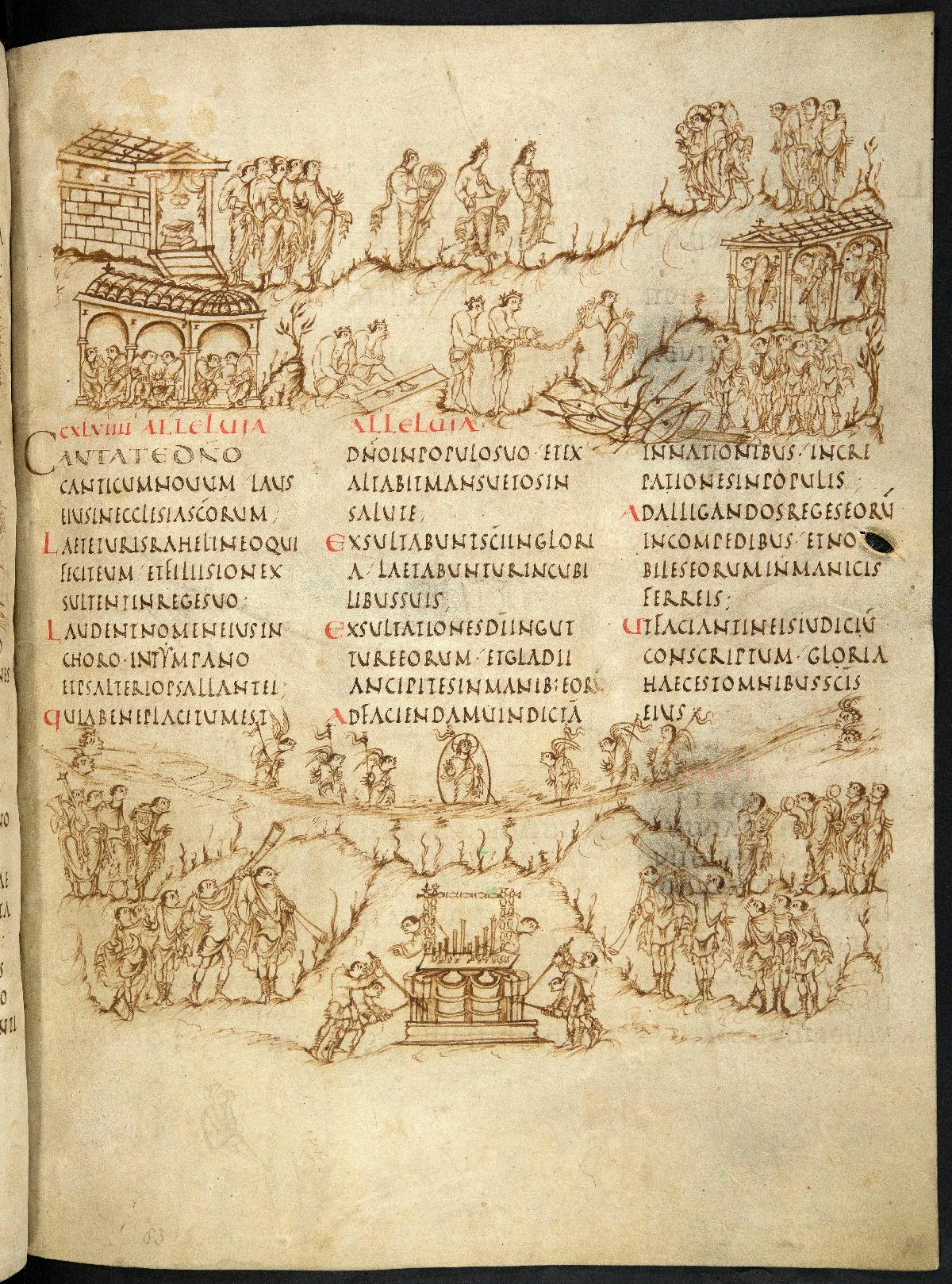
The Utrecht Psalter, about 800. Public domain.
Psalms 146 to 150 · Passage · Featured Study
The Final Hallel
The last five psalms each open and close with Hallelujah, praise the LORD.
Spurgeon wrote that with these psalms the reader is now among the Hallelujahs.
I will praise the LORD all my life; I will sing praises to my God while I have my being.
I will praise the LORD all my life; I will sing praises to my God while I have my being.
- The passage
- Psalm 146:1 to 10, Psalm 147:1 to 20, Psalm 148:1 to 14, Psalm 149:1 to 9, Psalm 150:1 to 6
- Book
- Psalms
- Hold in memory
- Psalm 146:3, Psalm 147:3, Psalm 148:13
Summary
The Talmud speaks of a Hallel for every day, and Rashi points to two of these psalms for it. The sword of the fourth psalm has been read in more than one way.
- Shabbat 118b keeps the Hallel of the feasts for days of miracles.
- Jerome, Calvin and Matthew Henry are quoted on three of the five.
- Both commentators on Psalm 149 warn against using it as a call to war.
Five Psalms Framed in Hallelujah
The frame stands in the Berean text, and Delitzsch noted it.
Hallelujah! Praise the LORD, O my soul.Hallelujah stands at the head of the first of the five.
The LORD reigns forever, your God, O Zion, for all generations. Hallelujah!This is the last line of the first of the five.
Franz Delitzsch counted these five among the psalms that begin and end with Hallelujah.
The Five in Sequence
Each psalm gives a different reason to praise.
- 1The Maker against the princesWarns against trust in princes, who return to the ground, and praises the Maker of heaven and earth, who frees prisoners and protects foreigners.Psalm 146:3
- 2The builder of JerusalemPraises the LORD who builds up Jerusalem, gathers the exiles of Israel, counts the stars and sends the snow.Psalm 147:2
- 3Heaven and earth called inCalls angels, sun and moon, sea creatures, kings, the young and the old to praise the LORD, for He gave the command and they were created.Psalm 148:13
- 4A new song for the godlyCalls the godly to a new song, for the LORD takes pleasure in His people.Psalm 149:1
- 5Praise in the sanctuaryNames where to praise God, why to praise Him, and the horn, harp, lyre and cymbals to praise Him with.Psalm 150:2
The builder of Jerusalem, Heaven and earth called in, A new song for the godly, Praise in the sanctuary
The Daily Hallel
The Talmud sets a Hallel said every day apart from the Hallel of the feasts.
In the Babylonian Talmud at Shabbat 118b, Rabbi Yosei wished to be among those who complete the Hallel every day.
The Gemara objects that one who reads the Hallel every day is like one who curses and blasphemes. It answers that Rabbi Yosei meant the verses of praise said in the morning service.
Rashi names those verses of praise as two psalms, Psalm 148 and Psalm 150.
A. F. Kirkpatrick wrote that the use of these five psalms in the synagogue's daily morning service is of great antiquity.
Voices on the Final Hallel
Each quotation is on one psalm of the five.
Jerome (died 420)
Homily 58, on Psalm 148
Jerome explained the two alleluias that stand before Psalm 148.
“This psalm has two alleluias in its title; and many think this is because they belong to the title of the psalm itself. But we ought to know that one alleluia belongs to the end of the preceding psalm, while the other alleluia is the beginning of the following psalm. And we ought to take up this rule and understand that all the psalms which have alleluia at their beginning have it also at their end. Many, however, suppose that it is the beginning of another psalm.”
on Psalm 148:1Patristic
John Calvin (1509 to 1564)
Commentaries
John Calvin read the builder of Jerusalem in Psalm 147:2 as the builder of the church.
“When he is here called the builder of Jerusalem, the allusion is not so much to the outward form and structure, as to the spiritual worship of God. It is a common figure in treating of the Church to speak of it as a building or temple.”
on Psalm 147:2Reformed
Matthew Henry (1662 to 1714)
Commentary on the Whole Bible
Matthew Henry set one Son of man against the princes of Psalm 146:3.
“There is indeed a Son of man in whom there is help, in whom there is salvation, and who will not fail those that trust in him. But all other sons of men are like the man they are sprung of, who, being in honour, did not abide.”
on Psalm 146:3Puritan
The Sword of Psalm 149
Two commentators read the double-edged sword of Psalm 149:6 by different standards.
May the high praises of God be in their mouths, and a double-edged sword in their hands, to inflict vengeance on the nations and punishment on the peoples,Delitzsch records that Caspar Scioppius used this psalm to stir the Roman Catholic princes to the Thirty Years' War, and that Thomas Münzer used it to stir up the Peasants' War. Kirkpatrick quotes him on both.
A sword the church prays only in the spiritFranz Delitzsch
Franz Delitzsch read the sword of Psalm 149:6 as a many-edged sword in the hands of a people sent to bring the nations under the God of Israel, as the Maccabees soon did. He held that the Christian cannot make the psalm his own as it stands.
The weapons of our warfare are not the weapons of the world. Instead, they have divine power to demolish strongholds.This is the verse Delitzsch quotes on the psalm.
Against this reading, Kirkpatrick holds that the psalm's morality must not be measured by the Christian standard.
A devouring sword, read by its own ageA. F. Kirkpatrick
A. F. Kirkpatrick took the sword of mouths to mean a devouring sword. He held that the lesson of winning the nations by a nobler way than force was learnt only by slow degrees.
Against this reading, Delitzsch points to the apostle's warning in 2 Corinthians 10:4.
Books to Read Next
All three works are in the public domain, and each has a free copy to read.
Biblical Commentary on the Psalms, volume 3
Franz Delitzsch, translated by Francis Bolton · 1871
Delitzsch sets out the misuse of the sword psalm on pages 411 to 413.
Read at the Internet ArchiveThe Book of Psalms, Books IV and V
A. F. Kirkpatrick · 1902
Kirkpatrick quotes Delitzsch on that misuse in his introduction to the psalm.
Read at the Internet ArchiveThe Treasury of David, volume 7
Charles Spurgeon · 1885
The volume holds Spurgeon's notes on all five psalms.
Read at the Spurgeon ArchivePraise All My Life
The five begin with one soul told to praise the LORD and go on to call heaven, earth and every people to the same work.
Hallelujah! How good it is to sing praises to our God, how pleasant and lovely to praise Him!The second of the five gives its reason to sing.
Sources
Scripture is the Berean Standard Bible.
- The Babylonian Talmud, Shabbat 118b, William Davidson edition, with Rashi on the passage (Vilna edition)
- Franz Delitzsch, Biblical Commentary on the Psalms, translated by Francis Bolton, vol. 1, T. and T. Clark, 1871, p. 22.
- Franz Delitzsch, Biblical Commentary on the Psalms, translated by Francis Bolton, vol. 3, T. and T. Clark, 1871, pp. 411 to 413.
- A. F. Kirkpatrick, The Book of Psalms, Books IV and V, Cambridge Bible for Schools and Colleges, 1902, on Psalms 146 and 149.
- Charles Spurgeon, The Treasury of David, vol. 7, 1885, on Psalm 146.
- Jerome, Homily 58, on Psalm 148.
- John Calvin, Commentaries, on Psalm 147:2.
- Matthew Henry, Commentary on the Whole Bible, on Psalm 146:3.
Keep Studying
Read it4