
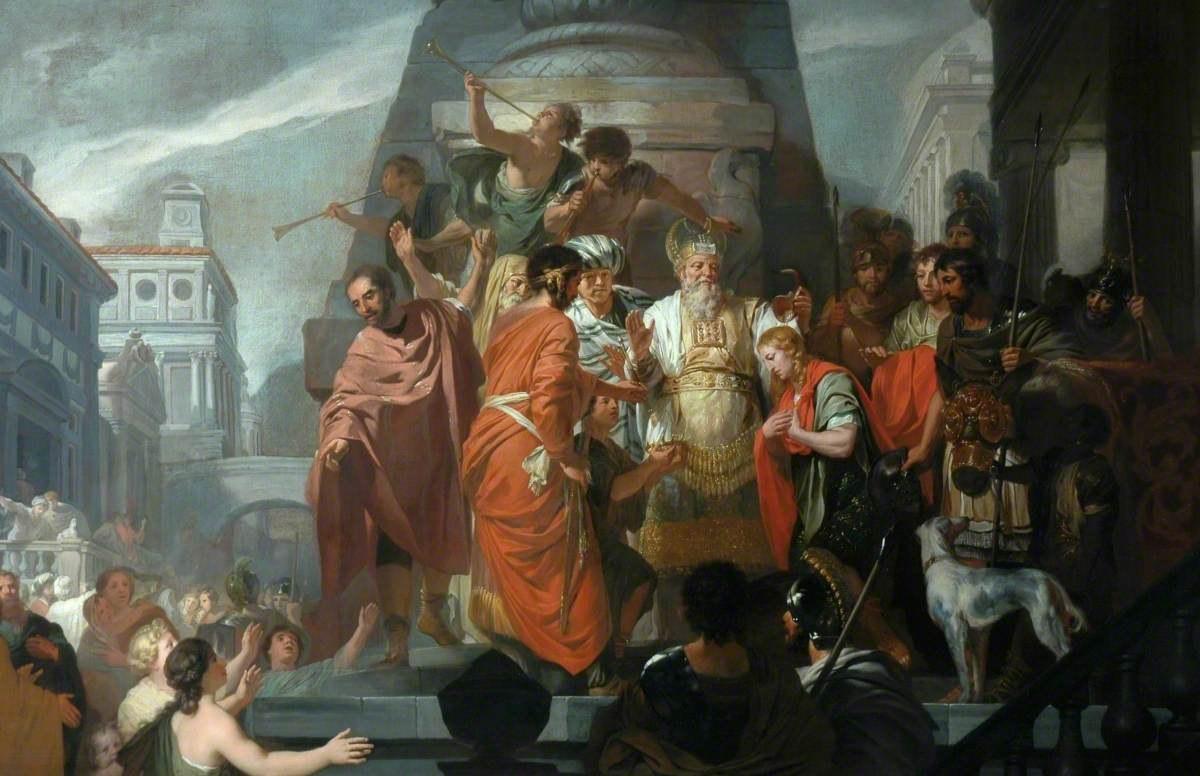
Gerard de Lairesse, The Anointing of Solomon. Public domain.
Psalms 20, 21 and 72 · Subject · Featured Study
The Royal Psalms
Hermann Gunkel set ten psalms apart as royal psalms, songs whose subject is the king of Israel.
Some trust in chariots and others in horses, but we trust in the name of the LORD our God.
- Book
- Psalms
- Hold in memory
- Psalm 20:7
The people pray, and the king gives thanks.
Summary
The royal psalms set the king of David's line at their centre. Psalm 72 asks God to give him justice, and Psalm 89 mourns his crown in the dust.
- Psalms 20 and 21 are an intercession and a thanksgiving, in Kirkpatrick's reading
- One of the ten is a ruler's vow about his house and his city
- Psalm 72 has been read of Solomon, of an ideal king and of Christ
What Makes a Psalm Royal
The class is defined by what a psalm is about.
Great salvation He brings to His king. He shows loving devotion to His anointed, to David and his descendants forever.The last verse of Psalm 18 names the king and his house.
Gunkel's ten are Psalms 2, 18, 20, 21, 45, 72, 101, 110, 132 and 144, and each refers explicitly to the king.
The King in the Text
One verse from each of Gunkel's ten shows where the king stands.
Eight of the ten name the king, the anointed one or David in the verse shown.
| Verse | What it says of the king | Verse | What it says of the king |
|---|---|---|---|
| Psalm 2:6 | The LORD has installed His King on Zion | Psalm 72:1 | God is asked to give the king His justice |
| Psalm 18:50 | Great salvation for His king and David's descendants | Psalm 101:8 | The singer will cut off evildoers from the city of the LORD |
| Psalm 20:9 | The people pray for the king to be saved | Psalm 110:1 | The LORD seats my Lord at His right hand |
| Psalm 21:1 | The king rejoices in the LORD's strength | Psalm 132:10 | A prayer for the anointed king of David's line |
| Psalm 45:1 | A singer recites his verses to the king | Psalm 144:10 | God gives victory to kings and frees His servant David |
The singer will cut off evildoers from the city of the LORD, The LORD seats my Lord at His right hand, A prayer for the anointed king of David's line, God gives victory to kings and frees His servant David
A Ruler's Vow
The vow is spoken in the first person.
My eyes favor the faithful of the land, that they may dwell with me; he who walks in the way of integrity shall minister to me. No one who practices deceit shall dwell in my house; no one who tells lies shall stand in my presence. Every morning I will remove all the wicked of the land, that I may cut off every evildoer from the city of the LORD.The singer names whom he will keep near him.
The singer vows to walk in his house with integrity of heart and to set no worthless thing before his eyes.
The Crown in the Dust
Psalm 89 recalls how God anointed David, then mourns his fallen crown.
Now, however, You have spurned and rejected him; You are enraged by Your anointed one. You have renounced the covenant with Your servant and sullied his crown in the dust.The psalm turns from the promise to the loss.
The psalm remembers God finding David and anointing him with sacred oil. Later it asks where the loving devotion sworn to David has gone.
Before the Battle and After
Two psalms stand on either side of one battle.
Now I know that the LORD saves His anointed; He answers him from His holy heaven with the saving power of His right hand.Kirkpatrick reads Psalm 20 as the people's intercession.
O LORD, the king rejoices in Your strength. How greatly he exults in Your salvation! You have granted his heart’s desire and have not withheld the request of his lips. SelahKirkpatrick reads Psalm 21 as their thanksgiving.
A. F. Kirkpatrick, in the Cambridge Bible, reads the two as a pair close in structure and content. In Psalm 20 the king is preparing to go out to battle against strong enemies, and in Psalm 21 the campaign is over.
Charles Ellicott has the congregation lead off with a prayer for the king's success in Psalm 20:1 to 5.
“In short, the faithful, that the body may not be separated from the head, further the king's prayers by their common and united supplications. The name of God is here put for God himself and not without good reason; for the essence of God being incomprehensible to us, it behoves us to trust in him, in so far as his grace and power are made known to us.”
John Calvin · Commentaries · on Psalm 20:1Reformed
Three Readings of Psalm 72
Three readings stand, each with its holders and its objection.
Endow the king with Your justice, O God, and the son of the king with Your righteousness. May he judge Your people with righteousness and Your afflicted with justice.The psalm opens with a prayer for the king and the king's son.
A prayer for Solomon's reignA. F. Kirkpatrick; Charles Spurgeon
The objection: Augustine, in The City of God, notes that Solomon's kingdom had known bounds, while the psalm asks for rule from sea to sea.
The ideal king, beyond any one reignA. F. Kirkpatrick
Kirkpatrick also sees in the psalm the vision of a perfect ruler who will champion the oppressed. Even if it first refers to a real king of Judah, he writes, it reaches far beyond him.
For he will deliver the needy who cry out and the afflicted who have no helper. He will take pity on the poor and needy and save the lives of the oppressed. He will redeem them from oppression and violence, for their blood is precious in his sight.Kirkpatrick's reading rests on these verses.
The objection: Calvin and Spurgeon read the same psalm of one person, Christ, rather than of an ideal.
Christ's kingdomJohn Calvin; Augustine; Charles Spurgeon
Calvin reads the psalm as teaching the people to obey the order God set in David's line, and to be led from that typical kingdom to Christ. Augustine sees in Solomon a figure, and in the psalm the truth itself presented in Christ. Spurgeon writes that Jesus is here beyond all doubt in the glory of His reign.
The objection: the psalm prays for the king in the third person and asks that people ever pray for him.
The King Who Trusts
The thanksgiving after the battle names the reason for the victory.
For the king trusts in the LORD; through the loving devotion of the Most High, he will not be shaken.The verse stands at the centre of the thanksgiving.
Psalm 21 ends by asking the LORD to be exalted in His strength, and the people promise to sing of His power.
Sources
Scripture is the Berean Standard Bible.
- Wikipedia, Royal psalms, which credits the class of ten to Hermann Gunkel.
- A. F. Kirkpatrick, The Book of Psalms, The Cambridge Bible for Schools and Colleges, on Psalms 20 and 72.
- Charles Ellicott, Commentary for English Readers, on Psalm 20.
- Augustine, The City of God, 17.8.
- John Calvin, Commentary on the Psalms, on Psalms 20:1 and 72.
- Charles Spurgeon, The Treasury of David, on Psalm 72.
Keep Studying
Doctrines5