
Genesis 45 and 50 · God's Rule over What Happens
Providence
Genesis 45 and 50 give Joseph's account of how God ruled over the wrong his brothers did him.
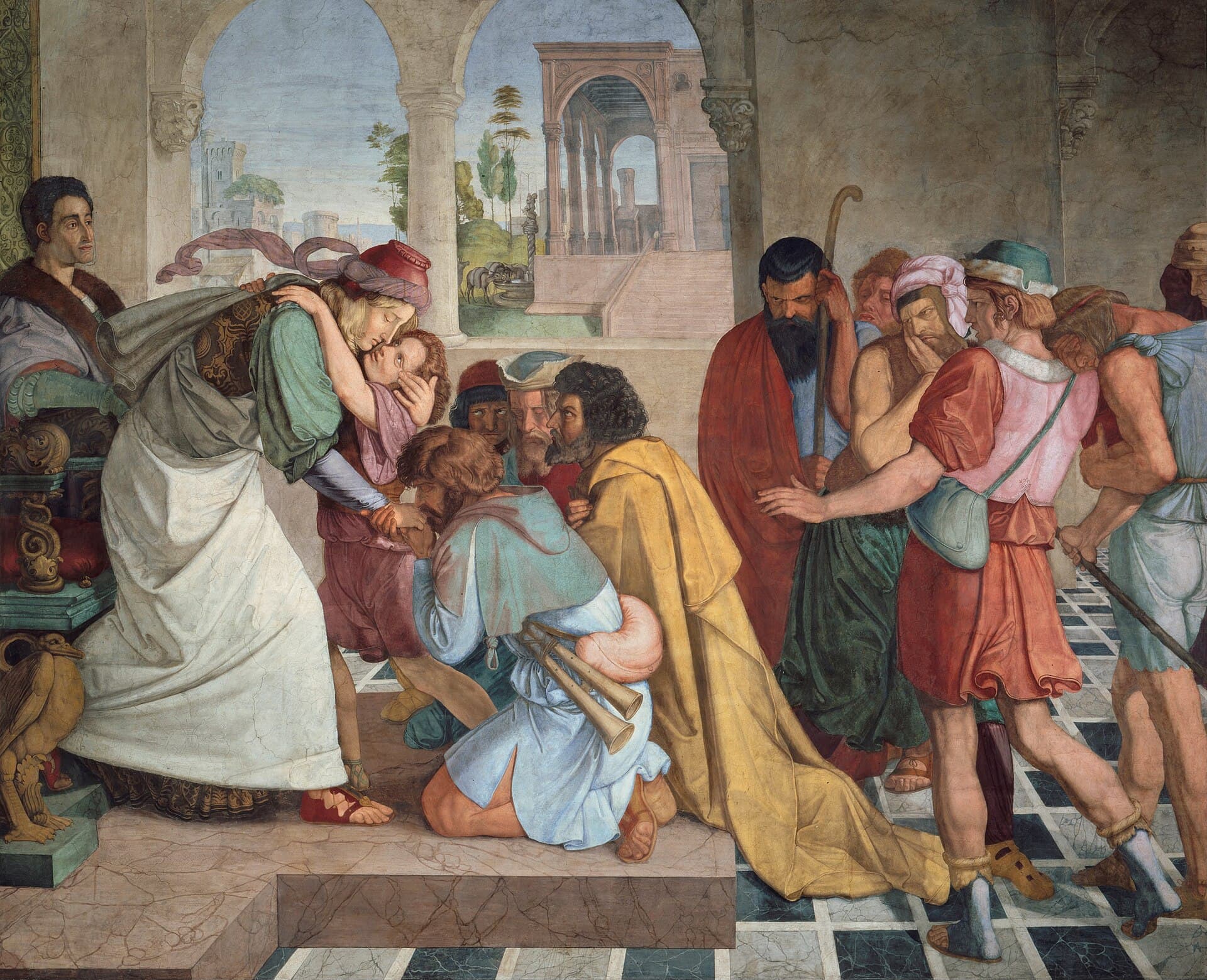
Peter von Cornelius, Joseph Reveals Himself to His Brothers, fresco, 1816 to 1817, from the Casa Bartholdy in Rome, Alte Nationalgalerie, Berlin. Public domain by date (the painter died in 1867), via Wikimedia Commons, File:Peter_von_Cornelius_-_Joseph_gibt_sich_seinen_Br%C3%BCdern_zu_erkennen_-_Google_Art_Project.jpg, a faithful reproduction of a public domain painting.
THE ARTWORKCornelius painted the moment of Genesis 45 when Joseph made himself known to his brothers in Egypt and told them that God had sent him ahead of them to keep them alive. Joseph holds Benjamin, as Genesis 45:14 records, while one brother kisses his hand and the rest draw back in fear.
Joseph spoke kindly to the brothers who sold him, because he saw God's purpose in what they had done.
Summary
Providence is God's rule over all that happens, and Joseph speaks of it when he tells his brothers that God intended for good the evil they intended against him.
- Joseph's brothers sold him to traders bound for Egypt, where he rose to rule the land under Pharaoh.
- Proverbs, Jesus and Paul set the same rule over every event, and Peter applies it to the cross.
- Christians agree that God rules over all things and divide over how His rule meets human choice.
What Joseph Told His Brothers
Joseph speaks of God's purpose in Genesis 45, when he makes himself known, and again in Genesis 50, after Jacob's death.
The brothers who had sold Joseph came to Egypt in the famine to buy grain, and they bowed before him without knowing who he was.
Then Joseph said to his brothers, “Please come near me.” And they did so. “I am Joseph, your brother,” he said, “the one you sold into Egypt! And now, do not be distressed or angry with yourselves that you sold me into this place, because it was to save lives that God sent me before you.Joseph names the wrong his brothers did him and in the same breath names God's purpose in it.
God sent me before you to preserve you as a remnant on the earth and to save your lives by a great deliverance. Therefore it was not you who sent me here, but God, who has made me a father to Pharaoh—lord of all his household and ruler over all the land of Egypt.Verse 8 gives the sending to God alone, the third time in four verses that Joseph says God sent him.
After Jacob's death the brothers feared that Joseph would now repay them for the evil they had done him.
But Joseph replied, “Do not be afraid. Am I in the place of God? As for you, what you intended against me for evil, God intended for good, in order to accomplish a day like this—to preserve the lives of many people.Joseph sets his brothers' intention and God's intention side by side over the one act, and he names the good that God intended.
The Hebrew of verse 20 uses one verb, chashav, to plan or devise, for the brothers' plan and for God's.
Where Scripture Teaches God's Rule
Five texts from the Psalms to Ephesians set God's rule over a famine, a man's steps, the lot, the sparrow and all things.
1The psalm of Israel's history
- What God rules
- the famine, and Joseph sent before them, sold as a slave
- What God rules
- the steps of a man who plans his own course
- What God rules
- every decision of the lot cast into the lap
- What God rules
- the fall of every sparrow, and the hairs of every head numbered
- What God rules
- everything, worked out by the counsel of His will
Five texts, each set beside what it says God rules.
Albert Barnes explains on Proverbs 16:33 that lots were thrown into the folds of a robe and drawn out, and that where everything seemed chance the Israelite teacher saw the guidance of a higher will.
The Case from Abraham to Joseph
Genesis builds the teaching in three steps, from the mountain of Genesis 22 to Joseph's answer in Genesis 50.
1. Genesis 22:8 and 14, the LORD will provide2 passages
Then Isaac said to his father Abraham, “My father!” “Here I am, my son,” he replied. “The fire and the wood are here,” said Isaac, “but where is the lamb for the burnt offering?” Abraham answered, “God Himself will provide the lamb for the burnt offering, my son.” And the two walked on together.Isaac's question is answered by a promise about God before Abraham knows how it will be kept.
The verb Abraham uses is ra'ah, to see, so his words say that God will see to the lamb.
Rashi, Rabbi Shlomo Yitzchaki of France (1040 to 1105), in his commentary on Genesis, reads the words as God looking out for a lamb and choosing it for Himself.
Then Abraham looked up and saw behind him a ram in a thicket, caught by its horns. So he went and took the ram and offered it as a burnt offering in place of his son. And Abraham called that place The LORD Will Provide. So to this day it is said, “On the mountain of the LORD it will be provided.”The name Abraham gives the mountain turns the promise of verse 8 into a memorial.
Rashi gives the meaning of the name as the Targum renders it, that the LORD would choose this place for His presence and for the offerings made there.
2. Genesis 37 to 41, the road to Egypt3 passages
Then Judah said to his brothers, “What profit will we gain if we kill our brother and cover up his blood? Come, let us sell him to the Ishmaelites and not lay a hand on him; for he is our brother, our own flesh.” And they agreed. So when the Midianite traders passed by, his brothers pulled Joseph out of the pit and sold him for twenty shekels of silver to the Ishmaelites, who took him to Egypt.This is the act Joseph calls evil in Genesis 50:20.
the LORD was with him and extended kindness to him, granting him favor in the eyes of the prison warden. And the warden put all the prisoners under Joseph’s care, so that he was responsible for all that was done in the prison. The warden did not concern himself with anything under Joseph’s care, because the LORD was with Joseph and gave him success in whatever he did.The narrator names the LORD's presence with Joseph at the lowest point of his road, in the prison.
So Pharaoh asked them, “Can we find anyone like this man, in whom the Spirit of God abides?” Then Pharaoh said to Joseph, “Since God has made all this known to you, there is no one as discerning and wise as you. You shall be in charge of my house, and all my people are to obey your commands. Only with regard to the throne will I be greater than you.” Pharaoh also told Joseph, “I hereby place you over all the land of Egypt.”Pharaoh himself credits Joseph's wisdom to God when he sets him over Egypt.
3. Genesis 50:15 to 19, the brothers' fear2 passages
When Joseph’s brothers saw that their father was dead, they said, “What if Joseph bears a grudge? Then he will surely repay us for all the evil that we did to him.” So they sent word to Joseph, saying, “Before he died, your father commanded, ‘This is what you are to say to Joseph: I beg you, please forgive the transgression and sin of your brothers, for they did you wrong.’ So now, Joseph, please forgive the transgression of the servants of the God of your father.” When their message came to him, Joseph wept.The brothers plead a command of their father because they doubt the forgiveness Joseph gave them in Genesis 45.
His brothers also came to him, bowed down before him, and said, “We are your slaves!”The brothers offer themselves as slaves to the brother they once sold as a slave.
John Gill reads their bow as a further fulfilment of Joseph's dream of the eleven stars in Genesis 37:9.
Rashi reads Joseph's question in verse 19 as an argument from the brothers' own failure. They had all planned evil against him and failed because God planned it for good, and Joseph alone could do them no harm without God's consent.
Adam Clarke allows the question to be read either as a question or as a statement that the matter now lies between the brothers and God.
Ephrem the Syrian, in his Commentary on Genesis, finds the ground of Joseph's mercy in the God of Jacob, who outlived Jacob.
What Genesis Leaves Unsaid
Genesis leaves three questions about Joseph and his brothers open.
Genesis does not explain how the two intentions of Genesis 50:20 were joined in one act.
Adam Clarke says that no one can tell whether Jacob gave the command the brothers report in Genesis 50:16 to 17, and Genesis records no such word from him.
The text does not say whether Joseph understood, in the pit or in the prison, what he told his brothers after the famine came.
God's Purpose over Evil in Acts, Romans and Esther
Four texts set the death of Jesus, the believer's life and the deliverance of the Jews in Persia under the purpose Joseph named.
He was delivered up by God’s set plan and foreknowledge, and you, by the hands of the lawless, put Him to death by nailing Him to the cross.Peter names God's set plan and the hands of the lawless in one sentence about one death, as Joseph named two intentions over one sale.
In fact, this is the very city where Herod and Pontius Pilate conspired with the Gentiles and the people of Israel against Your holy servant Jesus, whom You anointed. They carried out what Your hand and will had decided beforehand would happen.The church's prayer gives Herod, Pilate, the Gentiles and Israel their own act and gives the outcome to God's hand and will.
And we know that God works all things together for the good of those who love Him, who are called according to His purpose.Paul states as a rule for those who love God what Joseph found true in his own life.
In the book of Esther, Haman, the highest official of the Persian king, sought to destroy all the Jews of the kingdom, and the book never once names God in its Berean text.
On the thirteenth day of the twelfth month, the month of Adar, the king’s command and edict were to be executed. On this day the enemies of the Jews had hoped to overpower them, but their plan was overturned and the Jews overpowered those who hated them.The day the enemies of the Jews had chosen for their destruction became the day of their deliverance, as the sale of Joseph led to the saving of his family.
Matthew Henry on Joseph's Rise
Henry reads the rise of Joseph in Genesis 45 as God's care for one small family more than for a kingdom.
“God's Israel is the particular care of God's providence. Joseph reckoned that his advancement was not so much designed to save a whole kingdom of Egyptians as to preserve a small family of Israelites: for the Lord's portion is his people; whatever becomes of others, they shall be secured.”
Matthew Henry · Commentary on the Whole Bible · on Genesis 45:5 to 7Puritan
How God Governs What People Do
Four readings of Genesis 50:20 differ over how God's purpose and human choice meet.
Meticulous providence1 passage, 1 quotation
On this reading God's purpose stands over every act, the evil acts of people included, and Ephesians 1:11 is its plainest text.
R. C. Sproul, who holds this reading, keeps the guilt of the act with the brothers.
“Joseph's brothers meant his suffering for evil, and insofar as this was their motivation, they were culpable before God.”
R. C. Sproul · How Can God Bring Good Out of Evil? · on Genesis 50:20Reformed
Jacobus Arminius and John Wesley press the objection that God desires all people to be saved, and a purpose over every evil act seems to set His will against His desire.
This is good and pleasing in the sight of God our Savior, who wants everyone to be saved and to come to the knowledge of the truth.Paul says that God wants everyone to be saved, and the objection rests on these words.
General providence with real freedom1 passage
Jacobus Arminius set out this reading in his Declaration of Sentiments (1608), and John Wesley preached it in his sermons Free Grace and On Predestination.
On their reading God is sovereign over all things, and His sovereignty has itself set up real human freedom.
God's knowing what a person will choose is a different act from making the person choose it.
Do I take any pleasure in the death of the wicked? declares the Lord GOD. Wouldn’t I prefer that he turn from his ways and live?The reading takes God's wish that the wicked turn and live as proof that He does not decree their refusal.
The objection comes from John Calvin, in his Institutes, book 3, chapters 21 to 24, and from R. C. Sproul, in Chosen by God, who hold that Ephesians 1:11 sets no limit on the will by which God works out everything.
Middle knowledge1 passage
Luis de Molina, in his Concordia (1588), taught that God knows what every free creature would freely do in any circumstance and chooses which world to make with that knowledge.
Will the citizens of Keilah surrender me into his hand? Will Saul come down, as Your servant has heard? O LORD, God of Israel, please tell Your servant.” “He will,” said the LORD. So David asked, “Will the citizens of Keilah surrender me and my men into the hand of Saul?” “They will,” said the LORD. Then David and his men, about six hundred strong, set out and departed from Keilah, moving from place to place. When Saul was told that David had escaped from Keilah, he declined to go forth.The LORD tells David what Saul and the men of Keilah would do, and David leaves, so neither thing happens.
William Lane Craig, in The Only Wise God, reads the answer at Keilah as knowledge of what would have happened under conditions that never came about.
Open theism2 passages
Clark Pinnock, Richard Rice, John Sanders, William Hasker and Gregory Boyd hold that God knows all that can be known, and that future free choices are not yet there to be known. Boyd sets the reading out in his book God of the Possible.
“Do not lay a hand on the boy or do anything to him,” said the angel, “for now I know that you fear God, since you have not withheld your only son from me.”The open theist reads the words now I know as knowledge God gained in the event.
Jacobus Arminius held that God knows every free choice before it is made. The objection from his side points to the prophecies that name free acts before they happen, among them the naming of Cyrus.
Remember what happened long ago, for I am God, and there is no other; I am God, and there is none like Me. I declare the end from the beginning, and ancient times from what is still to come. I say, ‘My purpose will stand, and all My good pleasure I will accomplish.’God sets His knowledge of what is to come beside His claim to be God alone.
What Joseph's Words Ask of the Reader
Genesis 50 asks the reader to forgive a wrong and to trust God with what it was meant to do.
Therefore do not be afraid. I will provide for you and your little ones.” So Joseph reassured his brothers and spoke kindly to them.Joseph's trust in God's purpose becomes provision and kind words for his brothers and their little ones.
Christ prayed for the forgiveness of those who crucified Him, and the reader who trusts God's rule over evil is asked to forgive as Joseph forgave and as Christ forgave.
So do not be afraid; you are worth more than many sparrows.Jesus gives the command Joseph gave his brothers, and He grounds it on His hearers' worth, greater than that of many sparrows.
Keep studying
Studies5
Places1
Symbols1
Doctrines11
Subjects1