
Genesis 1, 5 and 9 · The Image of God · Featured Study
The Image of God
Genesis 1:26 to 28 says that God made man in His image and likeness to rule the earth.
Of all that God made in Genesis 1, Scripture says only of mankind that it bears His image.
- First taught
- Genesis 1:26
- Fullest statement
- Genesis 1:26 to 28
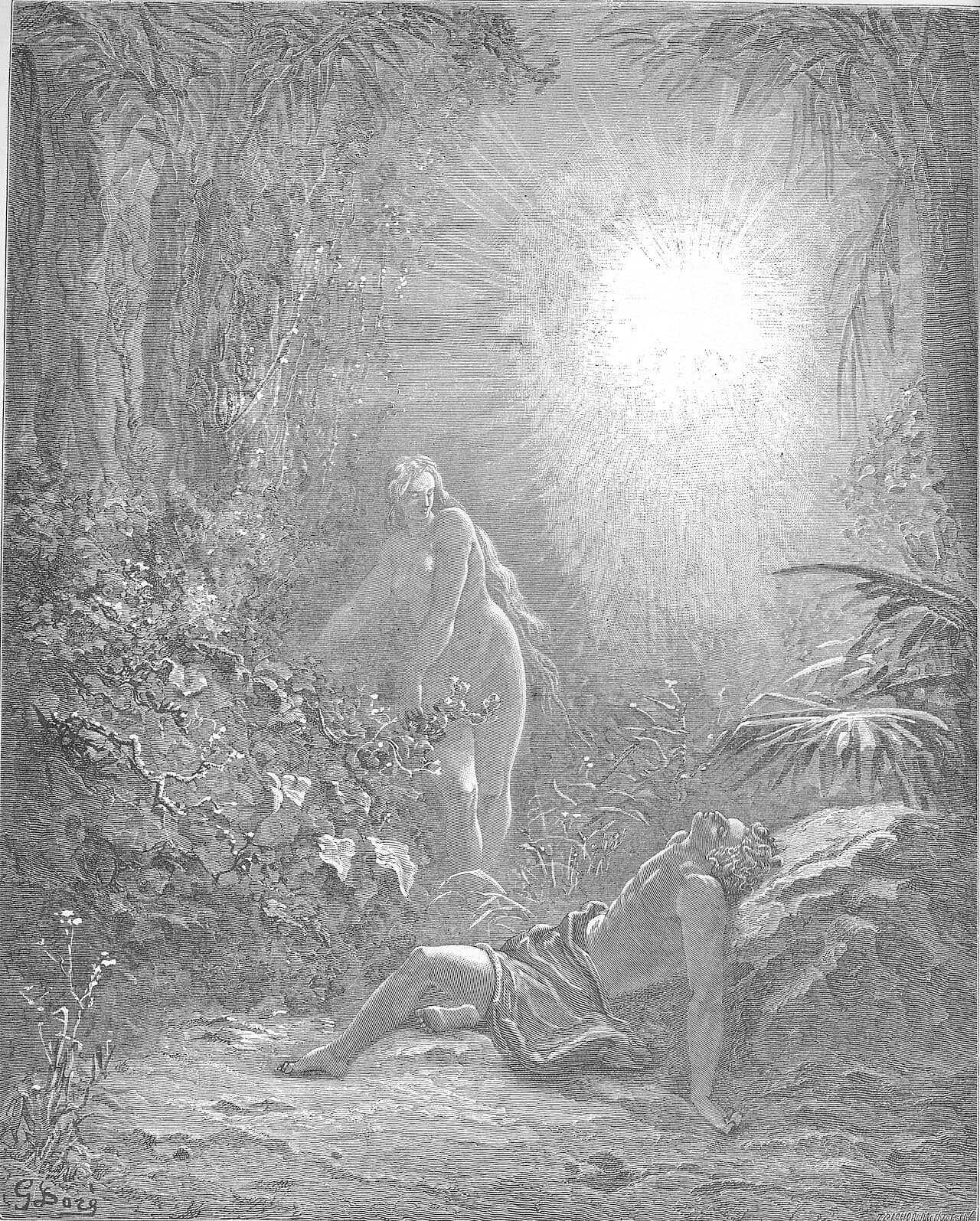
Gustave Doré, The Creation of Eve, 1866, from Doré's English Bible. Public domain.
THE ARTWORKDoré drew the moment of Genesis 2:21 to 22, when the LORD God has made the woman and the man still sleeps. Genesis 1:27 says that God created mankind in His own image, male and female, and Genesis 2 tells how the two were made.
Summary
Genesis 9:6 and James 3:9 speak of men as made in God's image and likeness long after the fall.
- Hebrew names what man bears with two words, tselem for image and demut for likeness.
- Readers have placed the image in reason and will, in relation, or in a royal office over the earth.
- Readers also differ on whether image and likeness are two gifts or one, and on what of the image the fall took away.
- Paul names Christ the image of God and says that believers are being transformed into His image.
Made in the Image of God
The three verses stand on the sixth day of creation, after the making of the land animals in Genesis 1:24 to 25.
Then God said, “Let Us make man in Our image, after Our likeness, to rule over the fish of the sea and the birds of the air, over the livestock, and over all the earth itself and every creature that crawls upon it.”This is the first verse of Scripture to name the image, and every later text on the doctrine reaches back to it.
So God created man in His own image; in the image of God He created him; male and female He created them.The verse repeats its verb three times over the making of mankind.
God blessed them and said to them, “Be fruitful and multiply, and fill the earth and subdue it; rule over the fish of the sea and the birds of the air and every creature that crawls upon the earth.”God speaks the blessing to them both, and the rule that Genesis 1:26 gives as a purpose is given here as a command.
The Image Across the Canon
Eleven texts run from the sixth day of Genesis 1 to the change Paul describes in 2 Corinthians 3:18.
- What it adds
- The image belongs to humanity from the first day of its life.
- What it adds
- The two nouns of the sixth day stand together again after Eden.
- What it adds
- After the flood the image becomes the ground of the law against murder.
- What it adds
- The psalm sings of the rank and rule of Genesis 1 as a crown given to man.
- What it adds
- James counts the likeness as present in the people his readers speak to.
- What it adds
- Hebrews finds the crown of Psalm 8 worn first by Jesus.
- What it adds
- The image of God is now seen by looking at Christ in the light of the gospel.
- What it adds
- Paul ties the image to the Son's place over the whole creation.
- What it adds
- The Son shows God's nature as the radiance of a light shows the light it comes from.
- What it adds
- The image is the end God set for His people before He called them, and the Son is its pattern.
- What it adds
- The renewal into the image is under way now, and the Spirit works it.
A chain of eleven texts, each with what it adds to the teaching of the image, from the first man to Christ and to those who are His.
Image, Likeness and Rule
Genesis 1:26 to 28 uses two nouns for what mankind bears and two verbs for what mankind does.
TSELEM, IMAGE
Strong's defines tselem as a resemblance, and hence a representative figure, especially an idol.
DEMUT, LIKENESS
Strong's defines demut as a resemblance, a model or a shape, and as an adverb the word means like.
RADAH, RULE
The verb of rule in Genesis 1:26 and Genesis 1:28 means to have dominion or to reign, from a root sense of treading down.
KABASH, SUBDUE
The verb of the blessing in Genesis 1:28 means to bring into subjection or to conquer.
Genesis 5:1 to 3, after the fall2 passages
This is the book of the generations of Adam. In the day that God created man, He made him in His own likeness. Male and female He created them, and He blessed them. And in the day they were created, He called them “man.”The record of Adam's descendants opens by repeating the sixth day before it names a single son.
When Adam was 130 years old, he had a son in his own likeness, after his own image; and he named him Seth.The verse uses the two words of Genesis 1:26 for a father and his son.
Genesis 9:5 to 6, the image after the flood1 passage
And surely I will require the life of any man or beast by whose hand your lifeblood is shed. I will demand an accounting from anyone who takes the life of his fellow man: Whoever sheds the blood of man, by man his blood will be shed; for in His own image God has made mankind.God speaks these words to Noah and his sons, and verse 7 repeats to them the blessing of Genesis 1:28.
What Genesis Leaves Unsaid
Genesis uses the word image five times in the Berean text and leaves three questions about it unanswered.
In what does the image consist?Genesis 1:26 to 28
These verses join the image to male and female, to the blessing and to the rule, and name no faculty of the soul. Each reading of the image under Where the Reading Is Contested reasons from these neighbours of the word.
What became of the image in Eden?Genesis 3
Genesis 3 tells of the first sin and its sentence without using the word image. Genesis 5:3 and Genesis 9:6, where the word returns, do not say that the image was lost or marred.
Christ the Image, and the Image Renewed
Paul, Hebrews and John take up the words of Genesis 1 and Psalm 8 and apply them to the Son and to those who are His.
The Son is the image of the invisible God, the firstborn over all creation.The next verse says that all things were created through the Son and for Him.
The Son is the radiance of God’s glory and the exact representation of His nature, upholding all things by His powerful word. After He had provided purification for sins, He sat down at the right hand of the Majesty on high.Hebrews says in its own words what Paul says with the word image.
For those God foreknew, He also predestined to be conformed to the image of His Son, so that He would be the firstborn among many brothers.Paul says that the likeness makes the Son the firstborn of a family of many brothers.
And we, who with unveiled faces all reflect the glory of the Lord, are being transformed into His image with intensifying glory, which comes from the Lord, who is the Spirit.The verse ends Paul's comparison of his ministry with the veil Moses put over his face, in 2 Corinthians 3:13 to 16.
The new self in Colossians and EphesiansColossians 3:9 to 10 and Ephesians 4:22 to 24
Do not lie to one another, since you have taken off the old self with its practices, and have put on the new self, which is being renewed in knowledge in the image of its Creator.Paul ties the renewal to the Creator's image and to a knowledge that is still growing.
to put off your former way of life, your old self, which is being corrupted by its deceitful desires; to be renewed in the spirit of your minds; and to put on the new self, created to be like God in true righteousness and holiness.Ephesians gives the change in three steps, and the middle one is in the mind.
Psalm 8 and Hebrews 2Psalm 8:4 to 8 and Hebrews 2:8 to 9
what is man that You are mindful of him, or the son of man that You care for him? You made him a little lower than the angels; You crowned him with glory and honor. You made him ruler of the works of Your hands; You have placed everything under his feet: all sheep and oxen, and even the beasts of the field, the birds of the air and the fish of the sea, all that swim the paths of the seas.The psalm names the creatures of Genesis 1:26 as the ones placed under man's feet.
and placed everything under his feet.” When God subjected all things to him, He left nothing outside of his control. Yet at present we do not see everything subject to him. But we see Jesus, who was made a little lower than the angels, now crowned with glory and honor because He suffered death, so that by the grace of God He might taste death for everyone.Hebrews admits that at present everything is not seen subject to man, and it turns from man to Jesus.
The likeness still to come1 Corinthians 15:49 and 1 John 3:2
And just as we have borne the likeness of the earthly man, so also shall we bear the likeness of the heavenly man.The likeness of the heavenly man comes with the resurrection body, as the likeness of Adam came with the body made of dust.
Beloved, we are now children of God, and what we will be has not yet been revealed. We know that when Christ appears, we will be like Him, for we will see Him as He is.John says the likeness will be complete when Christ appears and is seen as He is.
Where the Tradition Has Stood
Six readings of the image, on Genesis 1 and 5, Psalm 8 and Ephesians 4, come from Gregory of Nyssa, Matthew Henry, Thomas Aquinas, Charles Spurgeon and Jerome.
“This same language was not used for (the creation) of other things. The command was simple when light was created; God said, ‘let there be light.’ Heaven was also made without deliberation.… These, though, were before (the creation of) humans. For humans, there was deliberation. He did not say, as he did when creating other things, ‘Let there be a human.’ See how worthy you are! Your origins are not in an imperative. Instead, God deliberated about the best way to bring to life a creation worthy of honor.”
Gregory of Nyssa · On the Origin of Man · on Genesis 1:26Patristic
“We must, then, examine the words carefully: for we find, if we do so, that that which was made ‘in the image’ is one thing, and that which is now manifested in wretchedness is another.”
Gregory of Nyssa · On the Making of Man 16 · on Genesis 1:27Patristic
“This was Adam's own likeness, the reverse of that divine likeness in which Adam was made; but, having lost it himself, he could not convey it to his seed. Note, Grace does not run in the blood, but corruption does. A sinner begets a sinner, but a saint does not beget a saint.”
Matthew Henry · Commentary on the Whole Bible · on Genesis 5:3Puritan
“But there follows concerning man in comparison to the angels, to whom man is found to be close. ‘You have diminished him.’ In the angels the image of God is found through a simple intuition of truth, without inquiry; but in man through discursive reasoning; …”
Thomas Aquinas · Exposition on the Psalms of David · on Psalm 8:5Patristic
“These verses may set forth man's position among the creatures before he fell; but as they are, by the apostle Paul, appropriated to man as represented by the Lord Jesus, it is best to give most weight to that meaning. In order of dignity, man stood next to the angels, and a little lower than they; in the Lord Jesus this was accomplished, for he was made a little lower than the angels by the suffering of death.”
Charles Spurgeon · The Treasury of David, Vol. 1 · on Psalm 8:5 to 8
“The metaphors of creating and establishing are never spoken of in Scripture except in great works. The world is created. A city is established. But observe that a house, however grand it may be, is more commonly said to be built than established or created. Note then that it is a great work of God when it is said that ‘the new person is created by God in Christ.’ This creature towers over the other creatures.”
Jerome · Commentary on Ephesians 4:23-24 · on Ephesians 4:24Patristic
Where the Reading Is Contested
Three questions on which faithful readers of Genesis 1:26 to 27 differ, each with its holders.
What is the image of God?Three readings: capacity, relation and royal office
The first reading places the image in the powers of the soul, above all reason, and Thomas Aquinas holds it in his Exposition on the Psalms.
The second reading places the image in relation, to God and to one another. Karl Barth, in Church Dogmatics III/1, reads it from the words male and female in Genesis 1:27.
The third reading places the image in an office: mankind set on the earth to rule it as God's representative. D. J. A. Clines argues it in The Image of God in Man (Tyndale Bulletin 19, 1968), from the one sentence of Genesis 1:26 that holds both the image and the rule. Matthew Henry, in his Commentary on the Whole Bible, had called the rule of Psalm 8:6 a charter of royalty that bears the date of man's creation and was renewed after the flood.
Are image and likeness two things or one?Two readings of the two Hebrew words
Irenaeus, in Against Heresies 5.6.1, distinguishes the image, which every person bears, from the likeness, which the Spirit gives. Radak, the Jewish commentator David Kimhi, also gives the words two senses in his commentary on Genesis. On Genesis 5:3 he takes the image to mean Adam's mind and the likeness to mean the body as it shows the soul.
John Calvin, in his commentary on Genesis 1:26, reads the two words as one thing said twice. Readers who take the two words as one point to Genesis 5:1, which uses likeness alone, to Genesis 5:3, which reverses the order of the two words, and to Genesis 9:6, which uses image alone.
What remains of the image after the fall?Matthew Henry, and Jamieson, Fausset and Brown
Matthew Henry, in his Commentary on the Whole Bible, gave the image two senses. On James 3:9 he wrote of the image of God that men still have in their natural faculties, and on Colossians 3:10 of an image defaced by sin and renewed by sanctifying grace.
Jamieson, Fausset and Brown, in their Commentary Critical and Explanatory on Genesis 9:6, hold that the fall injured the image without destroying it. For that reason they set a high value on the life of every person, the poorest included.
Read the Great Books
Three works carry the teaching of the image further.
On the Making of Man
Gregory of Nyssa · c. 379
Gregory gives the whole treatise to the making of man in Genesis 1 and to the meaning of the image.
Institutes of the Christian Religion, Book 1, Chapter 15
John Calvin · 1559
Calvin sets out what the image was in man before the fall and where it is seen.
Commentary on the Whole Bible
Matthew Henry · 1706 to 1710
Henry's note on Genesis 5:1 says that God made man in His own likeness, righteous and holy.
Renewed in the Image of the Creator
The image asks for honour toward every person and for a life remade after Christ.
In Colossians 3:9 the life of the new self begins with a plain command, “Do not lie to one another.”
With the tongue we bless our Lord and Father, and with it we curse men, who have been made in God’s likeness. Out of the same mouth come blessing and cursing. My brothers, this should not be!James makes the image a rule for speech, so the renewed life is tested in how a believer speaks of other people.
Keep studying
Read it2
Studies5
Doctrines12
Peoples and groups2