
Exodus 30 · Exodus 38 · Nehemiah 10 · Subject · Featured Study
The Half Shekel and the Temple Tax
The law of Exodus 30 for the census of Israel, the silver it raised, and the yearly Temple tax of later centuries.
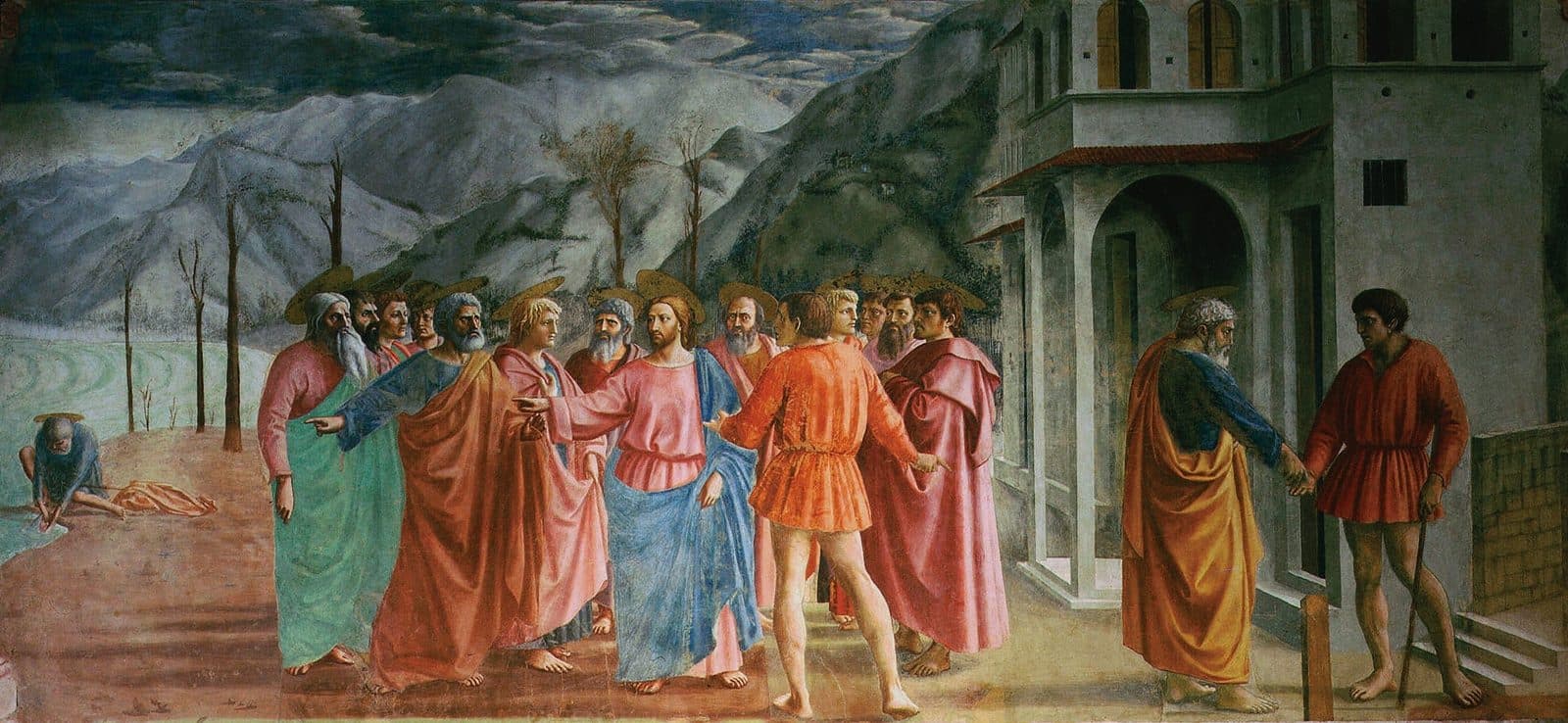
Masaccio, The Tribute Money, fresco in the Brancacci Chapel, Santa Maria del Carmine, Florence, 1424 to 1428. Public domain by date, published before 1930, via Wikimedia Commons.
THE ARTWORKMasaccio painted three moments on one wall of a Florentine chapel: the collector meeting Jesus and the apostles at the centre, Peter at the water's edge at left, and Peter paying the collector at right. The tax in the scene is the Temple tax of Matthew 17, which Adam Clarke traces to the half shekel of Exodus 30.
Most of the silver Israel paid when it was counted was cast into the hundred bases under the frames and the veil of the tabernacle.
Summary
In Exodus 30 the LORD sets a ransom of half a shekel on every man of twenty years or older counted in Israel's census.
- The rich gave no more and the poor no less, and the money served the Tent of Meeting as a memorial.
- Exodus 38 counts 603,550 men and 100 talents and 1,775 shekels of silver from them.
- Nehemiah's community pledged a third of a shekel each year, and the Mishnah describes a half shekel collected every Adar.
- Readers differ on whether the payment was owed at each census, every year, or once in a lifetime.
The Law of the Half Shekel
The command stands in Exodus 30 between the altar of incense and the bronze basin.
The other gifts for the tabernacle came from every man whose heart compelled him, and this one was set at one weight for every man counted.
“When you take a census of the Israelites to number them, each man must pay the LORD a ransom for his life when he is counted. Then no plague will come upon them when they are numbered.The verse states the purpose of the payment before it states the amount.
Everyone who crosses over to those counted must pay a half shekel, according to the sanctuary shekel, which weighs twenty gerahs. This half shekel is an offering to the LORD. Everyone twenty years of age or older who crosses over must give this offering to the LORD.These verses set the amount, the standard it is weighed by, and the age at which a man began to pay.
In making the offering to the LORD to atone for your lives, the rich shall not give more than a half shekel, nor shall the poor give less.One sum for every man makes the ransom the same for rich and poor.
Take the atonement money from the Israelites and use it for the service of the Tent of Meeting. It will serve as a memorial for the Israelites before the LORD to make atonement for your lives.”This verse gives the payment a lasting purpose in Israel's worship.
The Silver of the Count
Exodus 38:25 to 28 gives the number of men, the weight of their silver and what was cast from it.
| What the text counts | The figure | What the verse adds |
|---|---|---|
| Men counted | 603,550 | Every man twenty years of age or older who crossed over |
| What each man paid | A beka | That is, half a shekel by the sanctuary shekel |
| The silver of the count in all | 100 talents and 1,775 shekels | Weighed by the sanctuary shekel |
| Bases of the sanctuary and the veil | 100 talents | Cast into 100 bases, one talent per base |
| The silver left over | 1,775 shekels | Made into hooks for the posts, plating for their tops, and bands |
- What the text counts
- Men counted
- The figure
- 603,550
- What the verse adds
- Every man twenty years of age or older who crossed over
- What the text counts
- What each man paid
- The figure
- A beka
- What the verse adds
- That is, half a shekel by the sanctuary shekel
- What the text counts
- The silver of the count in all
- The figure
- 100 talents and 1,775 shekels
- What the verse adds
- Weighed by the sanctuary shekel
- What the text counts
- Bases of the sanctuary and the veil
- The figure
- 100 talents
- What the verse adds
- Cast into 100 bases, one talent per base
- What the text counts
- The silver left over
- The figure
- 1,775 shekels
- What the verse adds
- Made into hooks for the posts, plating for their tops, and bands
Half a shekel from each of 603,550 men comes to 301,775 shekels, so the talent of Exodus 38:25 held 3,000 shekels, the figure Rashi, the eleventh-century Jewish commentator, gives in his note on Exodus 38:24.
Where the hundred bases stoodExodus 26 and 38
| Place | Frames or posts | Silver bases |
|---|---|---|
| South side | 20 frames | 40 |
| North side | 20 frames | 40 |
| Rear, on the west, with its two corners | 8 frames | 16 |
| The veil | 4 posts | 4 |
| In all | 48 frames and 4 posts | 100 |
- Place
- South side
- Frames or posts
- 20 frames
- Silver bases
- 40
- Place
- North side
- Frames or posts
- 20 frames
- Silver bases
- 40
- Frames or posts
- 8 frames
- Silver bases
- 16
- Place
- The veil
- Frames or posts
- 4 posts
- Silver bases
- 4
- Place
- In all
- Frames or posts
- 48 frames and 4 posts
- Silver bases
- 100
What the 1,775 shekels madeExodus 38:17 to 19 and 28
Rashi reads the tops overlaid in Exodus 38:28 as the tops of the courtyard posts and the entrance posts, which Exodus 38:17 and 19 say were plated with silver.
The bases for the posts were bronze, the hooks and bands were silver, and the plating for the tops of the posts was silver. So all the posts of the courtyard were banded with silver.This verse is the ground of Rashi's reading of the tops.
From Sinai to the Second Temple
Numbers, Kings, Nehemiah and Matthew each record a later count or collection.
The second count in the wildernessNumbers 1
“Take a census of the whole congregation of Israel by their clans and families, listing every man by name, one by one. You and Aaron are to number those who are twenty years of age or older by their divisions—everyone who can serve in Israel’s army.The LORD orders a second count a month after the tabernacle was raised.
And all those counted totaled 603,550.This total matches the count of Exodus 38 man for man.
Albert Barnes, in his Notes on the Old Testament, reads this census as resting on the registration made when the silver was collected.
The census money under Joash2 Kings 12; Josephus, Antiquities 9.8.2
Then Joash said to the priests, “Collect all the money brought as sacred gifts into the house of the LORD—the census money, the money from vows, and the money brought voluntarily into the house of the LORD.The king names the census money first among the gifts he orders collected for the house.
Josephus, in his Antiquities of the Jews, tells the same repair as a levy of half a shekel of silver for every head, sought through the country by the priests and Levites.
A third of a shekel under NehemiahNehemiah 10
We also place ourselves under the obligation to contribute a third of a shekel yearly for the service of the house of our God: for the showbread, for the regular grain offerings and burnt offerings, for the Sabbath offerings, for the New Moons and appointed feasts, for the holy offerings, for the sin offerings to make atonement for Israel, and for all the duties of the house of our God.The returned exiles take the pledge on themselves and list what it pays for, from the showbread to the sin offerings.
The two drachmas at CapernaumMatthew 17
In Matthew 17:24 to 27 Jesus tells Peter to pay the two-drachma tax for them both with a coin from a fish's mouth.
What the Text Says of the Half Shekel
Three things often said of the payment, each beside the verse that tests it.
A COIN IN MOSES' DAY
The text weighs the half shekel against the sanctuary shekel of twenty gerahs. Rashi reports a midrash in which God showed Moses a coin of fire weighing half a shekel and said, “Like this shall they give.”
EVERY ISRAELITE PAID
The law names the men who crossed over to those counted. In the Mishnah's account the collectors took no pledge from women, slaves or minors.
COUNTING ISRAEL WAS A SIN
Exodus 30:12 sets a ransom for the time a census is taken, and Numbers 1:2 commands a count outright. Rashi says Moses learned the number by counting the half shekels the men gave. The plague after David's census in 2 Samuel 24 comes in an account that names no half shekel.
The Collection in the Second Temple
The Mishnah and Josephus describe how the half shekel was announced, gathered and carried to Jerusalem.
Josephus, in his Antiquities of the Jews, counts the shekel as equal to four Athenian drachmae, so the half shekel was two.
He gives the offerers at Sinai as 605,550 men between twenty and fifty, two thousand more than Exodus 38:26 and with an upper age the verse does not set.
The Jews of Babylonia stored their half shekels in the cities of Neerda and Nisibis on the Euphrates, and many thousands of men carried them up to Jerusalem (Antiquities 18.9.1).
In the Jewish War, Josephus records that Vespasian laid a tribute on the Jews wherever they lived, two drachmae a year paid into the Capitol, as they had paid it to the temple.
The month of AdarMishnah Shekalim 1:1 and 1:3
- The first of AdarThe court announces the shekels
- The fifteenth of AdarMoney changers set up their tables in the provinces
- The twenty-fifth of AdarThe tables are set up in the Temple, and pledges are taken from those who have not paid
The dates of the yearly collection in Mishnah Shekalim 1, from the announcement to the tables in the Temple.
The pledges were taken from Levites, Israelites, converts and freed slaves, and none were taken from the priests, for the sake of peace.
The coins of later centuriesMishnah Shekalim 2:4
Rabbi Judah says the shekel was paid in darics after the return from exile, then in selas, then in tibs, and that the people wanted to pay it in dinars. Rabbi Shimon answers that at any one time everyone paid the same.
The Words of the Half Shekel
Six Hebrew words from Exodus 30 and 38, each in the verse where it stands.
KOPHER, RANSOM (HEBREW, H3724)
The lexicon gives a cover and, figuratively, a redemption price, the sense of the ransom each man paid for his life.
PAQAD, TO NUMBER (HEBREW, H6485)
The lexicon gives to visit, oversee or muster, and Exodus 30:12 uses the verb three times for the count.
SHEQEL, SHEKEL (HEBREW, H8255)
The lexicon gives probably a weight, used as a commercial standard, and Exodus 30:13 names it four times.
TERUMAH, OFFERING (HEBREW, H8641)
The lexicon gives a present offered up, especially in sacrifice or as tribute, and the Berean text renders it offering in Exodus 30:13.
ZIKKARON, MEMORIAL (HEBREW, H2146)
The lexicon gives a memento or memorable thing, the word the Passover also bears in Exodus 12:14.
BEKA (HEBREW, H1235)
The lexicon gives a section of a shekel, its half, both a weight and a coin, and counts two uses in Scripture.
What the Text Leaves Unsaid
Two questions the law and Nehemiah's pledge leave open.
The law does not say what plague a count without a ransom would bring, or why a count would bring one.
Nehemiah does not say why the pledge was a third of a shekel, and Adam Clarke, in his Commentary on the Bible, asks why a third was promised where the law required a half.
A Ransom for Many
The half shekel in Calvin's Harmony, Henry's commentary and Spurgeon's pulpit, and the ransom of Mark 10:45.
John Calvin, in his Harmony of the Law, reads the half shekel as the tribute by which Israel owned God as the King who had redeemed them from Pharaoh. He takes David's census in 2 Samuel 24 as a casting off of that rule, and the one sum for all as a sign that every man, of whatever rank, belonged to God alike.
Charles Spurgeon preached Exodus 30 as redemption money, a type of the redemption to be paid for the souls of men, in the sermon he titled Silver Sockets, Redemption the Foundation.
Matthew Henry, in his Commentary on the Whole Bible, writes on Exodus 30:15 that rich and poor meet together in Christ, the Redeemer of them both.
For even the Son of Man did not come to be served, but to serve, and to give His life as a ransom for many.”Jesus gives the word ransom a new object, His own life given for many.
The Bronze Bases of the Court
The bronze of the wave offering made the bases of the courtyard and its gate.
Rashi, on Exodus 38:27, leaves these bases out of the hundred, and Matthew Henry turns from the metal to the people who gave it.
“The brass, though less valuable, was of use not only for the brazen altar, but for the sockets of the court, which probably in other tents were of wood: but it is promised ( Isa. lx. 17 ), For wood I will bring brass. See how liberal the people were and how faithful the workmen were, in both which respects their good example ought to be followed.”
Matthew Henry · Commentary on the Whole Bible · on Exodus 38:27Puritan
Once, Every Year, or Once in a Lifetime
Three readings of how often the half shekel was owed, each with its source and the strongest objection against it.
A ransom paid at each countRashi on Exodus 30:15
This reading holds that the half shekel was owed whenever Israel was counted. Rashi names two collections, each made at a count, the first for the bases and the second, at Numbers 1, used to buy the communal offerings for each year.
The objection: Chronicles has Joash collect the tax Moses imposed on Israel in the wilderness, and the account names no count.
And a proclamation was issued in Judah and Jerusalem that they were to bring to the LORD the tax imposed by Moses the servant of God on Israel in the wilderness.The proclamation follows the king's order to collect the money due annually from all Israel, in 2 Chronicles 24:5.
A tax paid every yearMishnah Shekalim 1; Josephus, Jewish War 7.6.6; Adam Clarke on Matthew 17:24
This reading takes the half shekel as due every year, as the collection of Adar and Vespasian's yearly two drachmae both assume. Adam Clarke, in his Commentary on the Bible, writes that the law of Exodus 30:13 obliged every male to pay half a shekel yearly.
The objection: Exodus 30 sets no interval, and Nehemiah's community takes a yearly third of a shekel on itself as a new pledge.
Once in a lifetime4Q159, Ordinances, edited by John Marco Allegro, 1968
A text from the fourth cave at Qumran, called Ordinances (4Q159), is read as asking the half shekel of a man only once in his life.
The objection: the men of Exodus 38 were counted again in Numbers 1, and Rashi takes that count as a second payment by the same men.
Books on the Half Shekel
Three works to read whole, earliest first.
Commentaries on the Four Last Books of Moses Arranged in the Form of a Harmony
John Calvin · 1563
Calvin places Exodus 30:11 to 16 under the First Commandment, in a supplement on the payment of tribute.
Read volume 1 free at the Christian Classics Ethereal LibraryCommentary on the Whole Bible
Matthew Henry · 1710
Henry's commentary covers every chapter of the Bible, so his notes on Exodus 30 and 38 can be read with the chapters around them.
Antiquities of the Jews, translated by William Whiston
Flavius Josephus · 1737
William Whiston adds notes of his own, and one of them traces the plague after David's census to the ransom of Exodus 30:12.
Read it free at Project GutenbergThe Price of Redemption
The half shekel told every man of Israel that his life belonged to the LORD and was redeemed at a price. Peter turns that lesson to the church and tells it what its own redemption cost.
Since you call on a Father who judges each one’s work impartially, conduct yourselves in reverent fear during your stay as foreigners. For you know that it was not with perishable things such as silver or gold that you were redeemed from the empty way of life you inherited from your forefathers, but with the precious blood of Christ, a lamb without blemish or spot.Silver, the metal of the half shekel, is one of the two things Peter says could not redeem.
Keep studying
Studies4