
Leviticus 17 to 26 · The Law of Holiness
The Holiness Code
Ten chapters of Leviticus order Israel's worship, family life, dealings with neighbors, priesthood, calendar and land.
Love your neighbor as yourself stands in Leviticus 19:18, one verse before a law against sowing a field with two kinds of seed.
- First taught
- Leviticus 17:2
- Fullest statement
- Leviticus 19:2 to 37
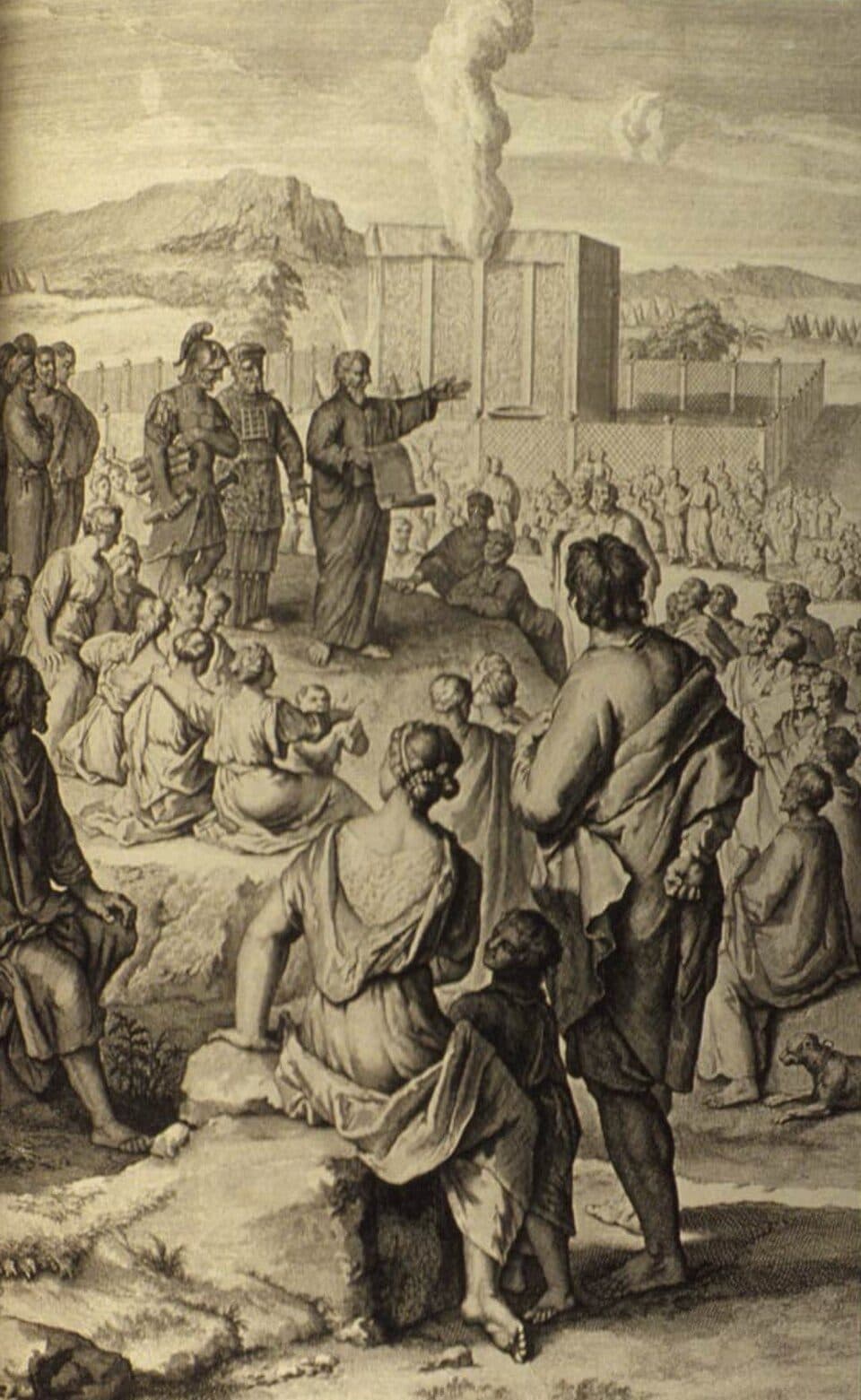
Gerard Hoet and others, Moses Promulgates the Law, Figures de la Bible, The Hague, P. de Hondt, 1728. Public domain by date (published before 1930), via Wikimedia Commons (File:Figures Moses Promulgates the Law.jpg).
THE ARTWORKThe plate was made for Deuteronomy 5, where Moses gives the law to all Israel, and in Leviticus 17:2 the LORD sends him to speak the code to Aaron, his sons and all the Israelites.
Summary
Leviticus 17 to 26 is a body of laws called the Holiness Code, after the title Das Heiligkeitsgesetz that August Klostermann gave it in a journal article of 1877.
- The laws run from the place of sacrifice and the blood in chapter 17 to the blessings and curses of chapter 26.
- God closes many of these laws with the words I am the LORD, and chapter 19 holds them most often.
- Chapter 19 sets love of neighbor and love of the foreigner beside the Sabbath, honest weights and the gleanings left for the poor.
- Ezekiel, Jesus and Paul quote the code, and Paul applies its promise of God's presence to the church.
- Scholars differ on whether the chapters were once a code of their own or were always a section of Leviticus.
Four Texts of the Code
The code runs from Leviticus 17:1 to 26:46, and these four verses come from its first, second, third and last chapters.
For the life of the flesh is in the blood, and I have given it to you to make atonement for your souls upon the altar; for it is the blood that makes atonement for the soul.The code's first chapter gives the reason the blood is kept from food, since God gave it for atonement on the altar.
Keep My statutes and My judgments, for the man who does these things will live by them. I am the LORD.This verse joins the keeping of God's statutes to life and closes with the words I am the LORD.
Do not seek revenge or bear a grudge against any of your people, but love your neighbor as yourself. I am the LORD.The command forbids revenge and a grudge against one of the people and puts love in their place.
I will walk among you and be your God, and you will be My people.The promises of the last chapter end with God walking among His people as their God.
Ten Chapters and Their Refrain
The words I am the LORD stand in 47 verses of chapters 18 to 26, and 15 of them are in chapter 19.
Each rung gives a chapter of Leviticus 17 to 26 in the division of S. R. Driver's Introduction to the Literature of the Old Testament (1892), with its subject, its key verse and the verses that hold the refrain in the Berean text.
Driver counted I am Jehovah nearly fifty times in the Hebrew of these chapters.
The refrain often closes a single law, as at Leviticus 19:14, and it is the last line of four of the ten chapters.
The Laws of the Code
The ten chapters run from the blood of chapter 17 to the covenant remembered in chapter 26.
1. Leviticus 17, the place of sacrifice and the blood2 passages
Driver counts four subjects in the chapter. Animals are slain at the sanctuary, sacrifice is offered only at its entrance, blood is never eaten, and whoever eats an animal found dead or torn must wash and is unclean until evening.
‘Anyone from the house of Israel who slaughters an ox, a lamb, or a goat in the camp or outside of it instead of bringing it to the entrance to the Tent of Meeting to present it as an offering to the LORD before His tabernacle—that man shall incur bloodguilt. He has shed blood and must be cut off from among his people.During the wilderness years this law tied the eating of domestic animals to the sanctuary.
And if any Israelite or foreigner living among them hunts down a wild animal or bird that may be eaten, he must drain its blood and cover it with dirt. For the life of all flesh is its blood. Therefore I have told the Israelites, ‘You must not eat the blood of any living thing, because the life of all flesh is its blood; whoever eats it must be cut off.’The hunter's game falls under the same law of blood, and verse 14 gives the reason for it again.
2. Leviticus 18, the customs of Egypt and Canaan2 passages, 1 quotation
You must not follow the practices of the land of Egypt, where you used to live, and you must not follow the practices of the land of Canaan, into which I am bringing you. You must not walk in their customs.The chapter sets God's statutes against the practices of the land Israel left and the land it would enter.
Do not defile yourselves by any of these practices, for by all these things the nations I am driving out before you have defiled themselves. Even the land has become defiled, so I am punishing it for its sin, and the land will vomit out its inhabitants.The land itself vomits out a people that defiles it, and Leviticus 20:22 gives Israel the same warning.
John Calvin, on Leviticus 18:26, ties the words I am the LORD at the end of these laws to the first of the Ten Commandments.
“The confirmation, which is added at the end of both clauses, has relation to the sum of the First Commandment; for when God declares Himself to be ‘Jehovah, and the God of Israel,’ he both claims the worship which is due to Him alone, and also condemns all the superstitions whereby pure religion is adulterated.”
John Calvin · Commentaries · on Leviticus 18:26Reformed
3. Leviticus 19, the laws of daily life3 passages, 1 quotation
Driver divides the laws after the chapter's opening command into two groups. Verses 3 to 8 are like the first table of the Ten Commandments, and verses 9 to 22 are like the second.
When you reap the harvest of your land, you are not to reap to the very edges of your field or gather the gleanings of your harvest. You must not strip your vineyard bare or gather its fallen grapes. Leave them for the poor and the foreigner. I am the LORD your God.Israel's harvest law provides for those who own no field.
You must treat the foreigner living among you as native-born and love him as yourself, for you were foreigners in the land of Egypt. I am the LORD your God.The foreigner receives the love that verse 18 commands for a neighbor, with Israel's years in Egypt as the reason.
Rashi, Rabbi Shlomo Yitzchaki of Troyes (1040 to 1105), in his commentary on Leviticus, explains verse 18 by a man who would not lend his sickle. Revenge refuses him the hatchet the next day, and a grudge lends the hatchet while reminding him of the refusal. Rashi also records Rabbi Akiba's saying that this command is a fundamental principle of the Torah.
Gregory the Dialogist reasons from the same command that love shares with a neighbor in need even what one needs oneself.
“For since it is written in the law: ‘You shall love your neighbor as yourself,’ he is proven to love his neighbor less who does not share with him even those things necessary to himself in his neighbor's time of need. Therefore the precept is given about dividing two tunics with one's neighbor, because this could not be said of one tunic, since if one is divided, no one is clothed. For with half a tunic, both he who receives remains naked and he who gave remains naked.”
Gregory the Dialogist · 40 Homilies on the Gospels - Homily 20 · on Leviticus 19:18Patristic
You must not use dishonest measures of length, weight, or volume. You shall maintain honest scales and weights, an honest ephah, and an honest hin. I am the LORD your God, who brought you out of the land of Egypt.The chapter's laws reach into every sale in the market.
4. Leviticus 20 to 22, the penalties, the priests and the holy things2 passages, 3 quotations
Albert Barnes sets chapter 20 beside the two chapters before it.
“The crimes which are condemned in Lev. 18; 19 on purely spiritual ground, have here special punishments allotted to them as offences against the well-being of the nation.”
Albert Barnes · Notes, Explanatory and Practical, on the Old and New Testaments (1832-1869) · on Leviticus 20:1Evangelical
The priest who is highest among his brothers, who has had the anointing oil poured on his head and has been ordained to wear the priestly garments, must not let his hair hang loose or tear his garments. He must not go near any dead body; he must not defile himself, even for his father or mother. He must not leave or desecrate the sanctuary of his God, for the consecration of the anointing oil of his God is on him. I am the LORD.The high priest keeps a stricter law than the other priests, since the anointing oil of his God is on him.
Barnes marks a change of hearer at Leviticus 21:8.
“The people of Israel are now addressed. They are commanded to regard the priests, who perform for them the service of the altar, as holy in respect of their office.”
Albert Barnes · Notes, Explanatory and Practical, on the Old and New Testaments (1832-1869) · on Leviticus 21:8Evangelical
You are to keep My commandments and practice them. I am the LORD.The law of the holy offerings ends with a call to keep God's commandments.
John Wesley names two ways in which God's name is hallowed among Israel.
“Hallowed, or sanctified, either by you in keeping my holy commands, or upon you in executing my holy and righteous judgments. I will manifest myself to be an holy God that will not bear the transgression of my laws.”
John Wesley · Explanatory Notes upon the Old Testament · on Leviticus 22:32Evangelical
5. Leviticus 23 to 25, the Sabbath, the feasts and the land4 passages, 3 quotations
For six days work may be done, but the seventh day is a Sabbath of complete rest, a day of sacred assembly. You must not do any work; wherever you live, it is a Sabbath to the LORD.The calendar of sacred seasons begins with the weekly Sabbath, kept wherever Israel lived.
You are to have the same standard of law for the foreign resident and the native; for I am the LORD your God.’”One standard of law binds the foreigner and the native, in the case of the man who blasphemed the Name.
So you are to consecrate the fiftieth year and proclaim liberty in the land for all its inhabitants. It shall be your Jubilee, when each of you is to return to his property and to his clan.The Jubilee undoes the sales of family land, so that no clan loses its share for ever.
The land must not be sold permanently, because it is Mine, and you are but foreigners and residents with Me.The law of redemption that follows rests on God's ownership of the land.
Barnes explains why the Sabbath year and the Jubilee stand apart from the feasts of chapter 23.
“The sabbatical year and the year of Jubilee belong to that great sabbatical system which runs through the religious observances of the Law, but rest upon moral rather than upon formally religious ground. It is not, therefore, without reason that they are here set apart from the set times which fell strictly within the sphere of religious observances.”
Albert Barnes · Notes, Explanatory and Practical, on the Old and New Testaments (1832-1869) · on Leviticus 25:1Evangelical
Basil of Caesarea describes what the Jubilee restored in Israel.
“Seven weeks of years in ancient times produced the celebrated jubilee, in which the earth kept the sabbath, debts were canceled, slaves were set free and, as it were, a new life was established again, the old one in a certain way attaining its fulfillment in the number seven.”
Basil of Caesarea · LETTER 260 · on Leviticus 25:10Patristic
Henry reads the release of the Jubilee as a figure of the redemption Christ gives.
“This was typical of our redemption by Christ from the slavery of sin and Satan, and our restoration to the glorious liberty of the children of God. Some compute that the very year in which Christ died was a year of jubilee, and the last that ever was kept.”
Matthew Henry · Commentary on the Whole Bible · on Leviticus 25:10Puritan
6. Leviticus 26, the blessings, the curses and the covenant remembered2 passages, 1 quotation
Henry reads the chapter's first two verses as a summary of two of the Ten Commandments.
“They are the abstract of the second and fourth commandments, which, as they are by much the largest in the decalogue, so they are most frequently insisted on in other parts of the law.”
Matthew Henry · Commentary on the Whole Bible · on Leviticus 26:1 to 2Puritan
If you follow My statutes and carefully keep My commandments, I will give you rains in their season, and the land will yield its produce, and the trees of the field will bear their fruit.The blessings begin with rain in its season for a people that keeps God's statutes.
But if they will confess their iniquity and that of their fathers in the unfaithfulness that they practiced against Me, by which they have also walked in hostility toward Me— and I acted with hostility toward them and brought them into the land of their enemies—and if their uncircumcised hearts will be humbled and they will make amends for their iniquity, then I will remember My covenant with Jacob and My covenant with Isaac and My covenant with Abraham, and I will remember the land.After curses that end in exile, God promises to remember His covenant with Jacob, Isaac and Abraham when Israel confesses.
What the Code Leaves Unsaid
Leviticus 17 to 26 leaves four questions open.
Leviticus gives these chapters no title of their own, and no verse calls them a code.
The text names no writer or compiler beyond Moses, to whom the LORD spoke, and it gives no year for the laws.
Chapter 17 holds no verse with the refrain, and the text gives no reason for its absence there.
The curses of chapter 26 end in exile among enemies, and the chapter names no nation and no century for them.
Where the Code Is Quoted
Ezekiel, Paul and Jerome read the code's promise of life, and Paul sums up the commandments in its command of love.
And I gave them My statutes and made known to them My ordinances—for the man who does these things will live by them.Ezekiel recalls the statutes given in the wilderness with the code's own promise of life.
The law, however, is not based on faith; on the contrary, “The man who does these things will live by them.”Paul quotes the same promise to set the law beside the righteousness that comes by faith.
Jerome limits that promised life to the present world.
“‘The man who carries out the law will find life through it.’ Scripture did not say he will find life through it, in the sense that through the law he will live in heaven, but he will find life through it to the extent that what he merits, he reaps in the present world.”
Jerome · HOMILY 76 · on Leviticus 18:5Patristic
The commandments “Do not commit adultery,” “Do not murder,” “Do not steal,” “Do not covet,” and any other commandments, are summed up in this one decree: “Love your neighbor as yourself.”Paul gathers the commandments against adultery, murder, theft and coveting into the code's command of love.
A Code of Its Own or a Section of Leviticus
Driver and Green give two answers to whether these chapters once stood as a code of their own.
An older code set into the Priestly law
S. R. Driver, in An Introduction to the Literature of the Old Testament (1892), reads these chapters as an older body of priestly law that a compiler set into the Priestly Code. He rests the case on phrases that stand here and seldom elsewhere, and on laws that repeat what Leviticus 7 and 11 had already given. He adds the frame, since the Book of the Covenant and Deuteronomy also open with the place of sacrifice and close with an exhortation.
Tell them that if anyone from the house of Israel or any foreigner living among them offers a burnt offering or a sacrifice but does not bring it to the entrance to the Tent of Meeting to sacrifice it to the LORD, that man must be cut off from his people.Driver's frame begins here, since the code opens by binding every sacrifice, the foreigner's as well as the Israelite's, to the entrance of the Tent of Meeting.
Driver adds that the code's phrases appear again and again in Ezekiel, some of them nowhere else. Klostermann's article of 1877 in the Zeitschrift für lutherische Theologie asks in its title whether Ezekiel wrote the collection of laws seen most plainly in Leviticus 18 to 26.
Against this reading stands a concession Driver makes in the same Introduction, that the chapters keep the general form of the Priestly Code and that chapter 17 is mixed with it.
A section of the book given at Sinai
William Henry Green, in The Higher Criticism of the Pentateuch (1895), reads the chapters as laws for the people, the priests, the feasts and the land within one book of laws given at Sinai. In his reading the blessing and the curse of chapter 26 conclude the book, and chapter 27 on vows stands after them as a supplement.
These are the statutes, ordinances, and laws that the LORD established between Himself and the Israelites through Moses on Mount Sinai.Green's reading rests on this verse, which names Moses and Mount Sinai for the laws that come before it.
Against this reading stands the refrain, which occurs in only two verses of the rest of Leviticus, Leviticus 11:44 and Leviticus 11:45.
God Dwelling Among His People
Matthew 22 and 2 Corinthians 6 to 7 carry Leviticus 19 and 26 into the teaching of the church.
The code asked Israel to keep its laws because the LORD who brought them out of Egypt would walk among them.
Jesus declared, “‘Love the Lord your God with all your heart and with all your soul and with all your mind.’ This is the first and greatest commandment. And the second is like it: ‘Love your neighbor as yourself.’Jesus joins the code's command of love to the command to love God and calls it the second command.
What agreement can exist between the temple of God and idols? For we are the temple of the living God. As God has said: “I will dwell with them and walk among them, and I will be their God, and they will be My people.”Paul applies the code's promise that God will walk among His people to the church as the temple of the living God.
Therefore, beloved, since we have these promises, let us cleanse ourselves from everything that defiles body and spirit, perfecting holiness in the fear of God.From that promise Paul draws the command to cleanse ourselves and perfect holiness in the fear of God.
So the code asks the reader to love God and neighbor and to live as one of the people among whom God dwells through Christ.
Keep studying
Read it1
Symbols2
Doctrines16