
Judges 3:12 to 30 · The Second Judge · The Left-Handed Deliverer
Ehud and the Deliverance from Moab
The second judge of Israel came from Benjamin, and he ended Moab's rule over Jericho in a single day.
Israel served Moab for eighteen years, and the LORD answered their cry with a left-handed Benjamite carrying a tribute and a hidden blade.
- Where
- Jericho, Gilgal, Ephraim, Moab
- Who
- Ehud, Eglon
- When
- the period of the judges, after Othniel
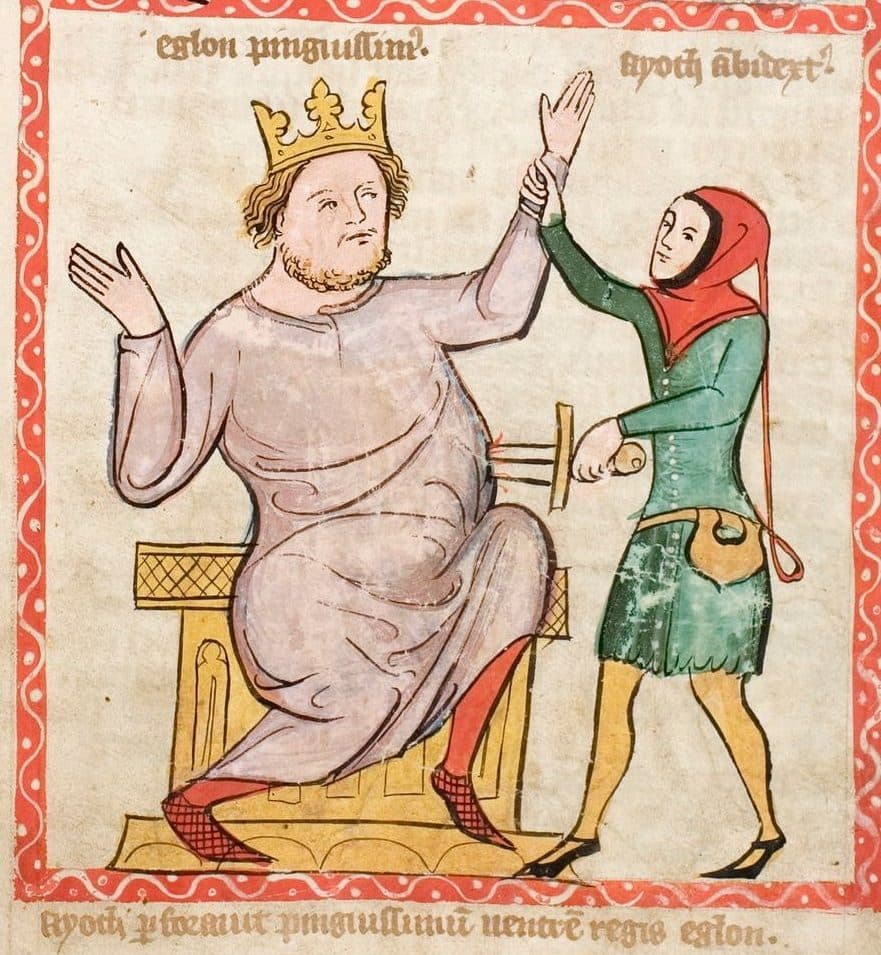
Unknown illuminator, Ehud and Eglon, Speculum Humanae Salvationis, Westphalia or Cologne, about 1360, Darmstadt University and State Library, Hs 2505, folio 55r. Wikimedia Commons, File:Speculum_Darmstadt_2505_55r_cropped.jpg, public domain.
THE ARTWORKThe painter labels the king "eglon pinguissimus", the fattest Eglon, and writes Ehud's name above the young man with the sword. The line at the foot says Ehud pierced the belly of King Eglon.
Summary
Judges 3:12 to 30 tells how Ehud son of Gera killed Eglon king of Moab and led Israel to take the fords of the Jordan.
- Eglon of Moab, with Ammon and Amalek, took the City of Palms, Jericho, and Israel served him eighteen years (Judges 3:13 to 14).
- Ehud hid a double-edged sword a cubit long on his right thigh under his cloak (Judges 3:16).
- He killed Eglon alone in his upper room, locked the doors and escaped while the servants waited (Judges 3:21 to 26).
- About ten thousand Moabites fell, and the land had rest for eighty years (Judges 3:29 to 30).
- Josephus and Matthew Henry commend the deed, and Keil and Delitzsch judge it no example to follow.
Eighteen Years under Eglon
Judges 3:12 to 15, from Israel's evil to the deliverer the LORD raised up
After Othniel died, Israel again did evil in the LORD's sight, and the LORD gave Eglon king of Moab power over them (Judges 3:12). Eglon enlisted the Ammonites and the Amalekites, defeated Israel and took the City of Palms.
The Israelites served Eglon king of Moab eighteen years.The oppression under Eglon ran more than twice as long as the eight years under Cushan-rishathaim in Judges 3:8.
The City of Palms is Jericho, as Deuteronomy 34:3 names it. Jericho lay near the fords of the Jordan (Joshua 2:7), with Moab across the river to the east.
And again they cried out to the LORD, and He raised up Ehud son of Gera, a left-handed Benjamite, as their deliverer. So they sent him with tribute to Eglon king of Moab.The title deliverer is the one Othniel received in Judges 3:9.
The Sword and the Upper Room
the weapon drawn to the measure Judges 3:16 gives, and a thirteenth-century page that paints the whole deliverance
Ehud's sword was one gomed long, a measure the Berean text renders a cubit and the Greek Septuagint a span.
6 inches, about 15 cm
- A cubit longJudges 3:16
- A span, the Greek readingJudges 3:16
- Two edgesJudges 3:16
- The handle sank in after the bladeJudges 3:22
- On his right thighJudges 3:16
6 inches, about 15 cm
The text gives the length, one gomed, and the two edges. A cubit is about 18 inches and a span about half; the blade's width and the hilt's length are the drawing's.
The sword at one cubit beside the two measures given the word, in inches, to one scale.
One page of the Morgan Picture Bible paints Ehud's deed, his horn on the hills and the battle at the fords.
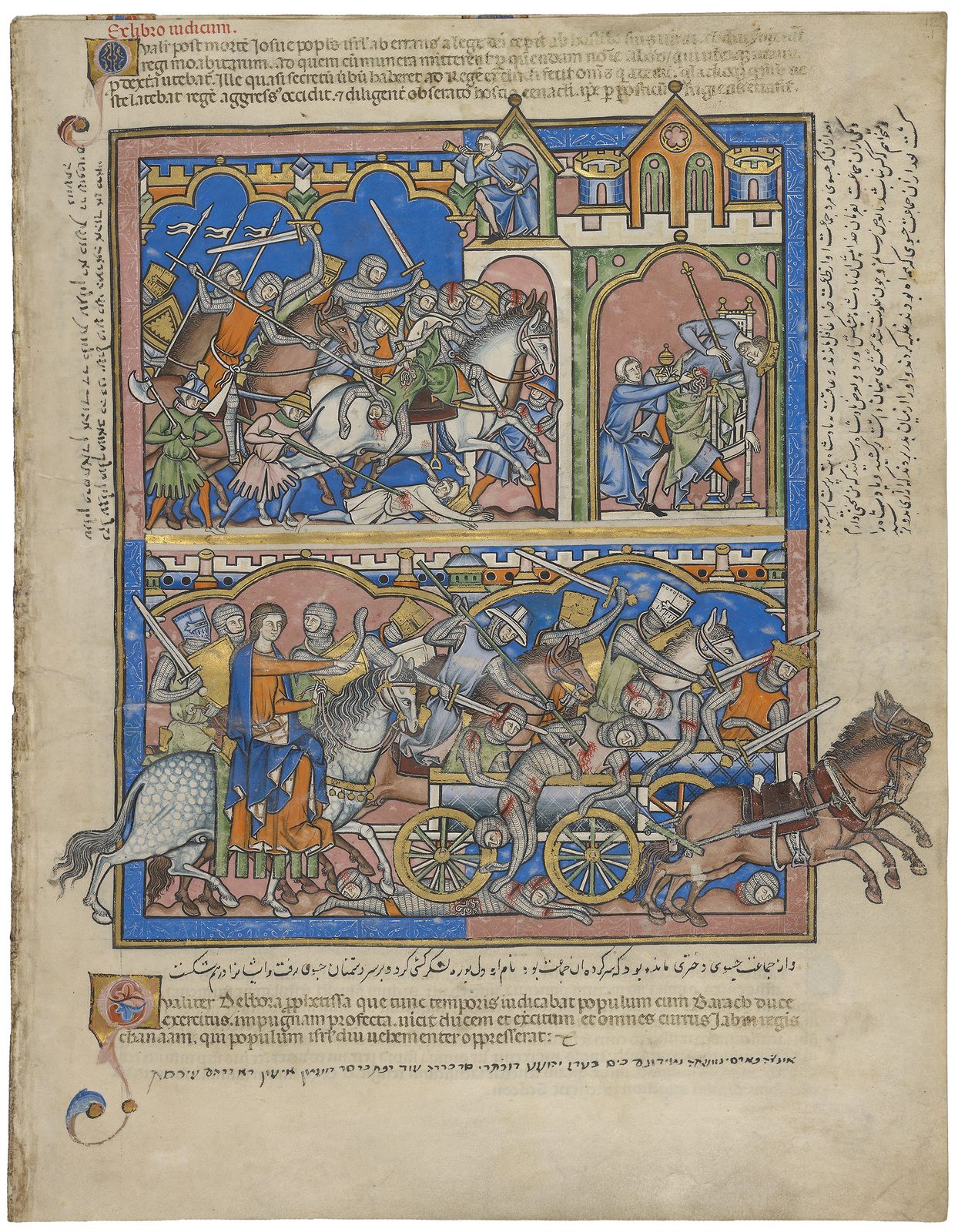
- Ehud strikes Eglon with his left handJudges 3:21
- Eglon falls from his seatJudges 3:25
- The trumpeter on the towerJudges 3:27
- The battle, in the armour of the painter's dayJudges 3:29
- Deborah and Barak, the next deliveranceJudges 4:15
The Morgan Picture Bible (Maciejowski Bible), Paris, about 1250, Morgan Library and Museum MS M.638, folio 12r. Wikimedia Commons, File:Maciejowski_Bible_-_Morgan_Library_%26_Museum_MS_M.638%2C_fol._12r.jpg, public domain.
Four parts of Judges 3 numbered on the page, with Deborah's battle of Judges 4 below.
A sword was usually worn on the left, so a blade on the right thigh was likelier to escape notice. Jamieson, Fausset and Brown make that point on Judges 3:16.
Now Ehud had made for himself a double-edged sword a cubit long. He strapped it to his right thigh under his cloakFrom the Upper Room to the Fords
Judges 3:17 to 30, the deed, the escape and the battle in the order the text tells them
The deed in Eglon's upper room set off Israel's rising at the fords.
- The day: the tributeThe gift is presented and the carriers are sent away.Judges 3:17 to 18
- The day: the returnEhud comes back alone with a secret message.Judges 3:19
- The day: the upper room"I have a word from God for you." Eglon rises and Ehud strikes.Judges 3:20 to 22
- The day: the escapeEhud leaves by the porch with the doors bolted behind him.Judges 3:23
- While the servants waitThey open with the key and find the king dead.Judges 3:24 to 25
- The musterThe trumpet sounds at Seirah and Israel comes down behind Ehud.Judges 3:26 to 27
- At that timeAbout ten thousand Moabites fall at the river crossing.Judges 3:28 to 29
- Eighty yearsMoab is subdued and the land has rest.Judges 3:30
Eight steps from Judges 3:17 to 30, the day of the deed and the rest after it.
Then Ehud approached him while he was sitting alone in the coolness of his upper room. “I have a word from God for you,” Ehud said, and the king rose from his seat.Keil and Delitzsch read the king's rising as reverence for a word from God, and Josephus says the king leapt up for joy at the promise of a dream.
And Ehud reached with his left hand, pulled the sword from his right thigh, and plunged it into Eglon’s belly.“Follow me,” he told them, “for the LORD has delivered your enemies the Moabites into your hand.” So they followed him down and seized the fords of the Jordan leading to Moab, and did not allow anyone to cross over.Ehud gives the victory to the LORD before the battle at the fords, as Judges 3:10 gives Othniel's.
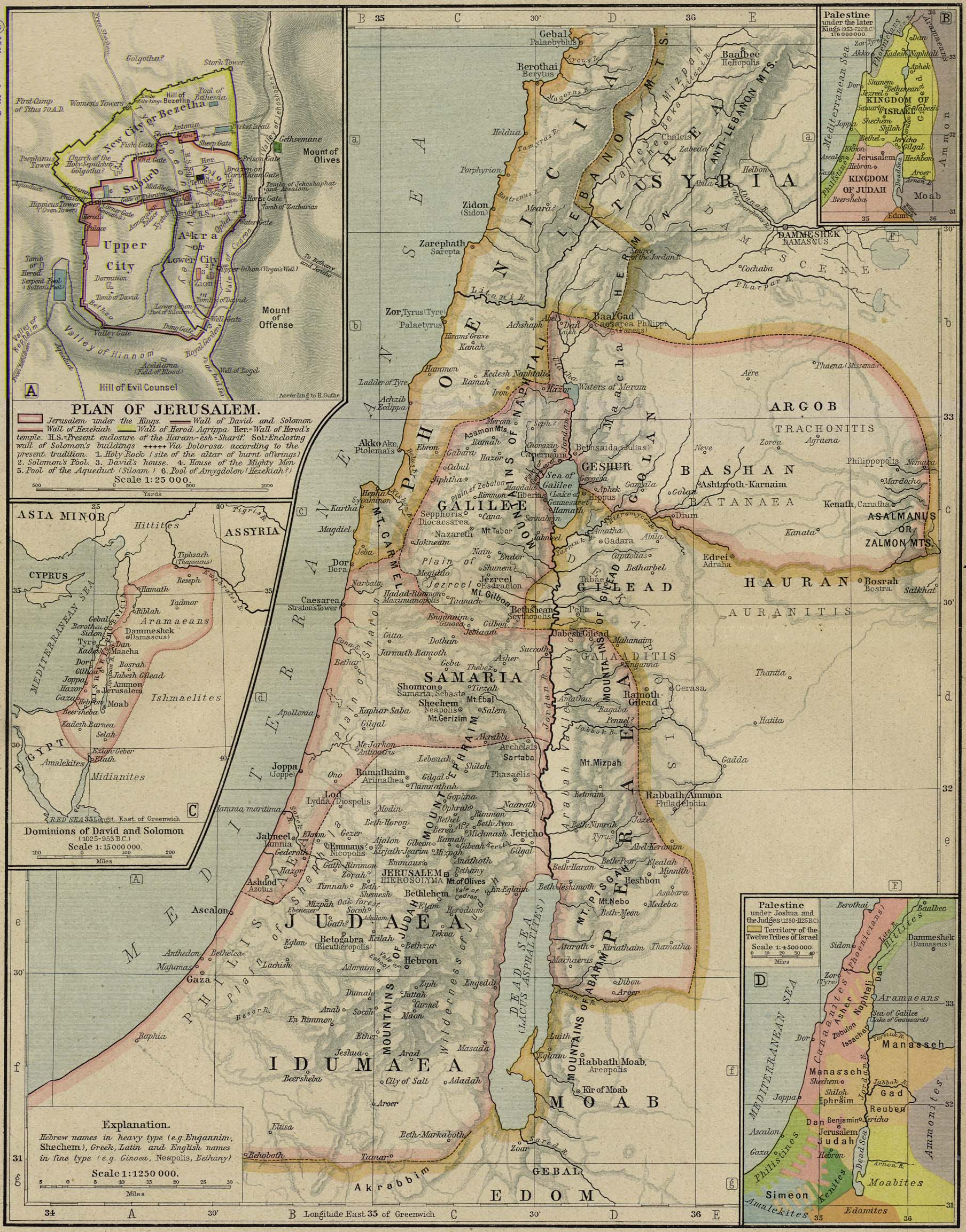
Ehud went from Eglon's court at Jericho past Gilgal and up into the hill country of Ephraim.
about 50 km (31 miles)
- 1Jericho, the City of Palms, Moab's seat west of the river. Judges 3:13
- 2Gilgal, The carved stones Ehud passed going and coming. Judges 3:19
- 3Ephraim, Israel's muster in the highlands. Judges 3:27
- 4Seirah, Named only here; not placed. Judges 3:26
- 5The fords of the Jordan, The crossing Israel closed; not placed. Judges 3:28
- 6Moab, Eglon's land across the Jordan; not placed. Judges 3:30
Not placed: Seirah (4), The fords of the Jordan (5), Moab (6).
Base map: Reference map of ancient Palestine, Rand McNally reference map (1926), public domain. Each place stands at its place page's coordinates, set on the plate by Jerusalem and Damascus, as the plate prints them.
Jericho, Gilgal and Ephraim stand so close on this plate that their marks overlap; Seirah, the fords and Moab are named in the key and not placed.
The Left Hand, the Tribute and the Word
four Hebrew words the story turns on
Judges 3:15 calls Ehud itter yad yemino, a man restricted in his right hand. The lexicon defines itter as shut up or impeded as to the use of the right hand.
ITTER, RESTRICTED IN THE RIGHT HAND
Rashi follows the Aramaic Targum and reads a right arm shrunken and closed. Keil and Delitzsch answer that seven hundred slingers cannot all have been crippled, and read a hand left unused from youth.
MINCHAH, THE TRIBUTE
The word for Israel's tribute is the word the Law uses for the grain offering. Keil and Delitzsch call it a polite word for tribute here, as in 2 Samuel 8:2.
GOMED, THE SWORD'S MEASURE
The word stands only here in the Hebrew Bible. Rashi calls it a short cubit, the length of the forearm.
PESILIM, THE IDOLS NEAR GILGAL
The word means carved images in Deuteronomy 7:25, and the Septuagint and the Vulgate keep that sense here. Keil and Delitzsch follow the Aramaic Targum and Rashi in reading stone quarries, and Adam Clarke suggested boundary stones.
Moab, Jericho and the Benjamites
the enemy, the city and the tribe behind Judges 3
Moab descended from Lot (Genesis 19:37), and the LORD told Moses not to provoke Moab, having given Ar to Lot's descendants (Deuteronomy 2:9). Balak king of Moab had sent for Balaam to curse Israel (Numbers 22:4 to 6). In Judges 3 a king of Moab crosses the Jordan and rules from Jericho.
Joshua had laid a curse on any man who rebuilt Jericho as a city (Joshua 6:26). Keil and Delitzsch hold that the town had been resettled without walls under that curse, which left it open to Moab.
Benjamin's soldiers were known to fight with both hands, and 1 Chronicles 12:2 says Saul's kinsmen from Benjamin slung stones and shot arrows with either hand. The Septuagint and the Vulgate render Ehud's word in Judges 3:15 as both-handed, the sense of that verse.
The Second Turn of the Cycle
how Judges sets Ehud in its pattern of sin, servitude, cry and rest
Judges 2:16 to 19 sets out the pattern the book follows. Israel turns to other gods and the LORD gives them to an oppressor. When they cry out He raises a judge, and the land rests while the judge lives. Ehud's account follows that pattern step by step, from "once again the Israelites did evil" in Judges 3:12 to the rest of Judges 3:30.
Othniel, the first judge, fills the pattern in five verses (Judges 3:7 to 11). Ehud's account sets a full story inside the same frame.
The eighty years of rest after Ehud are the longest rest the book of Judges records.
The 8 spans of years as a table
| Period | Spans of years | Verse |
|---|---|---|
| Under Cushan-rishathaim | 8 | Judges 3:8 |
| Rest after Othniel | 40 | Judges 3:11 |
| Under Eglon of Moab | 18 | Judges 3:14 |
| Rest after Ehud | 80 | Judges 3:30 |
| Under Jabin of Canaan | 20 | Judges 4:3 |
| Rest after Deborah | 40 | Judges 5:31 |
| Under Midian | 7 | Judges 6:1 |
| Rest after Gideon | 40 | Judges 8:28 |
Years of oppression and of rest for Othniel, Ehud, Deborah and Gideon, from Judges 3:8 to 8:28, on one scale from zero.
What the Text Leaves Unsaid
the date, the place of Seirah, the stones near Gilgal and Ehud's family
When did Ehud judge?Judges 3:30 and 1 Kings 6:1
The text gives the eighteen years and the eighty, and no date in any calendar. The years of Judges, added end to end, run past the 480 years of 1 Kings 6:1. One reading takes the judgeships as consecutive and another lets some of them overlap, and Keil and Delitzsch set out the reckoning in their introduction to Judges.
Whiston's note to Josephus observes that the eighty years of Ehud suit Josephus's longer count from the exodus to the temple and not the 480 years of 1 Kings 6:1.
Where was Seirah?Judges 3:26 to 27
Seirah is named nowhere else in Scripture. Keil and Delitzsch read the name as the hairy, a wooded place, and seek it north-west of Jericho.
Which Gilgal?Judges 3:19 and Joshua 18:17
Was Ehud the head of a family in Geba?1 Chronicles 8:3 to 7
1 Chronicles 8:3 and 1 Chronicles 8:5 name a Gera among the sons of Bela, Benjamin's firstborn, and 1 Chronicles 8:6 names the house of an Ehud that headed families in Geba. Keil and Delitzsch take "son of Gera" to mean of Gera's line, and Barnes reads 1 Chronicles 8:6 as Ehud's own house.
Ehud in the Rest of Scripture
the deliverer's name after Judges 3, and the pattern he belongs to
Outside Judges 3, Scripture names Ehud the judge with certainty only in Judges 4:1, where Israel does evil again after his death. Hebrews 11:32 names Gideon, Barak, Samson, Jephthah and Samuel and leaves Ehud out.
So You delivered them into the hands of enemies who oppressed them, and in their time of distress they cried out to You. From heaven You heard them, and in Your great compassion You gave them deliverers who saved them from the hands of their enemies.The Levites' prayer counts the judges among the LORD's mercies to a people who sinned again once they had rest (Nehemiah 9:28).
The word for deliverer in Judges 3:15, moshia, comes from yasha, to save or to free (Strong's H3467).
How Ehud Has Been Taught
three readings from Matthew Henry, John Wesley and John Calvin
The offering paid to a heathen king
“The present is called mincha in the original, which is the word used in the law for the offerings that were presented to God to obtain his favour; these the children of Israel had not offered in their season to the God that loved them; and now, to punish them for their neglect, they are laid under a necessity of bringing their offerings to a heathen prince that hated them.”
Matthew Henry · Commentary on the Whole Bible · on Judges 3:15Puritan
Why Eglon camped at Jericho
“Here he fixed his camp, for the fertility of that soil, and because of its nearness to the passage over Jordan, which was most commodious both for the conjunction of his own forces which lay on both sides of Jordan; to prevent the conjunction of the Israelites in Canaan with their brethren beyond Jordan; and to secure his retreat into his own country.”
John Wesley · Explanatory Notes upon the Old Testament · on Judges 3:13Evangelical
Calvin on the judges of Hebrews 11
“Thus, in all the saints, something reprehensible is ever to be found; yet faith, though halting and imperfect, is still approved by God.”
John Calvin · Commentaries on the Epistle of Paul the Apostle to the Hebrews, on Hebrews 11:32 · on Hebrews 11:32Reformed
Was Ehud's Ruse Right?
two readings of the killing of Eglon, each with its holders
The text calls Ehud a deliverer the LORD raised up (Judges 3:15) and passes no verdict on the secret message or the locked doors. Readers have judged the deed in two ways.
A just act of war by the deliverer God raised upJosephus; Matthew Henry
Josephus calls Ehud a man worthy of commendation even beyond the deed (Antiquities 5.4.3). Matthew Henry holds that Ehud put Eglon to death as a judge executing God's judgment on an enemy of God and Israel, and not as a murderer.
Henry himself adds that the deed justifies no one now, since no such commission is given.
God gave the deliverance without approving the meansKeil and Delitzsch
Keil and Delitzsch judge Ehud by the spirit of his times and call the deed a treacherous assassination that is no example to follow. They observe that Judges says the Spirit of the LORD came upon Othniel (Judges 3:10) and never says it of Ehud.
The first reading answers that the deliverance was the LORD's work from the start, since He raised Ehud up for it.
Read the Great Books
three works on Judges 3, each free to read
Biblical Commentary on the Old Testament: Joshua, Judges, Ruth
C. F. Keil and F. Delitzsch, translated by James Martin · 1872
Its notes on Judges 3:12 to 31 weigh the Hebrew words and the two judgments of the deed.
Read at the Internet ArchiveAntiquities of the Jews, translated by William Whiston
Flavius Josephus · about 94
Book 5, chapter 4 retells Ehud's deed with details the Bible does not give.
Read at Project GutenbergRashi on Judges
Rashi, in the Metsudah Tanach translation · eleventh century
Sefaria gives Rashi's notes in Hebrew and English, verse by verse.
Read at SefariaOne Left Hand and Eighty Years
The deliverer God chose was a man others would have passed over. The rest lasted while the deliverer lived, and the book turns at once to Israel's next fall, so the reader looks past Ehud to a Deliverer whose rescue does not end.
Keep studying
Studies6
People3
Peoples and groups1