
Genesis 2 · Exodus 20 · Colossians 3 · Subject · Featured Study
Work and Vocation
Work in Scripture from God's six days and the garden of Eden to the law of the Sabbath and the letters of Paul, with the Reformers' teaching on calling.
The Hebrew verb for the man's work in Eden is the verb Numbers uses for the Levites' service at the tabernacle.
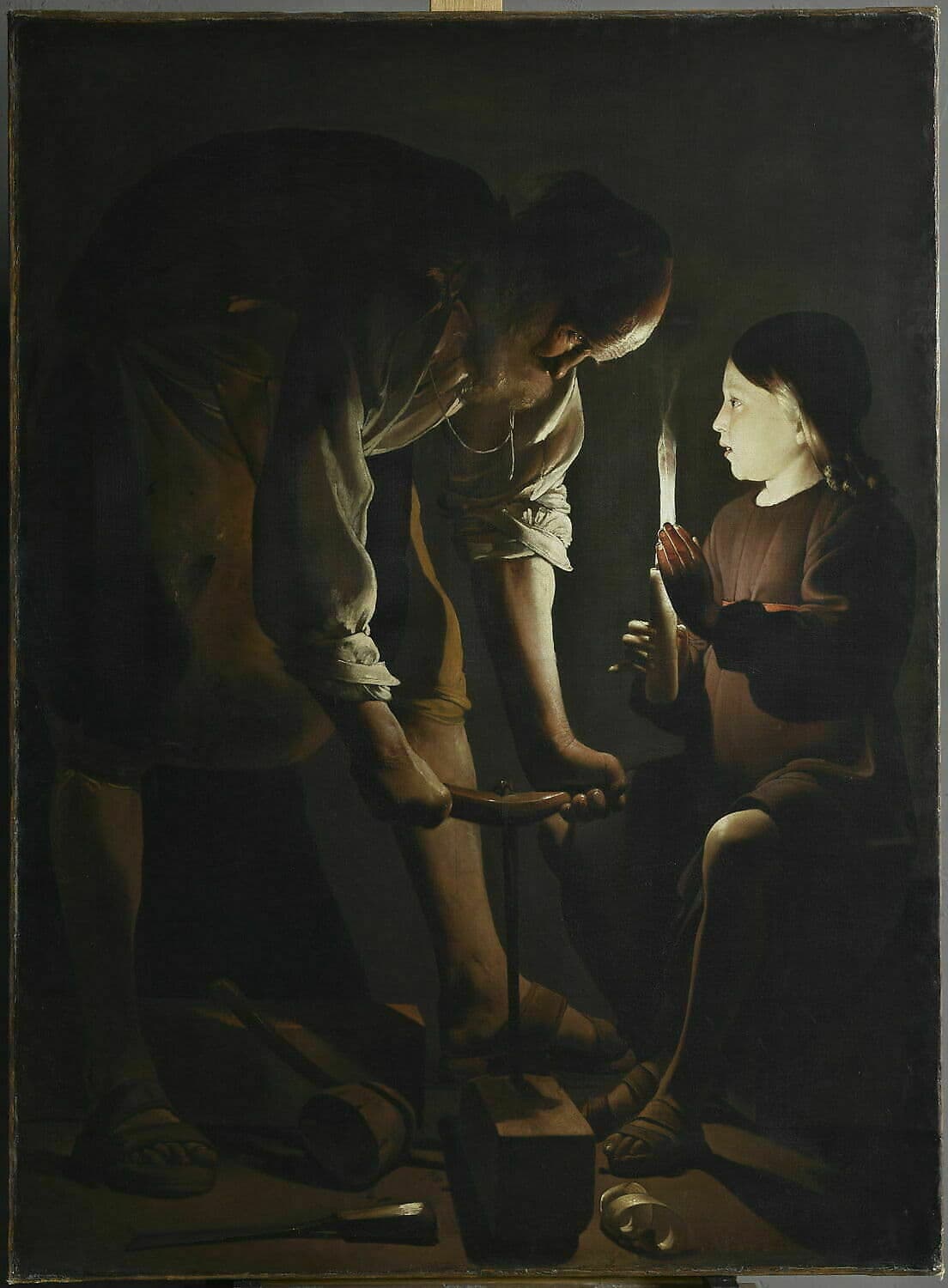
Georges de La Tour, Saint Joseph the Carpenter, between about 1642 and 1644. Public domain (published before 1930), via Wikimedia Commons.
THE ARTWORKLa Tour shows Joseph at his trade by candlelight, with the boy Jesus holding the light for him. The people of Nazareth call Jesus the carpenter's son (Matthew 13:54 to 56), and the painting sets ordinary labor inside the household of the Son of God.
Summary
Scripture treats work as part of the life God gave the man and the woman, and its later books order and honor that work.
- God works and then rests in Genesis 2, before any person is given a task.
- The law pays the hired worker before sunset, and Exodus credits the Spirit of God with Bezalel's skill in craft.
- Paul made tents in Corinth and told the Thessalonians that anyone unwilling to work should not eat.
- Luther, Calvin and Perkins taught that every lawful station in life is a calling from God.
Six Verses on Work
From God's rest in Genesis 2 to Paul's charge in Colossians 3, in the order Scripture gives them
And by the seventh day God had finished the work He had been doing; so on that day He rested from all His work. Then God blessed the seventh day and sanctified it, because on that day He rested from all the work of creation that He had accomplished.The two verses use melakhah three times for what God made and finished.
Then the LORD God took the man and placed him in the Garden of Eden to cultivate and keep it.God gives this task in the garden He planted Himself.
And to Adam He said: “Because you have listened to the voice of your wife and have eaten from the tree of which I commanded you not to eat, cursed is the ground because of you; through toil you will eat of it all the days of your life. Both thorns and thistles it will yield for you, and you will eat the plants of the field. By the sweat of your brow you will eat your bread, until you return to the ground—because out of it were you taken. For dust you are, and to dust you shall return.”The sentence on Adam reaches his work, his food and his death.
Six days you shall labor and do all your work, but the seventh day is a Sabbath to the LORD your God, on which you must not do any work—neither you, nor your son or daughter, nor your manservant or maidservant or livestock, nor the foreigner within your gates.The rest reaches servants, livestock and the foreigner, as well as the household.
Nothing is better for a man than to eat and drink and enjoy his work. I have also seen that this is from the hand of God.The Teacher calls the enjoyment of one's work a gift from the hand of God.
Whatever you do, work at it with your whole being, for the Lord and not for men, because you know that you will receive an inheritance from the Lord as your reward. It is the Lord Christ you are serving.Paul wrote these words to slaves, and they name the Lord Christ as the one every worker serves.
One Hebrew Verb for Work
The verb avad in six verses from Genesis, Exodus and Numbers
| Who works | The Berean English | Verse |
|---|---|---|
| No man yet, before the garden is planted | to cultivate | Genesis 2:5 |
| The man in the garden of Eden | to cultivate | Genesis 2:15 |
| The man sent out of Eden | to work | Genesis 3:23 |
| Jacob in Laban's household for twenty years | I have served | Genesis 31:41 |
| Israel on the six days of the week | you shall labor | Exodus 20:9 |
| The Levites at the Tent of Meeting | attending to the service | Numbers 3:7 |
From the Garden to the Letters of Paul
What the patriarchs, the law, the wisdom books and Paul add to Genesis 1 to 3
Each later chapter of Scripture adds to Genesis 1 to 3 a rule for work or a picture of a worker.
Jacob's twenty years with LabanGenesis 31:40 and 31:42
As it was, the heat consumed me by day and the frost by night, and sleep fled from my eyes.Jacob gives the cost of the work in his own body, heat by day and frost by night.
If the God of my father, the God of Abraham and the Fear of Isaac, had not been with me, surely by now you would have sent me away empty-handed. But God has seen my affliction and the toil of my hands, and last night He rendered judgment.”Jacob credits God, who saw the toil of his hands, with his protection from Laban.
The six days and the seventh in the lawExodus 20:11
For in six days the LORD made the heavens and the earth and the sea and all that is in them, but on the seventh day He rested. Therefore the LORD blessed the Sabbath day and set it apart as holy.The law gives its reason for the Sabbath here, in the week of creation.
Bezalel and the craftsmenExodus 31:2 to 3 and 31:6
“See, I have called by name Bezalel son of Uri, the son of Hur, of the tribe of Judah. And I have filled him with the Spirit of God, with skill, ability, and knowledge in all kinds of craftsmanship,This is a call by name, and the Spirit's gift in it is skill for the work of the tabernacle.
Moreover, I have selected Oholiab son of Ahisamach, of the tribe of Dan, as his assistant. I have also given skill to all the craftsmen, that they may fashion all that I have commanded you:The gift of skill reaches every craftsman who worked on the tabernacle.
The ant and the capable wifeProverbs 6:6 to 8, 31:27 and 31:31
Walk in the manner of the ant, O slacker; observe its ways and become wise. Without a commander, without an overseer or ruler, it prepares its provisions in summer; it gathers its food at harvest.The ant works with no overseer, which is the point the slacker is told to learn.
She watches over the affairs of her household and does not eat the bread of idleness.The capable wife manages her household and refuses idleness.
Give her the fruit of her hands, and let her works praise her at the gates.Proverbs ends by asking that her works be praised in public.
Work under the sunEcclesiastes 9:10
Whatever you find to do with your hands, do it with all your might, for in Sheol, where you are going, there is no work or planning or knowledge or wisdom.The Teacher urges full effort now because the grave ends every work.
Paul's own labor and his rulesActs 18:3, Ephesians 4:28, 1 and 2 Thessalonians
and he stayed and worked with them because they were tentmakers by trade, just as he was.Luke names Paul's trade, and it was the trade of Aquila and Priscilla.
nor did we eat anyone’s food without paying for it. Instead, in labor and toil, we worked night and day so that we would not be a burden to any of you.Paul worked night and day so that the church would not have to feed him.
He who has been stealing must steal no longer, but must work, doing good with his own hands, that he may have something to share with the one in need.The former thief is told to work so that he has something to give.
and to aspire to live quietly, to attend to your own matters, and to work with your own hands, as we instructed you. Then you will behave properly toward outsiders, without being dependent on anyone.Paul ties a quiet working life to the church's standing with outsiders.
For even while we were with you, we gave you this command: “If anyone is unwilling to work, he shall not eat.” Yet we hear that some of you are leading undisciplined lives and accomplishing nothing but being busybodies. We command and urge such people by our Lord Jesus Christ to begin working quietly to earn their own living.Verses 11 and 12 name the people this rule was written for and tell them what to do.
What the Text Says of Work
Two things often said of work, each with the verse that tests it
WORK AS THE CURSE OF THE FALL
The man is given his work in Genesis 2, before the fall. The curse of Genesis 3 falls on the ground and makes the work toil.
LONG HOURS AS FAITHFULNESS
Psalm 127 calls the early rising and the late nights vain when the LORD does not build, and it says He gives sleep to His beloved.
Calvin on the garden and the curseCommentary on Genesis, on 2:15 and 3:17
John Calvin drew from Genesis 2:15 that people were created to employ themselves in some work and to take care of what God has committed to their hands. On Genesis 3:17 he set the servile work of the curse against the pleasant labor Adam had known in the garden.
Henry on secular employmentCommentary on the Whole Bible, 1710, on Genesis 2:15 and 3:19
Matthew Henry wrote that Paradise itself was no place of exemption from work. Those who do their earthly business with an eye to God, he added, serve Him in it as truly as on their knees. On Genesis 3:19 he wrote that if Adam had not sinned, he would not have sweated.
Wages and Flocks
What the law and the commentators say of hired workers and shepherds
Jamieson, Fausset & Brown explain that a shepherd answered for losses in the flock unless he could prove that wild beasts caused them.
I did not bring you anything torn by wild beasts; I bore the loss myself. And you demanded payment from me for what was stolen by day or night.Jacob bore even the losses to wild beasts, which the custom would have excused.
Jamieson, Fausset & Brown note that hired servants in the East were paid at the close of each day.
Do not oppress a hired hand who is poor and needy, whether he is a brother or a foreigner residing in one of your towns. You are to pay his wages each day before sunset, because he is poor and depends on them. Otherwise he may cry out to the LORD against you, and you will be guilty of sin.The law names the reason for the daily wage: the worker is poor and depends on it.
You must not defraud your neighbor or rob him. You must not withhold until morning the wages due a hired hand.Leviticus sets the same rule beside the command against robbing a neighbor.
Six Hebrew and Greek Words for Work
Six words from the lexicon, each in a verse where it stands
AVAD, TO WORK OR SERVE (HEBREW, H5647)
The lexicon gives to work in any sense, and by implication to serve or till, and counts 288 uses.
SHAMAR, TO KEEP (HEBREW, H8104)
The lexicon gives to hedge about as with thorns, to guard, and generally to protect or attend to.
MELAKHAH, WORK (HEBREW, H4399)
The lexicon gives employment, never servile, or work, and the same noun names God's work in Genesis 2:2 and Bezalel's craft here.
SHABAT, TO REST (HEBREW, H7673)
The lexicon gives to repose or desist from exertion, the verb of God's rest on the seventh day.
ITSTSABON, TOIL (HEBREW, H6093)
The lexicon gives worrisomeness, labor or pain, and counts three uses; Genesis gives the same word to the woman's pain and to the man's toil.
ERGAZOMAI, TO WORK (GREEK, G2038)
The lexicon gives to toil at a task or an occupation, and Paul uses this verb here and in Colossians 3:23.
What the Text Leaves Unsaid
Three questions the verses leave open
Exodus names Bezalel's skills in metal, stone and wood and records no apprenticeship.
And the LORD has given both him and Oholiab son of Ahisamach, of the tribe of Dan, the ability to teach others.Bezalel and Oholiab could pass the craft on, which shows it was taught as well as given.
Mark records that the townspeople named Jesus by His trade, and no Gospel tells of anything He made at it.
Isn’t this the carpenter, the son of Mary and the brother of James, Joses, Judas, and Simon? Aren’t His sisters here with us as well?” And they took offense at Him.The neighbors who use the name take offense at Him in the same verse.
Revelation never lists the things the kings of the earth carry into the last city.
And into the city will be brought the glory and honor of the nations.The verse is the hinge of the question whether human work lasts into the new creation.
Calling, from Aquinas to the Reformers
Thomas Aquinas, Martin Luther, John Calvin and William Perkins, each with the work named
Aquinas prefers the contemplative life to the activeSumma Theologiae, Second Part of the Second Part, question 182
Thomas Aquinas held that the contemplative life is more excellent in itself than the active life. He took Mary of Bethany as its figure and allowed that in a particular case the active life is to be preferred for the needs of the present life.
“Martha, Martha,” the Lord replied, “you are worried and upset about many things. But only one thing is necessary. Mary has chosen the good portion, and it will not be taken away from her.”Jesus' answer to Martha is the text Aquinas sets against the claim that the active life is better.
Luther makes every work done in faith equalA Treatise on Good Works, 1520
Martin Luther taught that a work done in confidence that it pleases God is good, even a thing as small as picking up a straw. In faith, he wrote, all works become equal, and the distinctions between great and small works fall away.
Calvin names each station a callingInstitutes, Book 3, chapter 10, section 6
John Calvin taught that the Lord has given each person a station and named these stations callings. He wrote that no work done in one's calling is so mean that it lacks value in the eye of God.
Perkins divides the general calling from the particularA Treatise of the Vocations, Cambridge, 1603
William Perkins defined a calling as a kind of life ordained and imposed on man by God for the common good. He divided it into the general calling of every Christian and the particular calling of each person, and he preached it from Paul's word to the Corinthians.
Each one should remain in the situation he was in when he was called.Perkins took this verse as the text of his treatise.
Four Teachers on Work
Basil of Caesarea, Jerome, Matthew Henry and Charles Spurgeon, each with the work named
Writing in the fourth century, Basil joins Paul's rule on eating to the ant of Proverbs.
“Why should we dwell upon the amount of evil there is in idleness, when the apostle clearly prescribes that he who does not work should not eat. As daily sustenance is necessary for everyone, so labor in proportion to one's strength is also essential.… The Lord couples sloth with wickedness, saying, ‘Wicked and slothful servant.’ Wise Solomon, also, praises the laborer not only in the words already quoted, but also, in rebuking the sluggard, associating him by contrast with the tiniest of insects: ‘Go to the ant, O sluggard.’”
Basil of Caesarea · The Long Rules 37 · on Proverbs 6:6Patristic
Jerome names the temptation that trade brings to those who live by it.
“Those who live in the midst of this life's intense business appear to be forced, for the sake of food and necessary provisions, to buy and sell certain things and to seek unfair profit from business. It is difficult even for those who have been set free from the other passions—namely fornication, idolatry, adultery and murder—to escape being caught by this subtle vice.”
Jerome · Commentary on Ephesians 4:28 · on Ephesians 4:28Patristic
Henry explains why Moses needed Bezalel for the tabernacle.
“A great deal of fine work God had ordered to be done about the tabernacle; the materials the people were to provide, but who must put them into form? Moses himself was learned in all the learning of the Egyptians, nay, he was well acquainted with the words of God, and the visions of the Almighty; but he knew not how to engrave or embroider.”
Matthew Henry · Commentary on the Whole Bible · on Exodus 31:2Puritan
Spurgeon applies Psalm 128 to the daily trades of believers.
“For thou shalt eat the labour of thine hands. The general doctrine in Ps 128:1 here receives a personal application: note the change to the second person: ‘thou shalt eat’, etc. This is the portion of God's saints, —to work, and to find a reward in so doing. God is the God of labourers. We are not to leave our worldly callings because the Lord has called us by grace: we are not promised a blessing upon romantic idleness or unreasonable dreaming, but upon hard work and honest industry.”
Charles Spurgeon · The Treasury of David, Vol. 7 · on Psalm 128:2
Two Questions on Work
Genesis 1:28 and the new creation, each with two readings, their holders and the strongest objection
Genesis 1:28 as a charge to workAbraham Kuyper, Lectures on Calvinism, 1898
This reading takes subdue and rule as a charge that founds human work and culture, often called the cultural mandate. Kuyper called the subjection of nature to man a holy duty laid on him by the ordinances of Paradise. He also said that Calvinism left behind the two moral standards, one for the clergy and one for the laity.
The objection: the verse opens with a blessing, and the same words over the fish and the birds in Genesis 1:22 are a blessing with no task in them.
Then God blessed them and said, “Be fruitful and multiply and fill the waters of the seas, and let birds multiply on the earth.”Fish and birds receive these words before any person is made.
Genesis 1:28 as a blessing firstJohn Calvin, Commentary on Genesis; Matthew Henry, Commentary on the Whole Bible, 1710
This reading takes the verse as a gift to receive before it is a task. Calvin calls it the blessing from which the human race has flowed, and Henry calls the dominion an honor God put on man.
The objection: the verbs are spoken to the man and the woman as commands, and the next chapter gives the man a task in the garden at once.
God blessed them and said to them, “Be fruitful and multiply, and fill the earth and subdue it; rule over the fish of the sea and the birds of the air and every creature that crawls upon the earth.”Both readings start from these words, which bless and command in one sentence.
Work carried into the new creationJamieson, Fausset & Brown, Commentary Critical and Explanatory, 1871; Jerome, Commentary on Isaiah
This reading expects the present earth renewed, with what was good in human work brought into the city. Jerome read Isaiah 65:17 as a change of the creation for the better.
They will build houses and dwell in them; they will plant vineyards and eat their fruit. No longer will they build houses for others to inhabit, nor plant for others to eat. For as is the lifetime of a tree, so will be the days of My people, and My chosen ones will fully enjoy the work of their hands.This reading finds the work of hands in Isaiah's picture of the new heavens and new earth.
Jamieson, Fausset & Brown carry the same hope to the last city of Revelation.
“All that was truly glorious and excellent in the earth and its converted nations shall be gathered into it; and while all shall form one Bride, there shall be various orders among the redeemed, analogous to the divisions of nations on earth constituting the one great human family, and to the various orders of angels.”
Jamieson, Fausset & Brown · Commentary Critical and Explanatory on the Whole Bible · on Revelation 21:26Reformed
The objection: 2 Peter 3:10 says the elements will be destroyed by fire, and Isaiah's houses may picture lasting peace without promising that any present work survives.
Work that passes with this ageAlbert Barnes, Notes on 2 Peter; Tertullian, Against Hermogenes
This reading takes 2 Peter 3 as the dissolving of the present world, so that what lasts is the worker and the faithfulness of the work. Barnes drew from 2 Peter 3:11 that nothing on earth is permanent, and Tertullian held that heaven and earth will come to nothing.
But the Day of the Lord will come like a thief. The heavens will disappear with a roar, the elements will be destroyed by fire, and the earth and its works will be laid bare.This reading rests on the fire of this verse.
The objection: Revelation 21:24 to 26 has the kings and the nations bring their glory into the city, which suggests that something of this age is carried over.
Books on Work and Calling
Four works on calling, each free to read online, earliest first
A Treatise on Good Works
Martin Luther, translated by J. M. Reu · 1520
Luther arranged the treatise by the Ten Commandments, after a first part on faith as the noblest of good works.
Read it on Project GutenbergA Treatise of the Vocations, or Callings of Men
William Perkins · 1603
Perkins divided the treatise into the callings of men, their sorts and kinds, and their right use, as the title page says.
Read the first printing at the Internet ArchiveInstitutes of the Christian Religion
John Calvin, translated by Henry Beveridge · 1845
Calvin wrote chapter 10 of Book 3 on the use of the present life, and its last section treats calling.
Read Book 3, chapter 10 at CCELLectures on Calvinism
Abraham Kuyper · 1898
Kuyper gave these lectures at Princeton, and the first one treats the believer's relation to the world.
Read it at the Internet ArchiveThe Father Is at His Work
The subject begins with God resting from His work and ends with His Son at work. Jesus' words in John 5:17 and Paul's charge in 1 Corinthians 15:58 ask the reader to do daily work as service to the risen Lord.
But Jesus answered them, “To this very day My Father is at His work, and I too am working.”Jesus answers those who persecuted Him for healing on the Sabbath.
Therefore, my beloved brothers, be steadfast and immovable. Always excel in the work of the Lord, because you know that your labor in the Lord is not in vain.Paul draws this charge from the resurrection, the subject of the whole chapter.
Keep studying
Studies7
Places1
Symbols1