
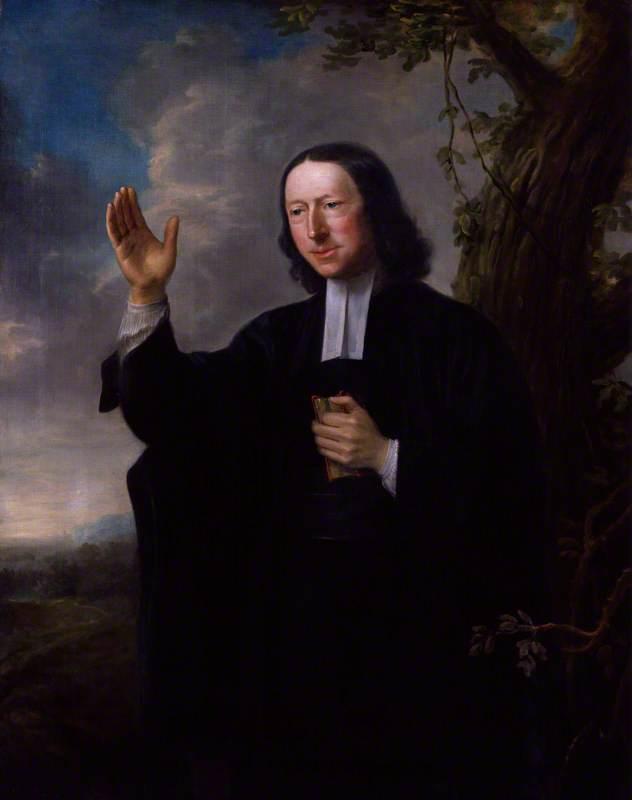
Nathaniel Hone the Elder, John Wesley, 1766. Public domain.
England, Georgia and the British Isles, 1703 to 1791 · Person · Featured Study
John Wesley
An Oxford fellow and priest of the Church of England who led the Methodist societies until he died.
A clergyman who had gone to Georgia to convert the Indians came home asking who would convert him.
Through these He has given us His precious and magnificent promises, so that through them you may become partakers of the divine nature, now that you have escaped the corruption in the world caused by evil desires.
- Born
- 17 June 1703 (Old Style) at Epworth rectory, Lincolnshire
- Died
- 2 March 1791
- Family
- father: Samuel Wesley; mother: Susanna Wesley; brother: Charles Wesley
- Places
- Epworth, Oxford, Savannah, London, Bristol
Summary
John Wesley was the son of the rector of Epworth and became a fellow of Lincoln College, Oxford, in 1726. He went to Georgia as a missionary and came home in despair of his own faith. Back in London, at a society meeting, he felt his heart strangely warmed. He then preached in the open air and organised the Methodist societies until his death.
- He opened his Testament on 2 Peter 1:4 on the morning of the day his heart was warmed.
- He held the Methodists inside the Church of England and said he would die a member of it.
- His last letter urged Wilberforce on against the slave trade.
The Verses of 24 May 1738
He opened his Testament twice on the day of Aldersgate, on 2 Peter 1:4 and on Mark 12:34.
Wesley wrote that the first was about five in the morning. The second was as he went out.
The question of this life is how a man who had kept every rule of the Oxford society came to say he had no faith. The question is also what he did with the assurance he found.
When Jesus saw that the man had answered wisely, He said, “You are not far from the kingdom of God.” And no one dared to question Him any further.He opened it on these words of Jesus as he went out that day.
The Life in Order
His Journal gives most of the dates himself, and Overton's life of 1891 gives the rest.
He was thirty-five at Aldersgate and preached for fifty-two years after it.
- June 1703He was born at Epworth rectoryOverton, chapter 1
- 9 February 1709He was saved from the fire at about eleven at nightOverton, chapter 1
- 28 January 1714He was admitted to the Charterhouse school in LondonOverton, chapter 2
- 17 March 1726He was elected Fellow of Lincoln College, OxfordOverton, chapter 3
- 14 October 1735He set out for Georgia with his brother CharlesWesley, Journal
- 25 January 1736The Moravians sang on through the stormWesley, Journal
- 1 February 1738He landed at Deal on his return from GeorgiaWesley, Journal
- 24 May 1738His heart was strangely warmed in Aldersgate StreetWesley, Journal
- 2 April 1739He first preached in the open air, at BristolWesley, Journal
- 1744The first Conference of his preachers metOverton, chapter 8
- 1784He set apart Thomas Coke for the work in AmericaOverton
- 2 March 1791He diedOverton; Elizabeth Ritchie's account
Each step of the life stands with its witness.
1 February 1738, 24 May 1738, 2 April 1739, 1744, 1784, 2 March 1791
From Epworth to the Open Air
Wesley told his life in his Journal, and Overton fills the years before it began.
John Wesley was born at Epworth in Lincolnshire on 17 June 1703, where his father Samuel was rector. On the night of 9 February 1709 he was taken out of the burning rectory. In later life he called himself a brand plucked out of the burning.
He went to the Charterhouse school in London in 1714 and on to Christ Church, Oxford. In 1726 Lincoln College elected him a fellow. With his brother Charles and a few friends he kept a society at Oxford that others mocked as the Holy Club and the Methodists.
In October 1735 he sailed for Georgia as a missionary. In a storm at sea he watched German Moravians sing on while the English screamed, and he saw that they were not afraid to die. The magistrates of Savannah turned against him, and he left Georgia on 2 December 1737. On the voyage home that winter he wrote that he had gone to America to convert the Indians, but who would convert him?
In London the Moravian Peter Böhler taught him that saving faith brings the witness of the Spirit and is given in a moment. On 24 May, at a society in Aldersgate Street, someone read Luther's preface to the Epistle to the Romans. About a quarter before nine, Wesley wrote, "I felt my heart strangely warmed." That summer he visited the Moravians at Herrnhut in Saxony.
George Whitefield called him to Bristol in 1739. On 2 April, he wrote, he submitted to be more vile and preached in the open air to about three thousand people. From then on he rode the roads of Britain and Ireland. In his old age he said he still travelled at least 4,500 miles a year.
He married a widow, Mrs. Vazeille, against his brother's wishes, and Overton judges that the marriage could not have turned out happily. In 1784 he set apart Thomas Coke as superintendent for the Methodists of America. He died on 2 March 1791, with his preachers and friends kneeling round his bed.
The Evening in Aldersgate Street
Wesley wrote the day down hour by hour, and Hutton says what the society was.
In the afternoon of 24 May 1738 he went to St Paul's. His Journal of 1738 names the anthem there: "Out of the deep have I called unto Thee, O Lord."
In the evening he went very unwillingly to the society in Aldersgate Street. There he felt that he did trust in Christ, Christ alone, for salvation, and an assurance was given him that his sins were taken away. He began at once to pray for those who had despitefully used him, and he told everyone there what he now felt in his heart.
Hutton, a Moravian historian, writes that many have assumed this was a Moravian meeting. He says the society had no more connection with the Moravian Church than any other religious society in England. Its members, he says, were all of the Church of England.
In Their Own Words
Five sayings from his letters, his Journal and his tracts, from 1732 to his last letter.
John Wesley (1703 to 1791)
Letter to Richard Morgan, 18 October 1732, the introductory letter of his Journal, page 11
The names they gave us
“As for the names of Methodists, Supererogation-men, and so on, with which some of our neighbours are pleased to compliment us, we do not conceive ourselves to be under any obligation to regard them, much less to take them for arguments.”
Evangelical
About this saying1 paragraph
He wrote to Richard Morgan from Oxford on 18 October 1732, about the society the town mocked.
John Wesley
Journal, 24 January 1738, Curnock, Standard Edition, volume I
Who shall convert me
“I went to America, to convert the Indians; but oh, who shall convert me?”
Evangelical
About this saying1 paragraph
He wrote this in his Journal on 24 January 1738, at sea on his way home from Georgia.
John Wesley
Journal, Curnock's edition, volume 2 (1909 to 1916), page 218
All the world my parish
“I look upon all the world as my parish; thus far I mean, that, in whatever part of it I am, I judge it meet, right, and my bounden duty to declare unto all that are willing to hear the glad tidings of salvation.”
Evangelical
About this saying1 paragraph
His Journal of 1739 prints this from a letter to a friend who had questioned his preaching in other men's parishes.
John Wesley
Farther Thoughts on Separation from the Church, section 7
On separation from the Church
“In flat opposition to these, I declare once more, that I live and die a member of the Church of England; and that none who regard my judgment or advice will ever separate from it.”
Evangelical
About this saying1 paragraph
He wrote this in Farther Thoughts on Separation from the Church, dated London, 11 December 1789.
John Wesley
Letter to William Wilberforce, 24 February 1791, in The Life of William Wilberforce, volume 1, page 297
The vilest that ever saw the sun
“Go on in the name of God, and in the power of His might, till even American slavery, the vilest that ever saw the sun, shall vanish away before it.”
Evangelical
About this saying1 paragraph
He wrote to William Wilberforce on 24 February 1791, six days before he died.
The People Around Him
The witnesses name his parents, his brother, his teachers in faith and those who carried his work on.
A rector's son of Epworth took his mother's rule of life to Oxford.
| Person | Tie to Wesley | The witness |
|---|---|---|
| Samuel Wesley | His father, rector of Epworth from 1696 to 1735. | Overton, chapter 1 |
| Susanna Wesley | His mother, who resolved after the fire to take particular care of his soul. | Overton, chapter 1 |
| Charles Wesley | His brother, who set out with him for Georgia. | Wesley, Journal; Overton |
| Peter Böhler | A Moravian ten years younger, who led him step by step to Aldersgate. | Overton, chapter 5 |
| George Whitefield | The Oxford friend who called him to the fields at Bristol in 1739. | Overton; Wesley, Journal |
| Mrs. Vazeille | The widow he married, against his brother's wishes. | Overton |
| Thomas Coke | A clergyman he set apart in 1784 for the work in America. | Overton |
| William Wilberforce | The member of Parliament to whom he wrote his last letter. | Overton |
Thomas Coke, William Wilberforce
The Places of His Life
His life ran from a Lincolnshire rectory to Georgia and back, and then along the roads of Britain and Ireland.
He crossed the Atlantic once each way and then never left the British Isles for long.
| Place | What the witnesses say | The witness |
|---|---|---|
| Epworth | His father was rector there, and the rectory burned in 1709. | Overton, chapter 1 |
| Oxford | He was a student of Christ Church and a fellow of Lincoln College. | Overton, chapters 2 and 3 |
| Savannah | He preached in Georgia for one year and nearly nine months, by his own count. | Wesley, Journal |
| Aldersgate Street | His heart was warmed at a society meeting there. | Hutton, A History of the Moravian Church |
| Herrnhut | He set out in the summer of 1738 to visit the Moravians there. | Overton, chapter 5 |
| Bristol | He first preached in the open air on a rise of ground beside the city. | Wesley, Journal |
| City Road, London | In 1788 the trustees of his chapel there tried to change its rules on seating, and he objected. | Overton |
A Society inside the Church
He organised the Methodists as societies of the Church of England and never meant them to leave it.
Overton writes that Wesley divided his societies into small bands, married or single men and women together, to confess their faults to one another and pray. The institution of the Conference in 1744 completed the organisation, with preachers appointed to circuits.
He kept the order of the Church of England as he could, with weekly communion and the church's feasts and fasts. In 1789 he warned that any who separated from it would dwindle into a dry, dull sect. He declared once more that he would live and die a member of it.
Overton calls early Methodism a clerical movement, led by priests of the church. He dates the last stage of Wesley's life from the ordinations for America.
How the Key Verse Was Taught
Athanasius, John Calvin and Charles Spurgeon read what it means to share the divine nature.
Athanasius of Alexandria (296 to 373)
On the Incarnation of the Word, 54.3
Athanasius said God became man so that we might be made like God.
“For He was made man that we might be made God ; and He manifested Himself by a body that we might receive the idea of the unseen Father; and He endured the insolence of men that we might inherit immortality.”
Early Church
John Calvin (1509 to 1564)
Commentaries on the Catholic Epistles, the end of the gospel
John Calvin said the end of the gospel is to make us conformable to God.
“Let us then mark, that the end of the gospel is, to render us eventually conformable to God, and, if we may so speak, to deify us.”
Reformed
Charles Spurgeon (1834 to 1892)
Faith and Life, sermon 551, The Metropolitan Tabernacle Pulpit, volume 10, the sermon, preached 24 January 1864
Charles Spurgeon warned that the creature does not share the essence of God.
“To be a partaker of the divine nature is not, of course, to become God. That cannot be. The essence of Deity is not to be participated in by the creature.”
Particular Baptist
What the Witnesses Leave Open
Readers differ on what kind of meeting Aldersgate was, on who began the ordinations for America and on his marriage.
A Moravian or Anglican societyJ. E. Hutton; the writers he answers
Many writers have assumed that Wesley was converted in a Moravian society, since he was still under Böhler's teaching. Hutton calls the assumption false and says the society was an ordinary Anglican one founded by James Hutton.
Who began the ordinations of 1784Robert Southey; J. H. Overton
Southey wrote that Wesley summoned Coke to Bristol and ordained presbyters for America with his help. Overton answers that the first step was Coke's own, and he cites Coke's letter of 1784 asking to receive the power of ordaining from Wesley.
Who was to blame for his marriageJ. H. Overton
Overton says Mrs. Wesley was jealous and suspicious, and "a perfect virago" when provoked. He adds that Wesley gave her provocation by the frank letters he wrote to other women, and by making a housekeeper his confidante in his troubles.
Books to Read Next
The Journal of John Wesley
John Wesley · 1735 to 1790
He kept this day-by-day record from his sailing for Georgia to his last years.
Read the Journal free at the CCELJohn Wesley
J. H. Overton · 1891
Overton, a clergyman of the Church of England, wrote a short life with Wesley's churchmanship in view.
Read Overton free at the Internet ArchiveA History of the Moravian Church
J. E. Hutton · 1909
Hutton tells Wesley's debt to the Moravians and where it ended.
Read Hutton free at Project GutenbergWhat Wesley Left
He left societies in every county he rode through, preachers bound by the Conference, and churches that carry his name.
Sources
Scripture is the Berean Standard Bible.
- The Holy Bible, Berean Standard Bible (read 2026)
- John Wesley, The Journal of John Wesley, abridged, with an introduction by Hugh Price Hughes (the CCEL text)
- J. H. Overton, John Wesley (London: Methuen, 1891)
- J. E. Hutton, A History of the Moravian Church (1909)
- Athanasius, On the Incarnation of the Word, 54.3, on 2 Peter 1:4.
- John Calvin, Commentaries on the Catholic Epistles, on 2 Peter 1:4.
- Charles Spurgeon, Faith and Life, sermon 551 (1864), on 2 Peter 1:4.
Keep Studying
Studies6
People and groups10
Places1
Doctrines7
Subjects1
Go further2