
Ezra 1 to 6 · Place · Featured Study
The Second Temple
The house of the LORD that the returned exiles rebuilt in Jerusalem under Persian rule, on the site of Solomon's.
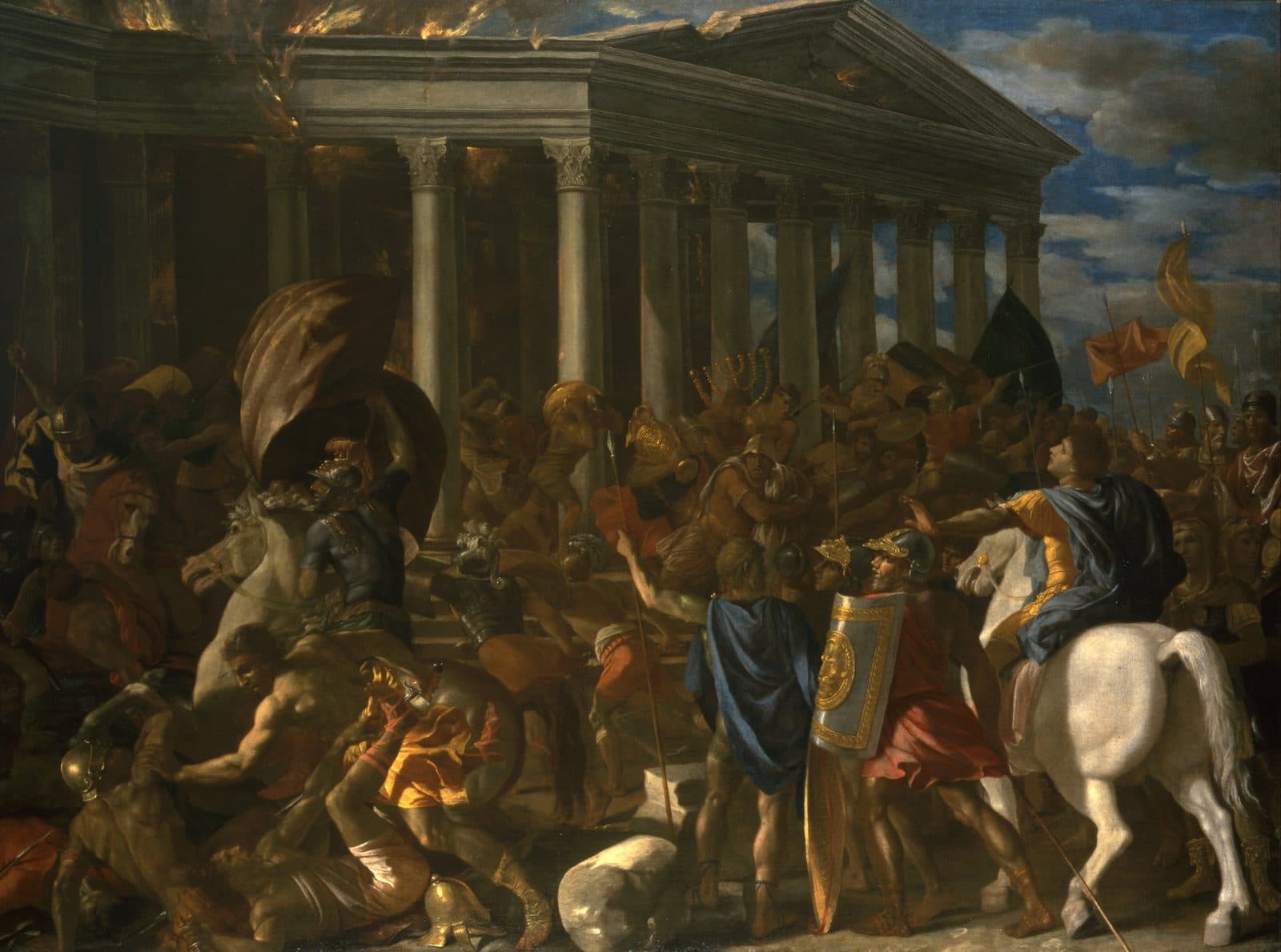
Nicolas Poussin, The Destruction and Sack of the Temple of Jerusalem, 1625-1626, oil on canvas, Israel Museum, Jerusalem. Public domain.
THE ARTWORKPoussin painted Roman soldiers carrying the seven-branched lampstand out of the burning house while their commander watches from a white horse.
The old men who had seen Solomon's house wept at the new foundation, and Haggai promised the plainer house a greater glory.
Summary
The second temple was the house Zerubbabel and Joshua built after the exile, and it stood for nearly six centuries.
- Cyrus decreed it in his first year, and the altar went up before any foundation was laid.
- Opposition stopped the work until the second year of Darius, when Haggai and Zechariah stirred the builders.
- It was finished on the third day of Adar in the sixth year of Darius.
- Herod rebuilt it on the same site from the eighteenth year of his reign.
- Fire took it on the tenth of Ab in AD 70, when the Roman army stormed the temple courts.
The House the Exiles Rebuilt
Cyrus king of Persia sent the exiles home with a decree to build.
Chronicles closes with the opening lines of Cyrus's decree, and Ezra opens with the whole of it. The exiles came home to a city whose temple Babylon had burned, and Cyrus gave back the gold and silver articles Nebuchadnezzar had carried off.
“This is what Cyrus king of Persia says: ‘The LORD, the God of heaven, who has given me all the kingdoms of the earth, has appointed me to build a house for Him at Jerusalem in Judah. Whoever among you belongs to His people, may his God be with him, and may he go to Jerusalem in Judah and build the house of the LORD, the God of Israel; He is the God who is in Jerusalem.Cyrus says the LORD has appointed him to build a house at Jerusalem.
From the Decree to the Dedication
Ezra, Haggai and Zechariah date each step of the building.
- The first year of CyrusCyrus proclaims that the house be built at Jerusalem, Ezra 1:1
- The first day of the seventh monthBurnt offerings begin on the rebuilt altar, Ezra 3:6
- The second month of the second yearThe foundation is laid with trumpets and singing, Ezra 3:8-10
- From Cyrus to DariusThe people of the land frustrate the work, Ezra 4:4-5
- Darius's second year, sixth month, first dayHaggai rebukes the builders, Haggai 1:1
- The same month, twenty-fourth dayZerubbabel, Joshua and the people begin the work, Haggai 1:14-15
- The seventh month, twenty-first dayHaggai promises the house a greater glory, Haggai 2:1
- The eighth monthZechariah's first word, Zechariah 1:1
- The ninth month, twenty-fourth dayHaggai names the day of the foundation, Haggai 2:18
- Darius's sixth year, the third of AdarThe house is finished, Ezra 6:15
Ten numbered cards give the steps in order, each with its verse. The house was finished about four and a half years after Haggai first spoke.
Why the Work Stopped and Started
Neighbours stopped the building, and two prophets set it going again.
In Darius's second year the word of the LORD came through Haggai to Zerubbabel the governor and Joshua the high priest, whom Ezra calls Jeshua. Zerubbabel and Joshua rose up to build, and the prophets of God were with them.
“Is it a time for you yourselves to live in your paneled houses, while this house lies in ruins?”Haggai puts his question to the people.
So the Jewish elders built and prospered through the prophesying of Haggai the prophet and Zechariah son of Iddo. They finished building according to the command of the God of Israel and the decrees of Cyrus, Darius, and Artaxerxes, kings of Persia.The elders build and prosper through the prophesying of Haggai and Zechariah.
Who stopped the work
The people of the land asked to build with the exiles, and Zerubbabel and Joshua refused them. They then hired counselors to frustrate the work through the reign of Cyrus and down to the reign of Darius.
How Darius found Cyrus's decree
Tattenai, governor of the region west of the Euphrates, asked who had authorized the building, and the elders' answer went to Darius. Darius had the archives searched, and a scroll of Cyrus's decree was found at Ecbatana in Media. He ordered the cost paid from the royal treasury so that the work would not be hindered.
Beside Solomon's House
Ezra and Haggai both set the new house against the old one.
In the first year of King Cyrus, he issued a decree concerning the house of God in Jerusalem: Let the house be rebuilt as a place for offering sacrifices, and let its foundations be firmly laid. It is to be sixty cubits high and sixty cubits wide,Cyrus's decree gives the new house its height and width.
The house that King Solomon built for the LORD was sixty cubits long, twenty cubits wide, and thirty cubits high.Kings gives Solomon's house its length, width and height.
But many of the older priests, Levites, and family heads who had seen the first temple wept loudly when they saw the foundation of this temple. Still, many others shouted joyfully.Weeping and shouts of joy rise together at the foundation.
‘Who is left among you who saw this house in its former glory? How does it look to you now? Does it not appear to you like nothing in comparison?’Haggai asks who saw the house in its former glory.
The Babylonian Talmud, in Yoma 21b, names five things the second house lacked. They are the ark with its cover and cherubim, the fire from heaven, the Divine Presence, the Divine Spirit, and the Urim and Thummim. Rashi, the commentator of Troyes in France who died in 1105, repeats the list on Haggai 1:8. He ties it to a letter missing from the Hebrew word for I will be glorified.
The Date of the Dedication
Ezra lists the offerings of the dedication, and Ezra, 1 Esdras and Josephus date it in three ways.
At the dedication the people offered a hundred bulls, two hundred rams, four hundred lambs and twelve male goats, one for each tribe of Israel.
Against Ezra's third of Adar in the sixth year, 1 Esdras 7:5 gives the twenty-third of Adar in the same year. Josephus, in Antiquities 11.4.7, gives the twenty-third of Adar in the ninth year of Darius. H. E. Ryle, in the Smaller Cambridge Bible for Schools of 1911, sets the dedication in 516 BC.
The House from the Maccabees to AD 70
Three later events, each told outside the Old Testament, close the history of the house.
The altar defiled and rededicated
Under King Antiochus, 1 Maccabees records, an idol altar was set on the altar of God on the fifteenth of Kislev in the year 145. On the twenty-fifth of Kislev in the year 148, Judas and his brothers offered sacrifice on a new altar and ordained an eight-day feast of its dedication.
At that time the Feast of Dedication took place in Jerusalem. It was winter, and Jesus was walking in the temple courts in Solomon’s Colonnade.Jesus walks in the temple courts at the Feast of Dedication.
Herod's rebuilding
Josephus writes that Herod, in the eighteenth year of his reign, undertook to rebuild the temple and make it larger in compass. The priests built the house itself in a year and six months, and Herod's cloisters and outer courts took eight years.
The rabbis of the Talmud said that one who has not seen Herod's building has never seen a beautiful building.
The burning in AD 70
Josephus writes that the house burned on the tenth of the month Ab, the day the king of Babylon had burned the first. A soldier acting without orders set fire to a golden window on the north side of the house.
As Jesus was leaving the temple, one of His disciples said to Him, “Teacher, look at the magnificent stones and buildings!” “Do you see all these great buildings?” Jesus replied. “Not one stone here will be left on another; every one will be thrown down.”Jesus foretells that not one stone will be left on another.
What the Text Leaves Unsaid
Ezra and Haggai leave three things about the house unrecorded.
Ezra records neither the length of the house nor a plan of its courts. No verse says of the second house what 2 Chronicles 7:1 to 2 says of Solomon's. No verse places the ark in it.
When Solomon had finished praying, fire came down from heaven and consumed the burnt offering and the sacrifices, and the glory of the LORD filled the temple. The priests were unable to enter the house of the LORD, because the glory of the LORD had filled it.Fire falls and the glory of the LORD fills Solomon's house at its dedication.
The Greater Glory of This House
The LORD promised this house a glory greater than the first.
The latter glory of this house will be greater than the former, says the LORD of Hosts. And in this place I will provide peace, declares the LORD of Hosts.”The LORD promises a greater glory and peace in this place.
Haggai tied the promise to this house, the one the builders were raising, and Zechariah spoke of the man who would build the temple of the LORD.
Jesus walked and taught in the courts of this house.
And you are to tell him that this is what the LORD of Hosts says: ‘Here is a man whose name is the Branch, and He will branch out from His place and build the temple of the LORD. Yes, He will build the temple of the LORD; He will be clothed in splendor and will sit on His throne and rule. And He will be a priest on His throne, and there will be peaceful counsel between the two.’The Branch will build the temple of the LORD.
Jesus answered, “Destroy this temple, and in three days I will raise it up again.” “This temple took forty-six years to build,” the Jews replied, “and You are going to raise it up in three days?” But Jesus was speaking about the temple of His body.Jesus names His body as the temple.
Four Voices on the Second House
Four Protestant voices, from Calvin to Spurgeon, read Haggai's word to the builders.
John Calvin, lecturing on Haggai 2:5, explains why the builders lost heart. John Wesley, in his Explanatory Notes of 1765, sets the first temple's worldly glory against the glory Christ would bring. Jamieson, Fausset and Brown, on Haggai 2:9, place the greater glory in the presence of the Messiah. Charles Spurgeon, preaching on the same promise, says the second house was built plainer than the first by design.
John Calvin
Inasmuch as the old people, who had seen the splendor of the former temple, considered this temple no better than a cottage, all their zeal evaporated; for, as we have said, without a promise there will continue in men no ardor, no perseverance.
John Calvin · Commentaries · on Haggai 2:5Reformed
John Wesley
With glory - The first temple had a glory in its magnificent structure, rich ornaments, and costly sacrifices; but this was a worldly glory; that which is here promised, is a heavenly glory from the presence of Christ in it.
John Wesley · Explanatory Notes upon the Old Testament · on Haggai 2:7Evangelical
Jamieson, Fausset and Brown
The glory of this latter house . . . greater than of the former--namely, through the presence of Messiah, in (whose) face is given the light of the knowledge of the glory of God (2Co 4:6; compare Heb 1:2), and who said of Himself, "in this place is one greater than the temple" (Mt 12:6), and who "sat daily teaching in it" (Mt 26:55).
Jamieson, Fausset & Brown · Commentary Critical and Explanatory on the Whole Bible · on Haggai 2:9Reformed
Charles Spurgeon
THE second Temple was never intended to be as magnificent as the first. The first was to be the embodiment of the full glory of the dispensation of symbols and types—and was soon to pass away. This comparative feebleness had been proved by the idolatry and apostasy of the people, Israel. And when they returned to Jerusalem they were to have a structure that would be sufficient for the purposes of their worship, but they were not again to be indulged with the splendors of the former house which God had erected by the hand of Solomon.
Charles Spurgeon · The Metropolitan Tabernacle Pulpit, Sermon No. 3442: “'The Desire Of All Nations'” (lightly modernized text, CCEL edition) · on Haggai 2:7
Three Questions in Dispute
Readers divide over the date of the foundation and over two promises of Haggai 2.
When the foundation was laid
C. F. Keil, in his commentary on Ezra of 1873, holds that Zerubbabel laid the foundation in the second year of the return. He rejects the reading of Haggai 2:18 as its first laying. Rashi reads Haggai 2:18 the same way, as a second beginning on the foundation built in the days of Cyrus.
Eberhard Schrader, as Keil reports him, argued that nothing was laid before Darius's second year and that Ezra 3 is the compiler's arrangement. His case rests on Haggai, who calls the house a ruin and dates a founding in that year.
Ezra 5:16 gives the founding to Sheshbazzar and Zechariah 4:9 to Zerubbabel, and Keil holds that the two names belong to one man.
Who or what the nations bring
The King James Version renders Haggai 2:7 as the desire of all nations shall come, and Augustine, Wesley and Spurgeon read it of Christ.
Calvin reads it of the nations bringing their treasures, because the next verse says the silver and the gold are the LORD's. The Hebrew sets a singular noun, chemdat, with a plural verb, and the Berean text reads that the nations will come with all their treasures.
Where the greater glory lies
Augustine, in the City of God, finds the greater glory in the church, built of living stones, where Wesley and Jamieson, Fausset and Brown find it in Christ's presence in the house.
Rashi records a dispute between Rav and Samuel. One said the second house was greater in its building, and the other in its years, four hundred and twenty against the first house's four hundred and ten.
Calvin refuses Herod's rebuilding any part in the promise and calls it an empty spectacle that kept the Jews from hoping for Christ.
Books to Read Next
Four older works, each free to read, carry the subject further.
Commentaries on Habakkuk, Zephaniah, Haggai
John Calvin, translated by John Owen · 1848
The volume holds Calvin's commentary on three of the Minor Prophets, Haggai the last of them.
Read it free at CCELThe Books of Ezra, Nehemiah, and Esther
C. F. Keil, translated by Sophia Taylor · 1873
Keil wrote this commentary on the three books, and Sophia Taylor translated it from the German.
Read it free at the Internet ArchiveThe Books of Ezra and Nehemiah
H. E. Ryle · 1911
Ryle wrote this volume of the Smaller Cambridge Bible for Schools, with an introduction, notes on the text and a map.
Read it free at the Internet ArchiveAntiquities of the Jews
Flavius Josephus, translated by William Whiston · 1737
Josephus told the building under Darius in Book 11 and Herod's rebuilding in Book 15.
Read it free at Project GutenbergKeep studying
Read it4