
Isaiah 14 and Ezekiel 28 · Doctrine · Featured Study
The Origin of Evil
Isaiah taunts the king of Babylon and Ezekiel laments the king of Tyre, in words that reach past any earthly throne.
A king of Babylon boasts that he will make himself like the Most High, and a king of Tyre is called a guardian cherub in Eden. Both are cast down, and readers since the third century have asked whether a greater rebel stands behind them.
- First taught
- Isaiah 14:12 “How you have fallen from heaven, O day…”
- Fullest statement
- Ezekiel 28:12 to 17 “Son of man, take up a lament for…”
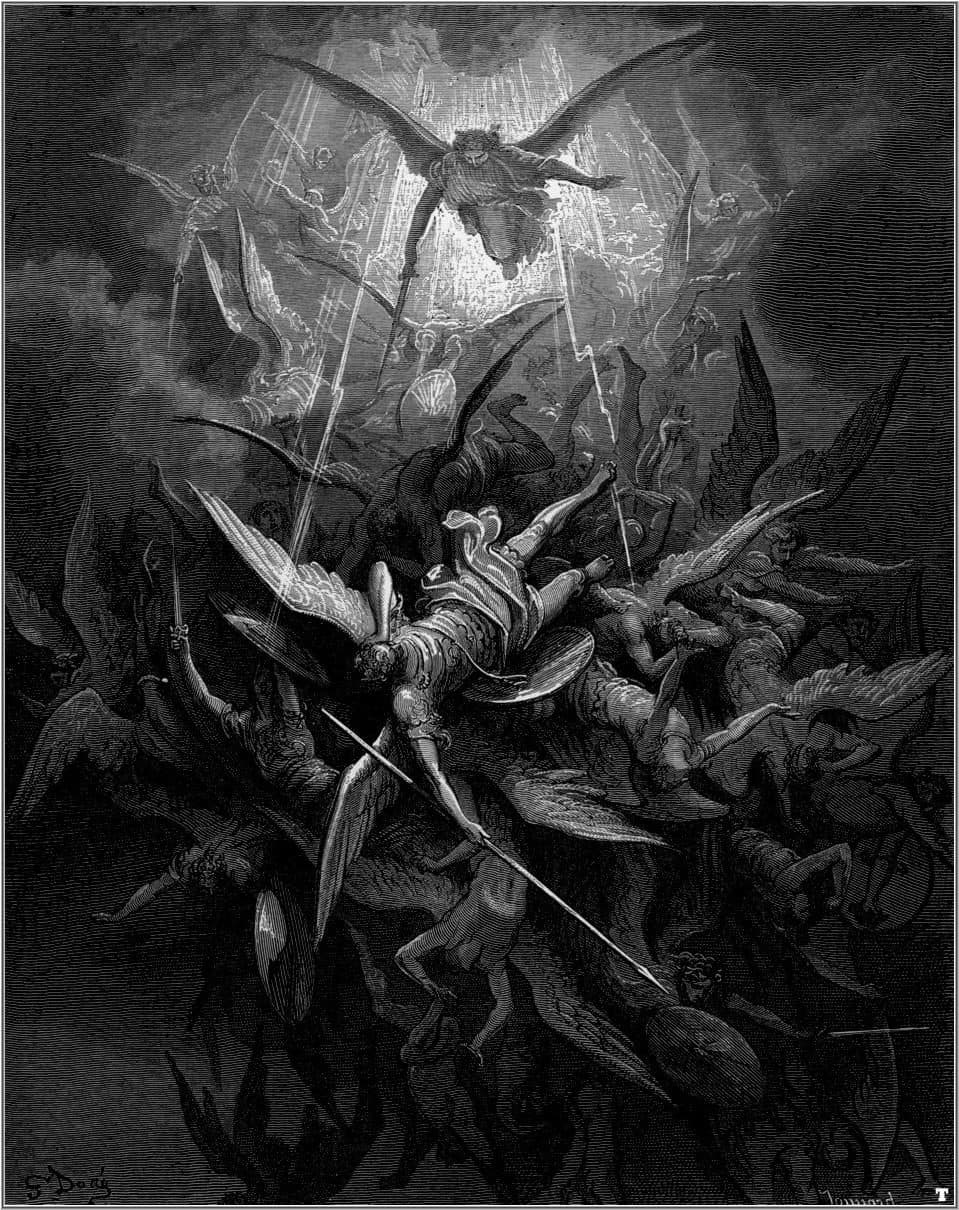
Gustave Doré, illustration for John Milton's Paradise Lost, Book 1, 1866. Public domain.
Summary
The doctrine of the origin of evil asks where evil began and why a good God permits it, and Isaiah 14 and Ezekiel 28 are its first texts.
- Three readings of the two oracles are held, each by named teachers from Origen to John Gill.
- The name Lucifer comes from the Latin Vulgate, which rendered the Hebrew helel, the day star, at Isaiah 14:12.
- Origen and Tertullian read both poems as the fall of the devil, and Calvin read Isaiah 14 of the king.
- Augustine answered why evil exists by calling it the absence of a good, and Origen by the free choice of a creature made good.
Two Kings, Face to Face
Isaiah 14:12 to 15 and Ezekiel 28:12 to 15 are the two oracles every reading of the origin of evil starts from.
How you have fallen from heaven, O day star, son of the dawn! You have been cut down to the ground, O destroyer of nations. You said in your heart: “I will ascend to the heavens; I will raise my throne above the stars of God. I will sit on the mount of assembly, in the far reaches of the north. I will ascend above the tops of the clouds; I will make myself like the Most High.” But you will be brought down to Sheol, to the lowest depths of the Pit.Isaiah sets the fall to Sheol directly after the five boasts.
Ezekiel 28 runs a parallel course over a different throne.
“Son of man, take up a lament for the king of Tyre and tell him that this is what the Lord GOD says: ‘You were the seal of perfection, full of wisdom and perfect in beauty. You were in Eden, the garden of God. Every kind of precious stone adorned you: ruby, topaz, and diamond, beryl, onyx, and jasper, sapphire, turquoise, and emerald. Your mountings and settings were crafted in gold, prepared on the day of your creation. You were anointed as a guardian cherub, for I had ordained you. You were on the holy mountain of God; you walked among the fiery stones. From the day you were created you were blameless in your ways—until wickedness was found in you.Ezekiel gives a human ruler a rank and a home that no human ruler ever held.
Both oracles reach for language that overshoots any mortal: Eden, an anointed cherub, a plunge from heaven. That gap between the named king and the cosmic imagery is the whole debate.
The fallen king among the deadIsaiah 14:15 to 16
“Never was death so great a change to any man as it is to him. Is it possible that a man, who a few hours ago looked so great, so pleasant, and was so splendidly adorned and attended, should now look so ghastly, so despicable, and lie thus naked and neglected? Is this the man that made the earth to tremble and shook kingdoms?”
Matthew Henry · Commentary on the Whole Bible (1710), on Isaiah 14:15 to 16Puritan
Two Kings, One Shadow
Isaiah 14 and Ezekiel 28 set side by side, row by row.
A table of six rows sets Isaiah 14 beside Ezekiel 28, from the king each names to his fall.
| Feature | Isaiah 14 | Ezekiel 28 |
|---|---|---|
| The king named | The king of Babylon (Isaiah 14:4) | The ruler and the king of Tyre (Ezekiel 28:2 and 28:12) |
| The form of the poem | A taunt-song, mashal | A lament, qinah |
| The title given | Day star, son of the dawn (Isaiah 14:12) | Guardian cherub (Ezekiel 28:14) |
| The boast | I will make myself like the Most High (Isaiah 14:14) | I am a god (Ezekiel 28:2) |
| The height | Above the stars of God, on the mount of assembly (Isaiah 14:13) | In Eden, on the holy mountain of God (Ezekiel 28:13 to 14) |
| The fall | Brought down to Sheol (Isaiah 14:15) | Cast to the earth before kings (Ezekiel 28:17) |
The Anatomy of a Fall
Isaiah 14:13 to 14 gives the king five vows, each set higher than the one before.
THE HEAVENS
I will ascend to the heavens: the first vow claims the place of God's own dwelling.
THE THRONE
The second vow sets the king's throne above the stars of God.
THE MOUNT OF ASSEMBLY
The third vow claims a seat on the mount of assembly in the far reaches of the north.
THE TOPS OF THE CLOUDS
The fourth vow climbs higher than the clouds.
LIKE THE MOST HIGH
The fifth vow reaches for the rank of God Himself, and the next verse brings the king down to Sheol.
The mount of assembly, The tops of the clouds, Like the Most High
Pride, the first sin of the angelsThomas Aquinas, Summa Theologiae, First Part, question 63
Self-exaltation that ends in ruin is the shape of the passage, and it is why the poem became Scripture's picture of pride itself. Thomas Aquinas taught that the first sin of the angels could only be pride or envy.
The One Word Behind Lucifer
The Hebrew helel of Isaiah 14:12 became the Latin lucifer, and Ezekiel 28:14 reads two ways in the oldest texts.
Much of the weight rests on a single Hebrew word, helel, at Isaiah 14:12. It describes the king and was never a proper name.
How helel became Luciferthe Latin Vulgate and the King James Version
"Lucifer" itself is Latin. Jerome's Vulgate translated helel as lucifer, "light-bringer", the ordinary Latin term for the planet Venus seen at dawn, and the King James Version carried the Latin word straight into English. The Vulgate uses the same Latin word in 2 Peter 1:19, of the light Christ brings.
So the name so many associate with the devil is, at the level of the text, a poetic epithet for the brightest point in the sky before dawn. Isaiah applies it to a king whose glory is about to be extinguished.
We also have the word of the prophets as confirmed beyond doubt. And you will do well to pay attention to it, as to a lamp shining in a dark place, until the day dawns and the morning star rises in your hearts.Here the title belongs to Christ, so the word names a light and holds no name of the devil.
The cherub of Ezekiel 28:14the Hebrew text and the Septuagint
Ezekiel adds its own contested term. The Hebrew of Ezekiel 28:14 calls the king an anointed guardian cherub; the Septuagint reads "with the cherub", which sets the king beside the guardian. Jamieson, Fausset and Brown read the cherub as an ideal picture of redeemed humanity, made the image of the king of Tyre. The human-king reading leans on exactly this kind of figurative sense.
The word helel at a glancethe Hebrew word of the day star
A table of four rows gives the Hebrew word of Isaiah 14:12, its gloss, its root and its count in the Old Testament.
| Field | helel |
|---|---|
| Hebrew and number | הֵילֵל, Strong's H1966 |
| Gloss | Shining one, morning star |
| Root | Halal, to shine, to boast |
| Times in the Old Testament | One, at Isaiah 14:12 |
Rashi on the day star and the cherubRashi, commentaries on Isaiah and Ezekiel, eleventh century
Rashi was the rabbi of Troyes in France and lived from 1040 to 1105. He takes helel as Venus, the morning star, from a root meaning to shed light. He calls the lament one over the heavenly prince of Babylon, who will fall from heaven.
On Ezekiel 28:13 Rashi reads Eden as the king's pleasure, as if he dwelt in the garden of God with every precious stone set on his robes. On Ezekiel 28:14 he reads the cherub as a great bird whose wings cover a wide area, a figure for a king who rules a large dominion.
Two Classical Answers to Why Evil at All
Christian teachers have given two main answers to the origin of evil.
These two oracles describe evil's shape, pride reaching past its station, but Christian theology has long pressed a harder question behind them: why does evil exist at all under a good and sovereign God?
A table of two rows sets the two answers side by side, each with its source and its holders.
| Answer | What it says | Representative source | Held by |
|---|---|---|---|
| Privation | Evil is the absence or corruption of a good that ought to be present, as disease is the absence of health. | Augustine, Enchiridion 11 to 12 (about 421) | Augustine, Thomas Aquinas and the Western church after them |
| Free will | Moral evil entered when creatures made good, angelic and human, chose to turn from God. | Origen, On First Principles 1.8.3 (about 220); Alvin Plantinga, God, Freedom, and Evil (1974) | Origen, C. S. Lewis, Alvin Plantinga and the Wesleyan tradition |
Augustine on the good that is diminishedEnchiridion 11 to 12
Augustine wrote that all things were made good, and that a creature good but less than perfectly good can have its good diminished, which is what evil is. On this reading, the boast of Isaiah 14 and the wickedness of Ezekiel 28:15 are a good will turned in on itself, with no new substance made.
The free will account and C. S. LewisMere Christianity (1952), Book II
The free will account holds that moral evil is the possible cost of a world with creatures able to love and obey God freely, since love that is forced is something less than love.
C.S. Lewis frames the origin of evil along these lines in Mere Christianity (1952), Book II. A good, free spirit turns to say "I am my own", and that act is the root of every later evil, angelic and human alike.
How the two answers fit togetherwhat evil is, and why God permits it
The two answers address different questions more than they compete. Privation names what evil is, a lack in a good thing; the free will defense addresses why God permits it. The Wesleyan-Pentecostal tradition, which holds real human and angelic responsibility, stands closer to the free will account of how moral evil entered, and it keeps Augustine's language of privation for what evil is.
What the Oracles Leave Unsaid
Neither oracle names Satan, and no text dates the fall of the angels.
Isaiah 14 and Ezekiel 28 name only the kings of Babylon and Tyre. Genesis 3 shows evil entering the human race through the serpent, and no chapter tells how the first sin arose in the devil.
You belong to your father, the devil, and you want to carry out his desires. He was a murderer from the beginning, refusing to uphold the truth, because there is no truth in him. When he lies, he speaks his native language, because he is a liar and the father of lies.This is the nearest the Gospels come to the devil's beginning, and it speaks of his work with no account of his fall.
The link between these oracles and the origin of evil is an inference, held in good faith by many readers, and the text itself supplies no caption that states it.
The Watchers of Genesis 6 are a separate accountGenesis 6:1 to 4
Genesis 6 tells of the sons of God, read by many as the Watchers, angels who left their proper dwelling and took human wives before the Flood. That is not the same claim as Isaiah 14 or Ezekiel 28, whatever indirect light the chapters shed on each other. The Watchers and the Nephilim are taught on their own page.
The New Testament Window
Luke 10:18 and Revelation 12:9 speak of Satan cast down from heaven.
The seventy-two return with joy and report that even the demons submit to them in Jesus' name.
So He told them, “I saw Satan fall like lightning from heaven.Jesus describes a fall from heaven, the image the older reading hears already in Isaiah 14 and Ezekiel 28.
The Gospels never quote either oracle as prophecy of Satan.
And the great dragon was hurled down—that ancient serpent called the devil and Satan, the deceiver of the whole world. He was hurled to the earth, and his angels with him.Revelation is the one text that joins the tempter of Eden to a fall from heaven.
“When therefore the Seventy say, ‘the devils [demons] are subject to us,’ and Jesus replies, ‘Mine eye was beholding Satan falling,’ it is plain that He meant to raise their minds not only from the particular to the general, but from a very temporary form of satanic operation to the entire kingdom of evil.”
Jamieson, Fausset & Brown · Commentary Critical and Explanatory on the Whole Bible · on Luke 10:18Reformed
“According to Christ's declaration, the harvest indeed was great, but the laborers were few. In addition to those first chosen, he appointed seventy others and sent them to every village and city of Judea before his face to be his forerunners and to preach the things that belonged to him.The authority that they carried to rebuke evil spirits and the power of crushing Satan was not given to them that they might be regarded with admiration. It was given to them so that Christ would be glorified by their means.”
Cyril of Alexandria · Commentary on Luke, Homily 64 · on Luke 10:17 to 19Patristic
Jamieson, Fausset & Brown, Cyril of Alexandria
The Fathers on the King of Tyre
Origen writes of a power that fell by its own choice, Jerome of the fire kindled in a proud heart, and Aphrahat of the anointing that made a cherub.
died 253 · Origen of Alexandria
“He had in himself the power of admitting either good or evil. Falling away from good, he turned with his whole mind to evil. There are other created beings who, while possessing the power to choose either, by the exercise of free will flee from evil and cleave to the good.”
Origen of Alexandria · On First Principles 1:8.3 · on Ezekiel 28:13Patristic
died 345 · Aphrahat the Persian Sage
“For the king who was anointed with the holy oil was called a cherub. And he was overshadowing all his people.… They were sitting in the shadow of the king, while he was standing at their head. And when the crown of their head fell, they were without shade. And if anyone should say that this word is spoken concerning Christ, let him accept what I write for him without dispute, and he will be persuaded that it was said with reference to the king.”
Aphrahat the Persian Sage · DEMONSTRATIONS 5:9 · on Ezekiel 28:14Patristic
died 420 · Jerome
“And you will no longer say, 'I am God,' but, having learned through your downfall, you will recognize that you are a human, not God. But if we wish to call the prince of Tyre the same power to whom the city itself, or the province, was given by God, let us accept that testimony. I said, 'You are gods, and all of you are sons of the Most High. But you will die like men, and fall like one of the princes' (Psalm 82:7).”
Jerome · Commentary on Ezekiel · on Ezekiel 28:2Patristic
died 420 · Jerome
“Therefore, he defiled his sanctification which he had when he dwelt on the mountain and conversed among the burning stones. It follows: I will bring fire in the midst of you which shall devour you. This fire was kindled in the heart of the king of Tyre by him whose arrows are kindled, as it is written: All those who commit adultery are like an oven, their hearts (Hosea).”
Jerome · Commentary on Ezekiel · on Ezekiel 28:18Patristic
Jerome, Jerome
Three Readings of Isaiah 14 and Ezekiel 28
Three positions are held in good faith, each with its holders and its work.
Dual reference: the kings, and the power behind themOrigen, On First Principles; Tertullian, Against Marcion
The oracles address real kings and also disclose the power standing behind proud thrones, the adversary's own fall. Origen, in On First Principles 1.5.4 to 5, holds that the second prophecy of Ezekiel 28 cannot be understood of a man, and reads Isaiah 14:12 as the fall of one who was once light. Tertullian, in Against Marcion 2.10, reads the prince of Tyre as the devil, an angel good by creation and corrupt by choice.
By the vastness of your trade, you were filled with violence, and you sinned. So I drove you in disgrace from the mountain of God, and I banished you, O guardian cherub, from among the fiery stones.The cherub driven from the mountain of God is the fall this reading hears behind the king.
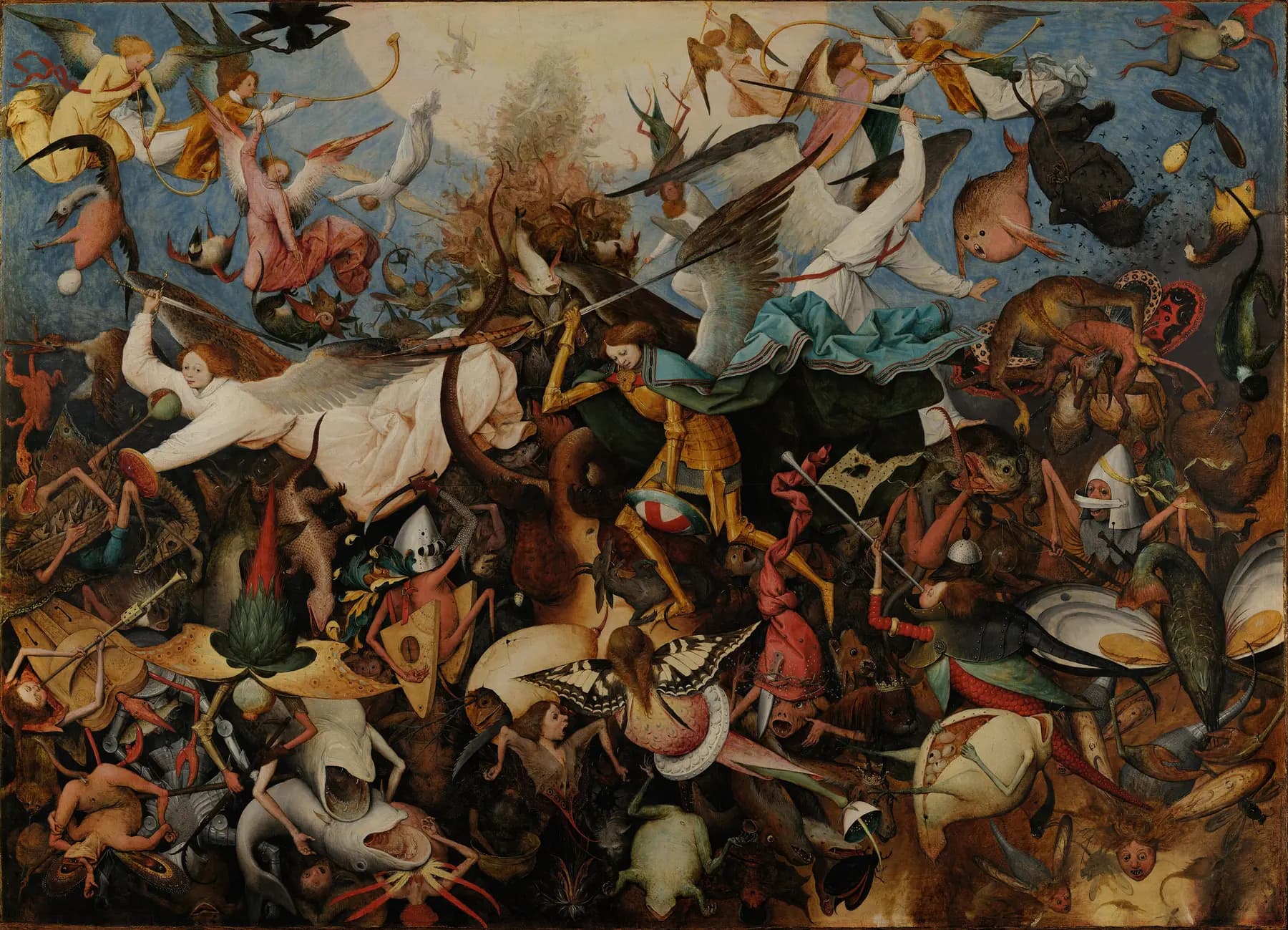
Pieter Bruegel the Elder, The Fall of the Rebel Angels, 1562, Royal Museums of Fine Arts of Belgium, Brussels. Public domain.
Bruegel painted the war in heaven as the church had long told it, with the rebel host thrown down out of the light.
The human kings aloneJohn Calvin, Commentary on Isaiah; Adam Clarke, Commentary on the Bible
Both oracles are political poems over Babylon and Tyre in the royal imagery of the ancient world, the garden and the morning star. John Calvin, in his Commentary on Isaiah, on Isaiah 14:12, says that the reading of the verse as Satan arose from ignorance, since the context shows it was spoken of the king of the Babylonians.
Adam Clarke, in his Commentary on the Bible, read the lament for the king of Tyre as irony from first to last. In his reading the king is likened to Adam in his innocence and to the cherub that guarded Paradise. He records that some, taking the stones of fire for the stars, have read the whole as the fall of Satan. On Isaiah 14:12 he writes that the context speaks of Nebuchadnezzar and calls the naming of the chief of the fallen angels Lucifer incongruous.
John N. Oswalt, in The Book of Isaiah: Chapters 1 to 39 (1986), and Daniel I. Block, in The Book of Ezekiel: Chapters 25 to 48 (1998), are among the modern commentators who read the two oracles of the kings.
you will sing this song of contempt against the king of Babylon: How the oppressor has ceased, and how his fury has ended!The human-king reading starts from the heading Isaiah gives the song, against the king of Babylon.
Canonical development: windows on the first rebellionJohn Gill
The passages describe kings in their own setting, and the New Testament reads self-exalting pride as the shape of the devil's revolt (Luke 10:18; Revelation 12:9). John Gill, in his Exposition of the Old Testament, on Isaiah 14:12, holds that the words speak of the king of Babylon. He allows that there may be an allusion to the fall of Satan, and he points to Luke 10:18.
Books to Read Next
Five works on the fall of the adversary and the origin of evil.
On First Principles
Origen · about 220
Book 1, chapter 5, On Rational Natures, asks whether any created power was evil by its nature.
Read Book 1 at New AdventAgainst Marcion
Tertullian · about 207
Book 2, chapter 10, answers the charge that the Creator made the devil.
Read Book 2 at New AdventEnchiridion
Augustine of Hippo · about 421
Augustine sets out in chapters 11 and 12 his account of evil as the absence of good.
Read the Enchiridion at New AdventCommentary on Isaiah, volume 1
John Calvin · 1551
The translation sets Calvin's own Latin version of each verse beside the English.
Read Isaiah 14 at CCELGod, Freedom, and Evil
Alvin Plantinga · 1974
Plantinga gives the free will defense its modern form.
In print: find it wherever books are sold.
The Works of the Devil Destroyed
1 John 3:8 sets the devil's sin from the start beside the coming of the Son of God.
Isaiah and Ezekiel show pride climbing toward the throne of God and falling to the Pit. Whatever a reader holds about those kings, the New Testament says why the Son of God came, and it asks the reader to take the lower place that the proud refused.
The one who practices sin is of the devil, because the devil has been sinning from the very start. This is why the Son of God was revealed, to destroy the works of the devil.John answers the devil's sin from the start with the purpose of Christ's coming, to destroy the devil's works.
Sources
Scripture is the Berean Standard Bible.
- Origen, On First Principles (about 220), translated by Frederick Crombie.
- Tertullian, Against Marcion (about 207), translated by Peter Holmes.
- John Calvin, Commentary on Isaiah, volume 1 (1551), translated by William Pringle.
- Augustine of Hippo, Enchiridion (about 421), translated by J. F. Shaw.
- Thomas Aquinas, Summa Theologiae (1265 to 1274)
- Matthew Henry, Commentary on the Whole Bible (1706 to 1710)
- Sefaria, the index entry for Rashi on Isaiah.
- Rashi, commentaries on Isaiah and Ezekiel, The Judaica Press complete Tanach with Rashi, translated by A. J. Rosenberg.
- Adam Clarke, Commentary on the Bible (1810 to 1826)
- Robert Jamieson, A. R. Fausset and David Brown, Commentary Critical and Explanatory on the Whole Bible (1871)
- John Gill, Exposition of the Old Testament (1748 to 1763)
- John N. Oswalt, The Book of Isaiah: Chapters 1 to 39 (New International Commentary on the Old Testament, 1986)
- Daniel I. Block, The Book of Ezekiel: Chapters 25 to 48 (New International Commentary on the Old Testament, 1998)
- C. S. Lewis, Mere Christianity (1952)
- Alvin Plantinga, God, Freedom, and Evil (1974)
- James Strong, The Exhaustive Concordance of the Bible (1890), Hebrew and Chaldee Dictionary.
Keep Studying
Words1
Doctrines10