
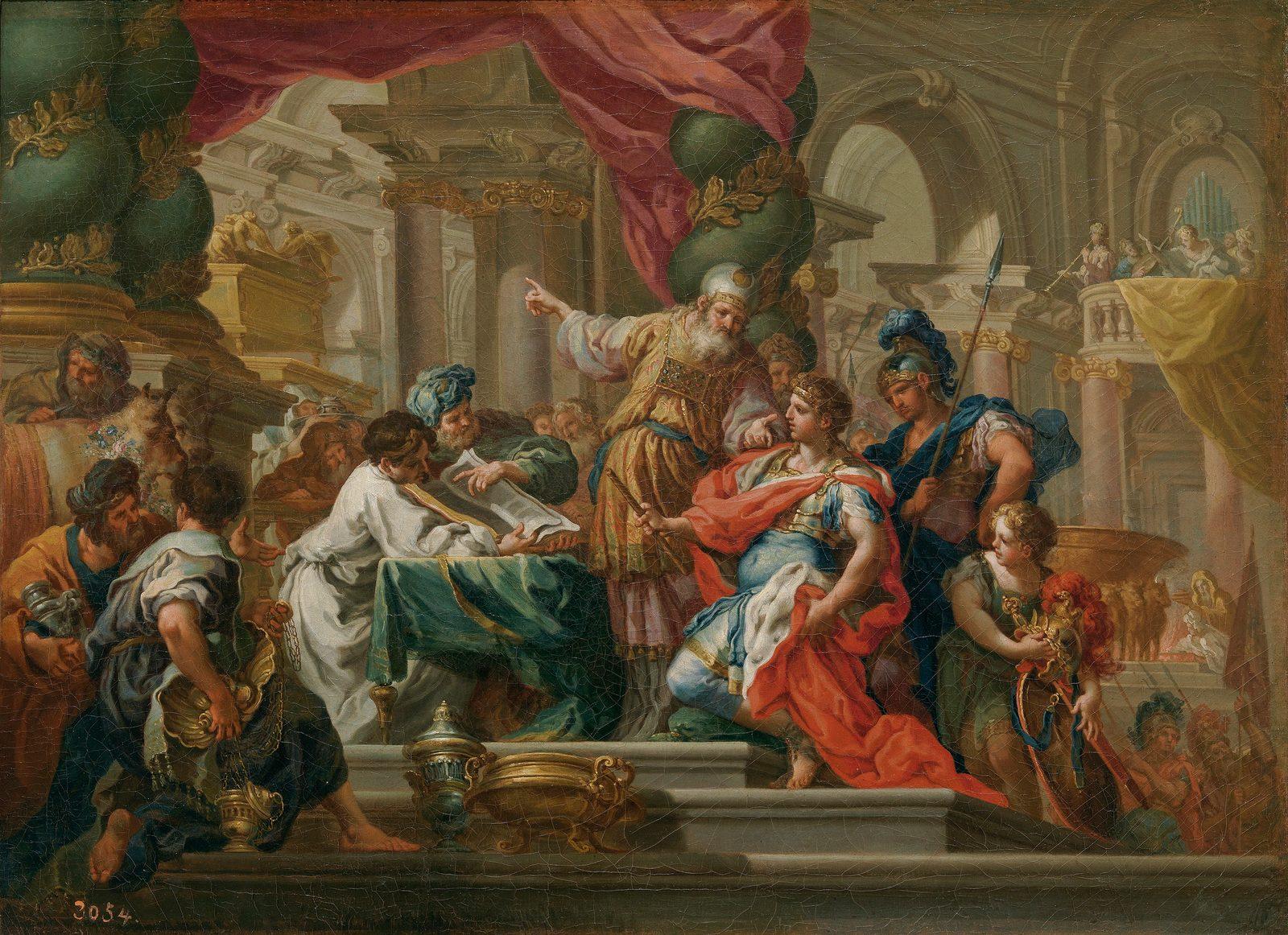
Sebastiano Conca, Alexander the Great in the Temple of Jerusalem, 1736. Public domain.
Zechariah 9:1 to 8 · Passage · Featured Study
The Coastal Oracle and the March of Alexander
Zechariah 9:1 to 8 is the first oracle of the book's last six chapters.
But I will camp around My house because of an army, because of those who march to and fro, and never again will an oppressor overrun My people, for now I keep watch with My own eyes.
- The passage
- Zechariah 9:1 to 8
- Book
- Zechariah
- Hold in memory
- Zechariah 9:8
The oracle names nine places in Syria, Phoenicia and Philistia, and it names no conqueror.
Summary
Zechariah 9:1 to 8 judges the towns near Judah and guards God's house. Readers ask if it tells of the march of Alexander the Great.
- Josephus says that the king did no harm to Jerusalem.
- Arrian tells how the king took Tyre and then Gaza.
- Readers have read it of the Greek king, of the king of Babylon, or of a later time.
The Oracle City by City
The oracle moves from Syria down the coast to Philistia, and it ends at the LORD's own house.
This is the burden of the word of the LORD against the land of Hadrach and Damascus its resting place—for the eyes of men and of all the tribes of Israel are upon the LORD— and also against Hamath, which borders it, as well as Tyre and Sidon, though they are very shrewd.The oracle opens in Syria, far north of Judah, before it turns to the coast.
Tyre has built herself a fortress; she has heaped up silver like dust, and gold like the dirt of the streets. Behold, the Lord will impoverish her and cast her wealth into the sea, and she will be consumed by fire.Tyre receives the longest word of judgment of all the cities in the oracle.
Ashkelon will see and fear; Gaza will writhe in agony, as will Ekron, for her hope will wither. There will cease to be a king in Gaza, and Ashkelon will be uninhabited. A mixed race will occupy Ashdod, and I will cut off the pride of the Philistines.After Tyre the oracle turns south to the Philistine cities.
I will remove the blood from their mouths and the abominations from between their teeth. Then they too will become a remnant for our God; they will become like a clan in Judah, and Ekron will be like the Jebusites.Judgment on the Philistines ends in a promise, so the oracle holds mercy for the nations.
Zechariah 9:5 to 6, Zechariah 9:7
The Cities on the Map
Hamath lies north of Damascus, and Hadrach near it.
The cities of the oracle ring Judah on the north and the west, and its promise rests on Jerusalem.
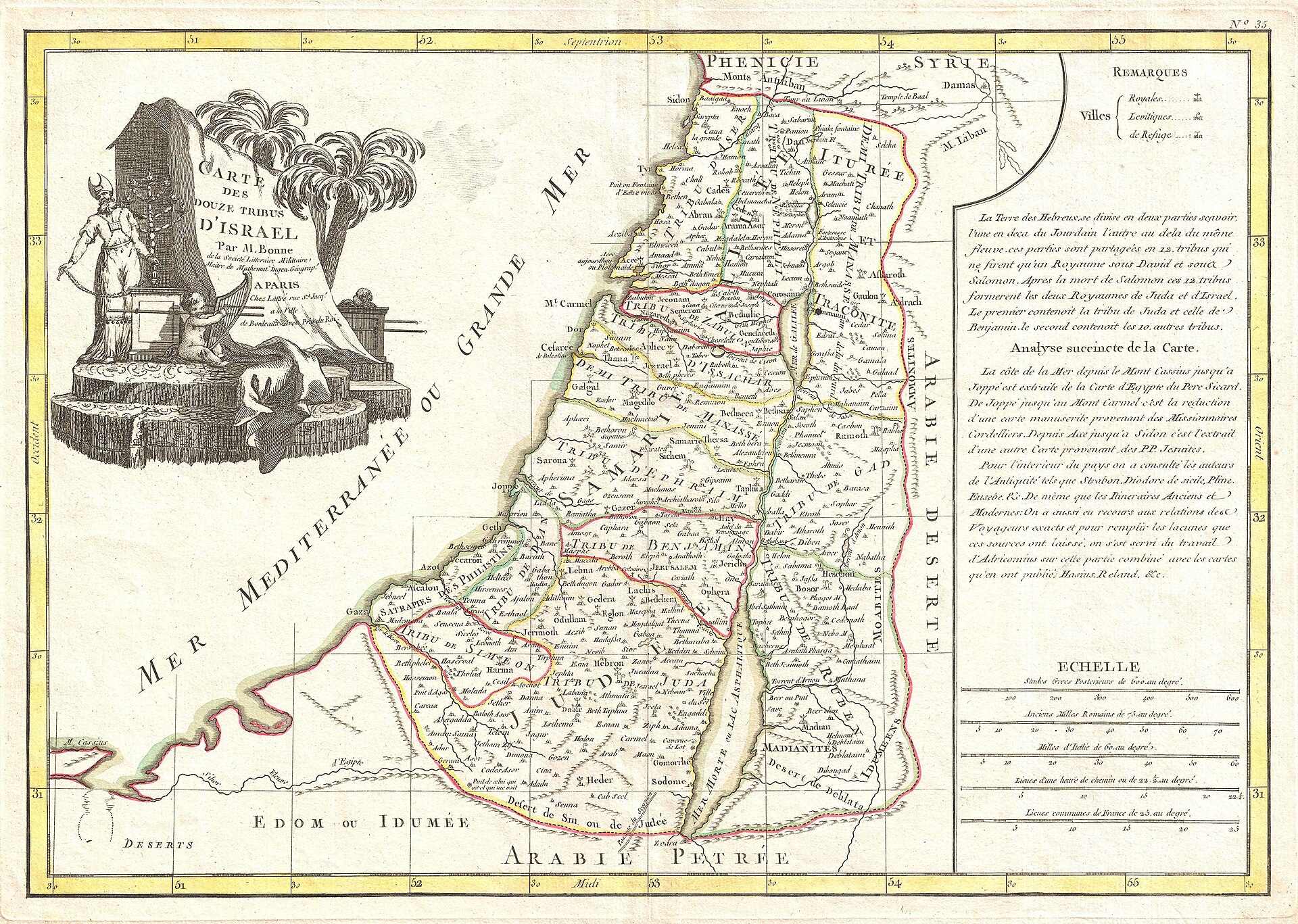
- 1Damascus, The burden rests on it.
- 2Tyre, Its wealth is cast into the sea and the city burns.
- 3Sidon, It is named with Tyre for its shrewdness.
- 4Ashkelon, It sees and fears, and is left uninhabited.
- 5Gaza, It writhes, and its king ceases.
- 6Ekron, Its hope withers, and it becomes like the Jebusites.
Ashdod, Jerusalem
- 7Ashdod, A mixed race occupies it.
- 8Jerusalem, The LORD camps around His house.
Base map: The Twelve Tribes of Israel, Rigobert Bonne (1770), public domain. Places with a place page stand at its coordinates and the others at the point cited for each, set on the plate by Hebron and Dan, as the plate prints them.
Each city with what the oracle says of it.
Alexander's March of 332 BC
Arrian and Josephus tell how Alexander came down the coast from Syria to Gaza.
Tyre held out for seven months, by Josephus's count.
- Alexander takes Damascus and receives SidonJosephus, Antiquities 11.8.3; Arrian 2.15
- He besieges TyreJosephus, Antiquities 11.8.3 to 4
- Tyre falls in the month HecatombaionArrian 2.24
- He takes GazaJosephus, Antiquities 11.8.4; Arrian 2.27
- He goes up to JerusalemJosephus, Antiquities 11.8.4 to 5
Each turn of the march with the source that tells it.
Josephus tells that Alexander bowed before the high priest at Jerusalem and was shown the book of Daniel. He granted the Jews their ancestral laws and freed them from tribute in the seventh year.
John Calvin noted that the historians who tell of Alexander's assault on Tyre show how deep the sea lay around the city.
What the Oracle Leaves Unnamed
Zechariah 9:4 gives the striking of Tyre to the Lord himself.
From Zechariah 9:6 to 8 the LORD speaks in the first person, of the Philistines and of His house.
The King Who Comes to Zion
The King of Zechariah 9:9 follows straight after the oracle of the cities.
Rejoice greatly, O Daughter of Zion! Shout in triumph, O Daughter of Jerusalem! See, your King comes to you, righteous and victorious, humble and riding on a donkey, on a colt, the foal of a donkey.Zion's King comes humble, where the cities' strength was judged.
This took place to fulfill what was spoken through the prophet: “Say to the Daughter of Zion, ‘See, your King comes to you, gentle and riding on a donkey, on a colt, the foal of a donkey.’”Matthew sets the prophecy beside the entry of Jesus into Jerusalem.
Who Fulfils the Oracle?
Each time the readers name has its holders and an objection.
The march of AlexanderE. B. Pusey and C. F. Keil, in their commentaries on the Minor Prophets, with Jamieson, Fausset and Brown (1871)
Pusey saw the course of Alexander's victories in the foreground of the prophecy, a march that circled the holy land without hurting it. Keil took Alexander's conquests as the beginning of the fulfilment.
“In literal fulfilment of this prophecy, after a two month's siege, Gaza was taken by Alexander, ten thousand of its inhabitants slain, and the rest sold as slaves. Betis the satrap, or petty ‘king,’ was bound to a chariot by thongs thrust through the soles of his feet, and dragged round the city.”
Jamieson, Fausset & Brown · Commentary Critical and Explanatory on the Whole Bible · on Zechariah 9:5Reformed
The objection: Adam Clarke answered that the destruction foretold had come already by Nebuchadnezzar.
The judgments of NebuchadnezzarAdam Clarke, Commentary on the Bible (1832), on Zechariah 9:4
Clarke pointed the reader to Amos 1 and Zephaniah 2, where the same Philistine cities are judged.
The objection: Jamieson, Fausset and Brown held that Nebuchadnezzar took old Tyre on the mainland, and read Zechariah's oracle against the island city.
Written or reworked after AlexanderStade, as S. R. Driver reports him; S. R. Driver, An Introduction to the Literature of the Old Testament (1891)
Stade placed the prophecy about 300 BC. Driver held that chapters 9 to 11 come from the eighth century BC and were reworked after the exile, because the Greeks of Zechariah 9:13 appear as a world power.
The objection: Keil held that the whole book is one prophet's work, a unity he judged placed beyond doubt by the testimony of tradition.
A Remnant from the Philistines
The oracle ends its word on the Philistines with Ekron like the Jebusites, the people who held Jerusalem until David took it (2 Samuel 5:6 to 7).
Sources
Scripture is the Berean Standard Bible.
- Jamieson, Fausset and Brown, Commentary Critical and Explanatory on the Whole Bible (1871), on Zechariah 9:3 and 9:5; Adam Clarke, Commentary on the Bible (1832), on Zechariah 9:4; John Wesley, Explanatory Notes upon the Old Testament (1765), on Zechariah 9:1.
- Arrian, Anabasis of Alexander 2.15, 2.24 and 2.27, translated by E. J. Chinnock (1884); public domain.
- Flavius Josephus, Antiquities of the Jews 11.8.3 to 5, translated by William Whiston (1737); public domain.
- E. B. Pusey, The Minor Prophets with a Commentary, vol. viii, Zechariah (Nisbet, 1907 reprint), on Zechariah 9:1; public domain.
- John Calvin, Commentaries on the Twelve Minor Prophets, vol. 5, translated by John Owen for the Calvin Translation Society, on Zechariah 9:4; public domain.
- C. F. Keil, Biblical Commentary on the Old Testament: The Twelve Minor Prophets, vol. 2 (T. and T. Clark, 1878), Introduction and on Zechariah 9:1 to 8; public domain.
- S. R. Driver, An Introduction to the Literature of the Old Testament (1891), pp. 326 to 328; public domain.
- OpenBible.info Bible-Geocoding-Data, ancient.jsonl, the points of Sidon, Ashkelon, Ekron and Ashdod.
Keep Studying
Studies5
People and groups4
Symbols1
Subjects1