
Genesis 4 · Story · Anger
Cain and the Sin at the Door
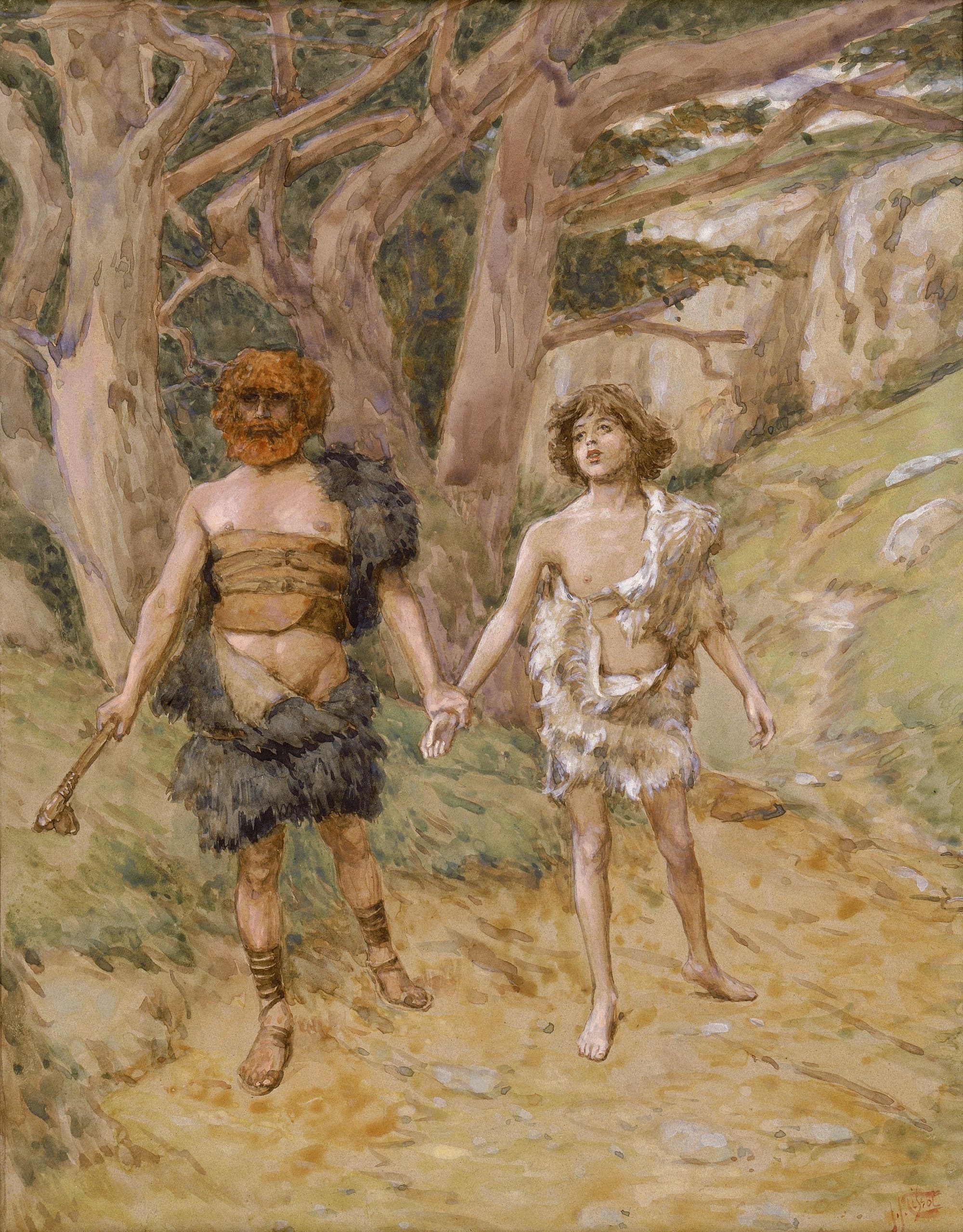
God warned the angry Cain that sin was crouching at his door, and Cain killed his brother Abel in the field.
The Hebrew verb for the crouching of sin at Cain's door is the verb Genesis uses for the three flocks of sheep that lay beside a well (Genesis 29:2).
If you do what is right, will you not be accepted? But if you refuse to do what is right, sin is crouching at your door; it desires you, but you must master it.”
- Where
- Eden
- Who
- Cain, Abel
Summary
Genesis 4 shows anger before it shows the act it led to. God speaks to Cain while the anger is still in his face, tells him that acceptance stands open, and warns him of a danger waiting to master him. Cain gives God no answer, and the next words he speaks are to his brother.
- The LORD looked with favor on Abel and his offering and had no regard for Cain and his, and Hebrews 11:4 names faith as the difference.
- Cain was driven out as a fugitive and a wanderer, yet the LORD set a mark on him so that no one would kill him (Genesis 4:12 to 15).
- Three New Testament writers name Cain, and Jesus traced murder back to anger.
Two Offerings and a Fallen Face
The first sons of Adam and Eve bring offerings, and one is turned away.
Cain and the Sin at the Door follows the anger of Cain through Genesis 4:3 to 16. It belongs to the trial of anger and reads the first account in Scripture where anger grows into murder, with God's warning standing between the two.
The question it answers is what Cain's anger was, what God told him to do with it, and what came of his refusal. It sets the steps from the fallen face to the land of Nod on a timeline, reads the Hebrew of God's warning, and gives the New Testament's readings of Cain. It also sets out how teachers have explained the rejected offering and the sin at the door.
Cain, a tiller of the soil, brought some of its fruit as an offering. Abel, a keeper of sheep, brought the best portions of the firstborn of his flock (Genesis 4:2 to 4). God accepted Abel's gift and refused Cain's (Genesis 4:4 to 5).
From the Fallen Face to the Land of Nod
Cain speaks three times, to call his brother out, to deny the murder and to complain of his sentence.
Cain's anger moves from his face to his brother's blood and ends in exile east of Eden.
- Cain's anger shows in his face“So Cain became very angry, and his countenance fell.”Genesis 4:5
- God asks Cain two questions“Why are you angry,” said the LORD to CainGenesis 4:6
- God warns Cain of the sin at the doorGod tells Cain that sin is waiting and that he must rule over it.Genesis 4:7
- Cain calls Abel out“Let us go out to the field.”Genesis 4:8
- Cain kills Abel“Cain rose up against his brother Abel and killed him.”Genesis 4:8
- Cain denies knowing“Am I my brother’s keeper?”Genesis 4:9
- Abel's blood cries out“The voice of your brother’s blood cries out to Me from the ground.”Genesis 4:10
- God curses Cain from the ground“You will be a fugitive and a wanderer on the earth.”Genesis 4:12
- Cain complains of his punishment“My punishment is greater than I can bear.”Genesis 4:13
- God sets a mark on Cain“the LORD placed a mark on Cain”Genesis 4:15
- Cain settles in Nod“settled in the land of Nod, east of Eden”Genesis 4:16
A timeline of eleven steps in Genesis 4:5 to 16, ten of them in the words of the Berean text.
Abel's blood cries out, God curses Cain from the ground, Cain complains of his punishment, God sets a mark on Cain, Cain settles in Nod
The Warning at the Door
God's words to Cain come between the anger and the killing.
The Hebrew of Genesis 4:5 reads wayyichar leqayin meod, and it burned to Cain exceedingly, followed by wayyippelu panav, and his face fell. The verb charah, to burn, stands here for the first time in Scripture.
Before the murder God asked Cain why he was angry and why his face had fallen (Genesis 4:6). His next words offer a lifting up, seet, the opposite of the fallen face, if Cain does well.
The participle robets, crouching, is glossed by Strong's “to crouch (on all four legs folded, like a recumbent animal).”
The word for sin's desire is teshuqah, and the verb for mastering it is mashal, to rule. God's word to Eve in Genesis 3:16 joins the same two words, desire and rule.
Cain spoke to Abel and killed him in the fieldGenesis 4:8
The account moves from the warning straight to Cain's words to Abel and to the field.
God asked where Abel wasGenesis 4:9 to 10
God puts a question to Cain again, as He put questions to Adam and Eve in the garden (Genesis 3:9 to 13). Cain answers with a lie and a second question, and God names the murder Cain has hidden.
Cain in the New Testament
The New Testament reads Cain as a warning and Abel as a man of faith.
Do not be like Cain, who belonged to the evil one and murdered his brother. And why did Cain slay him? Because his own deeds were evil, while those of his brother were righteous.John uses Cain as the pattern of hatred between brothers and gives the reason for the murder in Cain's own deeds.
By faith Abel offered God a better sacrifice than Cain did. By faith he was commended as righteous when God gave approval to his gifts. And by faith he still speaks, even though he is dead.The verse stands here because the New Testament's reading of the two offerings turns on it.
Jude warns against false teachers who “have traveled the path of Cain” (Jude 1:11). Jesus teaches that anger against a brother stands under the same judgment as murder.
A Preacher on Cain's Anger
Charles Spurgeon preached on Genesis 4:6 to 7 to people angry with godly friends.
Spurgeon taught that Cain's anger made him miserable as well as wicked.Charles Spurgeon, sermon 1929, To Those Who Are Angry with Their Godly Friends (1886)
Spurgeon said of Cain, “Cain's mind was angry and his heart was heavy.” He went on, “The short life of the vicious is not always a merry one.”
Why the Offering Was Refused, and What Lay at the Door
Teachers have read the refused offering and the warning at the door in more than one way.
God first accepted the person, by faith, and then the giftJohn Calvin
John Calvin, in his commentary on Genesis (translated by John King, 1847), noted that Moses names Abel before his offering. He wrote that “God will regard no works with favor except those the doer of which is already previously accepted and approved by him,” and joined this to the faith of Hebrews 11:4.
The objection: Genesis 4 itself names no faith, and it does record a difference between the two gifts.
Abel's gift was a blood sacrifice for sinJohn Wesley
John Wesley, in his Explanatory Notes upon the Old Testament (1765), called Cain's gift “only a sacrifice of acknowledgment” and Abel's “a sacrifice of atonement.”
The objection: the law of Moses later accepted grain offerings from the fruit of the soil, and Genesis 4 names no sin offering.
Sin crouched at the door like a beast of preyKeil and Delitzsch
Carl Friedrich Keil and Franz Delitzsch, in their Biblical Commentary on the Old Testament, wrote that “sin is personified as a wild beast, lurking at the door of the human heart.”
The objection: Genesis 4 names no beast. The picture of a beast of prey is read into the verse from the serpent of Genesis 3 and from 1 Peter 5:8, as Keil and Delitzsch themselves show.
Chattath read as the sacrifice for sinAdam Clarke
Adam Clarke, in his Commentary on the Bible (1832), read chattath as sin offering: “an animal proper to be offered as an atonement for sin is now couching at the door.”
The objection: the next words speak of its desire for Cain and of Cain ruling over it, which fit a power that threatens him better than an animal waiting to be offered.
You Must Master It
God met Cain's anger with questions and a warning before it became a deed, and the account shows what followed when the warning went unheeded. Anger that broods, or that comes with thoughts of harming another, is brought to God in prayer and to a physician's care as well, and prayer never takes the physician's place.
Sources
Scripture is the Berean Standard Bible.
- STEP Bible, Translators Amalgamated Hebrew Old Testament (Tyndale House, Cambridge), CC BY 4.0.
- STEP Bible brief lexicon of Extended Strongs for Hebrew (Tyndale House, Cambridge), CC BY 4.0, with the glosses of James Strong, Strong's Exhaustive Concordance of the Bible (1890)
- John Calvin, Commentaries on the First Book of Moses Called Genesis, translated by John King (Calvin Translation Society, 1847), on Genesis 4:4.
- Carl Friedrich Keil and Franz Delitzsch, Biblical Commentary on the Old Testament (1857 to 1878), on Genesis 4:7.
- John Wesley, Explanatory Notes upon the Old Testament (1765), on Genesis 4:4.
- Adam Clarke, Commentary on the Bible (1832), on Genesis 4:7.
- Charles Spurgeon, To Those Who Are Angry with Their Godly Friends, The Metropolitan Tabernacle Pulpit, sermon 1929 (1886), on Genesis 4:6 to 7.
Keep Studying
Read it1
In this trial7
People and groups6
Symbols2