
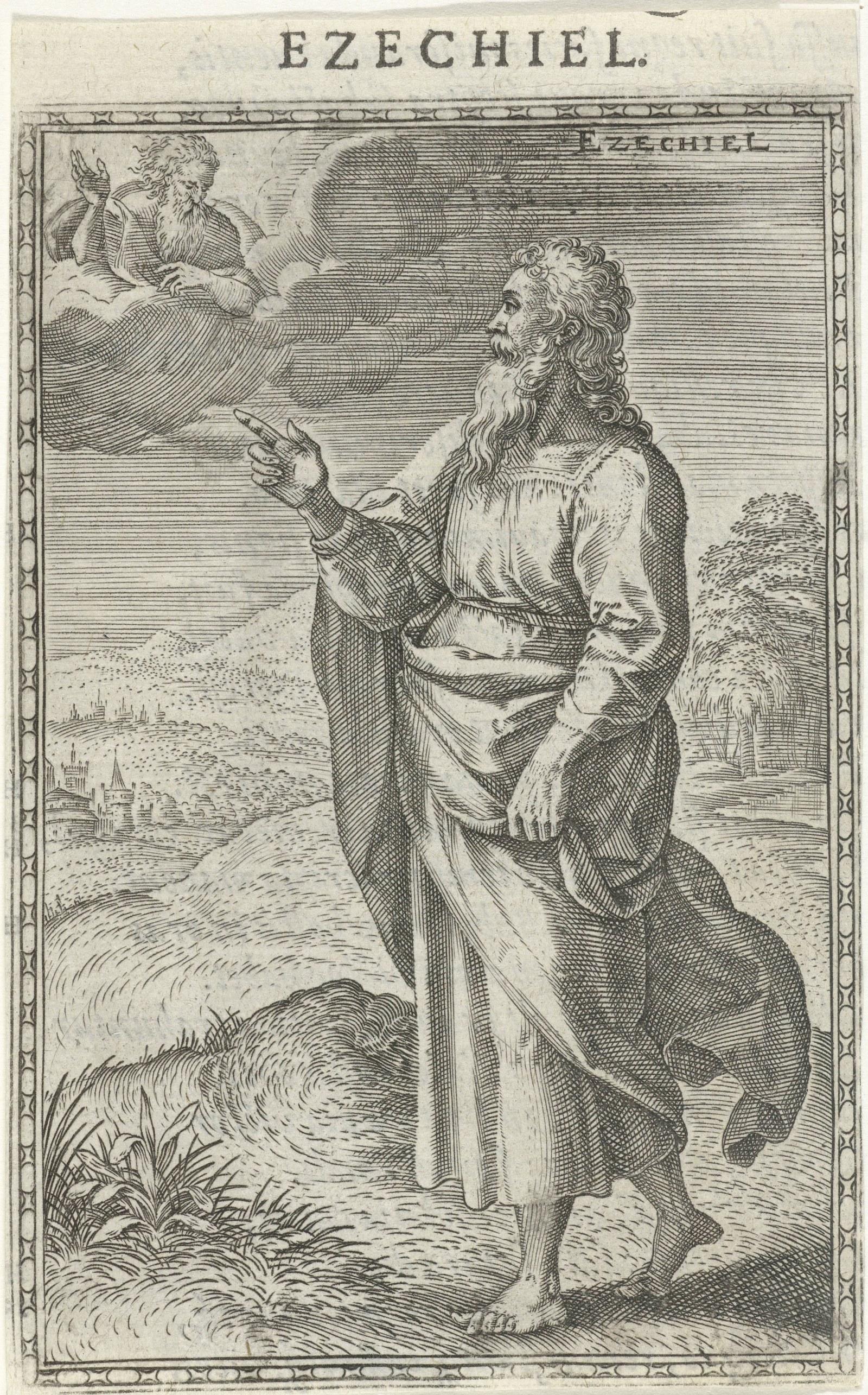
Johann Sadeler I after Crispijn van den Broeck, The Prophet Ezekiel, 1577. Public domain.
Ezekiel 1 to 5, Ezekiel 24 and Ezekiel 33 · Person · Featured Study
Ezekiel, the Priest Among the Exiles
Ezekiel was a priest, the son of Buzi, and he spoke for God to the exiles of Judah.
On the evening his wife died, God forbade Ezekiel to mourn her, so that his grief would become a sign to the exiles.
“Son of man, I have made you a watchman for the house of Israel. Whenever you hear a word from My mouth, give them a warning from Me.
“Son of man, I have made you a watchman for the house of Israel. Whenever you hear a word from My mouth, give them a warning from Me.
- Family
- father: Buzi; wife: unnamed, called the desire of his eyes
- Places
- Babylon, Jerusalem
- First named
- Ezekiel 1:3 “…the LORD came directly to Ezekiel the priest,…”
- Last named
- Ezekiel 24:24 “Thus Ezekiel will be…”
Summary
Ezekiel was taken to Babylonia with King Jehoiachin. God called him in the fifth year of that exile, and he dated his work by its years until the twenty-seventh. At God's command his body, his household and his grief became signs to the people.
- God made him a watchman for the house of Israel (Ezekiel 3:17).
- His name stands only twice in Scripture, at his call and at his wife's death.
- Readers count the thirtieth year of Ezekiel 1:1 in four different ways.
The Priest by the River Kebar
Ezekiel gives the year, the place and his priestly father before he tells any vision.
In the thirtieth year, on the fifth day of the fourth month, while I was among the exiles by the River Kebar, the heavens opened and I saw visions of God. On the fifth day of the month—it was the fifth year of the exile of King Jehoiachin— the word of the LORD came directly to Ezekiel the priest, the son of Buzi, in the land of the Chaldeans by the River Kebar. And there the LORD’s hand was upon him.The book opens with its own date and the prophet's line.
“Son of man,” He said to me, “I am sending you to the Israelites, to a rebellious nation that has rebelled against Me. To this very day they and their fathers have rebelled against Me. They are obstinate and stubborn children. I am sending you to them, and you are to say to them, ‘This is what the Lord GOD says.’The commission names his hearers before it gives him a word to speak.
His Ministry by the Years of the Exile
Ezekiel dates his words by the years since King Jehoiachin was taken to Babylon.
Seven turns of his ministry, in the order of the book's dates.
- The heavens open by the River KebarFifth year of the exile, fourth month, fifth dayEzekiel 1:1 to 2
- Seven days among the exiles at Tel-abib, then made a watchmanSeven days after the callEzekiel 3:15 to 17
- The elders sit before him, and he is carried in visions to JerusalemSixth year, sixth month, fifth dayEzekiel 8:1 to 3
- He writes down the day the king of Babylon besieges JerusalemNinth year, tenth month, tenth dayEzekiel 24:1 to 2
- A fugitive brings word that the city is taken, and his mouth is openedTwelfth year, tenth month, fifth dayEzekiel 33:21 to 22
- He is set on a very high mountain and shown the templeTwenty-fifth year, at the beginning of the year, tenth day of the monthEzekiel 40:1 to 2
- The latest date in his bookTwenty-seventh year, first month, first dayEzekiel 29:17
Each turn with the time the text gives and its verse.
The Signs He Acted
Ezekiel acted out the siege, the exile and the people's coming loss at God's command.
The brick and the siegeEzekiel 4:1 to 3
“Now you, son of man, take a brick, place it before you, and draw on it the city of Jerusalem. Then lay siege against it: Construct a siege wall, build a ramp to it, set up camps against it, and place battering rams around it on all sides. Then take an iron plate and set it up as an iron wall between yourself and the city. Turn your face toward it so that it is under siege, and besiege it. This will be a sign to the house of Israel.Ezekiel 24:1 to 2 records the day the real siege began.
On his left side and his rightEzekiel 4:4 to 6
Then lie down on your left side and place the iniquity of the house of Israel upon yourself. You are to bear their iniquity for the number of days you lie on your side. For I have assigned to you 390 days, according to the number of years of their iniquity. So you shall bear the iniquity of the house of Israel. When you have completed these days, lie down again, but on your right side, and bear the iniquity of the house of Judah. I have assigned to you 40 days, a day for each year.The sign makes the prophet carry the length of the people's guilt in his own body.
The hair in thirdsEzekiel 5:1 to 2
“As for you, son of man, take a sharp sword, use it as a barber’s razor, and shave your head and beard. Then take a set of scales and divide the hair. When the days of the siege have ended, you are to burn up a third of the hair inside the city; you are also to take a third and slash it with the sword all around the city; and you are to scatter a third to the wind. For I will unleash a sword behind them.Each part of the sign foretells one way the people will die or be driven out.
The bags for exileEzekiel 12:3 to 7
Therefore, son of man, pack your bags for exile. In broad daylight, set out from your place and go to another as they watch. Perhaps they will understand, though they are a rebellious house. Bring out your baggage for exile by day, as they watch. Then in the evening, as they watch, go out like those who go into exile. As they watch, dig through the wall and carry your belongings out through it. And as they watch, lift your bags to your shoulder and take them out at dusk; cover your face so that you cannot see the land. For I have made you a sign to the house of Israel.” So I did as I was commanded. I brought out my bags for exile by day, and in the evening I dug through the wall by hand. I took my belongings out at dusk, carrying them on my shoulder as they watched.God explains this sign in the verses that follow it.
The death of his wifeEzekiel 24:16 to 24
“Son of man, behold, I am about to take away the desire of your eyes with a fatal blow. But you must not mourn or weep or let your tears flow. Groan quietly; do not mourn for the dead. Put on your turban and strap your sandals on your feet; do not cover your lips or eat the bread of mourners.” So I spoke to the people in the morning, and in the evening my wife died. And the next morning I did as I had been commanded.His private loss is turned into a public sign.
‘Thus Ezekiel will be a sign for you; you will do everything that he has done. When this happens, you will know that I am the Lord GOD.’God gives the reason for the sign in this verse.
The Watchman for the House of Israel
God made Ezekiel answerable for warning the house of Israel, in Ezekiel 3 and again in Ezekiel 33.
So the Spirit lifted me up and took me away, and I went in bitterness and in the anger of my spirit, with the strong hand of the LORD upon me. I came to the exiles at Tel-abib who dwelt by the River Kebar. And for seven days I sat where they sat and remained there among them, overwhelmed.The seven days stand between the call and the charge.
Jerome, in his commentary on Ezekiel, wrote on the seven days.
“But the hand of the Lord is upon the prophet, strengthening him, so that he may receive the name of a watchman, and teach what he has learned. And for seven days he moves among them, seeing all that they do, so that afterwards he may know what he should reprove. Yet he mourns, or dwells among them, seeing their wickedness, and the just judgment of God for the iniquity of their sins.”
Jerome · Commentary on Ezekiel · on Ezekiel 3:14Patristic
As for you, O son of man, I have made you a watchman for the house of Israel; so hear the word from My mouth and give them the warning from Me.The charge is given again in the chapter where the news of Jerusalem's fall arrives.
Silent Until the City Fell
God bound his tongue at his call, and his mouth was opened on the evening before the fugitive came from Jerusalem.
I will make your tongue stick to the roof of your mouth, and you will be silent and unable to rebuke them, though they are a rebellious house. But when I speak with you, I will open your mouth, and you are to tell them, ‘This is what the Lord GOD says.’ Whoever listens, let him listen; and whoever refuses, let him refuse, for they are a rebellious house.His silence is part of the sign, broken only for God's own words.
On that day your mouth will be opened to him who has escaped; you will speak and no longer be mute. So you will be a sign to them, and they will know that I am the LORD.”God sets the end of the silence by an event.
In the twelfth year of our exile, on the fifth day of the tenth month, a fugitive from Jerusalem came to me and reported, “The city has been taken!” Now the evening before the fugitive arrived, the hand of the LORD was upon me, and He opened my mouth before the man came to me in the morning. So my mouth was opened and I was no longer mute.This is the day the promise of Ezekiel 24:27 was kept.
So My people come to you as usual, sit before you, and hear your words; but they do not put them into practice. Although they express love with their mouths, their hearts pursue dishonest gain. Indeed, you are to them like a singer of love songs with a beautiful voice, who skillfully plays an instrument. They hear your words but do not put them into practice.God describes the hearers he had after the city fell.
Matthew Henry wrote on the commission renewed in Ezekiel 33.
“But now that Jerusalem is taken, two years after, he is appointed again to direct his speech to them; and there his commission is renewed. If God had abandoned them quite, he would not have sent prophets to them; nor, if he had not had mercy in store for them, would he have shown them such things as these.”
Matthew Henry · Commentary on the Whole Bible · on Ezekiel 33:30 to 33Puritan
Ezekiel 33:21 to 22, Ezekiel 33:31 to 32
The Household of Ezekiel
The text names his father, Buzi, and tells of the death of his wife.
The Places of His Ministry
He lived among the exiles by the River Kebar and was carried in visions to Jerusalem and to the land of Israel.
Two of the five places he saw only in visions.
| Place | What happened there |
|---|---|
| The River Kebar, in the land of the Chaldeans | The heavens opened and he saw visions of God. |
| Tel-abib | He sat among the exiles for seven days, overwhelmed. |
| His own house | The elders of Judah sat before him. |
| Jerusalem, in visions of God | He was carried to the north gate of the inner court of the temple. |
| A very high mountain | He saw a structure that resembled a city. |
A Sanctuary for a Little While
To exiles far from the temple, God promised that He Himself would be their sanctuary.
Therefore declare that this is what the Lord GOD says: ‘Although I sent them far away among the nations and scattered them among the countries, yet for a little while I have been a sanctuary for them in the countries to which they have gone.’This verse stands in the vision of Ezekiel 8 to 11.
Matthew Henry drew a lesson for readers from this verse.
“They shall there see God's power and his glory, as they used to see them in the sanctuary; they shall have the tokens of God's presence with them, and his grace in their hearts shall sanctify their prayers and praises, as well as ever the altar sanctified the gift, so that they shall please the Lord better than an ox or bullock.”
Matthew Henry · Commentary on the Whole Bible · on Ezekiel 11:16Puritan
Voices on Ezekiel
Ambrose of Milan, Gregory the Great, Matthew Henry and John Wesley wrote on Ezekiel's call and on the charge he was given.
Ambrose of Milan (died 397)
LETTER 40:2
Ambrose of Milan, in his fortieth letter, wrote that a bishop must not keep back what he thinks.
“An emperor ought not to deny freedom of speech, and a bishop ought not to conceal his opinions. Nothing so much commends an emperor to the love of his people as the encouragement of liberty in those who are subject to him by the obligation of public service. Indeed, the love of liberty or of slavery is what distinguishes good emperors from bad, while in a bishop there is nothing so perilous before God or so disgraceful before people as not to speak his thoughts freely.”
on Ezekiel 3:17Patristic
Matthew Henry (1662 to 1714)
Commentary on the Whole Bible
On Ezekiel 1:3 he read the hand of the LORD upon the prophet as a token of God's grace.
“It was upon him (as upon St. John, Rev. i. 17 ), to revive and support him, that he might bear up, and not faint, under these discoveries, that he might neither be lifted up nor cast down with the abundance of the revelations. God's grace is sufficient for him, and, in token of that, his hand is upon him.”
on Ezekiel 1:3Puritan
Gregory the Great, in his second homily on Ezekiel, noted that a prophet first describes the person, the time and the place, and then speaks of the mysteries of prophecy.
John Wesley, in his notes on Ezekiel 1:3, wrote that Ezekiel was a priest by birth and a prophet by an extraordinary call.
What Does the Thirtieth Year Count?
Ezekiel 1:1 gives a thirtieth year beside the fifth year of the exile, and each reading has its holder and an objection.
His own ageAlbert Barnes, Notes on Ezekiel 1:1
Barnes held that the thirtieth year is joined so closely to the words “as I was” that it reads as a personal date. He noted that the Law set thirty as the age of the Levites' service.
Against this reading Jerome wrote that the thirtieth year is not the age of the prophet, as many think.
From the book found under JosiahJerome, Commentary on Ezekiel; the Aramaic paraphrase
Jerome counted the thirty years from the year of King Josiah in which the book of Deuteronomy was found in the temple. Adam Clarke reports that the Aramaic paraphrase reads the verse in the same way.
Against this reading stands the view of Albert Barnes in the first fold.
From a jubileeJohn Calvin, Commentaries on Ezekiel
Calvin counted from a year of jubilee.
“We nowhere read that succeeding writers adopted this date as a standard. Besides, there is no doubt that the usual method among the Jews was to begin to reckon from a Jubilee. For this was a point of starting for the future.”
John Calvin · Commentaries · on Ezekiel 1:1Reformed
Against this reading Jerome set the year of jubilee aside together with the prophet's age.
By the kings of BabylonMatthew Henry, Commentary on the Whole Bible
Henry added the nineteen years of Nabopolassar to eleven years of his son and reached thirty, a date the exiles in Babylon would have used.
Against this reading Adam Clarke wrote that no one knows what the date refers to.
A Prophet Among Them
So when it comes to pass—and surely it will come—then they will know that a prophet has been among them.”His renewed commission ends on the promise first made at his call.
The book that begins with a priest beside a foreign river ends with a city whose name says that the LORD is there.
Sources
Scripture is the Berean Standard Bible.
- Jerome (died 420), Commentary on Ezekiel; Gregory the Great, Homilies on Ezekiel, Book 1, Homily 2; John Calvin, Commentaries (1554); Matthew Henry, Commentary on the Whole Bible (1710); John Wesley, Explanatory Notes upon the Old Testament (1765); Adam Clarke, Commentary on the Bible (1832); Albert Barnes, Notes, Explanatory and Practical.
- Ambrose of Milan, Letter 40 (397); Matthew Henry, Commentary on the Whole Bible (1710), on Ezekiel 1:3.
- Asbury Bible Commentary (Zondervan, 1992), Ezekiel, III. Ezekiel's Dates; cite-only.
- Rodger C. Young, When Did Jerusalem Fall?, Journal of the Evangelical Theological Society 47/1 (2004), pp. 21 to 38; cite-only.
- Johann Sadeler I after Crispijn van den Broeck, The Prophet Ezekiel, engraving, 1577, Rijksmuseum RP-P-OB-5467, Public Domain Mark.
Keep Studying
Read it4
Studies6
Go further8