
Daniel 1 to 12 · Person · Featured Study
Daniel the Prophet
Daniel's life as an exile in royal service, with the readings of his age, of Darius the Mede and of the date of his book.
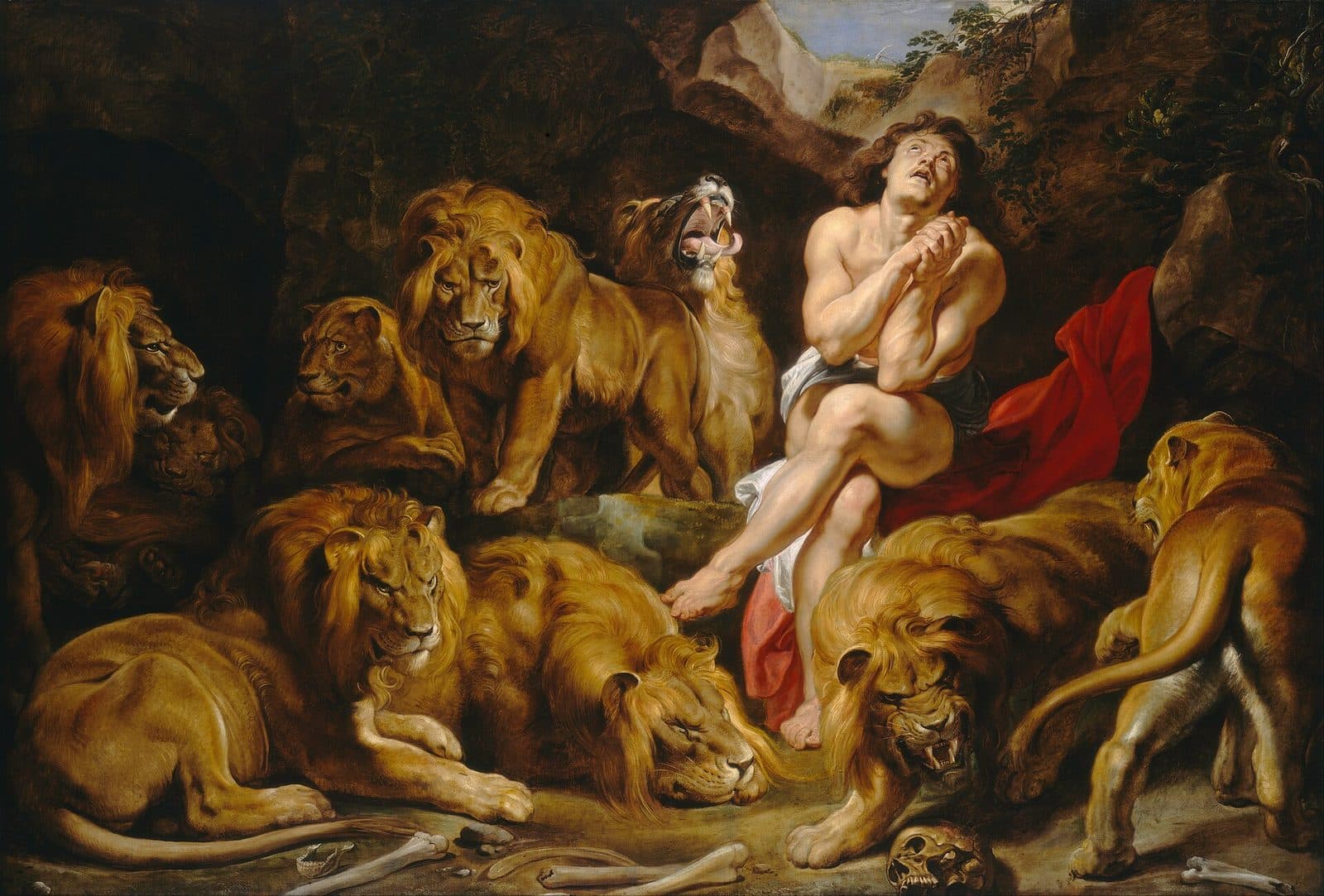
Peter Paul Rubens, Daniel in the Lions' Den, about 1614 to 1616. Public domain, via Wikimedia Commons.
THE ARTWORKRubens painted Daniel young and bare to the waist, seated among the lions with his hands clasped and his eyes on the opening above.
Ezekiel, an exile of the same generation, named Daniel beside Noah and Job as one of three righteous men.
Summary
Daniel was a young man of Judah taken to Babylon in the third year of King Jehoiakim, and he served at the courts of Babylon and Persia for the rest of his life.
- Nebuchadnezzar's chief official renamed him Belteshazzar and had him trained in the language and literature of the Chaldeans.
- He refused the king's food and wine because he would not defile himself.
- He interpreted Nebuchadnezzar's dreams and read the writing on Belshazzar's wall.
- Under Darius the Mede he was thrown to the lions for praying to his God, and the lions did not hurt him.
- His last vision came in the third year of Cyrus, and it ends with the promise that he will rest and rise.
Where Daniel Stands in Scripture
The books of Daniel, Ezekiel and Matthew name him
Among these young men were some from Judah: Daniel, Hananiah, Mishael, and Azariah.Daniel enters Scripture as one of four young men of Judah chosen for the king's service.
Behold, you are wiser than Daniel; no secret is hidden from you!Ezekiel can taunt the ruler of Tyre with Daniel's name because Daniel, then living, was known for his wisdom.
The Life, Turn by Turn
Thirteen turns, each with its verse
- Taken captive with the young men of JudahDaniel 1:1 to 6
- Renamed BelteshazzarDaniel 1:7
- Refuses the king's foodDaniel 1:8
- Tells and interprets the dream of the statueDaniel 2:31 to 45
- Made ruler of the province of BabylonDaniel 2:48
- Interprets the dream of the treeDaniel 4:19
- Sees the four beastsDaniel 7:1
- Sees the ram and the goatDaniel 8:1
- Reads the writing on the wallDaniel 5:25 to 30
- Set over the satrapsDaniel 6:2
- Thrown to the lionsDaniel 6:16
- Prays over Jeremiah's seventy yearsDaniel 9:1 to 3
- Sees the last visionDaniel 10:1 to 4
A timeline in the order of events, so the visions of Daniel 7 and 8 stand before the night of Daniel 5.
From Captive to Counsellor
Daniel 1 to 12
Daniel's book tells his life in two halves. Chapters 1 to 6 tell what he did at the courts of Nebuchadnezzar, Belshazzar and Darius, and chapters 7 to 12 record the visions he received, each dated by the reign in which it came.
The king's tableDaniel 1
Ashpenaz, the chief of the court officials, chose young men from Israel's royal family and nobility to serve in the palace. They were to learn the language and literature of the Chaldeans for three years.
But Daniel made up his mind that he would not defile himself with the king’s food or wine. So he asked the chief official for permission not to defile himself.Daniel accepts the new name and the training, and draws his line at the king's food.
Adam Clarke gives three likely reasons for the refusal: the king's table served animals the law forbade, meat not drained of its blood, and food first offered to idols. The text itself says only that Daniel would not defile himself.
To these four young men God gave knowledge and understanding in every kind of literature and wisdom. And Daniel had insight into all kinds of visions and dreams.The learning that carries Daniel's whole career is given by God.
The dream of the statueDaniel 2
Nebuchadnezzar demanded that his wise men tell him his dream before they interpreted it, and when they could not, he ordered every wise man in Babylon killed. Daniel asked for time, and he and his three friends pleaded with the God of heaven for mercy.
Daniel answered the king, “No wise man, enchanter, medium, or magician can explain to the king the mystery of which he inquires. But there is a God in heaven who reveals mysteries, and He has made known to King Nebuchadnezzar what will happen in the latter days. Your dream and the visions that came into your mind as you lay on your bed were these:The young exile points the most powerful ruler on earth away from himself.
Then the king promoted Daniel and gave him many generous gifts. He made him ruler over the entire province of Babylon and chief administrator over all the wise men of Babylon. And at Daniel’s request, the king appointed Shadrach, Meshach, and Abednego to manage the province of Babylon, while Daniel remained in the king’s court.Daniel's first promotion also brings his three friends into office.
The tree and the warningDaniel 4
Chapter 4 is Nebuchadnezzar's own proclamation. He dreamed of a great tree cut down to its stump, and he called for Daniel, whose Babylonian name he says was given after the name of his god.
For a time, Daniel, who was also known as Belteshazzar, was perplexed, and his thoughts alarmed him. So the king said, “Belteshazzar, do not let the dream or its interpretation alarm you.” “My lord,” replied Belteshazzar, “may the dream apply to those who hate you, and its interpretation to your enemies!Daniel is alarmed for the king he must warn and wishes the dream on the king's enemies.
Therefore, may my advice be pleasing to you, O king. Break away from your sins by doing what is right, and from your iniquities by showing mercy to the oppressed. Perhaps there will be an extension of your prosperity.”Daniel does more than interpret: he urges the king to show mercy to the oppressed.
The writing on the wallDaniel 5
Belshazzar drank from the vessels taken from the temple in Jerusalem, and a hand wrote on the wall of the palace. The queen had to remind the king that Daniel was there, a man his father had made chief of the magicians.
In response, Daniel said to the king, “You may keep your gifts for yourself and give your rewards to someone else. Nevertheless, I will read the inscription for the king and interpret it for him.He turns down the reward first, so no one can say his reading was bought.
But you his son, O Belshazzar, have not humbled your heart, even though you knew all this.Belshazzar is judged for knowing what had happened to Nebuchadnezzar and still refusing to humble himself.
Belshazzar was killed that night, and Darius the Mede received the kingdom at the age of sixty-two.
The den of lionsDaniel 6
Darius set 120 satraps over his kingdom and three administrators over them, Daniel among the three. The king planned to set him over the whole kingdom.
Thus the administrators and satraps sought a charge against Daniel concerning the kingdom, but they could find no charge or corruption, because he was trustworthy, and no negligence or corruption was found in him. Finally these men said, “We will never find any charge against this Daniel, unless we find something against him concerning the law of his God.”The trap is built from Daniel's religion because his administration gave his enemies nothing to use.
The officials persuaded the king to sign a decree that for thirty days no one should petition any god or man except the king.
Now when Daniel learned that the document had been signed, he went into his house, where the windows of his upper room opened toward Jerusalem, and three times a day he got down on his knees, prayed, and gave thanks to his God, just as he had done before.Daniel keeps the habit he already had, at windows that face the city he left as a young man.
My God sent His angel and shut the mouths of the lions. They have not hurt me, for I was found innocent in His sight, and I have done no wrong against you, O king.”Daniel credits the angel God sent, and gives his innocence before God and before the king as the reason.
The prayer over JeremiahDaniel 9
In the first year of Darius son of Xerxes, a Mede by descent, who was made ruler over the kingdom of the Chaldeans— in the first year of his reign, I, Daniel, understood from the sacred books, according to the word of the LORD to Jeremiah the prophet, that the desolation of Jerusalem would last seventy years. So I turned my attention to the Lord God to seek Him by prayer and petition, with fasting, sackcloth, and ashes.The date ties Daniel's reading of Jeremiah to the first year after Babylon fell to the Medes.
Jerome, in his Commentary on Daniel, observes that the promise Daniel had read did not make him careless, and instead encouraged him to pray that God would fulfil what He had promised.
While I was speaking, praying, confessing my sin and that of my people Israel, and presenting my petition before the LORD my God concerning His holy mountain—He places himself inside the guilt he is praying about.
Gabriel came while he was still praying, about the time of the evening sacrifice, and told him that an answer had gone out at the beginning of his petitions. The answer Gabriel brought is the prophecy of the seventy weeks.
The visions and the last wordDaniel 7, 8, 10 to 12
Thus ends the matter. As for me, Daniel, my thoughts troubled me greatly, and my face turned pale. But I kept the matter to myself.”Daniel had interpreted the king's dreams, and his own vision left him troubled and pale.
I, Daniel, was exhausted and lay ill for days. Then I got up and went about the king’s business. I was confounded by the vision; it was beyond understanding.The vision costs Daniel his strength, and still he returns to serve the king of Babylon.
The man who appeared to Daniel in his last vision said that his words had been heard from the first day. The prince of the kingdom of Persia had opposed the messenger for twenty-one days, until Michael came to help.
I heard, but I did not understand. So I asked, “My lord, what will be the outcome of these things?” “Go on your way, Daniel,” he replied, “for the words are closed up and sealed until the time of the end.Even at the end of his life the prophet is left without the full meaning of what he saw.
What the Text Sets Beside the Retelling
Six details retellings often drop
A WRITTEN RECORD
Daniel wrote down his dream of the four beasts and set down a summary of his account.
ABSENT FROM THE FURNACE
The men accused of refusing the golden statue are Shadrach, Meshach and Abednego, and chapter 3 never names Daniel.
TACT BEFORE THE EXECUTIONER
When the commander of the king's guard went out to execute the wise men, Daniel replied to him with discretion and tact.
A KING WHO COULD NOT SAVE HIM
Darius was deeply distressed and labored until sundown to rescue Daniel from his own decree.
PROSPERITY AFTER THE DEN
Daniel prospered during the reign of Darius and the reign of Cyrus the Persian.
LIONS THAT WERE HUNGRY
The lions crushed the accusers before they reached the bottom of the den, which shows that Daniel's night was a deliverance.
The World Behind the Story
The date of the exile, Belshazzar, and Daniel in the Jewish writings
Albert Barnes dates the siege of Daniel 1:1 to 606 BC by Ussher's reckoning and to 607 BC by Jahn's, and he holds that the difference of a year does not matter.
Jamieson, Fausset and Brown note that Berosus names Nabonidus as the last king of Babylon, and that the inscriptions show Belshazzar as distinct from Nabonidus and joint king with him.
Daniel in the Apocrypha1 Maccabees 2; Bel and the Dragon
In 1 Maccabees 2:60 the dying Mattathias names Daniel among the faithful, in the King James words "Daniel for his innocency was delivered from the mouth of lions."
Bel and the Dragon, one of the additions to Daniel in the Apocrypha, tells of a second den, where Daniel spent six days among seven lions. The seven lions and the six days belong to that book and are absent from Daniel 6.
Daniel in the Jewish commentatorsRashi
Rashi was a Jewish commentator of France who died in 1105. He reads Daniel's three weeks of mourning in Daniel 10 as grief that Cyrus had halted the building of the temple, after the letter of Judah's adversaries in Ezra 4.
On Daniel 1:21 Rashi reports the opinion of Rav, recorded in the Babylonian Talmud at Megillah 15a, that Hathach, whom Esther sent to Mordecai, was Daniel.
The Places of His Life
Five places, from Jerusalem to the bank of the Tigris
about 250 km (155 miles)
- 1Jerusalem, The Lord delivered its king into Nebuchadnezzar's hand. Daniel 1:2
- 2Babylon, Daniel ruled the province and served at the king's court. Daniel 2:48
- 3Susa, In a vision Daniel saw himself in the citadel, in the province of Elam. Daniel 8:2
- 4Ulai Canal, He stood beside the canal in the same vision. Daniel 8:2
- 5Tigris, He saw the man dressed in linen on the bank of the great river. Daniel 10:4
Not located: Ulai Canal, Tigris.
The coastline is simplified; each place stands at its place page's coordinates.
A map of the places in the order the book reaches them, with a door where the site has a place page.
Questions the Life Raises
Three questions, each answered from its verses
How old was Daniel when he was thrown to the lions?Daniel 6; Matthew Henry
Scripture gives no age, but the book's own dates leave a lifetime between the deportation and the den.
“We must take notice of it, to the glory of God, that, though Daniel was now very old (it was above seventy years since he was brought a captive to Babylon), yet he was as able as ever for business both in body and mind, and that he who had continued faithful to his religion through all the temptations of the foregoing reigns in a new government was as much respected as ever.”
Matthew Henry · Commentary on the Whole Bible · on Daniel 6:3Puritan
Did Daniel die in the first year of Cyrus?Daniel 1:21 and 10:1; Albert Barnes
Daniel 1:21 says he remained until the first year of King Cyrus, and Daniel 10:1 dates a vision to Cyrus's third year. Albert Barnes reads the first verse as the span of his office and influence, and holds that it does not mark his death.
Who was Darius the Mede?Daniel 5:31; Jamieson, Fausset and Brown; John Gill; Albert Barnes
Daniel 9:1 calls him the son of Xerxes and a Mede by descent. Jamieson, Fausset and Brown, John Gill and Albert Barnes identify him with Cyaxares, the uncle of Cyrus, in whose name Cyrus took the city.
What the Text Leaves Unsaid
Two silences: his household and his grave
Scripture names no father, wife or child of Daniel.
The book records no death or burial for Daniel.
Where Daniel Points
The Son of Man and the resurrection
In the first year of Belshazzar, Daniel saw One like the Son of Man come with the clouds of heaven to the Ancient of Days and receive a kingdom that will never be destroyed.
“I am,” said Jesus, “and you will see the Son of Man sitting at the right hand of Power and coming with the clouds of heaven.”Asked by the high priest whether He is the Christ, Jesus answers with Daniel's vision of the Son of Man.
And many who sleep in the dust of the earth will awake, some to everlasting life, but others to shame and everlasting contempt.This verse is the ground of the promise made to Daniel himself at the close of his book.
Matthew Henry notes that the Jews themselves read this verse of the resurrection at the end of time. He holds that Jesus has it in view in John 5:29, where He speaks of the resurrection of life and the resurrection of judgment.
Voices on Daniel
Three commentators on Daniel under Darius
Calvin explains the envy that rose against Daniel under the new king.
“We must notice, in the context of this history, how Daniel alone was chosen by Darius one of these three superior officers. He was the third in rank under king Belshazzar, although for a moment, yet it might occasion envy under the new king that so great an honor was conferred upon him.”
John Calvin · Commentaries · on Daniel 6:2Reformed
Hippolytus sees in the plot a pattern that every godly man meets.
“Accordingly, after this happened, the governors and satraps were stirred with jealousy and sought to find a pretext against Daniel, so that they might take some occasion against him and accuse him and kill him. In which manner the word was fulfilled, which we spoke a little before, that a pious man or one who fears God and has grace and wisdom from God is hated by the rest of men because they also were not honored with the same gift.”
Hippolytus of Rome · Commentary on Daniel 3.19.3-6 · on Daniel 6:4Patristic
Henry observes what Daniel's enemies did not do.
“It is observable that, when Daniel's enemies could find no occasion against him concerning the kingdom, they had so much sense of justice left that they did not suborn witnesses against him to accuse him of crimes he was innocent of, and to swear treason upon him, wherein they shame many that were called Jews and are called Christians.”
Matthew Henry · Commentary on the Whole Bible · on Daniel 6:5Puritan
When Was the Book of Daniel Written?
Two positions, each with the names of those who hold it
The book speaks of Daniel in the third person in chapters 1 to 6 and in the first person in the visions.
Daniel wrote it at BabylonJerome; John Gill
Jerome, in his Commentary on Daniel, and John Gill, in his Exposition of the Old Testament, hold that Daniel himself saw and recorded the visions. Gill rests on Daniel 8:15, where the seer gives his own name.
A later author wrote it under AntiochusPorphyry, Against the Christians, book 12, as Jerome reports him
Porphyry, as Jerome reports him, read the little horn of Daniel 7 as Antiochus Epiphanes and the three uprooted horns as two of the Ptolemies and a king of Armenia. Gill reports Porphyry's claim that the true Daniel never saw the vision and that the book was written after Antiochus's reign.
Books to Read Next
Four commentaries, from the third century to the eighteenth
Commentary on Daniel
Hippolytus of Rome · early third century
Hippolytus comments on the book chapter by chapter, from the young men's diet in Daniel 1 to the vision of Daniel 10.
Commentary on Daniel
Jerome · early fifth century
Jerome quotes Porphyry's readings of the visions as he goes and answers each of them.
Commentaries on the Book of the Prophet Daniel
John Calvin · 1561
Calvin delivered his commentary on Daniel as a series of lectures.
Commentary on the Whole Bible
Matthew Henry · 1710
Henry comments on Daniel from the vessels taken in Daniel 1:2 to the resurrection of Daniel 12:2.
Go Your Way to the End
But as for you, go on your way until the end. You will rest, and will arise to your inheritance at the end of the days.”The last word spoken to Daniel promises him rest and a share at the end of the days.
Daniel kept his habit of prayer in a foreign court for a lifetime, and the One like the Son of Man he saw is Jesus, who said He would raise the dead. The text asks the reader to keep faith where they are placed, as Daniel did, and to wait for that day.
Keep studying
Studies8
People6
Doctrines7
Peoples and groups1