
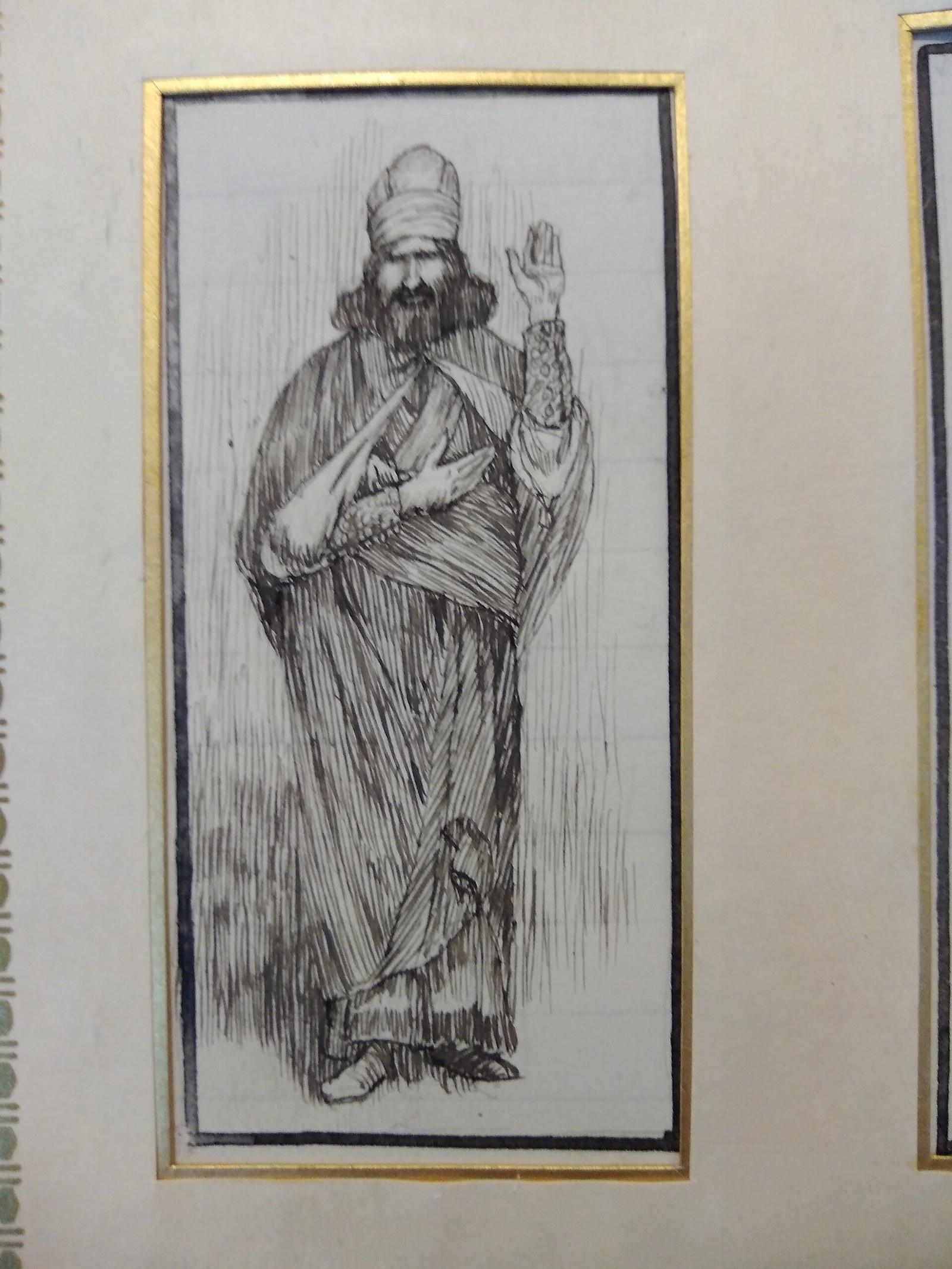
James Tissot, Zephaniah, 1902. Public domain.
Zephaniah 1:1 · Person · Featured Study
Zephaniah the Prophet and the Hezekiah of His Line
Zephaniah traced his line back four generations to a man named Hezekiah.
The prophet's own name stands in a single verse of the Bible.
This is the word of the LORD that came to Zephaniah son of Cushi, the son of Gedaliah, the son of Amariah, the son of Hezekiah, in the days of Josiah son of Amon king of Judah:
This is the word of the LORD that came to Zephaniah son of Cushi, the son of Gedaliah, the son of Amariah, the son of Hezekiah, in the days of Josiah son of Amon king of Judah:
- Family
- father: Cushi; grandfather: Gedaliah; great-grandfather: Amariah; great-great-grandfather: Hezekiah
- First named
- Zephaniah 1:1 “…the LORD that came to Zephaniah son of…”
- Last named
- Zephaniah 1:1 “…the LORD that came to Zephaniah son of…”
Summary
Zephaniah spoke the word of the LORD in the days of Josiah, king of Judah. His book closes with a promise of joy over Zion.
- Commentators divide over whether his forebear was the king.
- His father's name Cushi is also the word for a man of Cush.
- John Wesley called him a contemporary of Jeremiah and Ezekiel.
Where Zephaniah Stands in Scripture
Nine other verses name other men called Zephaniah.
His Time Under Josiah
The book dates his word to Josiah's reign of thirty-one years and gives no year within it.
Zephaniah spoke within a reign that turned from idols to reform.
- Josiah becomes king at eight years oldHis first year2 Kings 22:1
- The word of the LORD comes to ZephaniahIn the days of Josiah; no year is givenZephaniah 1:1
- Josiah begins to seek the God of DavidHis eighth year2 Chronicles 34:3
- Josiah begins to cleanse Judah and JerusalemHis twelfth year2 Chronicles 34:3
- The word of the LORD comes to JeremiahHis thirteenth yearJeremiah 1:2
- Josiah sends Shaphan the scribe to the house of the LORDHis eighteenth year2 Kings 22:3
- Josiah's body is carried from Megiddo, and Jehoahaz is made kingThe end of his thirty-one years2 Kings 23:30
Seven turns of Josiah's reign.
Adam Clarke dated the book early in the reign, before the reform, because the disorders it describes were still in Judah.
His Words Against the Court
Zephaniah names the princes and the king's sons and leaves the king himself unnamed.
“On the Day of the LORD’s sacrifice I will punish the princes, the sons of the king, and all who are dressed in foreign apparel.The royal house stands under the same judgment as the idol priests of the verses before.
Albert Barnes wrote that the prophet does not name Josiah, a godly king to whom the LORD had promised burial in peace.
‘Therefore I will indeed gather you to your fathers, and you will be gathered to your grave in peace. Your eyes will not see all the calamity that I will bring on this place.’” So they brought her answer back to the king.Barnes points to this promise to explain the king's absence from the oracle.
John Wesley read the king's sons as Josiah's sons and grandsons. Jehoahaz died a captive in Egypt, and Zedekiah and his children fared worse.
Her prophets are reckless, faithless men. Her priests profane the sanctuary; they do violence to the law.The charge then turns from the court to the city's prophets and priests.
Two Lines From Hezekiah
Hezekiah stands at the head of the king's line in 2 Kings and of the prophet's line in Zephaniah.
If his forebear was the king, Zephaniah stood one generation below Josiah.
Generation 1
- Hezekiah, king of JudahSon of Ahaz, at the head of the king's line
- Hezekiah of Zephaniah 1:1At the head of the prophet's line; the verse gives him no title
Generation 2
Generation 3
Generation 4
Generation 5
- ZephaniahThe prophet
Nine names in two lines, from 2 Kings and Zephaniah 1:1.
The Places in His Words
His oracles run from the gates of Jerusalem to Nineveh in Assyria.
Zephaniah named Jerusalem first and then the nations on every side.
| Place | What he says of it |
|---|---|
| Jerusalem | A cry from the Fish Gate and a wail from the Second District. |
| Gaza, Ashkelon, Ashdod and Ekron | The four Philistine cities abandoned and uprooted. |
| Moab and Ammon | Made like Sodom and Gomorrah, a place of weeds and salt pits. |
| Cush | Slain by the LORD's sword. |
| Nineveh | Made a desolation, as dry as a desert. |
The Name Cushi
Strong's numbering gives the name Cushi two entries.
The Hebrew text tags the prophet's father Cushi with h3569, the entry for a Cushite used of Ebed-melech. It tags the Cushi in the line of Jehudi with h3570, the entry for the personal name.
Now Ebed-melech the Cushite, a court official in the royal palace, heard that Jeremiah had been put into the cistern. While the king was sitting at the Gate of Benjamin,Here the same word marks a man from Cush who served in Jerusalem.
Then all the officials sent word to Baruch through Jehudi son of Nethaniah, the son of Shelemiah, the son of Cushi, saying, “Bring the scroll that you read in the hearing of the people, and come here.” So Baruch son of Neriah took the scroll and went to them.Here the name stands in an Israelite family line.
What the Text Leaves Unsaid
Scripture leaves most of his life untold.
It gives no year of his birth and no account of his death.
It does not say how the court received his words.
Voices on Zephaniah
John Calvin comments on the opening verse of the book.
John Calvin (1509 to 1564)
Calvin weighed both the four names and the prophet's claim about his message.
“It is possible that the father, grandfather, the great-grandfather, and the great-great-grandfather of the Prophet, were persons who excelled in piety; but this also is uncertain. What is especially worthy of being noticed is-- that he begins by saying that he brought nothing of his own, but faithfully, and, as it were, by the hand, delivered what he had received from God.”
John Calvin · Commentaries · on Zephaniah 1:1Reformed
Was His Forebear King Hezekiah?
Keil and Delitzsch, Ellicott and Wesley took him for the king, while Clarke and the Pulpit Commentary left the question open.
The king of JudahKeil and Delitzsch; Ellicott's Commentary; John Wesley
Keil and Delitzsch held that this Hezekiah must have been a well-known man, and in all probability the king. A. C. Jennings, in Ellicott's Commentary, noted that Jerome and Aben Ezra took him for the king, and that the line stops at Hezekiah and goes no further.
John Wesley wrote that the prophet is thought to have been the great-grandson of King Hezekiah.
A man of note in the lineAlbert Barnes
Albert Barnes wrote that the line is longer than Scripture's custom because the last man named was someone remarkable.
Left openThe Pulpit Commentary; Adam Clarke; Matthew Henry
The Pulpit Commentary wrote that whether the great King of Judah is meant may well be questioned. Adam Clarke wrote that nothing certain is known of the persons of the family. Matthew Henry noted only that the name in the Hebrew is the same as the king's.
A line of prophetsJerome, Commentary on Zephaniah
Jerome reported a Jewish tradition that a prophet's father or grandfather is named in the title when they too were prophets.
His Call to the Humble
The prophet who warned the court also called the humble to seek the LORD.
Seek the LORD, all you humble of the earth who carry out His justice. Seek righteousness; seek humility. Perhaps you will be sheltered on the day of the LORD’s anger.Shelter is offered before the day comes.
Sources
Scripture is the Berean Standard Bible.
- The Hebrew text of Zephaniah 1:1, Jeremiah 36:14 and 38:7, word by word, with Strong's numbers.
- The Hebrew Bible with Strong's numbers, every verse that names a Zephaniah (h6846)
- Strong's Hebrew lexicon, h2396, h3569 and h3570.
- Henry, Commentary on the Whole Bible; Calvin, Commentaries; Wesley, Explanatory Notes; Clarke, Commentary on the Bible; Barnes, Notes; Gill, Exposition; Jamieson, Fausset and Brown, Commentary Critical and Explanatory; Jerome, Commentary on Zephaniah; on Zephaniah 1:1, Zephaniah 1:8 and Zephaniah 3:3 to 4.
- John Calvin, Commentaries (1554), on Zephaniah 1:1.
- John Wesley, Explanatory Notes upon the Old Testament (1765), on Zephaniah 1:1 and 1:8.
- Albert Barnes, Notes, Explanatory and Practical, on Zephaniah 1:1 and 1:8.
- Matthew Henry, Commentary on the Whole Bible (1710), on Zephaniah 1:1.
- Adam Clarke, Commentary on the Bible (1832), on Zephaniah 1:1.
- Jerome, Commentary on Zephaniah (420), on Zephaniah 1:1.
- Carl Friedrich Keil and Franz Delitzsch, Biblical Commentary on the Old Testament: The Minor Prophets, introduction to Zephaniah.
- Ellicott's Commentary for English Readers, introduction to Zephaniah by A. C. Jennings.
- The Pulpit Commentary, on Zephaniah 1:1.
Keep Studying
People and groups8