
Genesis 12, 20 and 26 · Subject · Featured Study
The wife and sister scenes
Genesis 12, 20 and 26 tell how Abram in Egypt, Abraham at Gerar and Isaac at Gerar each passed off his wife as his sister before a foreign king.
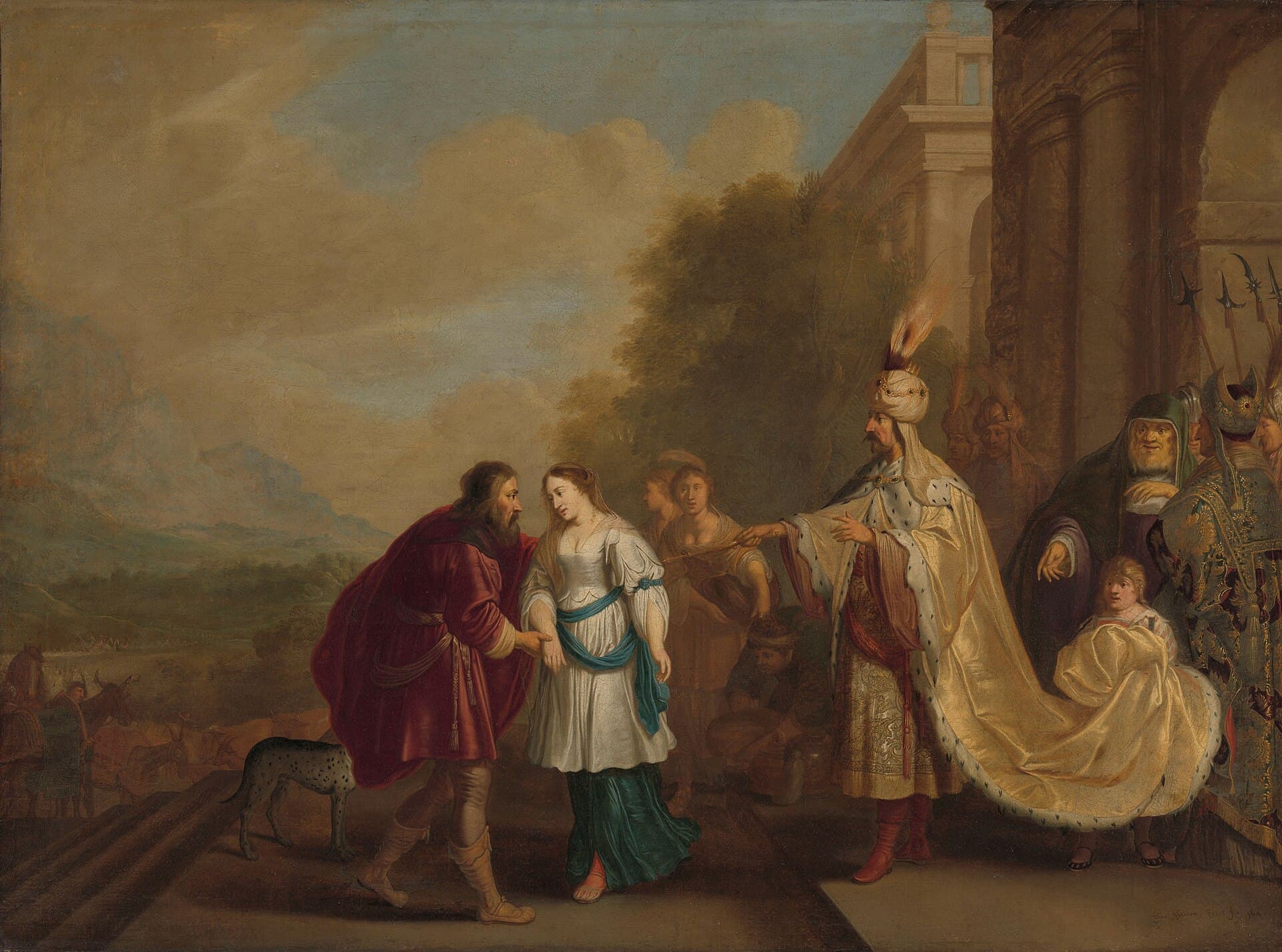
Isaac Isaacsz., Pharaoh Returns Sarah to Abraham, 1640, Rijksmuseum, Amsterdam. Public domain, via Wikimedia Commons.
THE ARTWORKThe king sends the couple away from his palace steps, the close of Genesis 12:18 to 20, after the plagues on his house. Abram's herds and servants wait on the plain at the left to leave Egypt with him.
Each time the patriarch feared he would be killed for his wife, and each time the king asked him what he had done.
Summary
Each scene put a wife of the promised line in danger, and each time God kept her from harm.
- A famine took Abram and Sarai to Egypt, where Pharaoh took Sarai into his palace until the LORD struck his household with plagues.
- Abraham called Sarah his sister at Gerar shortly before the birth of Isaac.
- Abraham told Abimelech that Sarah was the daughter of his father, though not the daughter of his mother.
- Isaac said the same of Rebekah at Gerar, and Abimelech found out when he saw Isaac caressing her.
Three Scenes in Two Generations
Two scenes belong to Abraham and one to Isaac.
The first scene follows the call directly, when a famine sends Abram out of the land the LORD had just promised to his offspring.
and when the Egyptians see you, they will say, ‘This is his wife.’ Then they will kill me but will let you live. Please say you are my sister, so that I will be treated well for your sake, and on account of you my life will be spared.”Abram's fear for his life and his plan for Sarai are set down here in his own words.
The second scene comes shortly before the birth of Isaac in Genesis 21.
Abraham said of his wife Sarah, “She is my sister.” So Abimelech king of Gerar had Sarah brought to him.This verse shows Abraham at Gerar using the words he had asked Sarai to say in Egypt.
Abraham replied, “I thought to myself, ‘Surely there is no fear of God in this place. They will kill me on account of my wife.’ Besides, she really is my sister, the daughter of my father—though not the daughter of my mother—and she became my wife. So when God had me journey from my father’s house, I said to Sarah, ‘This is how you can show your loyalty to me: Wherever we go, say of me, “He is my brother.”’”Abraham answers Abimelech with his fear, the half-sister fact and a plan made long before.
A generation later another famine brings Isaac to Gerar, and the LORD tells him to stay in the land.
But when the men of that place asked about his wife, he said, “She is my sister.” For he was afraid to say, “She is my wife,” since he thought to himself, “The men of this place will kill me on account of Rebekah, because she is so beautiful.”Isaac gives the reason his father gave and uses his father's words.
The Scenes Side by Side
Two of the scenes take place at Gerar, and in each scene the truth comes out by a different means.
| Point | Abram and Sarai, Genesis 12 | Abraham and Sarah, Genesis 20 | Isaac and Rebekah, Genesis 26 |
|---|---|---|---|
| The place | Egypt | Gerar, in the Negev between Kadesh and Shur | Gerar of the Philistines |
| What brought them | A severe famine | No reason given | A second famine |
| The king | Pharaoh | Abimelech, king of Gerar | Abimelech, king of the Philistines |
| Who says sister | Abram, who asks Sarai to say it too | Abraham, and Sarah calls him her brother | Isaac, when the men of the place ask about Rebekah |
| The wife | Taken into Pharaoh's palace | Brought to Abimelech, who does not go near her | Taken by no one |
| How the truth comes out | Severe plagues from the LORD | God warns Abimelech in a dream | Abimelech sees Isaac caressing Rebekah from a window |
| What the king gives or says | Flocks and servants given before the truth is known, then a rebuke and an escort out of Egypt | A rebuke, flocks, servants, a thousand pieces of silver and the offer of his land | A rebuke, and death for anyone who harms Isaac or Rebekah |
| The promise at stake | A great nation from Abram | A son by Sarah within the year | Offspring through whom all nations will be blessed |
- Point
- The place
- Abram and Sarai, Genesis 12
- Egypt
- Abraham and Sarah, Genesis 20
- Gerar, in the Negev between Kadesh and Shur
- Isaac and Rebekah, Genesis 26
- Gerar of the Philistines
- Point
- What brought them
- Abram and Sarai, Genesis 12
- A severe famine
- Abraham and Sarah, Genesis 20
- No reason given
- Isaac and Rebekah, Genesis 26
- A second famine
- Point
- The king
- Abram and Sarai, Genesis 12
- Pharaoh
- Abraham and Sarah, Genesis 20
- Abimelech, king of Gerar
- Isaac and Rebekah, Genesis 26
- Abimelech, king of the Philistines
- Point
- Who says sister
- Abram and Sarai, Genesis 12
- Abram, who asks Sarai to say it too
- Abraham and Sarah, Genesis 20
- Abraham, and Sarah calls him her brother
- Isaac and Rebekah, Genesis 26
- Isaac, when the men of the place ask about Rebekah
- Point
- The wife
- Abram and Sarai, Genesis 12
- Taken into Pharaoh's palace
- Abraham and Sarah, Genesis 20
- Brought to Abimelech, who does not go near her
- Isaac and Rebekah, Genesis 26
- Taken by no one
- Point
- How the truth comes out
- Abram and Sarai, Genesis 12
- Severe plagues from the LORD
- Abraham and Sarah, Genesis 20
- God warns Abimelech in a dream
- Isaac and Rebekah, Genesis 26
- Abimelech sees Isaac caressing Rebekah from a window
- Point
- What the king gives or says
- Abram and Sarai, Genesis 12
- Flocks and servants given before the truth is known, then a rebuke and an escort out of Egypt
- Abraham and Sarah, Genesis 20
- A rebuke, flocks, servants, a thousand pieces of silver and the offer of his land
- Isaac and Rebekah, Genesis 26
- A rebuke, and death for anyone who harms Isaac or Rebekah
- Point
- The promise at stake
- Abram and Sarai, Genesis 12
- A great nation from Abram
- Abraham and Sarah, Genesis 20
- A son by Sarah within the year
- Isaac and Rebekah, Genesis 26
- Offspring through whom all nations will be blessed
Pharaoh, Gerar and Its King
The scenes move between the court of Egypt and the town of Gerar in the Negev.
Adam Clarke, in his Commentary on the Bible, takes Pharaoh as the title every king of Egypt bore until the Greek kings, who were called Ptolemies.
Jamieson, Fausset & Brown place Gerar on the southern border of Canaan, in a rich and well-watered pasture land.
Clarke reckons Sarah to have been about ninety at Gerar. He thinks Abimelech took her to make an alliance with a very rich man more than for her beauty.
The Hebrew Word for Sister
The three scenes use one Hebrew word for every sister they name.
That word is achot (אָחוֹת), and it stands 114 times in the STEP-tagged Hebrew text, 24 of them in Genesis. Seven of those fall in the three scenes, at Genesis 12:13, Genesis 12:19, Genesis 20:2, Genesis 20:5, Genesis 20:12, Genesis 26:7 and Genesis 26:9.
You must not have sexual relations with your sister, either your father’s daughter or your mother’s daughter, whether she was born in the same home or elsewhere.The law later given through Moses forbids a marriage like that of Abraham and Sarah.
Jerome, in his Hebrew Questions on Genesis, defends the marriage on the ground that such marriages were not yet forbidden by law.
Sarah as Terah's daughter by another wifeAdam Clarke
Sarah as the daughter of HaranRashi; John Gill
Rashi, in his commentary on Genesis, reads Sarah as the daughter of Abraham's brother and counts a grandchild as a child, as Abram calls his nephew Lot a brother in Genesis 13:8. He adds that a daughter of the same father was permitted in marriage to the descendants of Noah.
John Gill, in his Exposition of the Old Testament, also makes Sarah the daughter of Haran and the sister of Lot, with Haran and Abraham born to Terah by two different wives.
What the Text Leaves Unsaid
Genesis leaves three questions about the scenes open.
Genesis gives no reason for Abraham's move to Gerar in chapter 20.
John Calvin, in his Commentaries on the First Book of Moses Called Genesis, holds that Abraham did not move for an insufficient cause, since a son had lately been promised him through Sarah.
Radak, in his commentary on Genesis, rules out a famine, since Genesis 26:1 names only the famine of Abraham's time in Egypt. He suggests that Abraham went to dwell in every part of the land God had promised.
The text does not name the plagues that fell in Egypt. Adam Clarke points to the closed wombs of Abimelech's household in Genesis 20:18 and leaves open whether Egypt suffered the same.
Genesis does not say whether Abraham ever told Isaac of Egypt and Gerar. Clarke supposes that he did not, out of shame, so that Isaac met the same temptation unwarned.
God Guards the Mother of the Promise
The promised line ran through Sarah and then through Rebekah, the two wives the scenes put in danger.
And I will bless her and will surely give you a son by her. I will bless her, and she will be the mother of nations; kings of peoples will descend from her.”God gave this promise before the scene at Gerar, so the woman Abimelech had brought to him was the one God had named as the mother of Abraham's son.
Stay in this land as a foreigner, and I will be with you and bless you. For I will give all these lands to you and your offspring, and I will confirm the oath that I swore to your father Abraham. I will make your descendants as numerous as the stars in the sky, and I will give them all these lands, and through your offspring all nations of the earth will be blessed,The LORD renews the oath sworn to Abraham just before Isaac calls Rebekah his sister.
Calvin reads the command that kept Isaac out of Egypt as God's care for a weaker man.
“Because, therefore, he knew that there was more infirmity in Isaac than there had been in Abraham, he was unwilling to expose him to danger; for he is faithful, and will not suffer his own people to be tempted beyond what they are able to bear.”
John Calvin · Commentaries · on Genesis 26:2Reformed
Psalm 105 looks back on the wanderings of the patriarchs.
they wandered from nation to nation, from one kingdom to another. He let no man oppress them; He rebuked kings on their behalf: “Do not touch My anointed ones! Do no harm to My prophets!”In the psalm God rebukes kings for the patriarchs, and in the scenes the kings rebuke them.
Jamieson, Fausset & Brown find Abimelech the more honorable of the two men at Gerar.
“Who would not rather be in the place of Abimelech than of the honored but sadly offending patriarch! What a dignified attitude is that of the king--calmly and justly reproving the sin of the patriarch, but respecting his person and heaping coals of fire on his head by the liberal presents made to him.”
Jamieson, Fausset & Brown · Commentary Critical and Explanatory on the Whole Bible · on Genesis 20:9Reformed
Readings of Abraham's Half-Truth
Commentators from the fourth century to the nineteenth judge the words Abram and Abraham used.
Ambrose of Milan finds the cause of the plan in what Abram knew of Egypt.
“There came a famine, and so he went to Egypt. He knew that in Egypt the dissipation of youth was widespread, characterized by lust, impudent desires and unrestrained passions. He understood that among such men the modesty of his wife would be defenseless and that her beauty would be a danger for him. So he told his wife to say that she was his sister. By this we are taught that it is not so much beauty that one should seek in a wife, for this often leads to the death of the husband.”
Ambrose of Milan · On Abraham 1.2.6 · on Genesis 12:11 to 15Patristic
Matthew Henry finds the fear behind the plan groundless.
“We often fear where no fear is. We fear the fury of the oppressor, as though he were ready to destroy, when really there is no danger, Isa. li. It would have been more for Abram's credit and comfort to have told the truth at first; for, after all, honesty is the best policy.”
Matthew Henry · Commentary on the Whole Bible · on Genesis 12:19Puritan
Henry also weighs whether the words spoken at Gerar were true.
“Some think she was own sister to Lot, who is called his brother Lot ( ch. xiv. 16 ), though he was his nephew; so Sarah is called his sister. But those to whom he said, She is my sister, understood that she was so his sister as not to be capable of being his wife; so that it was an equivocation, with an intent to deceive.”
Matthew Henry · Commentary on the Whole Bible · on Genesis 20:12Puritan
Jamieson, Fausset & Brown judge the counsel against Abram's calling as a servant of God.
“The counsel of Abram to her was true in words, but it was a deception, intended to give an impression that she was no more than his sister. His conduct was culpable and inconsistent with his character as a servant of God: it showed a reliance on worldly policy more than a trust in the promise; and he not only sinned himself, but tempted Sarai to sin also.”
Jamieson, Fausset & Brown · Commentary Critical and Explanatory on the Whole Bible · on Genesis 12:11 to 13Reformed
Adam Clarke on what makes a lieAdam Clarke
Adam Clarke, in his Commentary on the Bible, gives Abraham's defense of Genesis 20:12, that he had suppressed only part of the truth. Clarke then defines a lie as any word or act meant to deceive, even when the words are true in themselves.
John Wesley on a fall through unbeliefJohn Wesley
John Wesley, in his Explanatory Notes upon the Old Testament, observes that faith was the grace Abram was most eminent for, and that here he fell through unbelief after God had appeared to him twice.
On Genesis 20:13 Wesley suggests that God may have denied Abraham and Sarah children so long to punish the compact they made to deny one another.
Three Events or Two Sources
Readers divide over whether the scenes record three events or join older written sources.
The scenes share a plan, its words and its outcome.
Three events at three timesRashi; Radak; John Wesley; Adam Clarke
Now there was another famine in the land, subsequent to the one that had occurred in Abraham’s time. And Isaac went to Abimelech king of the Philistines at Gerar.The narrator sets Isaac's famine after the famine of Abraham's time and so counts the scenes as separate.
Rashi, in his commentary on Genesis, reads Genesis 20:2 in the light of Egypt: this time Abraham did not ask Sarah's consent, because she had already been taken once into Pharaoh's house.
Radak, in his commentary on Genesis, notes that Pharaoh was given no dream and learned of God's displeasure only through the plagues.
John Wesley holds that the Abimelech of Isaac's day reigned nearly a hundred years after the Abimelech of Abraham's. He takes the name as the common name of the Philistine kings, as Caesar was of the Roman emperors.
Adam Clarke calls it very strange that Isaac should deny his wife in the same place and in similar circumstances, as his father had done before him.
The objection: the three scenes follow one pattern, and a second king named Abimelech at Gerar is what a retold story would produce.
Two older episodes, joined in Genesis 20E. A. Speiser
E. A. Speiser, in Genesis (Anchor Bible, 1964), holds that the source called J knew only the episodes of Genesis 12 and Genesis 26, and that the source called E joined them into Genesis 20.
Speiser also read behind the scenes a Hurrian custom of sister adoption known from the tablets of Nuzi.
Samuel Greengus answered that reading in Sisterhood Adoption at Nuzi and the Wife-Sister in Genesis, in the Hebrew Union College Annual 46 (1975).
The objection rests on Genesis 20:13, where Abraham speaks of a plan for wherever they went, and on the narrator's note in Genesis 26:1.
Books on the Scenes
Three older works comment on the scenes.
On Abraham
Ambrose of Milan · c. 387
Ambrose reads the scene in Egypt as a lesson in marriage and chastity.
Commentaries on the First Book of Moses Called Genesis
John Calvin · 1554
Calvin reads the scene at Gerar as an instance of the infirmity of man and the grace of God.
Hebrew Questions on Genesis
Jerome · c. 391
Jerome answers questions of the Hebrew text, among them Abraham's marriage to Sarah.
The Line That Led to Christ
God kept His promise to Abraham and Isaac in the very scenes where each of them put it at risk.
if we are faithless, He remains faithful, for He cannot deny Himself.Paul states as a truth about God what the three scenes show of Him.
The promises were spoken to Abraham and to his seed. The Scripture does not say, “and to seeds,” meaning many, but “and to your seed,” meaning One, who is Christ.Paul names Christ as the seed promised to Abraham, so the line God kept safe in Egypt and at Gerar is the line that led to Him.