
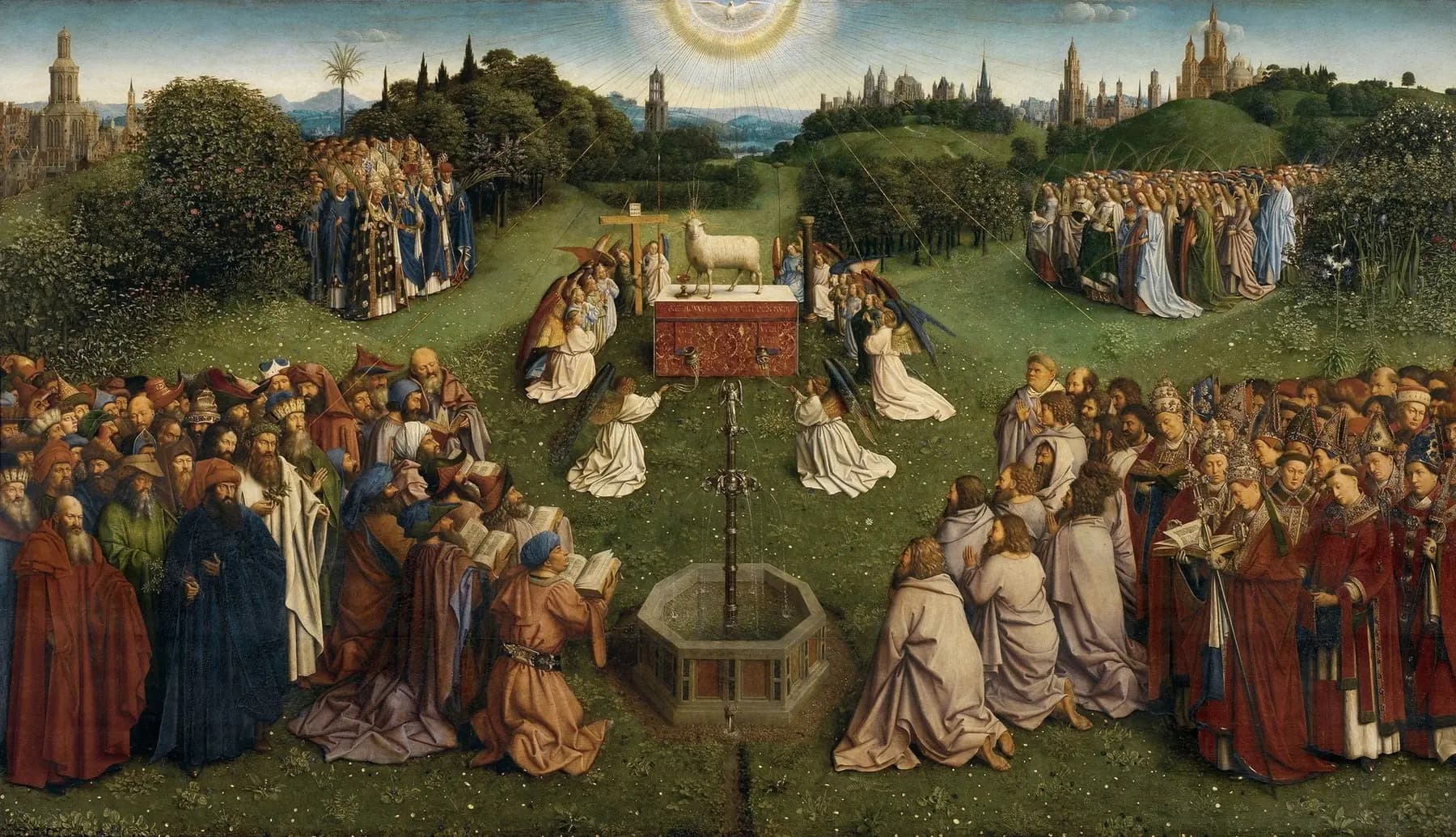
The Adoration of the Mystic Lamb, Jan and Hubert van Eyck, about 1430 to 1432. Public domain.
New Testament · Book 66 of 66
Revelation
Revelation records the visions John received on the island of Patmos. He sees the Lamb who was slain on the throne, God's judgments on the earth, the fall of Babylon, and the new Jerusalem coming down from heaven.
Revelation records the visions John received on the island of Patmos. He sees the Lamb who was slain on the throne, God's judgments on the earth, the fall of Babylon, and the new Jerusalem coming down from heaven.
What is Revelation about?
John, on Patmos, sees the risen Christ among seven lampstands and writes to seven churches. He is called up to the throne, where a Lamb who was slain takes a sealed scroll. Seals, trumpets and bowls fall on the earth, the dragon makes war on the woman and her children, and Babylon the great falls. The rider called Faithful and True returns, Satan is bound for a thousand years, and the dead are judged. John sees a new heaven, a new earth and the holy city, and the one on the throne says, “Behold, I make all things new.” (21:5).
All 22 chapters
Every chapter of the book, in one grid. Each cell opens that chapter.
- The Son of Man among the lampstandsChapters 1 to 3
- The throne and the LambChapters 4 to 5
- The seals and the trumpetsChapters 6 to 11
- The woman, the dragon and the beastsChapters 12 to 14
- The bowls and the fall of BabylonChapters 15 to 18
- The King and the new JerusalemChapters 19 to 22
The colour is the movement of the book the chapter stands in, and every cell opens that chapter's Study level.
Who wrote it, where, when, for whom, and why?
The writer names himself John four times (1:1, 1:4, 1:9, 22:8). He calls himself God's servant and a brother and partner of his readers in the tribulation, the kingdom and the perseverance that are in Jesus. The revelation comes from God to Jesus, through an angel, to John, who bears witness to all that he saw (1:1 to 2).
I, John, your brother and partner in the tribulation and kingdom and perseverance that are in Jesus, was on the island of Patmos because of the word of God and my testimony about Jesus.
Revelation 1:9, Berean Standard Bible.
John is on the island of Patmos because of the word of God and his testimony about Jesus (1:9). He is told to send what he sees to seven churches of the province of Asia, named in the order a messenger would travel them: Ephesus, Smyrna, Pergamum, Thyatira, Sardis, Philadelphia and Laodicea (1:11).
The vision comes on the Lord's day (1:10). It speaks of a faithful witness, Antipas, already killed at Pergamum (2:13), and of prison ahead for some at Smyrna (2:10). It calls its events what must soon come to pass and says the time is near (1:3, 22:10).
The letters are addressed to the churches by name, and each closes with the call to hear what the Spirit says to the churches, in the plural, so that every letter is read by all seven (2:7). The last chapter names the testimony as given for the churches (22:16).
The book is given to show God's servants what must soon take place (1:1). It carries a blessing on the one who reads it aloud and on those who hear and keep it (1:3), and it closes with a warning against adding to its words or taking from them (22:18 to 19).
Blessed is the one who reads aloud the words of this prophecy, and blessed are those who hear and obey what is written in it, because the time is near.
Revelation 1:3, Berean Standard Bible.
Sources. Revelation 1:1 to 4, 1:9 to 11, 2:7, 2:10, 2:13, 22:8, 22:10, 22:16 and 22:18 to 19. Every verse is read in the Berean Standard Bible.
How is Revelation arranged, and what is it for?
The six movements the book falls into, then what it teaches and what it was written to do.
- The Son of Man among the lampstandsChapters 1 to 3, 71 verses
John sees the risen Christ on Patmos and writes his letters to seven churches.
- The throne and the LambChapters 4 to 5, 25 verses
A door opens in heaven, and the slain Lamb takes the sealed scroll.
- The seals and the trumpetsChapters 6 to 11, 98 verses
The seals are opened and the trumpets sound, until the kingdom is proclaimed.
- The woman, the dragon and the beastsChapters 12 to 14, 55 verses
The dragon wars on the woman and her children through two beasts.
- The bowls and the fall of BabylonChapters 15 to 18, 71 verses
The seven bowls are poured out, and the great city falls in one hour.
- The King and the new JerusalemChapters 19 to 22, 84 verses
The King returns, reigns a thousand years, judges, and makes all things new.
The theme
The book shows who rules. The one seated on the throne is worshiped as Creator, and the Lamb who was slain is worthy to open the scroll of what must come to pass. Judgment comes in seals, trumpets and bowls, the dragon makes war through the beast and the harlot city, and the saints conquer by the blood of the Lamb and their testimony. The King returns, reigns, judges the dead, and makes a new heaven and a new earth where God dwells with his people.
The purpose
The book was sent to show God's servants what must soon take place (1:1), and it blesses the one who reads it aloud and those who keep what is written (1:3). It calls seven churches under pressure from outside and compromise within to hold fast, to repent where they must, and to endure. It ends with the promise of his coming and the church's answer, Come, Lord Jesus.
The four sevens
The seven churches2:1 to 3:22
- 1Ephesus“You have abandoned your first love.” (2:4)
- 2Smyrna“tribulation for ten days” (2:10)
- 3Pergamum“the teaching of Balaam” (2:14)
- 4Thyatira“that woman Jezebel” (2:20)
- 5Sardis“I will come like a thief” (3:3)
- 6Philadelphia“keep you from the hour of testing” (3:10)
- 7Laodicea“because you are lukewarm” (3:16)
The seven seals6:1 to 8:1
- 1The white horse“to overcome and conquer.” (6:2)
- 2The red horse“to take away peace” (6:4)
- 3The black horse“a pair of scales.” (6:5)
- 4The pale green horse“by sword, by famine, by plague” (6:8)
- 5The souls under the altar“How long, O Lord” (6:10)
- 6The great earthquake“a great earthquake” (6:12)
- 7Silence in heaven“silence in heaven” (8:1)
Interlude, 7:1 to 17: Between the sixth and the seventh seal: the servants of God sealed, and the multitude before the throne.
The seven trumpets8:2 to 11:19
- 1Hail and fire“hail and fire mixed with blood” (8:7)
- 2The burning mountain“the sea turned to blood” (8:8)
- 3The star Wormwood“a great star burning like a torch” (8:10)
- 4Sun, moon and stars“sun and moon and stars were struck” (8:12)
- 5The Abyss opened“the pit of the Abyss.” (9:1)
- 6The Euphrates“the great river Euphrates.” (9:14)
- 7The kingdom proclaimed“He will reign forever and ever.” (11:15)
Interlude, 10:1 to 11:14: Between the sixth and the seventh trumpet: the small scroll eaten, the temple measured, and the two witnesses.
The seven bowls16:1 to 21
- 1Sores“malignant sores” (16:2)
- 2The sea“blood like that of the dead” (16:3)
- 3Rivers and springs“rivers and springs of water” (16:4)
- 4The sun“to scorch the people with fire.” (16:8)
- 5The beast's throne“plunged into darkness” (16:10)
- 6The Euphrates dried“the kings of the East.” (16:12)
- 7It is done“It is done!” (16:17)
The Son of Man among the lampstands, Revelation 1 to 3
What the text says in these 71 verses, and the pages they open on.
The book opens as the revelation of Jesus Christ, given to his servant John, with a blessing on the one who reads it aloud (1:3). John greets seven churches of Asia from him who is and was and is to come. On Patmos, on the Lord's day, he hears a voice like a trumpet and turns to see one like a son of man among seven golden lampstands, holding seven stars (1:13 to 16). Christ then dictates seven letters, to Ephesus, Smyrna, Pergamum, Thyatira, Sardis, Philadelphia and Laodicea, and each ends with a promise to the one who overcomes.
the Living One. I was dead, and behold, now I am alive forever and ever! And I hold the keys of Death and of Hades.
- Study
Revelation 1the greeting, the vision on Patmos, the lampstandsShow the summary and 4 pagesShow summary, 4 pagesHide the summary
'This is the revelation of Jesus Christ, which God gave Him to show His servants what must soon come to pass', with the first of seven beatitudes attached: 'Blessed is the one who reads aloud the words of this prophecy, and blessed are those who hear' (1:3). Daniel 7 and Zechariah 12 are fused at once: 'Behold, He is coming with the clouds, and every eye will see Him … even those who pierced Him.' John, on Patmos, in the Spirit on the Lord's day, turns to see one like a son of man among seven golden candlesticks: hair white as white wool, eyes as a flame of fire, a sharp two-edged sword out of his mouth. 'I am the First and the Last, the Living One. I was dead, and behold, now I am alive forever and ever! And I hold the keys of Death and of Hades' (1:17-18).
On this chapter (4)
- John on Patmos
The exile and the vision on the Lord's day.
- The Son of Man
The title from Daniel 7 to the risen Christ.
- Which John wrote it?
Answered under Where do readers disagree, lower on this page, with each reading and who holds it.
- Revelation 1:8
The verse on its own page, with the commentators on it by era.
- John on Patmos
- Study
Revelation 2the letters to Ephesus, Smyrna, Pergamum and ThyatiraShow the summary and 2 pagesShow summary, 2 pagesHide the summary
Four of the seven letters, each cut to one pattern: a title from the vision of chapter 1, 'I know your deeds,' commendation, rebuke, a call to repent, a promise to him that overcometh. Ephesus tried false apostles: 'But I have this against you: You have abandoned your first love'; repent, or the candlestick is moved. Smyrna, rebuked for nothing, has tribulation and poverty ('though you are rich') and hears: 'Be faithful even … death, and I will give you the crown of life' (2:10). Pergamum dwells 'where the throne of Satan sits' yet tolerates the teaching of Balaam; hidden manna and a white stone are promised. Thyatira suffers Jezebel to teach, and the judge declares, 'I am the One who searches minds and hearts, and I will repay each of you according to your deeds.'
On this chapter (2)
- The lampstand
The lamp of the tabernacle and the churches.
- Revelation 2:7
The verse on its own page, with the commentators on it by era.
- The lampstand
- Study
Revelation 3the letters to Sardis, Philadelphia and LaodiceaShow the summary and 2 pagesShow summary, 2 pagesHide the summary
The last three letters, and the sharpest. Sardis gets an epitaph rather than a diagnosis: 'you have a reputation for being alive, yet you are dead', yet a few names there did not defile their garments, and the overcomer's name shall in no wise be blotted out of the book of life. Philadelphia receives no rebuke: from him that has the key of David: 'What He opens no one can shut' (Isaiah 22), comes a door none can shut: 'Because you have kept My command to persevere, I will also keep you from the hour of testing that is about to come upon the whole world' (3:10), which in the house's futurist reading is preservation out of the coming tribulation. Laodicea is neither cold nor hot, thinking itself rich but 'wretched, pitiful, poor, blind, and naked.'
On this chapter (2)
- The rapture
The four timings, and the promise to Philadelphia.
- Revelation 3:20
The verse on its own page, with the commentators on it by era.
- The rapture
The seven letters, part by part
Characters (3)
Who the text names. A name with a page carries its door.
- John
The servant who hears, sees and writes (1:9).
- One like a son of man
The risen Christ, robed, among the lampstands (1:13).
- Jezebel
The prophetess tolerated at Thyatira (2:20).
Places (3)
Where the chapters stand.
Themes (3)
What these chapters raise, each on its own page where one stands.
- John on Patmos
The exile and the vision.
- The lampstand
The lamp of the tabernacle and the churches.
- The one who overcomes
The promise that closes every letter.
Where these chapters take up the Old Testament (2)each marked as an allusion, with the evidence
- Probable allusionDaniel 7:13; Zechariah 12:10 at Revelation 1:7. He comes with the clouds, and those who pierced him will see him and mourn. The clouds come from Daniel's vision, and the piercing and the mourning from Zechariah.
- Probable allusionDaniel 7:9; 10:5 to 6 at Revelation 1:13 to 15. One like a son of man, hair white as wool, eyes like fire, feet like bronze. The Ancient of Days has hair like wool, and the man by the Tigris has eyes like torches and arms and feet like bronze.
Beside it: the Son of Man coming on the clouds at Matthew 24:30; the Word and the witness at John 1:1 to 14, and the one who calls himself the first and the last here.
The throne and the Lamb, Revelation 4 to 5
What the text says in these 25 verses, and the pages they open on.
John sees a door standing open in heaven and is called up (4:1). One sits on a throne ringed by a rainbow, with twenty-four elders on thrones around it and four living creatures who never stop crying holy. In his right hand is a scroll sealed with seven seals, and no one is found worthy to open it (5:4). An elder tells him that the Lion of the tribe of Judah has triumphed. John looks and sees a Lamb standing as though slain. The Lamb takes the scroll, and the elders, the angels and every creature break into song.
And they sang a new song: “Worthy are You to take the scroll and open its seals, because You were slain, and by Your blood You purchased for God those from every tribe and tongue and people and nation.
- Study
Revelation 4the open door, the throne, the elders and the living creaturesShow the summary and 3 pagesShow summary, 3 pagesHide the summary
'After this I looked and saw a door standing open in heaven. … Come up here, and I will show you what must happen after these things' (4:1): the hinge on which the house's futurist reading turns, everything from here still ahead. Straightway John was in the Spirit: a throne set in heaven, one sitting upon it like a jasper stone and a sardius, a rainbow round about like an emerald, twenty-four elders in white with crowns of gold, and 'a sea of glass, as clear as crystal.' Four living creatures full of eyes (lion, calf, a face as of a man, flying eagle) weave Ezekiel 1 into Isaiah 6: 'Holy, Holy, Holy, is the Lord God Almighty, who was and is and is to come!' The elders cast down their crowns.
On this chapter (3)
- The throne room
The throne room of chapters 4 and 5.
- Worship
The worship of heaven, and of the church.
- Revelation 4:11
The verse on its own page, with the commentators on it by era.
- The throne room
- Study
Revelation 5the sealed scroll, the Lion and the Lamb, the new songShow the summary and 2 pagesShow summary, 2 pagesHide the summary
In the right hand of him on the throne is a book close sealed with seven seals, and a strong angel cries, 'Who is worthy to break the seals and open the scroll?' No one in heaven or on earth was able, and John says he 'began to weep bitterly, because no one was found worthy to open the scroll or look inside it.' Then an elder stops him: 'Do not weep! Behold, the Lion of the tribe of Judah, the Root of David, has triumphed to open the scroll and its seven seals.' John turns to see the Lion and sees instead 'a Lamb who appeared to have been slain, standing in the center of the throne … The Lamb had seven horns and seven eyes' (5:6), the book's central substitution, power revealed as sacrifice. The new song follows: 'You were slain, and by Your blood You purchased for God those from every tribe and tongue and people and nation.'
On this chapter (2)
- The Lamb
The Lamb from Passover to the throne.
- Revelation 5:6
The verse on its own page, with the commentators on it by era.
- The Lamb
Five songs, widening from the throne
- 1. The living creatures: “Holy, Holy, Holy” (4:8)
- 2. The elders: “Worthy are You, our Lord and God” (4:11)
- 3. The new song: “Worthy are You to take the scroll” (5:9)
- 4. The angels: “Worthy is the Lamb, who was slain” (5:12)
- 5. Every creature: “To Him who sits on the throne and to the Lamb” (5:13)
Characters (2)
Who the text names. A name with a page carries its door.
- The one seated on the throne
Worshiped as the Creator of all things (4:11).
- The Lamb
Standing as though slain, the Lion of Judah (5:6).
Places (1)
Where the chapters stand.
- The throne in heaven
The centre of every vision that follows (4:2).
Themes (2)
What these chapters raise, each on its own page where one stands.
- The throne room
The throne room of chapters 4 and 5.
- Worship
The worship of heaven, and of the church.
Where these chapters take up the Old Testament (2)each marked as an allusion, with the evidence
- Probable allusionEzekiel 1; Isaiah 6:3 at Revelation 4:6 to 8. Four living creatures around the throne, full of eyes, crying holy, holy, holy. Ezekiel's four creatures have the faces of a man, a lion, an ox and an eagle; Isaiah's seraphim cry holy three times.
- Probable allusionGenesis 49:9; Isaiah 11:1 at Revelation 5:5. The Lion of the tribe of Judah, the Root of David. Jacob calls Judah a young lion, and Isaiah foretells a shoot from the stump of Jesse.
Beside it: the Lamb of God who takes away the sin of the world at John 1:29.
The seals and the trumpets, Revelation 6 to 11
What the text says in these 98 verses, and the pages they open on.
The Lamb opens the seals. Four riders go out on white, red, black and pale horses, the souls under the altar cry how long, and the great day of wrath comes (6:17). Before the seventh seal the servants of God are sealed from the tribes of Israel, and a multitude no one can count stands before the throne (7:9). The seventh seal brings silence, then seven trumpets: fire, a burning mountain, a falling star, darkness, locusts from the Abyss and horsemen from the Euphrates. John eats a small scroll, the temple is measured, and two witnesses prophesy, die and rise.
Then the seventh angel sounded his trumpet, and loud voices called out in heaven: “The kingdom of the world has become the kingdom of our Lord and of His Christ, and He will reign forever and ever.”
- Study
Revelation 6the four horsemen, the souls under the altar, the great dayShow the summary and 3 pagesShow summary, 3 pagesHide the summary
The Lamb opens six seals and the tribulation begins. A living creature calls 'Come!' and the four horsemen ride, Zechariah's colored horses behind them: a white horse whose rider has a bow and a crown; a red horse whose rider takes peace from the earth; a black horse whose rider holds a balance while a voice prices wheat and says, 'do not harm the oil and wine'; and a pale horse: 'Its rider’s name was Death, and Hades followed close behind.' The fifth seal opens under the altar, where the souls slain for the word of God cry, 'How long, O Lord, holy and true, until You avenge our blood and judge those who dwell upon the earth?' The sixth shakes creation, and kings and bondmen alike hide from 'the wrath of the Lamb … and who is able to withstand it?'
On this chapter (3)
- Seals, trumpets and bowls
The three sevens of judgment side by side.
- The day of the Lord
The great day of wrath the prophets foretold.
- Revelation 6:16
The verse on its own page, with the commentators on it by era.
- Seals, trumpets and bowls
- Study
Revelation 7the servants sealed, and the multitude in whiteShow the summary and 3 pagesShow summary, 3 pagesHide the summary
Between the sixth seal and the seventh, the action pauses to answer that question. Four angels hold the four winds while another ascends from the sunrising 'having the seal of the living God': hurt not the earth till the servants of our God are sealed on their foreheads. A hundred and forty and four thousand are sealed, twelve thousand of each tribe of Israel, named one by one, a census before a battle. Then John looks again and sees another company entirely: 'a great multitude, which no man could number, out of every nation and of all tribes and peoples and tongues,' in white robes with palms. An elder answers his own question: 'These are they that come out of the great tribulation, and they washed their robes, and made them white in the blood of the Lamb.'
On this chapter (3)
- The seal
The mark of ownership God sets on his own.
- Who are the 144,000 of 7:4 and 14:1?
Answered under Where do readers disagree, lower on this page, with each reading and who holds it.
- Revelation 7:14
The verse on its own page, with the commentators on it by era.
- The seal
- Study
Revelation 8the seventh seal, the censer, the first four trumpetsShow the summary and 2 pagesShow summary, 2 pagesHide the summary
'When the Lamb opened the seventh seal, there was silence in heaven for about half an hour': the most eloquent pause in Scripture. Seven angels receive seven trumpets, but first another stands at the golden altar with a censer and much incense 'to offer, along with the prayers of all the saints'; then he fills the censer with the altar's fire and casts it upon the earth. The prayers come back down as judgment. The first four trumpets fall in an Exodus-plague pattern, each striking a third: hail and fire mingled with blood, a burning mountain cast into the sea, a great star 'Wormwood' falling on the rivers, and a third of sun, moon, and stars darkened. Then an eagle cries, 'Woe! Woe! Woe to those who dwell on the earth, because of the trumpet blasts about to be sounded by the remaining three angels!'
On this chapter (2)
- The trumpet
The trumpet through Scripture.
- Revelation 8:3
The verse on its own page, with the commentators on it by era.
- The trumpet
- Study
Revelation 9the locusts from the Abyss, the army from the EuphratesShow the summary and 2 pagesShow summary, 2 pagesHide the summary
The last three trumpets are the three woes, and two sound here. A star fallen from heaven is given the key of the pit of the abyss; smoke rises as from a great furnace, and out of it come locusts with power as scorpions, told to hurt only 'those who did not have the seal of God on their foreheads', and not to kill but to torment five months: 'In those days men will seek death and will not find it; they will long to die, but death will escape them.' Their shapes are like horses prepared for war, with Joel's locust army behind the vision, and their king is the angel of the abyss, 'His name in Hebrew is Abaddon, and in Greek it is Apollyon.' The sixth trumpet looses four angels bound at the Euphrates, and the rest repented not of their murders and sorceries.
On this chapter (2)
- Seals, trumpets and bowls
The three sevens of judgment side by side.
- Revelation 9:20
The verse on its own page, with the commentators on it by era.
- Seals, trumpets and bowls
- Study
Revelation 10the mighty angel and the small scroll eatenShow the summary and 2 pagesShow summary, 2 pagesHide the summary
Another interlude, and one of the strangest. A strong angel comes down arrayed with a cloud, the rainbow upon his head, his face as the sun, his feet as pillars of fire, a little book open in his hand; he sets one foot upon the sea and one upon the earth and cries 'as a lion roareth'. And seven thunders utter their voices. John is about to write, and a voice from heaven stops him: 'Seal up the things which the seven thunders uttered, and write them not.' In a book that unseals everything, one thing stays sealed. Then the angel swears 'that there shall be delay no longer.' John is told to eat the little book: bitter in the belly, in the mouth 'sweet as honey,' Ezekiel's scroll handed to a second prophet.
On this chapter (2)
- The sevens of Scripture
The number seven from creation to the end.
- Revelation 10:7
The verse on its own page, with the commentators on it by era.
- The sevens of Scripture
- Study
Revelation 11the temple measured, the two witnesses, the seventh trumpetShow the summary and 3 pagesShow summary, 3 pagesHide the summary
John is given a reed and told to measure the temple and the altar, but to leave out the court without, 'because it has been given over to the nations, and they will trample the holy city for 42 months': the three and a half years that govern the middle of the book. Two witnesses prophesy a thousand two hundred and threescore days in sackcloth: 'These witnesses are the two olive trees and the two lampstands' (Zechariah 4), with power to shut the heaven that it rain not: Elijah and Moses plainly behind them. Then 'the beast that comes up from the Abyss', here first named, kills them, and their bodies lie in the street until the breath of life from God enters them. The seventh trumpet announces the outcome in advance: 'The kingdom of the world has become the kingdom of our Lord and of His Christ' (11:15).
On this chapter (3)
- The two witnesses
The two who prophesy, die and rise.
- When was Revelation written, under Nero or under Domitian?
Answered under Where do readers disagree, lower on this page, with each reading and who holds it.
- Revelation 11:3
The verse on its own page, with the commentators on it by era.
- The two witnesses
The trumpets and the plagues of Egypt
- 1. Hail and fire
Revelation: “hail and fire mixed with blood were hurled down upon the earth” (8:7)
Exodus, an allusion: “the LORD sent thunder and hail, and lightning struck the earth” (Exodus 9:23)
- 2. Water to blood
Revelation: “A third of the sea turned to blood” (8:8)
Exodus, an allusion: “all the water was turned to blood” (Exodus 7:20)
- 3. Darkness
Revelation: “a third of the day was without light” (8:12)
Exodus, an allusion: “total darkness covered all the land of Egypt for three days.” (Exodus 10:22)
- 4. Locusts
Revelation: “locusts descended on the earth” (9:3)
Exodus, an allusion: “By morning the east wind had brought the locusts.” (Exodus 10:13)
Characters (2)
Who the text names. A name with a page carries its door.
- The sealed servants
Sealed from the tribes of Israel (7:4).
- The two witnesses
Who prophesy in sackcloth, die and rise (11:3).
Places (2)
Where the chapters stand.
- The Euphrates
Where four angels are bound (9:14).
- Jerusalem
The great city where their Lord was crucified (11:8).
Themes (2)
What these chapters raise, each on its own page where one stands.
- Seals, trumpets and bowls
The three sevens of judgment.
- The wrath of the Lamb
The great day of their wrath (6:16 to 17).
Where these chapters take up the Old Testament (2)each marked as an allusion, with the evidence
- Probable allusionZechariah 6:1 to 8 at Revelation 6:1 to 8. Horses of four colours sent out over the earth. Zechariah sees chariots with red, black, white and dappled horses.
- Probable allusionZechariah 4:3, 4:14 at Revelation 11:4. The two witnesses are the two olive trees and the two lampstands. Zechariah sees two olive trees beside the lampstand, the two anointed ones.
Beside it: wars, famines and earthquakes as the beginning of birth pains at Matthew 24:6 to 8, and the sun darkened at Matthew 24:29.
The woman, the dragon and the beasts, Revelation 12 to 14
What the text says in these 55 verses, and the pages they open on.
A woman clothed with the sun gives birth to a son who will rule the nations, and a red dragon waits to devour him; the child is caught up to God (12:5). Michael and his angels throw the dragon down, and a voice in heaven says the saints have conquered him. A beast rises from the sea with ten horns and seven heads, and a second beast rises from the earth, makes the world worship the first and marks its followers with its name and number (13:16 to 18). John sees the Lamb on Mount Zion with those who bear his Father's name, three angels crying out, and the harvest of the earth.
They have conquered him by the blood of the Lamb and by the word of their testimony. And they did not love their lives so as to shy away from death.
- Study
Revelation 12the woman, the male child, Michael and the dragonShow the summary and 2 pagesShow summary, 2 pagesHide the summary
A great sign: a woman arrayed with the sun, the moon under her feet, on her head a crown of twelve stars: Joseph's dream in Genesis 37 supplying the count. And another: a great red dragon with seven heads and ten horns, whose tail draws the third part of the stars of heaven and casts them to the earth, standing to devour her child. She bears a man child, 'who will rule all the nations with an iron scepter' (Psalm 2), caught up to God. Then war in heaven: Michael and his angels against the dragon, 'that ancient serpent called the devil and Satan, the deceiver of the whole world', cast down to the earth. 'They have conquered him by the blood of the Lamb and by the word of their testimony. And they did not love their lives so as to shy away from death' (12:11).
On this chapter (2)
- The woman and the dragon
The sign in heaven and the war that follows.
- Revelation 12:10
The verse on its own page, with the commentators on it by era.
- The woman and the dragon
- Study
Revelation 13the beast from the sea, the beast from the earth, the markShow the summary and 4 pagesShow summary, 4 pagesHide the summary
Out of the sea comes a beast with ten horns and seven heads and names of blasphemy: 'like a leopard, with the feet of a bear and the mouth of a lion.' Daniel 7's four beasts compressed into one: 'And the dragon gave the beast his power and his throne and great authority.' One head is as though smitten to death, and his death-stroke is healed, and the whole earth wonders: 'Who is like the beast, and who can wage war against it?' He is given authority forty and two months and power to make war with the saints. Then a second beast out of the earth, two horns like a lamb, speaking as a dragon (the false prophet) marking all on the right hand or forehead, that none may buy or sell without it. His number is six hundred and sixty and six.
On this chapter (4)
- The mark of the beast
The mark, the name and the number.
- The antichrist
The beast and the man of lawlessness.
- What is the number of 13:18, and why do some manuscripts read 616?
Answered under Where do readers disagree, lower on this page, with each reading and who holds it.
- Revelation 13:8
The verse on its own page, with the commentators on it by era.
- The mark of the beast
- Study
Revelation 14the Lamb on Mount Zion, three angels, the harvestShow the summary and 2 pagesShow summary, 2 pagesHide the summary
Against the mark of the beast, a counter-mark: the Lamb standing on the mount Zion with a hundred and forty and four thousand 'who had His name and His Father’s name written on their foreheads', singing a new song no man could learn but they. Then three angels fly in mid heaven. The first has 'the eternal gospel to proclaim … to every nation and tribe and tongue and people': 'Fear God and give Him glory, because the hour of His judgment has come.' The second announces chapters 17 and 18 in advance: 'Fallen, fallen is Babylon the great, who has made all the nations drink the wine of the passion of her immorality.' The third warns that whoever takes the beast's mark 'will drink the wine of God’s anger, poured undiluted into the cup of His wrath.' Then: 'Blessed are the dead … those who die in the Lord from this moment on … they will rest from their labors' (14:13), and the double harvest of sickle and winepress (Joel 3).
On this chapter (2)
- The beast and the false prophet
The two beasts and their end.
- Revelation 14:13
The verse on its own page, with the commentators on it by era.
- The beast and the false prophet
The vision of chapters 12 and 13, and where it comes from
- 1. The serpent and the woman's children
Revelation: “went to make war with the rest of her children” (12:17)
Genesis, an allusion: “I will put enmity between you and the woman, and between your seed and her seed.” (Genesis 3:15)
- 2. The male child
Revelation: “a male child, who will rule all the nations with an iron scepter.” (12:5)
Psalm, an allusion: “You will break them with an iron scepter” (Psalm 2:9)
- 3. The beast from the sea
Revelation: “a beast with ten horns and seven heads rising out of the sea.” (13:1)
Daniel, an allusion: “four great beasts came up out of the sea” (Daniel 7:3)
- 4. War on the saints
Revelation: “the beast was permitted to wage war against the saints and to conquer them” (13:7)
Daniel, an allusion: “this horn was waging war against the saints and prevailing against them” (Daniel 7:21)
Characters (3)
Who the text names. A name with a page carries its door.
- The woman
Clothed with the sun, the mother of the male child (12:1).
- Michael
Who throws the dragon out of heaven (12:7).
- The two beasts
One from the sea, one from the earth (13:1, 13:11).
Places (2)
Where the chapters stand.
- The wilderness
Where the woman is nourished (12:6).
- Mount Zion
Where the Lamb stands with his own (14:1).
Themes (3)
What these chapters raise, each on its own page where one stands.
- The antichrist
The beast and the man of lawlessness.
- The mark of the beast
The mark, the name and the number.
- The patient endurance of the saints
Keeping God's commands and faith in Jesus (14:12).
Where these chapters take up the Old Testament (2)each marked as an allusion, with the evidence
- Probable allusionPsalm 2:9 at Revelation 12:5. The male child will rule all the nations with an iron scepter. The psalm's phrase of the anointed king, used again at 19:15.
- Probable allusionDaniel 7:3 to 8 at Revelation 13:1 to 2. A beast from the sea with ten horns, like a leopard, a bear and a lion. Daniel's four beasts rise from the sea, like a lion, a bear and a leopard, the fourth with ten horns.
Beside it: false christs and false prophets who show great signs at Matthew 24:24; the ruler of this world cast out at John 12:31.
The bowls and the fall of Babylon, Revelation 15 to 18
What the text says in these 71 verses, and the pages they open on.
The victors over the beast sing the song of Moses and of the Lamb (15:3). Seven angels come out of the temple with seven bowls of God's wrath and pour them on the earth, the sea, the rivers, the sun, the beast's throne and the Euphrates, and three unclean spirits gather the kings to Armageddon. At the seventh bowl a voice says it is done. An angel shows John a woman seated on a scarlet beast, named Babylon the great, drunk with the blood of the saints. A voice calls God's people to come out of her (18:4). Kings, merchants and seafarers mourn her fall, and an angel throws a millstone into the sea.
They will make war against the Lamb, and the Lamb will triumph over them, because He is Lord of lords and King of kings; and He will be accompanied by His called and chosen and faithful ones.”
- Study
Revelation 15the sea of glass, the song of Moses and of the LambShow the summary and 2 pagesShow summary, 2 pagesHide the summary
A short hinge chapter, the smallest in the book, holding its breath before the bowls: 'another great and marvelous sign in heaven: seven angels with the seven final plagues, with which the wrath of God is completed.' John sees a sea of glass mingled with fire, and standing on it 'those who had conquered the beast and its image and the number of its name', having harps of God. They sing two songs as one: 'the song of God’s servant Moses and of the Lamb:' Exodus 15 at the Red Sea joined to the Lamb's redemption: 'Great and wonderful are Your works, O Lord God Almighty!' Then seven golden bowls are given out, and the temple fills with smoke from his glory, and none was able to enter until the plagues are finished.
On this chapter (2)
- The ten plagues
The plagues of Egypt the bowls recall.
- Revelation 15:4
The verse on its own page, with the commentators on it by era.
- The ten plagues
- Study
Revelation 16the seven bowls poured out, and ArmageddonShow the summary and 4 pagesShow summary, 4 pagesHide the summary
'Go, pour out on the earth the seven bowls of God’s wrath'. And they fall in quick succession, the Egyptian plagues again but no longer limited to a third. A grievous sore upon them that had the mark; the sea becoming blood as of a dead man; the rivers becoming blood, with the angel of the waters vindicating the sentence: 'they have spilled the blood of saints and prophets, and You have given them blood to drink, as they deserve.' The sun scorching men with fire, and they 'did not repent and give Him glory'; darkness upon the throne of the beast; the Euphrates dried up for the kings that come from the sunrising, and three unclean spirits as it were frogs gathering the kings to Har-Magedon. The seventh is poured into the air, and a great voice from the throne says, 'It is done!'
On this chapter (4)
- Armageddon
The kings gathered for the great day.
- Seals, trumpets and bowls
The three sevens of judgment side by side.
- Do the seals, the trumpets and the bowls follow one another, or retell one span?
Answered under Where do readers disagree, lower on this page, with each reading and who holds it.
- Revelation 16:15
The verse on its own page, with the commentators on it by era.
- Armageddon
- Study
Revelation 17the woman on the scarlet beast, the heads and hornsShow the summary and 3 pagesShow summary, 3 pagesHide the summary
A bowl-angel invites John to see 'the judgment of the great harlot that sitteth upon many waters.' Carried in the Spirit into a wilderness, he sees a woman on a scarlet-colored beast with seven heads and ten horns, arrayed in purple and scarlet, decked with gold and precious stone and pearls, holding a golden cup full of abominations. And on her forehead a name: 'MYSTERY, BABYLON THE GREAT, THE MOTHER OF THE HARLOTS AND OF THE ABOMINATIONS OF THE EARTH.' She is 'drunken with the blood of the saints, and with the blood of the martyrs of Jesus.' Then the one sustained explanation in the book: the beast 'was, and is not, and is about to come up out of the abyss'; the seven heads are seven mountains and seven kings; the ten horns, ten kings of one hour and one mind. 'They will make war against the Lamb, and the Lamb will triumph over them' (17:14).
On this chapter (3)
- Babylon the great
The woman on the scarlet beast.
- What is Babylon the great: Rome, Jerusalem, or a city to come?
Answered under Where do readers disagree, lower on this page, with each reading and who holds it.
- Revelation 17:6
The verse on its own page, with the commentators on it by era.
- Babylon the great
- Study
Revelation 18Babylon fallen, the call to come out, the lamentsShow the summary and 2 pagesShow summary, 2 pagesHide the summary
A funeral dirge for a city, sung in the cadence of Isaiah 13, Jeremiah 50-51, and Ezekiel 27. An angel with great authority comes down, 'and the earth was illuminated by his glory', crying, 'Fallen, fallen is Babylon the great! She has become a lair for demons and a haunt for every unclean spirit, every unclean bird, and every detestable beast.' Another voice calls the faithful out: 'Come out of her, My people, so that you will not share in her sins or contract any of her plagues.' Then three laments, the kings weeping afar off; the merchants weeping over an unsold cargo list that runs from gold and pearls through cinnamon and wheat and ends 'horses, and chariots; of slaves and souls of men'; and the shipmasters casting dust on their heads. A strong angel casts a great millstone into the sea: so shall Babylon be cast down and found no more at all.
On this chapter (2)
- Babylon
The city from Babel to the last days.
- Revelation 18:20
The verse on its own page, with the commentators on it by era.
- Babylon
Three laments over the great city
- 1. The kings of the earth, 18:9 to 10
Revelation: “Woe, woe to the great city, the mighty city of Babylon!” (18:10)
Ezekiel, an allusion: “Their kings shudder with fear” (Ezekiel 27:35)
- 2. The merchants of the earth, 18:11 to 17
Revelation: “clothed in fine linen and purple and scarlet” (18:16)
Ezekiel, an allusion: “Your wealth, wares, and merchandise” (Ezekiel 27:27)
- 3. The seafarers, 18:17 to 19
Revelation: “What city was ever like this great city?” (18:18)
Ezekiel, an allusion: “Who was ever like Tyre, silenced in the middle of the sea?” (Ezekiel 27:32)
- Fallen: “Fallen, fallen is Babylon the great!” (18:2), beside Jeremiah, an allusion: “Suddenly Babylon has fallen and been shattered.” (Jeremiah 51:8)
- Come out: “Come out of her, My people” (18:4), beside Jeremiah, an allusion: “Come out of her, My people!” (Jeremiah 51:45)
- Cast down: “cast it into the sea” (18:21), beside Jeremiah, an allusion: “cast it into the Euphrates.” (Jeremiah 51:63)
Characters (3)
Who the text names. A name with a page carries its door.
- The seven angels
Who carry the seven last plagues (15:1).
- The woman Babylon
Seated on the scarlet beast, drunk with the saints' blood (17:6).
- The kings, the merchants and the seafarers
Who stand at a distance and mourn (18:9 to 19).
Places (3)
Where the chapters stand.
- Armageddon
Where the kings are gathered (16:16).
- Babylon
The great city of chapters 17 and 18.
- Rome
The city of seven hills, one reading of 17:9.
Themes (3)
What these chapters raise, each on its own page where one stands.
- The ten plagues
The plagues of Egypt the bowls recall.
- Babylon
The city from Babel to the last days.
- The great tribulation
The time of trouble the prophets and Jesus foretold.
Where these chapters take up the Old Testament (1)each marked as an allusion, with the evidence
- Probable allusionJeremiah 51; Ezekiel 27 at Revelation 18. The fall of Babylon, the call to come out, and the laments of those who traded with her. Jeremiah's oracle on Babylon and Ezekiel's lament over Tyre, set beside the chapter in the figure above.
Beside it: the great tribulation at Matthew 24:21, and the call to flee at Matthew 24:16.
The King and the new Jerusalem, Revelation 19 to 22
What the text says in these 84 verses, and the pages they open on.
Heaven sings hallelujah, for the marriage of the Lamb has come (19:7). A rider on a white horse called Faithful and True comes, and the beast and the false prophet are thrown into the lake of fire. An angel binds Satan in the Abyss for a thousand years, and those who died for their testimony come to life and reign with Christ. Satan is released, gathers Gog and Magog, and is thrown into the lake of fire. The dead stand before a great white throne. John sees a new heaven and a new earth and the holy city coming down, where God dwells with his people. The book closes with the river of life and the promise that Jesus is coming soon (22:20).
And the One seated on the throne said, “Behold, I make all things new.” Then He said, “Write this down, for these words are faithful and true.”
- Study
Revelation 19the hallelujahs, the marriage supper, the rider on the white horseShow the summary and 3 pagesShow summary, 3 pagesHide the summary
Heaven answers the dirge with the only Hallelujahs in the New Testament: four of them: 'Salvation and glory and power belong to our God! For His judgments are true and just. He has judged the great prostitute who corrupted the earth with her immorality.' Then: 'the marriage of the Lamb has come, and His bride has made herself ready': arrayed in fine linen, 'For the fine linen she wears is the righteous acts of the saints.' John falls to worship the angel and is corrected: 'Worship God! For the testimony of Jesus is the spirit of prophecy.' Then heaven opens on a white horse, and he that sits on it is 'called Faithful and True' (eyes a flame of fire, many diadems, a garment sprinkled with blood, 'and His name is The Word of God') and on his thigh a name written, 'KING OF KINGS AND LORD OF LORDS.'
On this chapter (3)
- The marriage supper
The wedding feast of the Lamb.
- The second coming
The rider on the white horse.
- Revelation 19:11
The verse on its own page, with the commentators on it by era.
- The marriage supper
- Study
Revelation 20the thousand years, Gog and Magog, the great white throneShow the summary and 5 pagesShow summary, 5 pagesHide the summary
The thousand years, which the house reads plainly as a real, coming reign of Christ upon the earth. An angel with the key of the abyss and a great chain lays hold on the dragon, 'that ancient serpent who is the devil and Satan,' binds him a thousand years and seals the abyss over him, 'so that he could not deceive the nations until the thousand years were complete.' Then thrones, and the souls of them beheaded for the testimony of Jesus: 'And they came to life and reigned with Christ for a thousand years.' 'Blessed and holy are those who share in the first resurrection! The second death has no power over them' (20:6). Afterward Satan is loosed, Gog and Magog come up out of Ezekiel 38-39, and fire devours them. Then the great white throne, and the books opened.
On this chapter (5)
- The millennial kingdom
The reign of Christ on the earth.
- Gog and Magog
The last rebellion.
- The great white throne
The judgment of the dead.
- What are the thousand years of 20:1 to 6?
Answered under Where do readers disagree, lower on this page, with each reading and who holds it.
- Revelation 20:12
The verse on its own page, with the commentators on it by era.
- The millennial kingdom
- Study
Revelation 21the new heaven and earth, the holy city and its wallsShow the summary and 2 pagesShow summary, 2 pagesHide the summary
'Then I saw a new heaven and a new earth, for the first heaven and earth had passed away, and the sea was no more' (21:1, with Isaiah 65 behind it). The holy city, new Jerusalem, comes down out of heaven from God, 'made ready as a bride adorned for her husband,' and a great voice says, 'Behold, the dwelling place of God is with man … He will wipe away every tear from their eyes … there will be no more death or mourning or crying or pain' (21:3-4). Then he that sitteth on the throne speaks: 'Behold, I make all things new.' An angel measures the city: twelve gates named for the twelve tribes, twelve foundations for the twelve apostles. 'And I saw no temple therein: for the Lord God the Almighty, and the Lamb, are the temple thereof.'
On this chapter (2)
- New heavens and new earth
The promise of Isaiah and the holy city.
- Revelation 21:3
The verse on its own page, with the commentators on it by era.
- New heavens and new earth
- Study
Revelation 22the river and the tree of life, I am coming soonShow the summary and 2 pagesShow summary, 2 pagesHide the summary
The Bible's last chapter reopens Eden: 'a river of water of life, bright as crystal, proceeding out of the throne of God and of the Lamb,' and on either side 'the tree of life… and the leaves of the tree were for the healing of the nations' (Ezekiel 47 supplying the river). 'And there shall be no curse any more': Genesis 3 answered at last; his servants shall serve him, 'and they shall see his face; and his name shall be on their foreheads.' Then the closing exchanges come rapidly. Unlike Daniel, John is told not to seal this prophecy, 'for the time is at hand.' 'I am the root and the offspring of David, the bright, the morning star.' Then the invitation the whole canon has built toward ('The Spirit and the bride say, Come') and the last words of Scripture: 'Amen: come, Lord Jesus.'
On this chapter (2)
- The tree
The tree of life from Eden to the city.
- Revelation 22:17
The verse on its own page, with the commentators on it by era.
- The tree
The first chapters and the last
- 1. The heavens and the earth
Revelation: “a new heaven and a new earth” (21:1)
Genesis, an allusion: “God created the heavens and the earth.” (Genesis 1:1)
- 2. The tree of life
Revelation: “stood a tree of life” (22:2)
Genesis, an allusion: “to guard the way to the tree of life.” (Genesis 3:24)
- 3. The river
Revelation: “a river of the water of life, as clear as crystal” (22:1)
Genesis, an allusion: “a river flowed out of Eden to water the garden” (Genesis 2:10)
- 4. The curse
Revelation: “No longer will there be any curse.” (22:3)
Genesis, an allusion: “cursed is the ground because of you” (Genesis 3:17)
- 5. The night
Revelation: “There will be no more night in the city” (22:5)
Genesis, an allusion: “and the darkness He called” (Genesis 1:5)
- 6. Death
Revelation: “there will be no more death” (21:4)
Genesis, an allusion: “you will surely die.” (Genesis 2:17)
Characters (2)
Who the text names. A name with a page carries its door.
- The rider on the white horse
Faithful and True, the Word of God (19:11).
- The bride
The wife of the Lamb, made ready (19:7).
Places (2)
Where the chapters stand.
- The new Jerusalem
The holy city coming down from God (21:2).
- The great white throne
Where the dead are judged (20:11).
Themes (2)
What these chapters raise, each on its own page where one stands.
- The millennial kingdom
The reign of Christ on the earth.
- The two resurrections
The first resurrection and the rest of the dead.
Where these chapters take up the Old Testament (2)each marked as an allusion, with the evidence
- Probable allusionIsaiah 65:17 at Revelation 21:1. A new heaven and a new earth. Isaiah's promise of new heavens and a new earth.
- Probable allusionEzekiel 47:1 to 12; Genesis 2:9 at Revelation 22:1 to 2. The river of the water of life and the tree of life with its leaves for healing. Ezekiel's river from the temple with trees whose leaves heal, and the tree of life in Eden.
Beside it: the coming of the Son of Man with power and great glory at Matthew 24:30; the Father's house of many rooms at John 14:2 to 3, and the living water at John 7:37 to 38.
- Author
- John (traditional: apostle of Jesus; same author as the Fourth Gospel). Some modern critical scholarship distinguishes ‘John of Patmos’ from the apostle; site defaults to traditional attribution
- Date
- Late-date c. AD 95–96 under Domitian (Irenaeus, mainstream traditional); early-date c. AD 65–68 under Nero (required by most preterist readings). Site surfaces both
- Audience
- Seven specific churches in Asia Minor (1:4, 2–3) and the wider church
Where do readers disagree?
One list: the readings with their holders, and what the evidence does not settle.
How is the book read as a whole?
The Four Schools of Revelation→- Futurist. Held by Hippolytus, On Christ and Antichrist (about 200), and by John F. Walvoord, The Revelation of Jesus Christ (1966).
- Historicist. Held by Isaac Newton, Observations upon the Prophecies of Daniel and the Apocalypse of St. John (1733).
- Preterist. Held in its partial form by Kenneth L. Gentry, Before Jerusalem Fell (1989), and David Chilton, The Days of Vengeance (1987).
- Idealist. Held by William Hendriksen, More Than Conquerors (1940).
What the evidence does not settle: The book gives its outline at 1:19, what John has seen, what is, and what will happen after this, and readers place each vision in that outline differently.
The argument in full
Futurist. John is told to write the things that are and the things that will happen after this (1:19), and at 4:1 he is called up to see what must happen after these things. The visions from chapter 4 onward describe the last days and the return of Christ.
Historicist. The seals, trumpets and bowls run in order through the history of the church from the apostles to the return, and each age can find its place in the sequence.
Preterist. The book says its events must soon take place (1:1), so most of its visions answer the first century, the fall of Jerusalem in the year 70 or the fall of Rome, while the return of Christ and the last judgment remain future.
Idealist. The visions picture the conflict between Christ and evil in every age, and the sevens retell that conflict from different sides, so every generation of the church reads itself in them.
This site's tradition, Wesleyan-Pentecostal and premillennial, reads the book as futurist from chapter 4, taking the letters as written to seven real churches and to the whole church. The full preterist claim that the resurrection and the return are already past is the error Paul names at 2 Timothy 2:18, and this site teaches the return as still to come (Acts 1:11).
When was Revelation written, under Nero or under Domitian?
- Under Domitian, about 95. Held by Irenaeus, Against Heresies (about 180), 5.30.3, and by Robert H. Mounce, The Book of Revelation (1977).
- Under Nero, before the year 70. Held by John A. T. Robinson, Redating the New Testament (1976), and by Gentry in Before Jerusalem Fell.
What the evidence does not settle: The temple John measures at 11:1 may be a vision's temple, and the one early witness to a date is the sentence in Irenaeus.
The argument in full
Under Domitian, about 95. Irenaeus writes that the vision was seen near the end of Domitian's reign. The letters fit a later date: Ephesus has had time to leave its first love (2:4) and Laodicea to grow rich (3:17).
Under Nero, before the year 70. John is told to measure the temple (11:1), which reads most easily of a building still standing, and the seven kings of 17:10 can be counted from Augustus to land on Nero.
Which John wrote it?
John→- John the apostle, the son of Zebedee. Held by Justin Martyr's Dialogue with Trypho (about 155), 81, and by Irenaeus's Against Heresies, 4.20.11.
- Another John, the elder. Held by Dionysius of Alexandria, On the Promises (about 250), as Eusebius preserves it in the Ecclesiastical History (about 325), 7.25.
- A prophet of the Asian churches named John. Held by David E. Aune, Revelation 1 to 5 (1997).
What the evidence does not settle: The writer gives his name as John (1:9, 22:8); the difference in Greek from the Gospel is real, and whether it points to a different writer or a different kind of writing is open.
The argument in full
John the apostle, the son of Zebedee. Justin names John, one of the apostles of Christ, as the one who received the revelation, and Irenaeus had heard Polycarp, who had known John.
Another John, the elder. Dionysius compared the Greek of this book with the Gospel of John and judged that one man did not write both; he notes that two tombs at Ephesus were shown as John's.
A prophet of the Asian churches named John. The writer calls himself a servant (1:1) and a brother (1:9), and he speaks of the twelve apostles of the Lamb at a distance (21:14).
What are the thousand years of 20:1 to 6?
The Millennial Kingdom→- Premillennial: a reign of Christ on the earth after his return. Held by Justin Martyr in the Dialogue with Trypho, 80 to 81, and by George Eldon Ladd, A Commentary on the Revelation of John (1972).
- Amillennial: the thousand years are the present age. Held by Augustine, The City of God (about 426), book 20, and by G. K. Beale, The Book of Revelation (1999).
- Postmillennial: the gospel brings a long age of peace before the return. Held by B. B. Warfield, The Millennium and the Apocalypse (1904).
What the evidence does not settle: The passage is the only place in Scripture that numbers the reign, and each reading has to place the binding of 20:3 and the first resurrection of 20:5.
The argument in full
Premillennial: a reign of Christ on the earth after his return. The rider of chapter 19 returns before the thousand years begin. Those who were beheaded come to life and reign with Christ, and the rest of the dead do not come to life until the thousand years are over (20:4 to 5). The same verb names two bodily resurrections a thousand years apart.
Amillennial: the thousand years are the present age. The binding of Satan is the victory of the cross, the first resurrection is the new birth or the believer's life with Christ after death, and the reign is the reign of the saints now.
Postmillennial: the gospel brings a long age of peace before the return. The spread of the gospel through the nations brings a long age of righteousness, and Christ returns at its close.
This site's tradition, Wesleyan-Pentecostal, teaches the premillennial reading, the reading of the second-century church. The amillennial reading is held by honoured teachers, and its costs are stated plainly: it takes the verb for coming to life in two senses within two verses (20:4 to 5) with nothing in the sentence to mark the change, it reads the binding of Satan so that he deceives the nations no more (20:3) as a description of the present age, and it leaves the promises of Ezekiel 36 to 48 with no age in which they are kept.
What is the number of 13:18, and why do some manuscripts read 616?
The Mark of the Beast→- The number of a man still to be revealed. Held by Irenaeus, Against Heresies, 5.30.1 to 3, who declined to name him.
- Nero, counted in Hebrew letters. Argued by D. C. Parker, A New Oxyrhynchus Papyrus of Revelation (2005), on Papyrus 115.
- A number that falls short three times. Held by Hendriksen in More Than Conquerors.
What the evidence does not settle: The verse asks the one who has insight to calculate the number of the beast (13:18), and readers have counted it in both Hebrew and Greek letters; the variant 616 is old, and Irenaeus knew of it.
The argument in full
The number of a man still to be revealed. The number is in all the good and ancient copies, the reading 616 is a copyist's error, and the name is best left until the man appears, since the beast is destroyed at the return of Christ (19:20).
Nero, counted in Hebrew letters. The Greek form of Nero Caesar written in Hebrew letters totals 666, and the Latin form totals 616, the reading of Papyrus 115, which suggests a copyist who counted the name in its other form.
A number that falls short three times. Six falls short of seven, the book's number of fullness, and the triple six marks the beast as a counterfeit that never arrives at completeness.
This site keeps the restraint of Irenaeus: no living person, office, state, movement, system or device is identified with the beast or the mark, and no date is set.
Who are the 144,000 of 7:4 and 14:1?
- Israelites sealed in the last days. Held by Walvoord in his commentary on 7:4 to 8.
- The whole people of God, pictured as Israel's army. Held by Beale in The Book of Revelation.
What the evidence does not settle: The list of tribes puts Judah first and names Joseph and Manasseh both (7:5 to 8), and readers explain that order in more than one way.
The argument in full
Israelites sealed in the last days. The text numbers twelve thousand from each tribe of Israel by name (7:5 to 8) and sets them apart from the multitude from every nation that follows (7:9). God's promises to Israel stand, and these are Jewish servants of God kept through the time of trouble.
The whole people of God, pictured as Israel's army. John hears the number (7:4) and then looks and sees the multitude (7:9), as he hears of a Lion and sees a Lamb (5:5 to 6); the census of tribes is the church drawn up for the Lamb's war.
What is Babylon the great: Rome, Jerusalem, or a city to come?
Babylon the Great→- Rome. Held by Aune in Revelation 1 to 5 and its later volumes, and by Mounce in The Book of Revelation.
- Jerusalem. Held by Chilton in The Days of Vengeance.
- A city and a world system still to come. Held by Charles H. Dyer, The Rise of Babylon (1991).
What the evidence does not settle: The angel gives clues, the hills and the rule over kings, and the book calls the name a mystery (17:5); whether the clues point to one city in one age is open.
The argument in full
Rome. The seven heads are seven mountains on which the woman sits (17:9), and she is the great city that rules over the kings of the earth (17:18); Rome was the city of seven hills and ruled the kings when John wrote.
Jerusalem. The great city is called the place where their Lord was crucified (11:8), and the blood of prophets is found in her (18:24).
A city and a world system still to come. The prophets foretell a destruction of Babylon more complete than any in history (Isaiah 13, Jeremiah 50 to 51), and the book names the city plainly.
Do the seals, the trumpets and the bowls follow one another, or retell one span?
Seals, Trumpets and Bowls→- In sequence, each seventh opening the next. Held by Robert L. Thomas, Revelation 8 to 22: An Exegetical Commentary (1995).
- Retelling the same span. Held by Victorinus of Pettau's Commentary on the Apocalypse (about 260), the first to argue it.
What the evidence does not settle: Each seven ends with the end in view, and each is also counted in order; readers divide over whether the visions are told in the order they happen.
The argument in full
In sequence, each seventh opening the next. The seventh seal opens into the seven trumpets (8:1 to 2), and the bowls are called the last plagues, with which the wrath of God is completed (15:1), so the three sevens run one after another.
Retelling the same span. Each seven ends at the end: the sixth seal brings the great day of wrath (6:17), the seventh trumpet the kingdom (11:15), the seventh bowl the words it is done (16:17). The trumpets and the bowls strike the earth, the sea, the rivers and the sun in the same order.
The pages Revelation opens on
Studies189
- The Four Schools of Revelation
- The Lamb
- The Millennium
- The Millennial Kingdom
- The Rapture and the Four Timings
- John on Patmos
Show the next 6 titles
- The Throne Room
- Seals, Trumpets and Bowls
- The 144,000
- The Two Witnesses
- The Woman and the Dragon
- The Mark of the Beast
Show the next 6 titles
- The Antichrist
- Babylon the Great
- Armageddon
- The Marriage Supper of the Lamb
- The Second Coming
- The Great White Throne
Show the next 6 titles
- New Heavens and New Earth
- The Great Tribulation
- The Sevens of Scripture
- 1 John, the Study Guide
- 2 John, the Study Guide
- 2 Peter, the Study Guide
Show the next 6 titles
- 2 Thessalonians: the Study Guide
- Afterlife Vocabulary
- Revelation, the Canon's Closing Scroll
- Creation to New Creation
- Faithfulness
- John, the Study Guide
Show the next 6 titles
- Jude, the Study Guide
- Michael the archangel
- Satan Across the Testaments
- The Door & the Gate
- The Key
- The Lampstand
Show the next 6 titles
Show the next 6 titles
- Trees: Eden, Cross, New Jerusalem
- Power Made Perfect in Weakness: 2 Corinthians 12:7-10
- Root of David / Lion of Judah
- Lamb of God
- The Scarlet Thread
- Mazzaroth
Show the next 6 titles
- Taw: The Mark of God
- The Seed Promise
- King of Kings
- The Word / Logos
- The Messianic Psalms
- The God Who Sings: Zephaniah 3:17
Show the next 6 titles
Show the next 6 titles
- How to Study the Bible
- The Ascension: Acts 1:1-11 · Luke 24:50-53
- The Branch and the King: the Four Plantings of Tsemach
- The Christian Year
- The Firstborn
- Sunday and the Sabbath
Show the next 6 titles
Show the next 6 titles
Show the next 6 titles
Show the next 6 titles
- Gold, Silver, Bronze & Iron
- The Furnace & the Refiner's Fire
- The Throne
- Heaven
- Isaiah in the Temple
- The Words Qadosh and Hagios
Show the next 6 titles
- The Cherubim
- The Crown
- Worship
- The Animal Apocalypse
- God and the Nations, from Abraham to the New Jerusalem
- Incense and the Censers
Show the next 6 titles
- Jesus: Titles & Roles
- Judah, the Brother Who Stood Surety
- Redemption
- The Sacrificial System
- Shiloh and the Scepter: Genesis 49:10
- The Horn
Show the next 6 titles
- The Land of Judah
- The Lion
- The Scroll & the Book
- The Imprecatory Psalms
- Ephraim and Manasseh, the two tribes of Joseph
- Micah's idol and the migration of Dan
Show the next 6 titles
- The Table of Nations
- The Blessing of Jacob: Genesis 49 Tribe by Tribe
- The Lord Is My Shepherd: Psalm 23
- The Seal & the Signet
- White
- The Altar
Show the next 6 titles
- Locusts in Scripture
- Satan
- The Names of Satan
- Egypt
- The Ark of the Covenant
- The Night Visions of Zechariah
Show the next 6 titles
- The Trumpet & the Shofar
- The Third Temple
- Unto Us a Child Is Born
- Demonology
- Eternal Security, and the Five Warnings of Hebrews
- I Saw Satan Fall
Show the next 6 titles
Show the next 6 titles
- The Beast and the False Prophet
- Gematria and Its Limits
- The Fourth Man in the Fire: Daniel 3
- The Four Beasts and the Little Horn
- Firstfruits
- Hell and the Final State of the Lost
Show the next 6 titles
- The Word Hypomone
- The Harvest
- The Vine & the Vineyard
- The Exodus, Redemption's Master-Type
- The Red Sea Crossing
- The Song of Moses
Show the next 6 titles
Show the next 6 titles
- Two Traditions, One Song
- The Bride & the Jewish Wedding
- The King
- The Name
- The Rod and the Staff
- The Seven Days of a Jewish Wedding
Show the next 6 titles
- Covenant Theology and Dispensationalism
- Gog and Magog
- The Lord's Prayer
- The Two Resurrections
- The Apocalypse of Weeks
- Courage
Show the next 6 titles
- Darkness
- Ezekiel's Temple, Ezekiel 40-48
- The Fall Feasts
- The Hebrew Feasts
- God Dwelling with His People, from Eden to the New Jerusalem
- Immanuel
Show the next 6 titles
Words7
Sources for this page
The movements, the chapter entries, the figures and the Context are read off the text of Revelation. The works behind the readings under Where do readers disagree are Justin Martyr, Dialogue with Trypho (about 155); Irenaeus, Against Heresies (about 180); Hippolytus, On Christ and Antichrist (about 200); Dionysius of Alexandria, On the Promises (about 250); Victorinus of Pettau, Commentary on the Apocalypse (about 260); Eusebius, Ecclesiastical History (about 325); Augustine, The City of God (about 426); Isaac Newton, Observations upon the Prophecies of Daniel and the Apocalypse of St. John (1733); B. B. Warfield, The Millennium and the Apocalypse (1904); William Hendriksen, More Than Conquerors (1940); John F. Walvoord, The Revelation of Jesus Christ (1966); George Eldon Ladd, A Commentary on the Revelation of John (1972); John A. T. Robinson, Redating the New Testament (1976); Robert H. Mounce, The Book of Revelation (1977); David Chilton, The Days of Vengeance (1987); Kenneth L. Gentry, Before Jerusalem Fell (1989); Charles H. Dyer, The Rise of Babylon (1991); Robert L. Thomas, Revelation 8 to 22 (1995); David E. Aune, Revelation 1 to 5 (1997); G. K. Beale, The Book of Revelation (1999); and D. C. Parker, A New Oxyrhynchus Papyrus of Revelation (2005). Every verse quoted on this page is the Berean Standard Bible, read from the store.