
Exodus 20 to 23 · Subject · Featured Study
How Scripture Shapes Christian Ethics
Exodus 20 to 23 read beside Leviticus 19, Micah 6, Matthew 22 and Romans 13, with four readings of how the law of Moses binds Christians.
Before God gave Israel a single command at Sinai, He told them who He was and that He had brought them out of slavery.
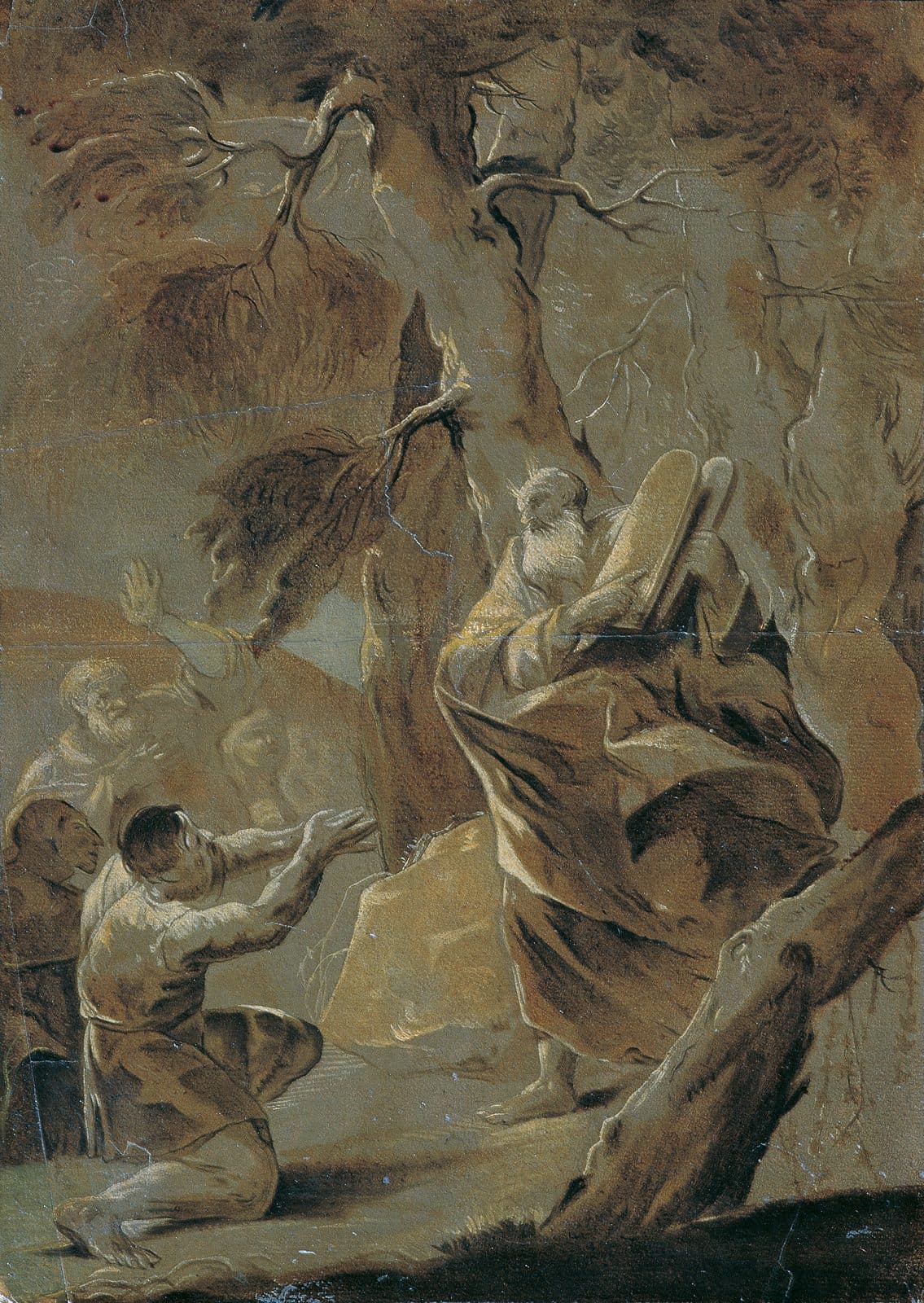
Paul Troger, Moses Brings the Law from Mount Sinai, 1750, Belvedere, Vienna. Public domain by date, published before 1930, via Wikimedia Commons.
THE ARTWORKTroger painted Moses coming down with the two tablets under storm-bent trees, his robe swept by the wind, as a kneeling man reaches up toward him and the elders behind him raise their hands.
Summary
Scripture forms moral judgment through general commands, rulings on particular cases, and love of God and neighbor as the sum of both.
- The Ten Words state duties in a sentence each, and the ordinances of Exodus 21 to 23 apply them to injury, theft, loans and lawsuits.
- Jesus hangs all the Law and the Prophets on two commands, and Paul names love as the fulfillment of the law.
- Christians read the law's hold on them in four main ways, and the threefold division of Aquinas, Calvin and the Westminster Confession is the oldest of them.
Six Verses on the Law and the Life
From the mountain in Exodus to Paul's last letter, in canon order
Four of the six verses are from the Law of Moses or quote it.
And God spoke all these words: “I am the LORD your God, who brought you out of the land of Egypt, out of the house of slavery.The whole people heard these words from God before they asked Moses, in verse 19, to speak to them in His place.
“These are the ordinances that you are to set before them:This verse opens the ordinances, the rulings case by case that fill most of the Book of the Covenant.
Do not seek revenge or bear a grudge against any of your people, but love your neighbor as yourself. I am the LORD.The command Jesus calls second stands in a chapter of laws about gleaning, wages, the deaf and the blind.
He has shown you, O man, what is good. And what does the LORD require of you but to act justly, to love mercy, and to walk humbly with your God?Micah gives this answer to a man who asks whether rams, oil or his firstborn would please the LORD.
Jesus declared, “‘Love the Lord your God with all your heart and with all your soul and with all your mind.’ This is the first and greatest commandment. And the second is like it: ‘Love your neighbor as yourself.’ All the Law and the Prophets hang on these two commandments.”Jesus gives this answer to an expert in the law who asked which commandment is the greatest.
All Scripture is God-breathed and is useful for instruction, for conviction, for correction, and for training in righteousness, so that the man of God may be complete, fully equipped for every good work.Paul writes this of the Holy Scriptures Timothy had known from infancy, the books that held the law.
The Case Laws of the Book of the Covenant
The rulings of Exodus 20:24 to 23:17, in the order Exodus gives them
| Subject | The ruling | Passage |
|---|---|---|
| Altars | An altar of earth, or of stones not shaped by tools, with no steps up to it | Exodus 20:24 to 26 |
| Hebrew servants | Six years of service, and freedom in the seventh year without payment | Exodus 21:2 to 6 |
| A daughter sold as a servant | She may be redeemed, and she goes free if she is denied food, clothing or marital rights | Exodus 21:7 to 11 |
| Killing | Death for a willful killing, and a place to flee for a killing not planned | Exodus 21:12 to 14 |
| Parents and kidnapping | Death for striking or cursing father or mother, and for kidnapping | Exodus 21:15 to 17 |
| Injury in a quarrel | The one who struck pays for the lost work and sees the man completely healed | Exodus 21:18 to 19 |
| A servant struck with a rod | Punishment if the servant dies by the master's hand | Exodus 21:20 to 21 |
| A pregnant woman struck | A fine as the court allows, and life for life and eye for eye if serious injury follows | Exodus 21:22 to 25 |
| A servant's eye or tooth | Freedom for the servant whose eye or tooth the master destroys | Exodus 21:26 to 27 |
| An ox that gores | The ox stoned, and its owner put to death if he had been warned and did not restrain it | Exodus 21:28 to 32 |
| An open pit and fighting oxen | The owner of the pit pays for the dead animal, and the owners of fighting oxen divide the loss | Exodus 21:33 to 36 |
| Theft | Five oxen for an ox and four sheep for a sheep, and double when the animal is found alive | Exodus 22:1 to 4 |
| Grazing and fire | Restitution for a field grazed by stray livestock or burned by a fire someone started | Exodus 22:5 to 6 |
| Goods kept for a neighbor | Double from the thief, and an oath before the LORD when no one saw the loss | Exodus 22:7 to 15 |
| Seduction | The man pays the dowry, whether or not the father gives her to him | Exodus 22:16 to 17 |
| Sorcery, a beast and other gods | Death for a sorceress, for lying with an animal and for sacrifice to another god | Exodus 22:18 to 20 |
| The foreigner, the widow and the orphan | No exploiting the foreigner and no mistreating the widow or orphan, whose cry God hears | Exodus 22:21 to 24 |
| Loans | No interest from a poor man of God's people, and a cloak taken as collateral returned by sunset | Exodus 22:25 to 27 |
| Rulers and offerings | No cursing God or the ruler, and the firstborn and the first of the harvest given to God | Exodus 22:28 to 31 |
| Courts and witnesses | No false report, no siding with the crowd, and no favoritism to a poor man in his lawsuit | Exodus 23:1 to 3 |
| An enemy's animal | Return his stray ox or donkey, and help his donkey when it has fallen under its load | Exodus 23:4 to 5 |
| Justice for the poor | No denying the poor justice, no false accusation, and no bribe | Exodus 23:6 to 8 |
| The foreign resident | No oppressing him, since Israel knows how it feels to be foreigners | Exodus 23:9 |
| The seventh year and the seventh day | The land lies fallow in the seventh year for the poor, and the ox and the servant rest on the seventh day | Exodus 23:10 to 12 |
| The three feasts | Unleavened Bread, Harvest and Ingathering, with every male appearing before the Lord GOD | Exodus 23:14 to 17 |
From Principle to Case
Five cases from Exodus 21 to 23, with the verses and voices that read them
A judge needed more than a command against theft, since he had to know what a thief owed when the stolen animal was found alive and what a borrower owed when a borrowed animal died.
Injury and the measure of a penaltyExodus 21:23 to 25 and Matthew 5:38 to 39
But if a serious injury results, then you must require a life for a life— eye for eye, tooth for tooth, hand for hand, foot for foot, burn for burn, wound for wound, and stripe for stripe.Adam Clarke, in his Commentary on the Bible, calls this the earliest account of the law of like for like, and Leviticus 24:19 to 20 gives the rule again.
You have heard that it was said, ‘Eye for eye and tooth for tooth.’ But I tell you not to resist an evil person. If someone slaps you on your right cheek, turn to him the other also;Jesus sets a disciple's answer to a personal wrong beside the judges' rule of Exodus.
The poor borrower and his cloakExodus 22:25 to 27
If you lend money to one of My people among you who is poor, you must not act as a creditor to him; you are not to charge him interest. If you take your neighbor’s cloak as collateral, return it to him by sunset, because his cloak is the only covering he has for his body. What else will he sleep in? And if he cries out to Me, I will hear, for I am compassionate.God names Himself compassionate here, so the lender's duty rests on God's own character.
Clement of Alexandria reads the ban on interest as a call to free giving among those who share one faith.
“There is a great deal about sharing and exchanging, but it is enough to say that the law forbids lending at interest to a brother. By brother it means not merely one born of the same parents but a member of the same tribe or one of the same faith, who shares in the same Logos. The law does not deem it right to collect interest on the capital. It seeks to enable free giving to those in need, with hands and minds wide open. God is the creator of this free gift.”
Clement of Alexandria · The Stromata Book 2 · on Exodus 22:25Patristic
The enemy's ox and donkeyExodus 23:4 to 5
If you encounter your enemy’s stray ox or donkey, you must return it to him. If you see the donkey of one who hates you fallen under its load, do not leave it there; you must help him with it.The help is owed to the man who hates you, and the law names his animals so the duty is plain.
Clement of Alexandria hears in this law an early lesson in praying for one's enemies.
“The Lord tells us to relieve and lighten the burden of beasts of burden, even when they belong to our enemies. He is teaching us at a distance not to take pleasure in the misfortunes of others and not to laugh at our enemies. He wants to teach those who have exercised themselves in these disciplines to pray for their enemies.”
Clement of Alexandria · The Stromata Book 2 · on Exodus 23:5Patristic
The foreign residentExodus 22:21 and 23:9
You must not exploit or oppress a foreign resident, for you yourselves were foreigners in the land of Egypt.The foreign resident stands first in this list of the weak, ahead of the widow and the orphan.
Matthew Henry finds the same care for the stranger in the English law of his own day.
“It is an instance of the equity and goodness of our law, that, if an alien be tried for any crime except treason, the one half of his jury, if he desire it, shall be foreigners; they call it a trial per mediatatem linguae, a kind provision that strangers may not be oppressed. The reason here given is the same with that in ch. xxii.”
Matthew Henry · Commentary on the Whole Bible · on Exodus 23:9Puritan
Courts and witnessesExodus 23:1 to 3 and 23:6 to 8
You shall not deny justice to the poor in their lawsuits. Stay far away from a false accusation. Do not kill the innocent or the just, for I will not acquit the guilty. Do not accept a bribe, for a bribe blinds those who see and twists the words of the righteous.These verses guard the court from both sides, since verse 3 forbids favoring a poor man in his lawsuit.
What the Ordinances Say
Three things often said of the law of Moses, each with the verse that tests it
EYE FOR EYE AS PRIVATE REVENGE
The rule stands among rulings for judges, and the verse before it sets a fine as the court allows.
THE TEN WORDS AS THE WHOLE LAW
Moses told the people all the words and the ordinances, and then read them the Book of the Covenant.
COMMANDS WITHOUT REASONS
Many ordinances carry their reason, and the law against a bribe says what a bribe does to those who see.
The Words of the Law
Seven Hebrew and Greek words, each in the verse where it stands
DAVAR, WORD (HEBREW, H1697)
The lexicon gives a word, and by implication a matter or a thing, and this verse calls all that God spoke at Sinai these words.
MISHPAT, ORDINANCE (HEBREW, H4941)
The lexicon gives a verdict pronounced judicially, and the same word also means justice.
TORAH, LAW (HEBREW, H8451)
The lexicon gives the meaning instruction, and its gloss names a precept, the Ten Commandments or the five books of Moses.
MITSVAH, COMMANDMENT (HEBREW, H4687)
The lexicon gives a command, human or divine, and the Law taken as a whole.
CHOQ, STATUTE (HEBREW, H2706)
The lexicon gives an enactment, and Moses uses the plural for the statutes the peoples will hear of.
REA, NEIGHBOR (HEBREW, H7453)
The lexicon gives an associate, more or less close, and this is the neighbor Israel is told to love.
NOMOS, LAW (GREEK, G3551)
The lexicon uses the word of the law of Moses and also of the law of Christ in Galatians 6:2.
What the Text Leaves Unsaid
Two silences, one in Exodus and one in the whole of Scripture
The ordinances of Exodus 21 to 23 set no penalty for adultery or for coveting, though Exodus 20:14 and 20:17 forbid both.
No verse sorts the laws of Moses into moral, ceremonial and civil, and Calvin, in the Institutes of the Christian Religion, calls that division one the ancients adopted, so the three names are the church's.
Love as the Sum of the Law
Deuteronomy 6, Romans 13, Galatians 5 and Matthew 23
The two loves sum the commands, and each command still stands inside them.
Hear, O Israel: The LORD our God, the LORD is One. And you shall love the LORD your God with all your heart and with all your soul and with all your strength.The first command Jesus names follows the confession that the LORD is one.
Be indebted to no one, except to one another in love. For he who loves his neighbor has fulfilled the law. The commandments “Do not commit adultery,” “Do not murder,” “Do not steal,” “Do not covet,” and any other commandments, are summed up in this one decree: “Love your neighbor as yourself.” Love does no wrong to its neighbor. Therefore love is the fulfillment of the law.Paul names four of the Ten Words and gathers them into one decree.
The entire law is fulfilled in a single decree: “Love your neighbor as yourself.”Paul writes this to churches being pressed to be circumcised and keep the law of Moses.
Woe to you, scribes and Pharisees, you hypocrites! You pay tithes of mint, dill, and cumin. But you have disregarded the weightier matters of the law: justice, mercy, and faithfulness. You should have practiced the latter, without neglecting the former.Jesus ranks the commands by weight and still keeps each one, which is how love sums them.
Teachers on the Law and the Life
Eight passages, from Origen in the third century to John Wesley in the eighteenth
Why a law known to conscience was spoken aloudMatthew Henry on Exodus 20:1
“They were not only spoken audibly (so he owned the Redeemer by a voice from heaven, Matt. iii. 17 ), but with a great deal of dreadful pomp. This law God had given to man before (it was written in his heart by nature); but sin had so defaced that writing that it was necessary, in this manner, to revive the knowledge of it.”
Matthew Henry · Commentary on the Whole Bible · on Exodus 20:1Puritan
Why the ordinances are called judgmentsJohn Wesley on Exodus 21:1
“The first verse is the general title of the laws contained in this and the two following chapters. Their government being purely a theocracy; that which in other states is to be settled by human prudence, was directed among them by a divine appointment. These laws are called judgments; because their magistrates were to give judgment according to them.”
John Wesley · Explanatory Notes upon the Old Testament · on Exodus 21:1Evangelical
The love of money and the last of the tenAmbrose of Milan on Exodus 20:17
“Love of money then is an old, an ancient vice, which showed itself even at the declaration of the divine law; for a law was given to check it.”
Ambrose of Milan · On the Duties of the Clergy 2.26.130 · on Exodus 20:17Patristic
Whether the commandments differ in weightOrigen on Matthew 22:38
“If the Lord had given no answer to the Pharisee who thus tempted Him, we should have judged that there was no commandment greater than the rest. But when the Lord adds, This is the first and great commandment, we learn how we ought to think of the commandments, that there is a great one, and that there are less down to the least. And the Lord says not only that it is a great, but that it is the first commandment, not in order of Scripture, but in supremacy of value.”
Origen of Alexandria · Catena Aurea by Aquinas · on Matthew 22:38Patristic
How the two great commands depend on each otherCyril of Alexandria on Matthew 22:37
“Therefore the first commandment teaches every kind of godliness. For to love God with the whole heart is the cause of every good. The second commandment includes the righteous acts we do toward other people. The first commandment prepares the way for the second and in turn is established by the second. For the person who is grounded in the love of God clearly also loves his neighbor in all things himself. The kind of person who fulfills these two commandments experiences all the commandments.”
Cyril of Alexandria · FRAGMENT 251 · on Matthew 22:37Patristic
How the laws on skin disease can hang on loveOrigen on Matthew 22:40
“After this you ask how it is that ‘all the law and the prophets depend upon these two commands.’ For it seems that the texts show us that whatever was written in Exodus or Leviticus or Numbers or Deuteronomy depend ‘upon these two commands.’ But how is the law which regards lepers or the continual flow of blood or the menstruation of women dependent ‘upon these two commands’?”
Origen of Alexandria · Commentary on Matthew 4 · on Matthew 22:40Patristic
Love as restraint from evil and a spur to goodMatthew Henry on Romans 13:10
“For it is a sin not only to devise evil against thy neighbour, but to withhold good from those to whom it is due; both are forbidden together, Prov. iii. This proves that love is the fulfilling of the law, answers all the end of it; for what else is that but to restrain us from evil-doing, and to constrain us to well-doing?”
Matthew Henry · Commentary on the Whole Bible · on Romans 13:10Puritan
Love of neighbor and the second tunicGregory the Great, called the Dialogist, on Leviticus 19:18
“For since it is written in the law: ‘You shall love your neighbor as yourself,’ he is proven to love his neighbor less who does not share with him even those things necessary to himself in his neighbor's time of need. Therefore the precept is given about dividing two tunics with one's neighbor, because this could not be said of one tunic, since if one is divided, no one is clothed. For with half a tunic, both he who receives remains naked and he who gave remains naked.”
Gregory the Dialogist · 40 Homilies on the Gospels - Homily 20 · on Leviticus 19:18Patristic
How the Law of Moses Binds the Christian
Four readings, each with its holders, its case and the strongest objection
The threefold divisionThomas Aquinas, Summa Theologiae; John Calvin, Institutes of the Christian Religion; the Westminster Confession of Faith
Aquinas divides the precepts of the Old Law into moral precepts dictated by natural law, ceremonial precepts for the worship of God and judicial precepts for justice among men. He holds that the ceremonies became deadly to keep once the Gospel was published, while the judicial precepts lost their binding force but would be no sin for a ruler to enact.
Calvin calls the moral law the true and eternal rule of righteousness for the people of every nation and age. He leaves each nation free to frame its own laws, so long as they rest on the equity the moral law prescribes. The Westminster Confession holds the ceremonial laws abrogated, the judicial laws expired with the state of Israel beyond what their general equity may require, and the moral law binding on all.
The objection: Paul binds whoever takes up circumcision to obey the whole law in Galatians 5:3, so the law is not taken up in parts.
Whoever keeps the whole law but stumbles at just one point is guilty of breaking all of it.James gives the same objection from the side of a single breach.
The law of Christ in the new covenantSteve Lehrer, New Covenant Theology: Questions Answered, 2006
This reading, called New Covenant Theology, takes the whole law of Moses as the terms of the covenant with Israel, which the new covenant has made obsolete. The Christian is under the law of Christ, and a command of Moses binds him as the New Testament takes it up.
By speaking of a new covenant, He has made the first one obsolete; and what is obsolete and aging will soon disappear.The reading takes its word obsolete from this verse.
To the Jews I became like a Jew, to win the Jews. To those under the law I became like one under the law (though I myself am not under the law), to win those under the law. To those without the law I became like one without the law (though I am not outside the law of God but am under the law of Christ), to win those without the law.Paul says he is not under the law of Moses and yet is under the law of Christ.
The objection: the apostles still give the Ten Words to the church as commands.
“Honor your father and mother” (which is the first commandment with a promise), “that it may go well with you and that you may have a long life on the earth.”Paul gives children the fifth commandment with its promise.
The judicial laws for the nationsGreg L. Bahnsen, Theonomy in Christian Ethics, 1977; R. J. Rushdoony, The Institutes of Biblical Law, 1973
This reading, called theonomy, holds that the law of Moses, its case laws included, is God's standard for civil rulers today, applied by the general equity of each law.
Observe them carefully, for this will show your wisdom and understanding in the sight of the peoples, who will hear of all these statutes and say, “Surely this great nation is a wise and understanding people.” For what nation is great enough to have a god as near to them as the LORD our God is to us whenever we call on Him? And what nation is great enough to have righteous statutes and ordinances like this entire law I set before you today?The verse sets Israel's statutes before the watching nations, which is the subject of this reading.
The objection: Paul turns the closing line of Deuteronomy's laws of stoning into a sentence of expulsion from the church, and he leaves the judgment of those outside the church to God.
God will judge those outside. “Expel the wicked man from among you.”The quoted line closes Deuteronomy 17:7 and 22:21 to 24, where the evil was purged by death, so the change of sentence can be checked.
Israel's law as a patternChristopher J. H. Wright, Old Testament Ethics for the People of God, 2004
Wright reads all of Israel's laws, the ceremonial and civil with the moral, within a theological, social and economic framework. He draws from them for economics and the poor, for politics and the nations, and for law and justice. Paul reads a law about oxen this way in his first letter to Corinth.
For it is written in the Law of Moses: “Do not muzzle an ox while it is treading out the grain.” Is it about oxen that God is concerned? Isn’t He actually speaking on our behalf? Indeed, this was written for us, because when the plowman plows and the thresher threshes, they should also expect to share in the harvest.Paul draws from the ox law the right of the worker to share in the harvest.
The objection: Jesus spoke of the smallest marks of the Law lasting, which reaches past the principle of a law to its wording.
For I tell you truly, until heaven and earth pass away, not a single jot, not a stroke of a pen, will disappear from the Law until everything is accomplished.The objection rests on this saying from the Sermon on the Mount.
Further Reading on Ethics
Four works to read whole, earliest first
Summa Theologiae
Thomas Aquinas · 1265 to 1274
Aquinas treats the precepts of the Old Law, the end of its ceremonies and how long its judicial precepts bind in questions 99, 103 and 104 of the First Part of the Second Part.
Read it free at New AdventInstitutes of the Christian Religion
John Calvin · 1559
The last chapter, on civil government, holds Calvin's account of the law of Moses and the laws of the nations.
Read it free at the Christian Classics Ethereal LibraryToward Old Testament Ethics
Walter C. Kaiser Jr. · 1983
Kaiser gives chapters to the Ten Words, to the Book of the Covenant and to the Old Testament law and New Testament believers.
In print: find it wherever books are sold.
Old Testament Ethics for the People of God
Christopher J. H. Wright · 2004
The book revises and expands Wright's Living as the People of God of 1983.
In print: find it wherever books are sold.
If You Love Me
Romans 8 on the law fulfilled in those who walk by the Spirit, and John 14 on love and obedience
The cases of Exodus 21 to 23 show what love does in a field, a court and a loan.
So the text asks the reader to keep Christ's commands as one who loves Him, toward God and toward every neighbor.
For what the law was powerless to do in that it was weakened by the flesh, God did by sending His own Son in the likeness of sinful man, as an offering for sin. He thus condemned sin in the flesh, so that the righteous standard of the law might be fulfilled in us, who do not walk according to the flesh but according to the Spirit.It answers how sinful people can meet what the law requires.
If you love Me, you will keep My commandments.The request of this section rests on this saying, where obedience follows from love for Christ.
Keep studying
Studies11