
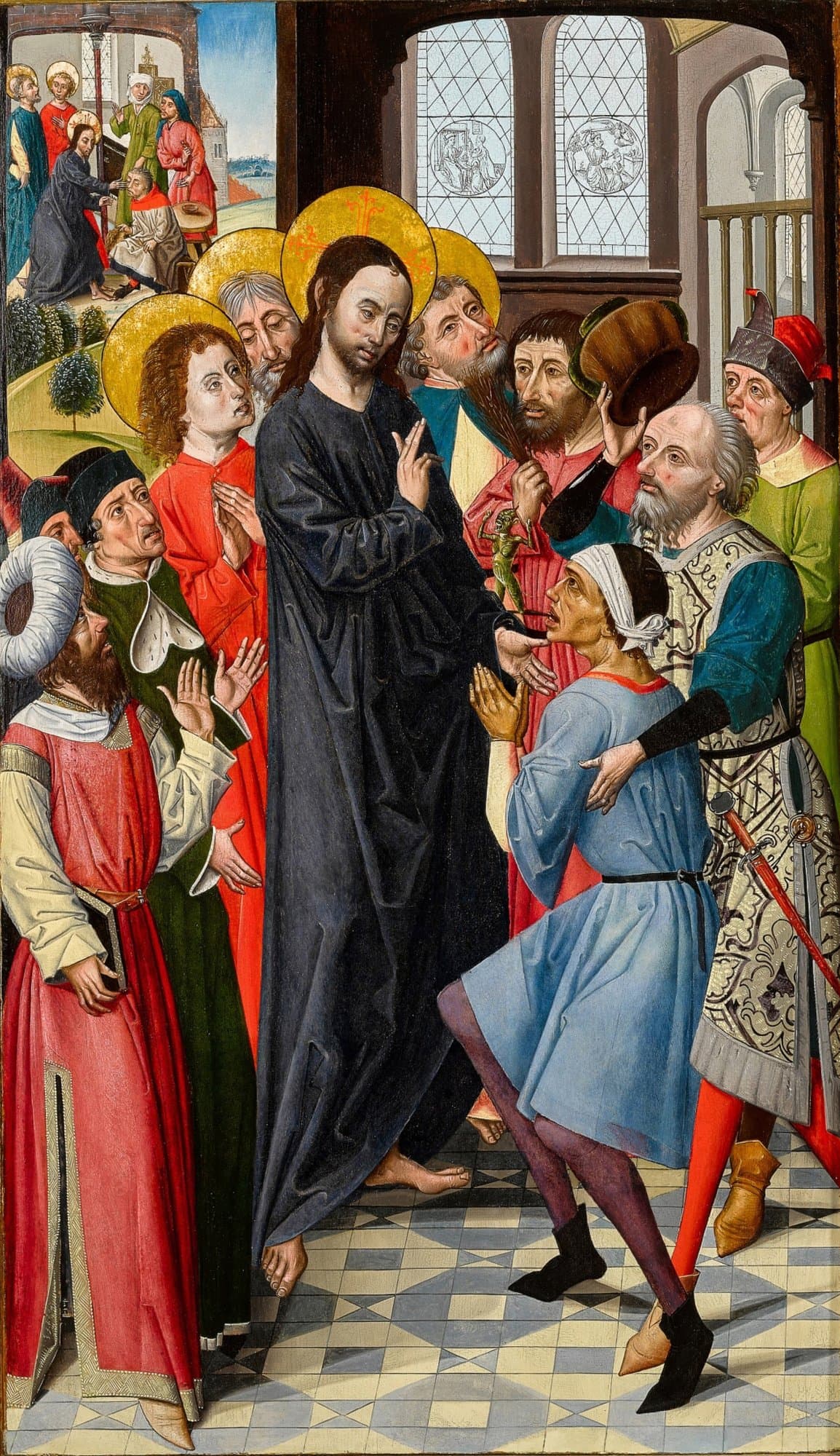
James 1 and Jude 1:22 · Debate · Doubt
Is Doubt Sin?
James 1:6 warns the believer who doubts when he prays, and Jude 1:22 commands mercy for those who doubt.
Jesus asked Peter why he doubted only after His hand had already taken hold of him.
But he must ask in faith, without doubting, because he who doubts is like a wave of the sea, blown and tossed by the wind.
- The question
- Is doubt itself a sin?
- The texts
- James 1:6 to 8, Hebrews 3:12, Jude 1:22, Mark 9:24, John 20:27
Summary
Hebrews warns against a heart of unbelief, yet the Gospels show Jesus answering doubters with what they could see and touch. Christian teachers have weighed these texts in three ways. Some read doubt as the sin of unbelief that God condemns. Others read it as an honest question that God answers. A third reading counts it a weak faith that the church bears with mercy and sets apart from the unbelief that turns away from God.
- Hebrews says that the generation Moses led out of Egypt was unable to enter God's rest because of unbelief (Hebrews 3:16 to 19).
- James 1:6 and Jude 1:22 use the same Greek verb for doubting, diakrino, which Acts 15:9 uses for God making no distinction between Jew and Gentile.
- Paul writes that Abraham did not waver through disbelief in the promise of God and was strengthened in his faith (Romans 4:20).
- Jesus answered the question John the Baptist sent from prison with an account of His works, and then praised John to the crowds (Matthew 11:4 to 11).
The Texts Each Reading Weighs
The warning of James, the doubt of the disciples before the risen Jesus and Jude's call for mercy frame the question.
Is Doubt Sin? takes up the question a doubting believer asks of himself, whether his doubt stands against him before God. Doubt is one of the trials of the Christian life, and Scripture speaks of it both as the wavering of a believer and as the unbelief that rejects Him. The answer decides whether a doubter comes to God as a penitent, as a questioner or as a weak believer asking for help.
The question it answers is whether doubt is itself a sin. It gives the texts each reading weighs, the three readings with their holders from the second century to the nineteenth and the objection each one meets. It then reads Romans 14:23 in its chapter, sets out the ground every reading shares and names the books in which the holders make their case.
That man should not expect to receive anything from the Lord. He is a double-minded man, unstable in all his ways.James names what the man who doubts may expect from the Lord, and every reading of the question must account for these words.
When they saw Him, they worshiped Him, but some doubted.Matthew records doubt among the disciples who worshiped the risen Jesus, and Jesus went on to give those same disciples His commission.
And indeed, have mercy on those who doubt;Jude asks the church for mercy toward those who doubt, and the readings that decline to call doubt a sin rest much of their case on this verse.
Three Readings of Doubt
Each reading rests on its own key text and meets its strongest objection from a text the other readings hold.
The three readings rest on three different texts, and each meets an objection drawn from the others.
| The reading | Its key text | Held by | The objection |
|---|---|---|---|
| Doubt is the sin of unbelief | "See to it, brothers, that none of you has a wicked heart of unbelief that turns away from the living God." (Hebrews 3:12) | The Shepherd of Hermas; John Chrysostom | Jude 1:22 asks mercy for those who doubt, and Jesus met Thomas by showing him His wounds. |
| Doubt is an honest question that God answers | "Put your finger here and look at My hands." (John 20:27) | Gregory the Great; the reading Ambrose of Milan reports | Jesus told Thomas to stop doubting and believe, and Chrysostom called the reading Ambrose reports hardly reasonable. |
| A weak faith is borne with mercy and set apart from unbelief | "I do believe; help my unbelief!" (Mark 9:24) | John Calvin; the Westminster Confession of Faith; John Wesley; Charles Spurgeon | James 1:7 makes no exception for a weak believer, and Hermas held that the double-souled obtain none of their requests. |
Each Reading in Its Holders' Words
Nine works, from a book of the second century to a sermon of 1890, state the three readings.
Doubting counted as sinCommandment 9 and Homily 87 on John
The Shepherd of Hermas, a Christian book of the second century, gives its ninth commandment to prayer made without doubting. It says, "For this doubting is the daughter of the devil, and acts exceedingly wickedly to the servants of God".
The same commandment holds that "those who doubt regarding God are double-souled, and obtain not one of their requests". It joins that warning to the mercy of God, who "remembers not evils, and has compassion on His own creature".
John Chrysostom, preaching on John 20 in his Homilies on the Gospel of John, said, "On this account Thomas is held to blame". He held Thomas at fault for refusing the word of the other apostles, "not so much mistrusting them, as deeming the thing to be impossible".
Doubt answered with the woundsHomily 26 on the Gospels and Ambrose on Luke 7:19
Gregory the Great, in his twenty-sixth homily on the Gospels as Thomas Aquinas gathers it in the Catena Aurea, held that Thomas was absent by the ordering of mercy. He wrote that "a doubting disciple should, by feeling in his Master the wounds of the flesh, heal in us the wounds of unbelief". He went on, "The unbelief of Thomas is more profitable to our faith, than the belief of the other disciples".
Ambrose of Milan, commenting on Luke 7:19, reported how some read the question of John the Baptist. On that reading John could not think that the One he had believed in was to suffer death, so "he doubted therefore though not in faith, yet in love".
Faith shaken and still rootedInstitutes 3.2.17, the Westminster Confession 14.3, Wesley's Notes and Sermon 2173
John Calvin, in the Institutes of the Christian Religion, wrote that "believers have a perpetual struggle with their own distrust". He denied that they "fall off and abandon that sure confidence which they have formed in the mercy of God".
In his commentary on James 1:6 Calvin held that James "strikingly expresses how God punishes the unbelief of those who doubt his promises". He set beside it the believer shaken by temptation, who is like a tree that "shakes, indeed, through the blowing of the wind, but is not rooted up".
The Westminster Confession of Faith was drafted by the Puritan clergy who met at Westminster Abbey in 1643. It teaches that faith "is different in degrees, weak or strong" and that it "may be often and many ways assailed and weakened, but gets the victory".
John Wesley's notes keep unbelief and wavering apart. On Hebrews 3:12 he wrote that "the very essence of unbelief lies in departing from God". On Jude 1:22 he asked the church to help those "that are wavering in judgment" and to convince them "of the whole truth as it is in Jesus".
Charles Spurgeon preached on Matthew 14:31 in 1890 and measured the distance between the two states. He said, "An immeasurable abyss yawns between the man who has even the smallest faith in Christ and the man who has none".
The site's tradition is Wesleyan-Pentecostal, and John Wesley, from whom its Wesleyan stream comes, held the third reading. Scripture leaves this question open to more than one reading.
Romans 14:23 and the Conscience
Paul's sentence on the one who has doubts stands in a chapter on food and holy days.
But the one who has doubts is condemned if he eats, because his eating is not from faith; and everything that is not from faith is sin.Paul's word condemned in this verse carries much of the weight of the debate, and its setting decides how far it reaches.
Paul wrote this verse about a believer who eats a food that his own conscience doubts, while others eat it freely (Romans 14:2 to 6).
What Every Reading Holds
All three readings share three teachings about faith.
FAITH PLEASES GOD
Every reading holds with Hebrews that no one can please God without faith.
SALVATION IS GOD'S GIFT
Every reading holds with Paul that salvation comes by grace through faith as the gift of God.
JESUS PERFECTS FAITH
Every reading holds that Jesus is the author and perfecter of faith, so a weak faith looks to Him.
Books to Read Next
Five works state the readings in the words of their own holders.
The Shepherd of Hermas
Hermas · second century
Its twelve commandments set out the life of a believer, and the ninth is given to prayer.
READ IT FREE →Homilies on the Gospel of John
John Chrysostom · English translation 1889
Homily 87 takes up the absence of Thomas and his refusal to believe the other apostles.
READ IT FREE →Institutes of the Christian Religion
John Calvin · English translation 1845
Book 3, chapter 2 defines faith and asks how its certainty stands beside the fears and temptations of believers.
READ IT FREE →Commentaries on the Catholic Epistles
John Calvin · 1551
Calvin comments verse by verse on 1 Peter, 1 John, James, 2 Peter and Jude.
READ IT FREE →The Westminster Confession of Faith
The Westminster Assembly · drafted from 1643
Chapter 14 treats saving faith, and chapter 18 treats the assurance of grace and salvation.
READ IT FREE →Faith Asked For
Every reading leaves the doubter free to ask God for more faith.
The three readings differ over how God regards a doubter on the way, and they agree that faith is where He calls him to come.
Where doubt comes with depression or with intrusive, obsessive fears, a physician or a counsellor belongs beside prayer and never in its place.
The apostles said to the Lord, “Increase our faith!”Each of the three readings allows a doubter to make this request his own prayer.
Sources
Scripture is the Berean Standard Bible.
- STEP Bible TAGNT, Tyndale House, CC BY 4.0.
- The Shepherd of Hermas, Book 2, Commandment 9, translated by F. Crombie, Ante-Nicene Fathers, volume 2 (Christian Literature Publishing Co., 1885)
- Ante-Nicene Fathers, volume 2, Fathers of the Second Century, edited by Philip Schaff, the introductory note to the Pastor of Hermas.
- The Shepherd of Hermas, Commandment 9, in the Crombie translation.
- John Chrysostom, Homilies on the Gospel of John, Homily 87, translated by Charles Marriott, Nicene and Post-Nicene Fathers, first series, volume 14 (1889)
- Gregory the Great, Homily 26 on the Gospels, in Thomas Aquinas, Catena Aurea, on John 20:24.
- Thomas Aquinas, Catena Aurea, volume 1, Gospel of Matthew, on Matthew 11:3, Ambrose on Luke 7:19 and Chrysostom after him (London: J.G.F. and J. Rivington, 1842)
- John Calvin, Institutes of the Christian Religion, book 3, chapter 2, section 17, translated by Henry Beveridge (first published 1845)
- John Calvin, Commentaries on the Catholic Epistles (dedication dated 1551), translated and edited by John Owen (1855), on James 1:6 and Jude 1:22.
- The Westminster Confession of Faith, chapters 14 and 18; CCEL's summary of the work for the Westminster Assembly of 1643.
- John Wesley, Explanatory Notes upon the New Testament (1755), on Hebrews 3:12.
- John Wesley, Explanatory Notes upon the New Testament (1755), on Jude 1:22.
- Charles Spurgeon, The Metropolitan Tabernacle Pulpit, Sermon No. 2173, "Little Faith and Great Faith" (1890), on Matthew 14:31.
Keep Studying
Studies5
In this trial5
People and groups12
Values1