
Exodus 21:22 to 25 · Debate · Featured Study
An Eye for an Eye in the Law of Moses
Three readings of the law of retaliation in Exodus, Leviticus and Deuteronomy, and three readings of the answer Jesus gives in Matthew 5:38 to 42, each set out with its holders and their works.
Eye for eye stands in the law of Moses and again in the Sermon on the Mount, and its readers have long disagreed about what it requires of a judge and of a disciple.
- The question
- Did the law of eye for eye in Exodus 21:23 to 25 order a bodily penalty, a payment for the injury, or a limit set on judges, and what did Jesus do with it in Matthew 5:38 to 42?
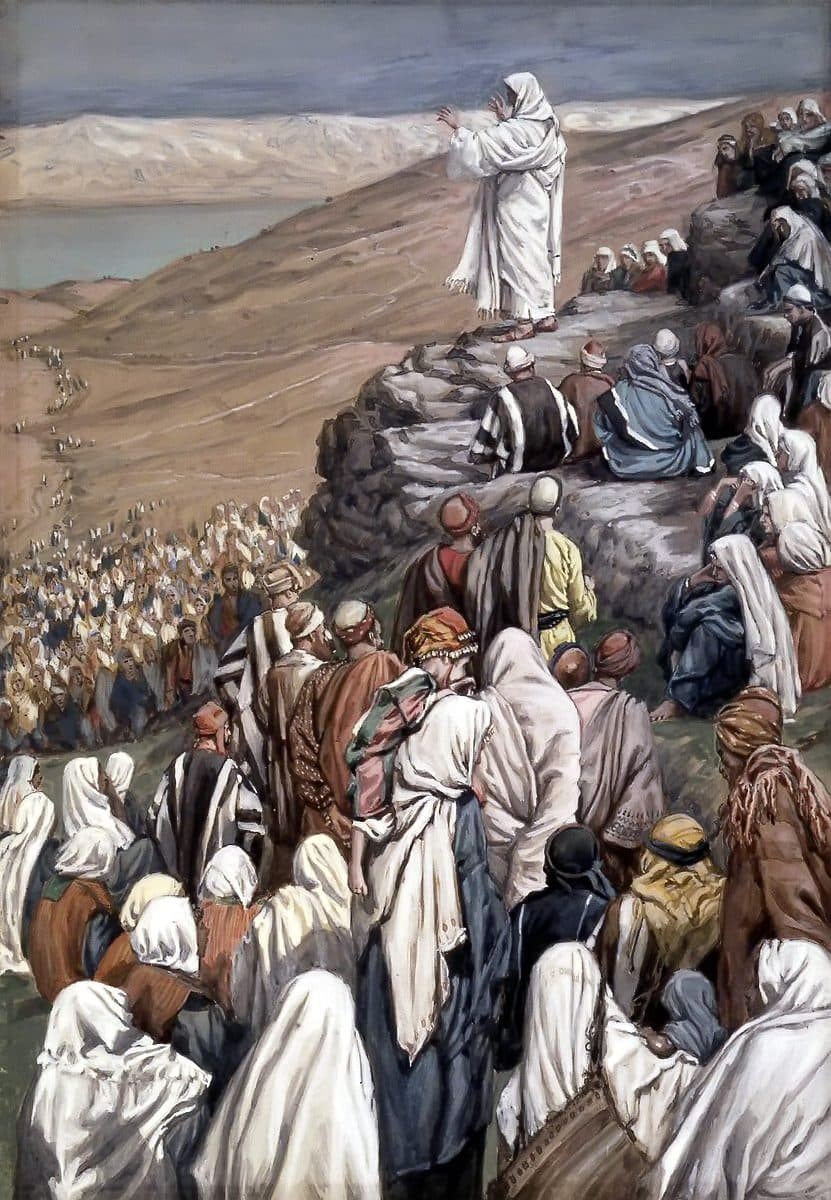
James Tissot, The Sermon of the Beatitudes, 1886 to 1896, Brooklyn Museum. Public domain.
THE ARTWORKTissot painted Jesus teaching a great crowd from a rock on a hillside above the lake, in the sermon where He answers the law of eye for eye.
Summary
Exodus 21:24 sets eye for eye among the laws on injury, and Jewish and Christian readers have read it in three ways.
- Josephus reads it as the same injury done to the offender, unless the injured man accepts money in its place.
- The Mishnah, the Talmud and Rashi read it as payment for the injury from the start.
- Tertullian, Augustine, Calvin and Wesley read it as a rule for the courts that keeps revenge from going further.
- In Matthew 5:38 to 42 Jesus quotes the law and tells His hearers not to resist an evil person.
- Christian readers divide on whether He forbids private revenge alone or every use of force by His disciples.
The Texts Every Reading Weighs
Exodus, Leviticus and Deuteronomy give the formula, and Matthew records the answer Jesus gave to it.
But if a serious injury results, then you must require a life for a life— eye for eye, tooth for tooth, hand for hand, foot for foot, burn for burn, wound for wound, and stripe for stripe.The formula first stands in a case the court already judges, since verse 22 fines the man as the court allows.
If anyone injures his neighbor, whatever he has done must be done to him: fracture for fracture, eye for eye, tooth for tooth. Just as he injured the other person, the same must be inflicted on him.The bodily reading leans on this verse, which says that the same injury must be inflicted on the one who caused it.
you must do to him as he intended to do to his brother. So you must purge the evil from among you. Then the rest of the people will hear and be afraid, and they will never again do anything so evil among you. You must show no pity: life for life, eye for eye, tooth for tooth, hand for hand, and foot for foot.Here the judges apply the formula to a false witness, who must suffer what he intended to bring on his brother.
You have heard that it was said, ‘Eye for eye and tooth for tooth.’ But I tell you not to resist an evil person. If someone slaps you on your right cheek, turn to him the other also;Jesus quotes the formula and sets His own command beside it, so every reading of the law must account for His answer.
The Three Readings Side by Side
Each reading of the law answers three questions: what the law orders, who carries it out and which verse decides it.
| The question | The bodily penalty | Payment | A measure for judges |
|---|---|---|---|
| What does eye for eye order? | The same injury, done to the one who caused it. | The value of the injury, paid in money. | A penalty no larger than the injury. |
| Who carries it out? | The court, which inflicts the same injury. | The court, which values the injury and sets the payment. | The judges, and never the injured man himself. |
| Which verse decides it? | Leviticus 24:19 to 20. | Exodus 21:36, on ox for ox. | Deuteronomy 19:17 to 18, on the judges' hearing. |
- The question
- What does eye for eye order?
- The bodily penalty
- The same injury, done to the one who caused it.
- Payment
- The value of the injury, paid in money.
- A measure for judges
- A penalty no larger than the injury.
- The question
- Who carries it out?
- The bodily penalty
- The court, which inflicts the same injury.
- Payment
- The court, which values the injury and sets the payment.
- A measure for judges
- The judges, and never the injured man himself.
- The question
- Which verse decides it?
- The bodily penalty
- Leviticus 24:19 to 20.
- Payment
- Exodus 21:36, on ox for ox.
- A measure for judges
- Deuteronomy 19:17 to 18, on the judges' hearing.
The Three Readings of the Law
Each reading has its holders, its works and its case from the text.
The bodily penalty
The first reading takes the words as they stand, so that the one who blinds an eye loses an eye. Josephus, in his Antiquities of the Jews (4.8.35), writes that the one who maims another must undergo the like, unless the injured man will accept money. The law, he says, lets the sufferer set the value of what he has suffered. John Gill, in his Exposition of the New Testament on Matthew 5:38, reports that the Sadducees also read the law in its literal sense. The Talmud (Bava Kamma 84a) reports Rabbi Eliezer saying that the verse means an actual eye, though it reads his words as a rule for valuing the injury. Thomas Aquinas, in the Summa Theologiae (I-II, question 105, article 2), holds that for blows and maiming the Old Law authorized punishment by retaliation.
Payment from the start
The second reading holds that the law never ordered the cutting off of a limb. The Mishnah (Bava Kamma 8:1) makes the one who injures another pay for the damage, the pain, the healing, the lost work and the humiliation. It values the damage as a court would value a slave sold in the market. The Talmud (Bava Kamma 83b to 84a) argues the point from many verses, and it asks how the law could be kept to the letter when a blind man blinds another. Rashi, in his commentary on Exodus 21:24, writes that the offender pays the value of the eye. Among Protestant commentators John Gill reads Leviticus 24:20 the same way, as the price of the eye paid in money.
A measure for judges
The third reading holds that the law gave the judges a measure, so that no penalty would exceed the injury. Augustine, in his Reply to Faustus (19.25), writes that few men are content with a revenge equal to the injury, and that the law set the measure to keep the fire already kindled from spreading. Tertullian, in Against Marcion (2.18), calls the statute a provision for restraining violence that gives no permission to injure. John Calvin, in his commentary on the four last books of Moses, teaches that the penalty keeps a just proportion to the injury and that the injured man must still not seek vengeance. John Wesley, in his Explanatory Notes upon the Old Testament (1765), writes that the law was never put into the hands of private persons and that magistrates kept to it in punishing offenders.
The Evidence the Readings Dispute
Three passages of the law are read as evidence by more than one side.
The judges of Deuteronomy 19
both parties to the dispute must stand in the presence of the LORD, before the priests and judges who are in office at that time. The judges shall investigate thoroughly, and if the witness is proven to be a liar who has falsely accused his brother,The case is heard before the priests and judges, so the formula in verse 21 is a court's sentence.
The Talmud (Bava Kamma 84a) reads the same chapter for payment. The school of Rabbi Hiyya argues that verse 19 would already cover the limbs themselves. It therefore takes the list of limbs in verse 21 as a payment in money.
Ox for ox and the servant's eye
Rav Ashi, in the Talmud (Bava Kamma 84a), sets eye for eye beside ox for ox in Exodus 21:36, where the owner pays the value of the dead ox. He reads the word for in the same way in both laws.
If a man strikes and blinds the eye of his manservant or maidservant, he must let the servant go free as compensation for the eye.The law itself sets the servant's freedom as the penalty for his eye, two verses after the formula.
The ransom of Exodus 21:30
Exodus 21:30 lets the owner of a goring ox redeem his life with a payment, which the Mekhilta (Tractate Nezikin 8) calls kofer. The Mekhilta argues that if money may answer for a death there, money answers all the more for an eye. Jamieson, Fausset and Brown, in their Commentary Critical and Explanatory (1871), call Exodus 21:30 the only case in the law of Moses where money is expressly allowed in place of a death.
You are not to accept a ransom for the life of a murderer who deserves to die; he must surely be put to death.The Talmud (Bava Kamma 83b) reads this ban as touching the murderer alone, which leaves the lesser injuries open to payment.
The Laws of Hammurabi Beside Exodus
The Code of Hammurabi, a Babylonian law code, sets the penalty for an eye, a limb or a tooth by the rank of the injured man.
| The injury | The Code of Hammurabi | The law of Moses |
|---|---|---|
| A gentleman's eye | Section 196: his own eye shall be lost. | Exodus 21:24: eye for eye, with no rank named. |
| A gentleman's limb | Section 197: his own limb shall be shattered. | Leviticus 24:20: fracture for fracture. |
| A poor man's eye or limb | Section 198: one mina of silver. | Leviticus 24:22: the same standard of law for the foreign resident and the native. |
| A servant's eye or limb | Section 199: half his price. | Exodus 21:26: the servant goes free as compensation for the eye. |
| A tooth | Section 200: an equal's tooth for his tooth. Section 201: one third of a mina of silver for a poor man's tooth. | Exodus 21:24 and 27: tooth for tooth, and freedom for a servant's tooth. |
- The injury
- A gentleman's eye
- The Code of Hammurabi
- Section 196: his own eye shall be lost.
- The law of Moses
- Exodus 21:24: eye for eye, with no rank named.
- The injury
- A gentleman's limb
- The Code of Hammurabi
- Section 197: his own limb shall be shattered.
- The law of Moses
- Leviticus 24:20: fracture for fracture.
- The injury
- A poor man's eye or limb
- The Code of Hammurabi
- Section 198: one mina of silver.
- The law of Moses
- Leviticus 24:22: the same standard of law for the foreign resident and the native.
- The injury
- A servant's eye or limb
- The Code of Hammurabi
- Section 199: half his price.
- The law of Moses
- Exodus 21:26: the servant goes free as compensation for the eye.
- The injury
- A tooth
- The Code of Hammurabi
- Section 200: an equal's tooth for his tooth. Section 201: one third of a mina of silver for a poor man's tooth.
- The law of Moses
- Exodus 21:24 and 27: tooth for tooth, and freedom for a servant's tooth.
Adam Clarke, in his Commentary on the Bible (1832), calls Exodus 21:24 the earliest account of the lex talionis, the law of like for like. He writes that Rome's Twelve Tables carried the same law until the penalty was changed to a fine. Calvin also sets the law beside the Twelve Tables and finds their wording too obscure, while the law of Moses names the case in which the penalty applies.
If men who are fighting strike a pregnant woman and her child is born prematurely, but there is no further injury, he shall surely be fined as the woman’s husband demands and as the court allows.How the Law Was Read
Eleven dated marks trace the readings from Josephus to Tolstoy.
From Josephus to Augustinefive marks, AD 93 to AD 400
| When | Reading | What |
|---|---|---|
| AD 93 | The bodily penalty | Josephus finishes his Antiquities of the Jews in the thirteenth year of Domitian. |
| About AD 200 | Payment | The Mekhilta of Rabbi Ishmael, a midrash on the laws of Exodus, is compiled in the land of Israel. |
| AD 190 to 230 | Payment | The Mishnah's tractate on damages, Bava Kamma, is completed. |
| AD 207 | A measure for judges | Tertullian finishes the first book of the final edition of Against Marcion. |
| AD 400 | A measure for judges | Augustine writes his Reply to Faustus the Manichaean. |
- When
- AD 93
- Reading
- The bodily penalty
- What
- Josephus finishes his Antiquities of the Jews in the thirteenth year of Domitian.
- When
- About AD 200
- Reading
- Payment
- What
- The Mekhilta of Rabbi Ishmael, a midrash on the laws of Exodus, is compiled in the land of Israel.
- When
- AD 190 to 230
- Reading
- Payment
- What
- The Mishnah's tractate on damages, Bava Kamma, is completed.
- When
- AD 207
- Reading
- A measure for judges
- What
- Tertullian finishes the first book of the final edition of Against Marcion.
- When
- AD 400
- Reading
- A measure for judges
- What
- Augustine writes his Reply to Faustus the Manichaean.
From the Talmud to Tolstoysix marks, AD 450 to 1894
| When | Reading | What |
|---|---|---|
| AD 450 to 550 | Payment | The rabbis of Babylon complete the Talmud's discussion of the same tractate. |
| AD 1075 to 1105 | Payment | Rashi writes his commentary on Exodus in France. |
| 1765 | A measure for judges | John Wesley publishes his Explanatory Notes upon the Old Testament. |
| 1838 | All force forbidden | William Lloyd Garrison writes the Declaration of Sentiments for a peace convention in Boston. |
| 1871 | Private revenge forbidden | Jamieson, Fausset and Brown publish their Commentary Critical and Explanatory. |
| 1894 | All force forbidden | Leo Tolstoy's The Kingdom of God Is Within You appears in Constance Garnett's English. |
- When
- AD 450 to 550
- Reading
- Payment
- What
- The rabbis of Babylon complete the Talmud's discussion of the same tractate.
- When
- AD 1075 to 1105
- Reading
- Payment
- What
- Rashi writes his commentary on Exodus in France.
- When
- 1765
- Reading
- A measure for judges
- What
- John Wesley publishes his Explanatory Notes upon the Old Testament.
- When
- 1838
- Reading
- All force forbidden
- What
- William Lloyd Garrison writes the Declaration of Sentiments for a peace convention in Boston.
- When
- 1871
- Reading
- Private revenge forbidden
- What
- Jamieson, Fausset and Brown publish their Commentary Critical and Explanatory.
- When
- 1894
- Reading
- All force forbidden
- What
- Leo Tolstoy's The Kingdom of God Is Within You appears in Constance Garnett's English.
What the Text Leaves Unsaid
The passages leave three questions open.
Exodus 21:23 to 25 gives the formula without saying who carries out the penalty. The law never says whether money may stand in place of an eye, or how an eye would be valued if it did. Matthew 5:38 to 42 gives the disciple's part and leaves the duty of rulers and courts unaddressed.
if someone wants to sue you and take your tunic, let him have your cloak as well; and if someone forces you to go one mile, go with him two miles. Give to the one who asks you, and do not turn away from the one who wants to borrow from you.What Jesus Did with the Law in Matthew 5
Three readings of Matthew 5:38 to 42 say whether Jesus forbade private revenge, forbade all force, or overturned the law.
He forbids private revenge
Augustine, in Our Lord's Sermon on the Mount (1.19), calls the law's measure the beginning of peace and the wish for no vengeance at all its perfection. He holds that punishment for correction still belongs to the one to whom the power is given. Calvin teaches that the penalty publicly awarded does not serve private passion, and that Jesus refutes the error of hastening to retaliate.
For he is God’s servant for your good. But if you do wrong, be afraid, for he does not carry the sword in vain. He is God’s servant, an agent of retribution to the wrongdoer.This reading sets Paul's word on the ruler who carries the sword beside Matthew 5:39.
Do not say, “I will avenge this evil!” Wait on the LORD, and He will save you.This proverb, with Proverbs 24:29, already tells the injured man to wait on the LORD instead of avenging himself.
He forbids all force by His disciples
Leo Tolstoy, in The Kingdom of God Is Within You (1894), reads the command not to resist an evil person as binding every disciple in every case. He calls this the doctrine of non-resistance to evil by force. In its first chapter he quotes William Lloyd Garrison's Declaration of Sentiments of 1838, which holds that Christ abrogated the penal code of eye for eye and enjoined the forgiveness of enemies. Menno Simons, in A Humble and Christian Defense, asks how a Christian can retaliate or make war when all Christians are commanded to love their enemies and to turn the other cheek.
He overturns the law
Faustus the Manichaean, as Augustine reports him in Reply to Faustus (19.3), held that Jesus destroyed eye for eye and set a precept of the opposite tendency in its place. Tertullian answered the followers of Marcion in Against Marcion (4.16) that Christ's word on the cheek furthers what the law intended, since it ends reprisal altogether. Origen, in Against Celsus (7.25), answered the same claim from Lamentations.
Let him offer his cheek to the one who would strike him; let him be filled with reproach.Origen cites this verse to show that the command about the cheek already stood in the older Scriptures.
How the Commentators Read Matthew 5
Three teachers of the church comment on the cheek and the cloak, two from the third century and one from the nineteenth.
Tertullian on the cloakthird century
“Else how will one, when he has two coats, give the one of them to the naked, unless he be a man likewise to offer to one who takes away his coat his cloak as well? How shall we fashion to us friends from mammon, if we love it so much as not to put up with its loss? We shall perish together with the lost mammon.”
Tertullian · Of Patience · on Matthew 5:40Patristic
Origen on the law and the gospelthird century
“Celsus does not quote any passages from the law which are apparently in contradiction to what stands in the gospel, so that we might compare them. He says, ‘And to a man who has struck one once one should offer oneself to be struck again.’ But we will say that we are aware that ‘it was said to them of old time, 'An eye for an eye and a tooth for a tooth,' ‘ and that we have read also the words ‘But I say unto you, to him that strikes you on one cheek offer the other one also.’”
Origen of Alexandria · Against Celsus 7.25 · on Exodus 21:24Patristic
Jamieson, Fausset and Brown on the second blow1871
“It is the preparedness, after one indignity, not to invite but to submit meekly to another, without retaliation, which this strong language is meant to convey.”
Jamieson, Fausset & Brown · Commentary Critical and Explanatory on the Whole Bible · on Matthew 5:39Reformed
The Readings Weighed
Every reading has one problem in the text that its holders must answer.
| Reading | Held by | Tradition |
|---|---|---|
| The bodily penalty | Josephus; the Sadducees, as Gill reports them; Thomas Aquinas | First-century Judaism; the medieval Catholic schools |
| Payment | The Mekhilta; the Mishnah; the Talmud; Rashi; John Gill on Leviticus 24:20 | Rabbinic Judaism; one Reformed commentator |
| A measure for judges | Tertullian; Augustine; John Calvin; John Wesley | The church fathers; the Reformed and Methodist churches |
| Private revenge forbidden | Augustine; John Calvin; Jamieson, Fausset and Brown | The Catholic and Reformed churches |
| All force forbidden | Menno Simons; William Lloyd Garrison; Leo Tolstoy | The Anabaptists; the Christian non-resistance movement |
| The law overturned | Marcion; Faustus the Manichaean | The Marcionites; the Manichaeans |
- Reading
- The bodily penalty
- Held by
- Josephus; the Sadducees, as Gill reports them; Thomas Aquinas
- Tradition
- First-century Judaism; the medieval Catholic schools
- Reading
- Payment
- Held by
- The Mekhilta; the Mishnah; the Talmud; Rashi; John Gill on Leviticus 24:20
- Tradition
- Rabbinic Judaism; one Reformed commentator
- Reading
- A measure for judges
- Held by
- Tertullian; Augustine; John Calvin; John Wesley
- Tradition
- The church fathers; the Reformed and Methodist churches
- Reading
- Private revenge forbidden
- Held by
- Augustine; John Calvin; Jamieson, Fausset and Brown
- Tradition
- The Catholic and Reformed churches
- Reading
- All force forbidden
- Held by
- Menno Simons; William Lloyd Garrison; Leo Tolstoy
- Tradition
- The Anabaptists; the Christian non-resistance movement
- Reading
- The law overturned
- Held by
- Marcion; Faustus the Manichaean
- Tradition
- The Marcionites; the Manichaeans
The bodily reading and the life taken with the eye
The school of Hizkiyya, in the Talmud (Bava Kamma 84a), asks what the court does when its blow takes the offender's life as well as his eye.
The payment reading and life for life
Exodus 21:23 says life for life in the same breath, and there the court takes a life; the Talmud raises this against its own reading (Bava Kamma 84a).
The judges' reading and the penalty itself
This reading must still say what the judges did to the offender. Calvin answers that he lost his own eye, which joins this reading to the bodily one, while the rabbis answer with money.
Private revenge and the ruler's office
Garrison's Declaration of Sentiments, which Tolstoy quotes, answers that a disciple of Jesus may not sit on the bench or in the legislature, so the sword of the magistrate is no office for him.
All force and the officer's blow
When an officer struck Jesus in John 18:22 to 23, He asked why He was struck, and Augustine notes in Our Lord's Sermon on the Mount (1.19.58) that He did not offer the other cheek. Augustine reads the command as a readiness of the heart to bear more, which Jesus showed when He went to the cross.
The overturned law and Matthew 5:17
Jesus says in Matthew 5:17 that He did not come to abolish the Law or the Prophets but to fulfill them, a few verses before He quotes eye for eye.
Read the Great Books
These seven works set out the readings at length, and each is free to read.
The Oldest Code of Laws in the World
Hammurabi, translated by C. H. W. Johns · 1903
Johns gives the whole Babylonian code in English, with the laws on injury at sections 196 to 201.
Read at Project GutenbergAntiquities of the Jews
Flavius Josephus, translated by William Whiston · AD 93
Book 4, chapter 8 retells the laws of Moses as a Jew of the first century read them.
Read at Project GutenbergMishnah Bava Kamma, chapter 8
The Mishnah, in the William Davidson English edition · AD 190 to 230
The chapter on one who injures another is the text that the Talmud's discussion of eye for eye expounds.
Read at SefariaAgainst Marcion, Book 2
Tertullian · AD 207
Tertullian defends the laws the followers of Marcion attacked, the law of retaliation among them, in chapter 18.
Read at New AdventReply to Faustus the Manichaean, Book 19
Augustine of Hippo · AD 400
Augustine answers the claim that Jesus destroyed the law and reads each saying of Matthew 5 as its fulfilment.
Read at New AdventThe Complete Works of Menno Simon
Menno Simons · 1871
The Humble and Christian Defense in this English edition gives the Anabaptist case against retaliation and war.
Read at the Internet ArchiveThe Kingdom of God Is Within You
Leo Tolstoy, translated by Constance Garnett · 1894
Tolstoy traces the refusal of all force from the first Christians to Garrison and Adin Ballou in his own century.
Read at Project GutenbergLeave Room for God's Wrath
Romans 12:19 and 1 Peter 2:23 give the disciple's part when another does him wrong.
Augustine, Calvin, Menno Simons, Tolstoy and Faustus all agree that Jesus forbids His hearers to pay back an injury in kind on their own account. Paul gives the church in Rome the same command and leaves repayment to God, and Peter gives it again in his first letter. Matthew 5:39 to 42 asks the reader to bear the injury and to give to the one who asks.
Do not avenge yourselves, beloved, but leave room for God’s wrath. For it is written: “Vengeance is Mine; I will repay, says the Lord.”Paul's ground is the law's own word in Deuteronomy 32:35 that vengeance belongs to the Lord.
When they heaped abuse on Him, He did not retaliate; when He suffered, He made no threats, but entrusted Himself to Him who judges justly.Christ's silence under abuse is the pattern Peter sets before the reader.
Keep studying
Studies11
Places2
People1